Monday, June 6, 2011

A Reason to Live, a Reason to Die (1972)


By the early ’70s, the whole spaghetti Western thing had gotten pretty wheezy, but that didn’t stop enterprising international producers from hiring American tough guys for more tedious slaughter in the arid plains, usually set to insanely overwrought music by Ennio Morricone or one of his numerous clones. In the forgettable A Reason to Live, a Reason to Die, the old Dirty Dozen formula of convicts recruited for a suicide mission is applied to Civil War intrigue. At the beginning of the movie, Union officer Colonel Pembroke (James Coburn), an otherwise hard-as-nails military man, is pilloried by his superiors for surrendering a supposedly impregnable Union fort to ruthless Confederate officer Major Ward (Telly Savalas). Pembroke offers to redeem himself by retaking the fort, but the only men the Union will give him are a group of condemned scoundrels. To motivate these lowlifes, Pembroke claims that his real motivation is recovering $500,000 in gold from the fort, but it’s clear he’s compelled by something deeper. The eventual revelation of what’s driving Pembroke is potent enough that it should have been articulated at the beginning of the movie, because this simple revenge angle gives the story clarity it lacks until the revelation. However, murky motivation is the least of the picture’s problems, because the movie also lacks distinctive characterizations, interesting drama, and really much of anything resembling narrative momentum; between the set-up and the finale, all the characters do is quarrel and wander without much interference from outside parties. This makes A Reason to Live, a Reason to Die quite boring, no matter how effectively Coburn scowls from beneath his cowboy hat. Plus, as in most spaghetti Westerns, much of the dialogue is dubbed, with supporting actors clearly speaking Italian on-set. So while this movie may indeed provide a reason for its characters to live and a reason for its characters to die, it certainly doesn’t give viewers a reason to watch.

A Reason to Live, a Reason to Die: LAME

Sunday, June 5, 2011

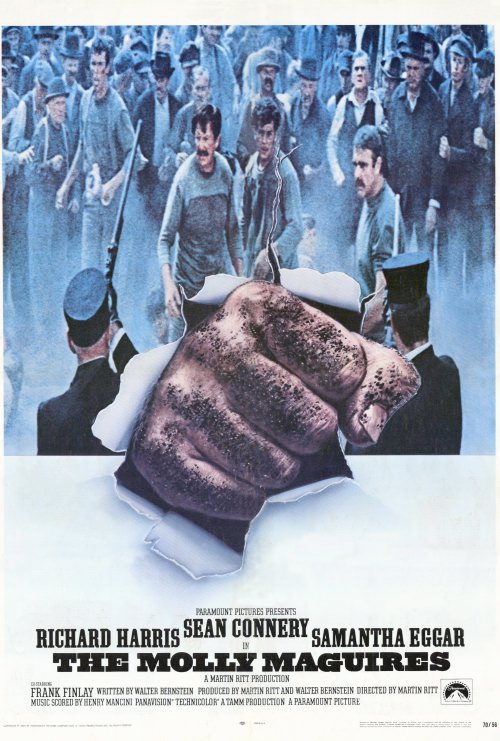
The Molly Maguires (1970)


          An old-fashioned morality tale somewhat in the vein of John Ford’s classic film The Informer (1935), The Molly Maguires offers a fictionalized take on a group of real-life Irish immigrants who worked in Pennsylvania’s coalmines during the late 19th century. When a group of fed-up miners led by Jack Kehoe (Sean Connery) lashes out at their oppressive employers through a covert campaign of bombings and murders, the police send an Irish-born detective, James McParlan (Richard Harris), to infiltrate and expose Kehoe’s group, causing McParlan to experience a crisis of conscience: The more he learns about the secret guerilla organization called “The Molly Maguires,” the more he sympathizes with them.
          As scripted by once-blacklisted Hollywood lefty Walter Bernstein and as directed by sensitive humanist Martin Ritt, The Molly Maguires takes an unusually nuanced view of radical politics. The picture lays out the reasons why the workers rebel—dangerous work conditions, a usurious pay structure in which the mining company withholds nearly all wages through outrageous “deductions”—yet the filmmakers don’t paint the Maguires as heroes. Instead, the Maguires are depicted as desperate men who resort to violence when pushed beyond reasonable limits.
          This distinction puts viewers squarely inside McParlan’s conflicted psyche, and the melancholy nature of Harris’ screen persona suits the story well. The actor is believable as a working-class bruiser and as a man who realizes he’s selling his soul for career advancement. The betrayal inherent to the story is accentuated by Connery’s tightly controlled performance, since the Kehoe character is acutely self-aware; especially toward the end of the picture, Connery does a strong job of demonstrating that Kehoe values his life less than the goal of making his oppressors understand his rage.
          Fittingly for a story about the Irish, there’s a darkly lyrical quality to The Molly Maguires; in particular, the tin whistles of Henry Mancini’s score and the lilting accents of the various players make the gloomy mines and rolling hills of Pennsylvania seem like lost colonies of the Emerald Isle. Several strong supporting players add muscle to the picture as well. Frank Finlay is odiously pragmatic as McParland’s superior officer, while Anthony Costello, Art Lund, and Anthony Zerbe are fierce as Kehoe’s accomplices. Female lead Samantha Eggar, making the most of an underwritten role, is quietly principled as the local girl who falls for McParland without knowing his true identity.
          Although too conventionally made and slow-moving to qualify as any sort of classic, The Molly Maguires is intelligent, sincere, and thought-provoking.

The Molly Maguires: GROOVY

Saturday, June 4, 2011

Piranha (1978)


          Of the myriad killer-fish flicks that followed Jaws (1975), the tongue-in-cheek Roger Corman production Piranha is probably the most beloved. While not a great movie by any measure—or even, quite frankly, a particularly good movie—Piranha is endearingly self-aware, satirizing its own silliness even as it delivers enough gore and nudity to please B-movie enthusiasts. Directed by the exuberant Joe Dante with a tip of the stylistic hat to Jack Arnold, the pulp specialist who made the original Creature from the Black Lagoon (1954), the cheaply produced Piranha tells the slight story of a summer resort getting attacked by a school of genetically engineered fish. The piranhas were created in a government facility, then accidentally released by a bounty hunter (Heather Menzies) and a mountain man (Bradford Dillman) while searching the government facility for signs of missing teenagers. (The teenagers, naturally, were the piranha’s first victims.)
          Most of the picture comprises a Huckleberry Finn-inspired rafting trip during which the heroes, along with a loopy scientist (Kevin McCarthy), slowly discover the piranhas’ lethal potential. After being captured by and escaping from nefarious government types (who, of course, want to cover up the crisis), the heroes try to prevent the killer fish from eating all the young swimmers at the resort, which lies dead ahead on the river.
          Boasting a whimsical screenplay by future indie-cinema star John Sayles, Piranha actually suffers for having too many jokes, because the wiseass tone and the chintzy special effects make it impossible to get frightened. Luckily, Corman stalwart Dick Miller steals the show with his thoroughly enjoyable performance as the resort’s cantankerous owner, because it’s fabulous to watch him keep a straight face while saying things like, “Don’t bother me about the goddamned piranhas!” Dante refined his jokey approach to horror with later hits including Gremlins (1984), and the killer fish he released into the world proved durable. No less a figure than James Cameron was hired (and fired) as the director of the awful sequel Piranha II: The Spawning (1981), and the original movie was remade with even more gore and nudity as Piranha 3D (2010).

Piranha: FUNKY

Friday, June 3, 2011

“There Was a Crooked Man…” (1970)


          The prospect of venerable studio-era director Joseph L. Mankiewicz (All About Eve) collaborating with brash New Hollywood screenwriters Robert Benton and David Newman (Bonnie and Clyde) raises curiosity about “There Was a Crooked Man…”, a Western comedy-drama centered around a brutal prison from which convicts conspire to break out so they can recover a cache of hidden loot. Unfortunately, the movie’s narrative is as fussy as its excessively punctuated title—the picture is a sloppy hodgepodge aspiring to run the stylistic gamut from adrenalized drama to insouciant comedy.
          One suspects that protagonist Paris Pitman Jr. (Kirk Douglas) was envisioned as a charming rogue, and Douglas certainly tries to sell the idea that his character is a heartless criminal whom we’ll find interesting because he does everything with a wink and a smile. But unlike the crooks in other Benton-Newman scripts, who evince believable complexity and vulnerability, Pitman comes across as a Hollywood contrivance, partially because Douglas brings so much movie-star baggage, and partially because Mankiewicz can’t decide from scene to scene whether the movie is dark, light, or some nebulous thing in between. The picture is shot in a blown-out, garish style that makes every image seem artificial; the cast is loaded with familiar character actors (Hume Cronyn, Burgess Meredith, Warren Oates, John Randolph), all of whom play silly caricatures; and the cringe-worthy music by Charles Strouse, complete with an awful title song performed by Trini Lopez, brings the movie close to camp.
          Worst of all, the story itself is convoluted and dull. It begins when Pitman robs a rich man for half a million dollars in cash, then buries the money in a desert rattlesnake pit. After Pitman is captured and imprisoned, assorted characters try to find out where the money is hidden, and Pitman builds a team of eccentric convicts so he can stage an elaborate breakout. Meanwhile, a relentless lawman (played by a bored-looking Henry Fonda) chases after Pitman for personal reasons.
          The narrative is such an anything-goes jumble that at one point, Cronyn literally does a slapstick routine by backing toward a hot stove before jumping up and down while shouting, “My heinie is on fire!” Veering completely to the other extreme, a studly inmate played by Michael Blodgett (Beyond the Valley of the Dolls) gets strapped to a pole, shirtless, and whipped for rebuffing the homosexual advances of a guard. Given the presence of that sort of material, it’s possible there was some sort of satirical purpose to the original Benton-Newman script, but as cluelessly directed by Mankiewicz (who couldn’t be further outside his comfort zone of tense verbal jousting), “There Was a Crooked Man…” has no discernible purpose except befuddling viewers.

“There Was a Crooked Man…”: LAME

Thursday, June 2, 2011

Nickelodeon (1976)


          The notorious flop that finally knocked director Peter Bogdanovich off the Hollywood A-list after a precipitous slide, Nickelodeon is a fascinating movie unfairly relegated to obscurity. In the overstuffed narrative, Ryan O’Neal and Burt Reynolds play early-20th-century ne’er-do-wells who stumble into cinema careers when they encounter a disreputable producer (Brian Keith); a romantic triangle then emerges because O’Neal and Reynolds are both infatuated with the beautiful klutz (Jane Hitchcock) who keeps crossing their respective paths. Eventually, O’Neal becomes a director and Reynolds becomes his long-suffering leading man, so they wend their way through calamitous filmmaking experiences accompanied by a motley crew of actors and technicians (played by a vibrant ensemble including George Gaynes, Tatum O’Neal, John Ritter, and Stella Stevens).
          In a rare case of a movie being too meticulously scripted for its own good, Nickelodeon smothers a slight premise with painstaking detail, since each new plot development is dramatized at considerable length; accordingly, the movie wavers between happy-go-lucky farce and romantic dramedy as Bogdanovich endeavors to include every colorful episode he can imagine, whether the episodes advance the narrative or not. Bogdanovich, a scholarly cinephile who interviewed many of the great studio-era directors, rewrote W.D. Richter’s original script to include fictionalized anecdotes drawn from the life experiences of real-life cinematic pioneers, and the all-business soberness of Bogdanovich’s attempt to re-create the madcap milieu of silent-era comedy undercuts the story’s frothy appeal.
          Yet even with these storytelling excesses (and an overreliance on slapstick gags like breakaway walls and pratfalls), there’s a lot of gorgeous filmmaking on display in Nickelodeon. Laszlo Kovacs’ photography is elegant, the craftsmanship of the sight gags is impressive, and the nerdy motif of shout-outs to classic directors is endearing. Ryan O’Neal and Reynolds lock into smooth grooves during light-comedy passages like their epic fistfight, while Tatum O’Neal delivers a memorable dose of her signature old-before-her-years edginess. So even though Nickelodeon is excessive and undisciplined, it’s crafted with such care that it can’t be ignored. In 2009, Bogdanovich revisited the movie for its DVD debut, adding several minutes of previously unused footage and converting the imagery to black-and-white, the format he originally intended to use; the disc features both the monochromatic version and the original full-color theatrical release.

Nickelodeon: GROOVY

Wednesday, June 1, 2011

Busting (1974)


          One of the first examples of what later became known as the “buddy cop” subgenre, Busting exemplifies the subgenre’s virtues and weaknesses. When buddy-cop flicks ruled the box office in the ’80s, for instance, movies like Walter Hill’s 48 Hrs. (1982) alternated wildly between broad humor and brutal violence. That same tendency is on display throughout Busting, which features a pair of scruffy vice cops determined to take down an arrogant crime lord who lubricates his operation with payoffs to powerful city officials. In some scenes, Busting feels like an out-and-out comedy, with leading players Robert Blake and Elliot Gould trading amusingly cynical quips. Yet in other scenes, Busting is a full-on action thriller, featuring intense shootouts and scary car chases. The piece doesn’t hang together perfectly, and the story meanders a bit in the middle, but Busting is nonetheless fascinating as a rough draft for a type of movie that soon became ubiquitous.
          Like Richard Rush’s outrageous Freebie and the Bean, which was released almost a year after Busting, writer-director Peter Hyams’ Busting presents cops who disrespect authority as much as the crooks they pursue. Detectives Farrel (Blake) and Keneely (Gould) are veteran LAPD officers tired of pinching perverts and prostitutes only to see the worst offenders set free because underworld boss Carl Rizzo (Allen Garfield) has so much pull downtown. So even though the cops know Rizzo is protected on every level, they go after him anyway, harassing his nightclubs, stalking him while he drives around town, and waiting for the day they catch him making a connection with his drug supplier.
          Throughout the first hour of the movie, this is all quite entertaining, because Gould’s world-weary routine is delightful. “We could be good bad guys,” he opines at one point. “Pays better. Better hours. More cooperation from the police.” Blake, later famous as TV’s Baretta (and as an alleged felon in private life), ratchets down his signature intensity, and he’s surprisingly effective as a straight man. Garfield is suitably slimy, especially in a long scene when the cops get in Rizzo’s face during a boxing match.
          The movie goes dark around the one-hour mark, losing a bit of its liveliness as it speeds toward an unsatisfying conclusion—yet even when it’s tonally awkward, Busting is impressive to watch. Hyams, a former photographer who closely supervises the look of his films, gives Busting a grimy feel with lots of wide shots filled with atmospheric detail; the only recurring visual hiccup is a device of extremely wide dolly shots for which the camera is positioned so far ahead of the actors that the camera rounds corners before the talent, leaving empty frames onscreen for long beats. Given how flatly many ’70s crime films were shot, however, noting that Busting has overly ambitious imagery is a compliment instead of a criticism. (Available as part of the MGM Limited Collection on Amazon.com)

Busting: FUNKY

Tuesday, May 31, 2011

Minnie and Moskowitz (1971)


          “There’s some kinda crazy going on that’s not right,” Minnie Moore exclaims during a harrowing argument with her would-be paramour, Seymour Moskowitz—and that pretty much sums up the problems with this shambling character piece written and directed by indie-cinema icon John Cassavetes. The original anti-Hollywood auteur, Cassavetes practiced a unique style of filmmaking in which actors built improvisations around his scene ideas, resulting in pictures short on story but long on unique behavior. In Minnie and Moskowitz, however, the behavior veers way too far in the direction of absurd hysterics and repetitive melodrama. So instead of seeming incisive and intimate, the picture feels shapeless and shrill.
          The basic story of lonely, middle-aged museum curator Minnie (Gena Rowlands) stumbling into love with eccentric parking-lot attendant Seymour (Seymour Cassel) is innocuous enough, but the characters spend so much time enmeshed in shrieking arguments that it’s as if they live in some parallel Method-acting universe where every emotion is expressed via primal-scream therapy or simply repeating the same words over and over again. (This excess gets even more tiresome during lengthy cameos by familiar character players Val Avery, Timothy Carey, and Cassavetes himself, all of whom play frightening grotesques.)
          The title characters are in nearly every scene, either alone or together, so the picture belongs to Cassavetes regular Cassel and the director’s real-life wife, Rowlands. Cassel’s performance is undisciplined and wild, a string of colorful but unbelievable behaviors assembled into a hodgepodge that feels less like a character than an overeager audition reel. Rowlands offers her usual grounded work, but the storyline saddles her with irritating behaviors like drinking to excess and talking about her feelings in such introspective detail that her stupid life choices feel incongruous with her personal insights.
          The idea that these characters are compatible with each other is the movie’s biggest and least convincing contrivance, more or less rendering the whole enterprise moot, and the film is so monotonously screechy that it’s a relief when the director’s mother, Katherine Cassavetes, shows up for a funny but stereotypical featured role toward the end of the picture as Seymour’s overbearing Jewish mother.

Minnie and Moskowitz: LAME

Monday, May 30, 2011

Willy Wonka & the Chocolate Factory (1971)


          “Pure Imagination.” The title of this sweet Leslie Bricusse-Anthony Newley song, as performed by wizardly candy-maker Willy Wonka, says everything about why the exuberant musical fantasy bearing the character’s name is so deeply beloved by audiences: With its flamboyant characterizations, outrageous visuals, and whimsical attitude, Willy Wonka & the Chocolate Factory is one of the most purely imaginative children’s movies ever made. And thanks to tart touches like Gene Wilder’s amazing performance as Wonka–to say nothing of one of the freakiest boat rides in movie history–the picture leavens its touchy-feely narrative elements with edges of real darkness.
          The story, for the few who haven’t read the book upon which it is based, seen the picture itself, or slogged through the shoddy remake Charlie and the Chocolate Factory (2005), begins when reclusive candy-maker Wonka announces a contest in which the prizes are tours of his never-before-seen factory. Public mania ensues, with candy-industry competitors scheming to get peeks inside Wonka’s works, millionaires buying up contest entries to ensure their children win, and kids everywhere dreaming they might get lucky. The story then focuses on one such dreamer, the sweet but desperately poor Charlie Bucket (Peter Ostrum), and sure enough he gets a “golden ticket.”
          Accompanied by his good-hearted grandfather (Jack Albertson), Charlie joins a gallery of strange children and their guardians for a weird adventure inside Wonka’s fantasy-land factory, which is staffed by orange-faced and green-haired little people called Oompa-Loompas. As the story progresses, children who exhibit unsavory qualities like gluttony and greed get kicked off the tour in colorful ways, and Charlie discovers an unexpected destiny.
          Geared toward spectacle in every aspect of its production, the movie is not for every taste; some of the songs are so twee that they’re more sugary than the onscreen candy, and the scary bits like the aforementioned boat ride are too intense for many young viewers. Yet the idea of a land with edible rivers and trees is irresistible, the special-effects sequences like Mike Teevee’s cathode-ray comeuppance are clever, and Roald Dahl’s screenplay retains the most important themes from his 1964 book Charlie and the Chocolate Factory. The script also bursts with playful wit, like this eternal line: “Violet, you’re turning violet, Violet!” Best of all, Wilder is wonderful from start to finish. His unforgettable entrance sets a (candy) bar that he regularly meets and surmounts; his Wonka is capricious, judgmental, punitive, and ultimately transformative.
          So in short, if you can watch this movie without wishing you were Charlie, then you’ve forgotten what it meant to be a child.

Willy Wonka & the Chocolate Factory: RIGHT ON

Sunday, May 29, 2011

Fire Sale (1977)


At his best, Alan Arkin is a one-of-a-kind actor who blends humor, intelligence, and sensitivity into vibrant performances. At his worst, he’s a screamer whose characterizations are abrasive in the extreme. Unfortunately, Fire Sale—the second theatrical feature Arkin directed—plays to his worst instincts on every level. Arkin’s acting in the lead role is loud and whiny, he lets other actors deliver numbingly overwrought performances, the film’s jokes are insultingly stupid, and every character is so unpleasant that even at 88 minutes (including a lengthy animated title sequence) the movie goes on way too long. One of those “madcap” comedies about a bunch of people whose insane behavior collides in an allegedly humorous fashion, Fire Sale stars Arkin and Rob Reiner as the sons of an aging Jewish retailer (Vincent Gardenia). Arkin is a ne’er-do-well high school basketball coach, and Reiner is the heir apparent of the family’s foundering department store. Various subplots involve Arkin’s offensive scheme to “adopt” a black teenager who can serve as a ringer for his basketball team, Reiner’s plan to burn down the family business for an insurance settlement, and crazy uncle Sid Caesar’s escape from a mental institution to conduct a military mission because he thinks it’s still World War II. Despite the presence of so many comedy pros, Fire Sale somehow manages to be completely obnoxious and unrelentingly boring at the same time. Thanks to competent technical execution, it’s not the worst comedy of the ’70s by a long shot, but it’s still truly unwatchable.

Fire Sale: SQUARE

Saturday, May 28, 2011

The Wild Geese (1978)


          An old-fashioned adventure story that could have been made in the ‘50s or even earlier, if not for its focus on ’70s-era African politics, The Wild Geese is a rousing action thriller with just enough attention to characterization that its climax has an emotional punch. More importantly, the picture features a unique combination of larger-than-life Brits playing larger-than-life roles: Welshman Richard Burton, Irishman Richard Harris, and Englishman Roger Moore play a trio of aging mercenaries hired to rescue a revolutionary African leader from political imprisonment.
          The story unfolds in classic men-on-a-mission fashion. Nefarious banker Sir Edward Matherson (Stewart Granger) hires alcoholic ex-Army man Col. Allen Faulkner (Burton) to free African political prisoner Julius Limbani (Winston Ntshona) from an unnamed African country because Limbani is slated for execution. Distrustful of his new employer but in need of a paycheck, Faulkner recruits a team including pilot Shaun Flynn (Moore), strategist Rafer Janders (Harris), drill sergeant Sandy Young (Jack Watson), and displaced South African Pieter Coetzee (Hardy Kruger). The vignettes of Faulkner building his crew are breezily entertaining, though screenwriter Reginald Rose and director Andrew McLaglen layer ominous foreshadowing into the derring-do bits to lay the groundwork for what’s coming later.
          The rescue mission goes well, but then the group’s getaway plane takes off prematurely, leaving the mercenaries and the liberated Limbani alone in enemy territory. Damn that double-crossing Matherson! This juncture is when the picture gets really exciting, because the soldiers have to fight their way through a jungle filled with heavily armed troops in order to seize another plane and escape. The movie pays clumsy lip service to social consciousness when Coetzee becomes Limbani’s bodyguard, forcing a racist white man to learn grudging respect for a saintly black man, but The Wild Geese is less about politics and more about macho militarism: By the end of the movie, nearly every character has mowed down opponents to save his mates.
          With its corny musical score, which could have been lifted from an old RAF training film, The Wild Geese is unapologetically retro, and the storyline is so schematic that some will find it trite. Nonetheless, McLaglen’s sure hand with the action scenes, combined with the easy chemistry that the three leads have with each other and a surprisingly poignant climax, make The Wild Geese a fun romp with much more substance than the average shoot-’em-up.

The Wild Geese: GROOVY

Friday, May 27, 2011

H.O.T.S. (1979)


One doesn’t expect much from a teen sex comedy, and yet nearly every movie belonging to the genre manages to disappoint even those low expectations, because in the course of delivering teen sex, the low-budge sleazoids behind movies like H.O.T.S. inevitably forget to deliver actual comedy—or, for that matter, much of anything beyond fleeting moments of titillation. In the deeply uninteresting H.O.T.S., several female students at a fictional college called Fairenville University—which, of course, is commonly abbreviated as “F.U.”—decide to get revenge after they’re refused membership in a snotty sorority because of nerdiness, poverty, or unattractiveness. They form a new sorority called H.O.T.S. and scheme to seduce every man on campus so the rich bitches of the evil sorority are left lonely. There could have been the germ of a satirical notion somewhere inside this idea, but in the hands of the soft-core panderers who made this movie, the premise is merely a reason for crude jokes about things like bumbling gangsters, an off-course parachutist, spiked food and the resulting gastrointestinal torment, unruly animals, a wet T-shirt contest, and, because nothing succeeds like excess, a game of topless football. (Admittedly, the last bit is impressive, after a fashion, for the sheer amount of flesh on display.) It’s a measure of this picture’s ambition that the biggest name in the cast is Partridge Family vet Danny Bonaduce, playing a would-be stud who ends up in bed with a seal. (Don’t ask.) The starlets in H.O.T.S. have attractive bodies that they’re not shy about displaying, so viewers craving loving shots of large breasts will thrill as D-cups runneth over. Viewers craving more than that will be left C.O.L.D.

H.O.T.S.: SQUARE

Thursday, May 26, 2011

The Kremlin Letter (1970)


          Before venturing into the wilds of his fantastic ’70s character pieces, director John Huston punched the clock on this turgid espionage thriller, a half-hearted effort so overstuffed with plot twists and supporting characters that it’s borderline incomprehensible. One of those murky Cold War stories in the vein of John Le Carre’s books, The Kremlin Letter dramatizes efforts by American spies to recover a controversial letter in which a U.S. official agrees to help the Russian government derail China’s nuclear ambitions. The first half of the movie depicts the convoluted process by which the Tillinger Foundation, a front for the CIA, recruits a spy with a photographic memory to lead a covert op inside Russia; next comes the spy’s campaign to build a team of specialists for the mission.
          The unanswerable questions pile up immediately: Why isn’t a properly trained spy available? Why is a newbie entrusted with recruiting accomplices? Why can’t normal channels like bribes and double agents be used to recover the letter, especially since both tools are used for other purposes throughout the movie? The Kremlin Letter never solves any of these mysteries, and one gets the impression the filmmakers were so bogged down in the convoluted plot they barely understood which scene they were shooting on any given day. So as a story, The Kremlin Letter is a complete waste.
          As quasi-sophisticated entertainment, however, it has some amusing moments. Honey-voiced Orson Welles pontificates pleasantly about politics. Bitchy All About Eve star George Sanders plays a cranky old queen, right down to a scene performed in drag. Barbara Parkins essays a sexy thief who demonstrates her skills by opening a safe with her feet while dressed in a leotard. The movie also boasts some kinkiness; Max von Sydow, at his most unnerving, plays a sadistic Russian enforcer with a soft side for his crazed wife, a pain freak who likes rough sex with gigolos. (Cinematic footnote: Playing von Sydow’s wife is Bibi Andersson, his costar in numerous Ingmar Bergman movies.)
          None of this even remotely adds up at the end, and laconic leading man Patrick O’Neal seems far too bored with the material to have much of an impact, but some scenes are quite interesting to watch. The movie’s best element, by far, is onetime Have Gun–Will Travel star Richard Boone as Ward, the amiable overlord of the American operation. Gleefully blending bloodlust and chattiness, he presents the movie’s most interesting vision of a sociopathic spook.

The Kremlin Letter: FUNKY

Wednesday, May 25, 2011

The Land That Time Forgot (1975) & The People That Time Forgot (1977)


          Based on a novel by Tarzan creator Edgar Rice Burroughs, The Land That Time Forgot is executed with amiable B-movie aplomb. The outlandish tale begins in the Atlantic Ocean during World War I, when a U-boat sinks a British ship. Survivors from the wreck, conveniently led by American submarine expert Bowen Tyler (Doug McClure), manage to hijack the U-boat, only to have the German commander (John McEnry) covertly steer the ship due south, instead of toward America. Soon, the U-boat reaches Antarctica, where the submarine cruises through a tunnel beneath an iceberg and emerges in, well, the land that time forgot: a continent-sized valley populated by cavemen and dinosaurs. You can pretty much figure out what happens next. Sworn enemies have to work together for survival against hostile natives and hungry dinosaurs, and before long everyone’s in trouble because the land that time forgot is about to go kablooey thanks to persnickety volcanic activity. Hate when that happens!
          A joint presentation of U.S. drive-in supplier American International Pictures and cheapo English outfit Amicus Productions, The Land That Time Forgot is silly but fun, a fast-moving lark with laughably bad special effects, so there’s plenty of harmless amusement to be found watching the heroes and their primitive buddies battle carnivorous mega-reptiles. Discriminating adult viewers won’t have a whit of interest in The Land That Time Forgot, but those who remember the joy of getting whisked away by goofy matinee attractions will get a nostalgic charge out of the flick.
          Unfortunately, it’s hard to imagine anyone getting any sort of a charge out of the sequel The People That Time Forgot, which cops a few tricks from the playbook of the original Planet of the Apes film series. Like the first Apes sequel, The People That Time Forgot kicks the previous film’s leading man into a minor supporting role and goes for a simultaneously darker and more simplistic story. And like the first Apes sequel, The People That Time Forgot lacks nearly everything that made its predecessor enjoyable.
          Patrick Wayne stars as Ben McBride, an adventurer who travels to the site of the first movie in order to find his lost friend, Tyler. Soon Ben and his companions hook up with a sexy cavewoman, Ajor (Dana Gillespie), who somehow has immaculate makeup and a push-up bra built into her animal-skin costume. Excepting an amusingly goofy mid-air fight between an biplane and a pterodactyl, dinosaurs mostly take a backseat to the creepy primitive tribes who capture Ben’s crew. And whereas the first picture had all sorts of plot complications stemming from things like how to fuel the U-boat for an escape voyage, the second picture is just a series of insipid cliffhanger moments, and the production design is so tacky it would barely pass muster in an episode of Land of the Lost.

The Land That Time Forgot: FUNKY
The People That Time Forgot: LAME

Tuesday, May 24, 2011

The Legend of Hell House (1973)


          Although he spent most of the ’70s writing for TV, sci-fi legend Richard Matheson acquitted himself nicely with the big-screen endeavor The Legend of Hell House, a smart blend of “old dark house” hokum and then-modern concepts about using scientific gadgets to record paranormal phenomena. The plot is standard nonsense about a team of experts confined in a haunted house for a set period of time, but that’s inconsequential because as with any proper scary movie, the main appeal is the vibe of the thing.
          The movie kicks off when an eccentric millionaire hires a respected scientist, Lionel Barrett (Clive Revill), to debunk or prove claims that a gloomy British mansion is haunted. The mansion, known as the Belasco House, was the site of assorted grisly murders and torture scenes, so rumor has it the spirits of victims still roam the halls. Barrett agrees to move into Belasco House and run assorted scientific and non-scientific tests, with the aid of his wife, Ann (Gayle Hunnicutt), and two psychics, Ben Fischer (Roddy McDowall) and Florence Tanner (Pamela Franklin).
          Things get weird quickly, as the various investigators start feeling the effects of malevolent spirits, and the film presents a wide variety of phenomena: In addition to the usual bits like characters falling into reveries of otherworldly possession and objects moving seemingly of their own volition, there are kinky scenes of the female characters giving themselves over to unexpected sexual urges apparently triggered by the power of the house. Particularly when the investigators start discovering hard evidence of the horrible things that once happened in the mansion, The Legend of Hell House gets creepier still because it mixes the plausible and the supernatural to create an anything’s-possible mystique.
          Matheson, scripting from his own novel, and director John Hough break the picture into tidy chapters (it’s the sort of movie where every few minutes there’s a hard cut to an establishing shot with “Tuesday” or “Thursday” superimposed onto the frame), and the storytellers leave many creepy events unexplained so the characters (and the audience) get roped into the idea that something freaky is happening.
          McDowall gives an effectively twitchy performance as the most colorful of the paranormal investigators, his jangled nerves surfacing as a sort of tweaked charm, and the picture’s focus on modern trappings makes it feel different from standard haunted-house fare. Of special note among those modern trappings is the disturbing electronic score, created by the wonderfully named “Delia Derbyshire and Brian Hodgson of Electrophon Ltd.” And while it’s true that the plot crumbles under scrutiny—if the house is so damn haunted, leave!—criticizing an enjoyable creepshow for logical gaps seems unsportsmanlike.

The Legend of Hell House: GROOVY

Monday, May 23, 2011

At Long Last Love (1975)


          Director Peter Bogdanovich’s twin preoccupations with classic cinema and Cybill Shepherd, the model/actress for whom he left his wife in the early ’70s, collided in one of the most infamous flops of the decade, At Long Last Love. A sincere but wholly unnecessary homage to the champagne-and-caviar musicals of the Depression era, the film presents the uninteresting story of two swell couples trading partners back and forth as they serenade each other with dizzy ditties by the great Cole Porter. Displaying his usual meticulousness, Bogdanovich gets most of the details right (frothy patter, glossy interior sets, perfect evening dresses), but the film is far less than the sum of its parts.
          The characters are abstractions because all they do is cavort about and wait for money to appear from nowhere (some are penniless strivers faking affluence, others are spoiled wastrels with trust funds), which means it’s impossible to care about their romantic entanglements. The story takes forever to unfold, since each plot development, no matter how trivial, is explained in a full-length song. Ironically, Shepherd is the best thing about the movie, because while she’s a natural singer with a brassy voice, her costars Eileen Brennan, John Hillerman, Madeline Kahn, and Burt Reynolds display far less impressive vocal talents. (The other major player, Italian actor Duilio Del Prete, is a fine actor and singer, but he’s adrift as an unfamiliar foreigner in a sea of recognizable Hollywood faces.) Worst of all, Bogdanovich completely botches a key element of any successful musical: dancing. None of his performers has any real hoofing skill, so most of the numbers are delivered while characters sit in chairs or walk around lush estates. Dullsville, baby.
          Had the picture been faster, shorter, and infused with fleet footwork, it might have been a pleasant trifle. But as is, it’s nearly interminable. At Long Last Love bombed so badly that it nearly killed its directors once-blazing career. After making the much better Nickelodeon (1976), which was already in motion by the time At Long Last Love tanked, Bogdanovich spent three years in the wilderness before returning with Saint Jack (1979), the low budget of which reflected his diminished stature.

At Long Last Love: LAME

Sunday, May 22, 2011

The Inglorious Bastards (1978)


          Best known as the flick from which Quentin Tarantino borrowed the title for his 2009 World War II epic Inglorious Basterds, this Italian production is an enjoyably overstuffed riff on The Dirty Dozen (1967) and assorted other World War II men-on-a-mission flicks. Starring a pair of American B-movie stalwarts, Fred Williamson and Bo Svenson, The Inglorious Bastards borrows the basic plot device from The Dirty Dozen—soldiers incarcerated for various crimes end up redeeming themselves when thrust back into combat—then adds on narrative bits and bobbles from countless other flicks, resulting in an absurd plot that hurtles from one violent incident to the next.
          The story begins when M.P.s holding the convicts are killed in a Nazi air raid, freeing the “heroes” to roam the European countryside in search of freedom. Then, after assorted convenient plot twists, the protagonists take the place of a team of highly trained commandoes for a dangerous covert mission. Along the way, a series of colorful adventures ensues, most of which are pleasant diversions even if they’re not particularly believable. At the movie’s silliest moment, several of the convicts cozy up to a gaggle of German beauties who are splashing around in a country stream, only to have the nude women pick up machine guns and blast away at the Yanks when the frauleins realize their new friends aren’t from the fatherland.
          There’s absolutely nothing in The Inglorious Bastards that fans of World War II flicks haven’t seen before, from the comic-relief enlisted man who carries a secret stash of contraband goods to the tension between Williamson’s character and the racist G.I. played by Peter Hooten; furthermore, the acting is unremarkable, especially since a fair amount of the dialogue was dubbed sloppily. Nonetheless, The Inglorious Bastards is entertaining in a stupidly macho sort of way, thanks to the over-the-top plotting, some genuinely harrowing stunt work, and zesty ingredients like Williamson’s amusing swagger. (Providing the requisite ’70s kitsch factor, actor Michael Pergolani, who plays the comic-relief enlisted man, wears anachronistic shoulder-length hair and a ginormous ’70s moustache—why not?) There’s a reason this flick lodged itself into the brain of a young Quentin Tarantino, and the reason seems to be that The Inglorious Bastards is an eager-to-please sampler platter of escapist war-picture thrills.

The Inglorious Bastards: FUNKY

Saturday, May 21, 2011

Prime Time (1978)


The creators of this atrocious comedy strung together a group of lame sketches under the premise that some unknown anarchistic force hijacked the American airwaves in order to beam subversive content into the nation’s boob tubes. The level of humor here is indicated by an ad for a Candid Camera-type gotcha show called The Shitheads, in which unsuspecting participants have buckets of excrement dropped onto their noggins. If that doesn’t sufficiently warn you away from investigating Prime Time, consider the ad for “Stay Down,” an aerosol erection suppressant with the unfortunate side effect of uncontrollable flatulence. Every so often, the movie triggers a reaction with its audacity. The best-executed sketch is probably the celebrity sports show in which two hunters (one of whom is played by Warren Oates!) climb to the top of the tower on the University of Texas campus in Austin, then open fire for “The Charles Whitman Invitational,” named after the crazed sniper who killed 16 people from that tower in 1966. The filmmakers include a few brief interstitial bits of things like government officials trying to stop the pirate broadcast, but the movie rises and falls on the quality of the gags, and the gags are consistently juvenile, obvious, and unfunny, with homophobic and racist overtones thrown in for good measure. Even appearances by familiar faces—among them Joanna Cassidy, Fred Dryer, Kinky Friedman, Dick O’Neill, and Harry Shearer—aren’t enough to generate interest. The Groove Tube (1974), Kentucky Fried Movie (1977), and even the deranged Mr. Mike’s Mondo Video (1979) did this sort of thing so much better.

Prime Time: SQUARE

Friday, May 20, 2011

The Deadly Trackers (1973)


This brutal Western began life as a project for writer-director Samuel Fuller, but the tough-guy auteur was reportedly canned after butting heads with leading man Richard Harris. Although Harris’ volatility produced his fascinating screen persona, the Irish-born actor’s out-of-control alcoholism and violent temper made him a monster of a collaborator during this era—and also more or less eliminated subtlety as a performance option. In other words, The Deadly Trackers is yet another picture in which Harris screams most of his role. The story concerns a sheriff (Harris) chasing the bank robbers who killed his family. Harris’ character is accompanied on his journey by a Mexican cop (Al Lettieri) who doesn’t share his bloodlust, and there’s quite a bit of chatter about Harris’ character being a pacifist. There’s also some attempt at exploring moral relativism by contrasting the righteous indignation of the Harris character with the rampant greed of the lead bank robber (Rod Taylor). What this thematic material was like in Fuller’s original vision is anybody’s guess, but in the final product, the pacifism element is merely an excuse for cheap slow-burn tension predicated on the question of how far Harris’ character will go for revenge. Since stories about gunfighters who don’t really want to draw their weapons are as old as the Western genre, there’s nothing here that viewers haven’t seen before, and as usually happens when directors are changed partway through production, the film lacks coherence and drive. So while there are a few intense confrontations and the picture has a handful of reliable B-movie supporting players (including the indestructible William Smith as an especially savage crook named “Schoolboy”), everything about this mean-spirited misfire is so trite that the picture disappears from the brain as soon as it’s over.

The Deadly Trackers: SQUARE

Thursday, May 19, 2011

Logan’s Run (1976)


          For many fantasy fans of a certain Gen-X vintage, Logan’s Run is the most beloved sci-fi film of the ’70s—with the notable exception of a certain George Lucas-directed blockbuster. Featuring a terrific premise, exciting action sequences, memorable production design, and a musical score filled with far-out electronic sounds, Logan’s Run has an intoxicating vibe. So even though the cheese factor is high, thanks to questionable special-effects miniatures and a generally dated aesthetic, the picture still works as stylish escapism.
          Based on a novel by George Clayton Johnson and William F. Nolan, the story introduces a 23rd-century society comprising a series of interconnected domes that contain climate-controlled luxury environments. By day, the society’s gorgeous young citizens perform easy jobs aided by pervasive technology. By night, they engage in culturally acceptable hedonism, trading sexual favors without emotional hang-ups. The only catch is that when each citizen reaches the age of 30, he or she must enter a violent arena called the Carousel, in which strivers who fail to reach the prize of “renewal” die on the spot.
          The citizens are so narcotized by their easy lives that no one questions their built-in expiration dates except “runners,” rebels who flee the domes to join a secret underground. Logan-5 (Michael York) is a “sandman,” a gun-toting cop employed by the city’s computerized overlords to hunt and kill runners as a means of maintaining order. When Logan discovers a clue about the runners’ hidden citadel, Sanctuary, his lifespan is abruptly abbreviated so he can go undercover as a runner—a harsh move that eventually turns Logan against his former superiors.
          Logan’s Run is filled with imaginative details, like the high-tech “New You” plastic-surgery salon that predicts laser-guided medical procedures (and features a sexy Farrah Fawcett-Majors as a receptionist). York and leading lady Jenny Agutter, who plays Logan’s fellow runner, make an attractive couple, their posh English accents lending the film a certain elegance, and Richard Jordan is frighteningly impassioned as Logan’s friend-turned-pursuer. Yet it’s the visuals that impress the most, because the filmmakers ingeniously converted a modernist shopping mall into the interior of the domed city, then created similarly vivid environments for the Carousel, the den of a group of animalistic street urchins called “cubs,” and even the ice-covered cavern of an overbearing robot called Box.
          Like a great old Jules Verne yarn, Logan’s Run is a fast-moving adventure that introduces one wild situation after another, and the whole story is anchored by Logan’s relatable journey from conformist to anarchist. Logan’s Run may be silly and stilted, but it’s also a great ride with a handful of resonant ideas thrown in for good measure. FYI, small-screen hunk Gregory Harrison slipped on the sandman spandex for a short-lived series adaptation, also called Logan's Run, which ran on CBS for most of the 1977-1978 season.

Logan’s Run: GROOVY

Wednesday, May 18, 2011

Harry & Tonto (1974)


          A triumph of naturalistic acting, sensitive writing, and unobtrusive direction, Harry & Tonto is one of the best character studies of the ’70s, a kind-hearted but completely unsentimental portrait of an everyman knocked out of his staid routine. Director and co-writer Paul Mazursky employs his acting background to nudge performers toward interesting behavior that’s devoid of actor-ish affectation, and he orchestrates the simple story with easy confidence, gently accentuating key moments.
          The story begins when aging New York City widower Harry Coombes (Art Carney) is forced out of his apartment because the building is scheduled for demolition—police officers literally carry him out to the street in his favorite easy chair, which is not only a memorably sad/funny image, but also a tart metaphor representing the movie’s theme of seniors for whom society has little use. Harry is dead weight, and he knows it, so all he wants to do is be left alone so he can enjoy life in the company of his affectionate marmalade cat, Tonto, to whom Harry sings old-time songs and with whom Harry enjoys nostalgic “conversations.”
          After the displacement, Harry and Tonto move in with Harry’s adult son, Burt (Philip Burns), but when it becomes apparent that Burt’s house is too crowded with family, Harry embarks on a cross-country adventure, ostensibly to visit his two other grown children but really to search for a new identity. Throughout the picture, Mazursky sketches Harry’s personality by throwing this rich protagonist into contrast with colorful supporting characters. Although seemingly straight-laced and uptight on first glance, Harry is actually an intellectual with a deep curiosity about human nature, allowing him to bond with everyone from his spiritually confused grandson, Norman (Josh Mostel), who has taken a vow of silence and adheres to a strict macrobiotic diet, to a restless young hippie, Ginger (Melanie Mayron), who left her family to join a commune.
          It’s immensely pleasurable to watch Mazursky and co-writer Josh Greenfeld subvert expectations in one scene after another, because the further Harry gets from his old environment, the more he embraces surprises—the simple act of discovering a larger world revives him in a way he never anticipated. Offering a broad tonal palette, Harry & Tonto alternates humor, pathos, and satire, often in the same scene. Harry’s combative visit with his daughter, Shirley (Ellen Burstyn), is fascinating because it reveals what a different dynamic he has with each of his children, and his melancholy encounter with a sweetheart from his younger years, Jessie (Geraldine Fitzgerald), is poignant because she’s lost in the ravages of dementia.
          Making Harry’s journey feel organic and purposeful is Carney, who won a well-deserved Oscar. Subtly employing the comic timing he displayed back in his Honeymooners days, Carney is brusque, inquisitive, and warm, portraying Harry as a man who learns to embrace change at an age when change is deeply frightening. It’s a beautiful performance, and Mazursky serves the performance well by crafting a brisk film that never lingers too long on any one sequence, instead building a strong head of emotional steam until the wonderfully bittersweet denouement.

Harry & Tonto: RIGHT ON

Tuesday, May 17, 2011

Drive-In Massacre (1977)


For fans of ’70s cheese, the prospect of a low-budget slasher flick set at a drive-in theater—and bearing the cheerfully blunt title Drive-In Massacre—is tantalyzing. Unfortunately, this particular picture’s appeal ends there, because the amateurish movie squanders every bit of potential its concept promises. Directed by rank-and-file pornographer Stuart Seagall in one of his only legit-cinema offerings, Drive-In Massacre depicts an incompetent police investigation into a series of murders committed by a sword-wielding maniac. Because, of course, the most interesting part of any slasher flick is the police investigation. A cast of unknown (and mostly untalented) actors stumbles through perfunctory scenes in which a pair of overweight cops interrogate crazies and pervs who work and/or hang out at the drive-in where the murders are taking place. Inexplicably, the lawmen never think to close the drive-in, which would seem prudent since people who go there keep getting decapitated. So while the chubby policemen periodically chase suspects through suburbs near the theater, the killer keeps chopping heads and evading capture. Over the course of 74 mercifully brief minutes, virtually nothing of any interest happens, excepting perhaps some fleeting gore and an amusing-ish performance by chrome-domed actor Newton Naushaus as the drive-in’s irritable manager, for whom the murders are merely another workplace inconvenience. If for some reason your curiosity about this picture remains unsatisfied after reading these remarks, seek out this awful flick’s trailer, which crams every watchable moment of Drive-In Massacre into two and a half lurid minutes.

Drive-In Massacre: SQUARE

Monday, May 16, 2011

Cooley High (1975)


          An African-American alternative to American Graffiti (1973), this charming nostalgia piece depicts the highs and lows of teen life in the black housing projects of Chicago’s North Side during the mid-’60s. Writer Eric Monte based the script on his experiences as a student at the real Cooley High, an inner-city vocational school, and together with director Michael Schultz, Monte does a wonderful job of capturing the exuberance and vitality of a particular historical moment. Boasting a soundtrack filled with great Motown tunes, Cooley High doesn’t dwell on the challenged economic circumstances of its characters, but at the same time the picture doesn’t shy away from the dangers of ghetto life.
          Underachieving pseudo-intellectual Leroy “Preach” Jackson (Glynn Turman) and swaggering basketball prodigy Richard “Cochise” Morris (Lawrence Hilton-Jacobs) know that unless they get bold or lucky, if not both, they could end up working in dead-end jobs like so many of the adults in their neighborhood, and they’re also painfully aware of the prevalence of street-level crime among their peers. Yet they’re still testosterone-crazed adolescents, so they think they’ve got the world figured out, they’re big on breaking rules, and they feel invincible. By focusing on universal coming-of-age rituals like joyriding in cars, skipping school, and trying to make time with pretty girls, Monte creates characters to which anyone can relate, even as he integrates the countless ultra-specific details that make Cooley High a unique study of a vibrant subculture as it existed for a fleeting moment in time.
          Turman is incredibly appealing, communicating that special mixture of arrogance and insecurity that distinguishes young men trying to carve out their own identities, and he’s also very funny, especially when his character tries to manage a complicated love life. Preach has a thing going on with Sandra (Christine Jones), a classmate who won’t let him get very far, but then he falls wildly in love with Brenda (Cynthia Davis), a gorgeous girl who rebuffs his advances until she discovers his interest in poetry. Cochise, on the other hand, is the guy every teenage boy wants for a best friend—a popular jock who’s always ready for an adventure, a fight, or a prank. Hilton-Jacobs, who later achieved fame as a regular on the sitcom Welcome Back, Kotter, offers a tart counterpoint to Turman’s sweetness.
          Cooley High is filled with memorable scenes and characters, like the zaftig greasy-spoon proprietor who chases troublesome kids out of her place by brandishing a cleaver, and the story advances from high jinks to melodrama in a graceful fashion. So in addition to being one of the most important black films of the ’70s—an authentic, sensitive change of pace from the demeaning sleaze of blaxploitation—it’s one of the best pictures about teen life to emerge from any era.

Cooley High: RIGHT ON

Sunday, May 15, 2011

Murder on Flight 502 (1975)


Although he’s best known for overseeing such vapidly entertaining series as Charlie’s Angels and Starsky & Hutch, crapmeister Aaron Spelling also produced dozens of TV movies, most of which were justifiably banished to obscurity after their original broadcast runs. Encountered today, these telefilms are amusing artifacts from a bygone era, cinematic catnip for ’70s junkies who relish watching semi-famous actors swathed in head-to-toe polyester. Murder on Flight 502 is a prime example, because the mystery/thriller is disposable junk noteworthy only for its potluck cast. (Have Farrah, will travel!) The story begins when a commercial flight leaves New York for Europe and airline staffers discover that one of the passengers plans to murder someone on the plane. This standard catch-a-killer premise powered innumerable episodes of Spelling’s TV shows, because the set-up justifies cutting back and forth between various melodramas as viewers try to guess the villain’s identity. In lieu of actual thrills, the movie offers the kitschy spectacle of random actors grinding through the machinations of a trite plot: Ralph Bellamy as a surgeon who becomes a target because he once failed to save a patient; Polly Bergen as a drunken crime author savoring the proximity of real homicide; Danny Bonaduce as a wiseass kid prone to elaborate practical jokes; Sonny Bono as a sensitive singer-songwriter itching for a comeback after years out of the spotlight; Lorenzo Lamas as an international criminal afraid that he’s going to pay for his past crimes; Farrah Fawcett-Majors, her gleaming helmet of golden hair firmly in place, as a stewardess; Robert Stack as the sort of absurdly square-jawed pilot he satirized a few years later in Airplane! (1980); and so on. In short, watching Murder on Flight 502 is like watching a greatest-hits reel culled from various interchangeable ’70s detective shows, meaning the experience is either awful or awesome, depending on your degree of ’70s-TV masochism.

Murder on Flight 502: FUNKY

Saturday, May 14, 2011

Walkabout (1971)


          Iconoclastic British filmmaker Nicolas Roeg defined his cinematic identity with Walkabout, the first feature he directed alone. Previously, he earned notoriety as the cinematographer of stylish films including Petulia (1968), and he tested the directorial waters by co-helming the bizarre crime flick Performance (1970) with Donald Cammell. Yet Roeg’s distinct style of brainiac surrealism didn’t fully emerge until Walkabout, which presents an ostensibly simple story in such a complex fashion that it acquires myriad layers of meaning.
          The story involves two young children, a preadolescent boy and his teenaged sister, becoming stranded in the Australian outback. As they try to make their way toward civilization, they encounter a young Aborigine man on “walkabout,” the coming-of-age ritual in which he must wander the wilderness, and the trio forms a surrogate family until their inevitable separation. Within this straightforward framework, Roeg addresses burgeoning sexuality, cultural misunderstanding, the savagery of the natural world, and other provocative themes.
          Shooting with a documentarian’s eye for miniscule details like insects skittering across granules of sand, Roeg studies his characters and their environment meticulously; it’s as if he’s observing unexpected chemical reactions instead of interpersonal dynamics. The unusual nature of the film is evident right from the first important scene, when the children’s father drives his kids into the wilderness, opens fire on them with a gun, douses his body and car in gasoline, starts a fire, and shoots himself. In Roeg’s bleak cinematic universe, capricious fate is an everyday danger, so whenever his characters start to feel comfortable in their lives, a shock is never far behind.
          Working from a persausive script by Edward Bond, which was based on a novel by James Vance Marshall, Roeg shows equal interest in everything from the intuitive wanderings of the young boy’s nonstop chattering to the quiet naturalism of the Aborigine’s hunting-and-gathering lifestyle. The picture even cuts away periodically to snippets of native and foreign culture in Australia, glimpsing places tangentially related to the main characters.
          This is all very heady stuff for an outdoor-survival story, and yet the picture also makes room for the artsy leering that permeates so much of Roeg’s filmography. Roeg, who also photographed the movie, regularly lingers on leading lady Jenny Agutter’s body, particularly during a long nude swim, and this visual preoccupation is noteworthy given how intensely sexual Roeg’s subsequent pictures became.
          Although quite restrained by comparison to those subsequent pictures, Walkabout is nonetheless a strange film by comparison to, say, the average Hollywood release—the impressionistic editing moves the film along with offbeat rhythms, and the script refuses to employ simple paradigms like lampooning white culture’s foibles or venerating native culture’s virtues. As challenging as it is weirdly beautiful, Walkabout disallows easy interpretations.

Walkabout: GROOVY