Showing posts with label richard benjamin. Show all posts

Tuesday, May 22, 2018

Portnoy’s Complaint (1972)


          Success creates demand for repeat performances, hence this Philip Roth adaptation starring Richard Benjamin, a follow-up to the well-received Goodbye, Columbus (1969), which had the same actor/source material combo. Portnoy’s Complaint did not fare well, as represented by the fact that the picture began and ended the directorial career of Ernest Lehman, one of Hollywood’s most acclaimed screenwriters. Whereas Goodbye, Columbus leavened its harshest elements with tenderness, Portnoy’s Complaint is unremittingly loud and vulgar. The film is not without its virtues, thanks partly to the psychosexual preoccupations of the source material and partly to the skill of the actors on display, but the picture is as fake and mean-spirited as Goodbye, Columbus is authentic and humane.
          Benjamin plays Alexander Portnoy, a horny civil servant who becomes involved with uninhibited fashion model Mary Jane Reid (Karen Black). Not only is she a Gentile, fulfilling one of self-hating Jew Alexander’s deepest fantasies, but she’s also nicknamed “Monkey” because of her agility in bed. The nearly illiterate Mary Jane is a plaything for Alexander, who gets to feel superior while lecturing her about culture and virile while driving her wild during sex. Yet the more she pushes for a real relationship, the more he cuts at her self-image with sarcasm. Revealing that Alexander eventually drives Mary Jane to suicide doesn’t spoil Portnoy’s Complaint, because the movie is built around a therapy session during which Alexander explores his guilt over the way he treated Mary Jane. He also works through his relationship with his oppressive mother, Sophie (Lee Grant), as well as his addiction to masturbation.
          One must admire Lehman’s commitment to presenting Alexander so unflinchingly—and since Jack Nicholson got away with playing men like this many times, the no-prisoners approach had precedents. Yet very little in Portnoy’s Complaint works. The movie is fast and slick, but it’s neither erotic nor illuminating. Instead, it comes across like a misguided morality tale wrapped inside a dirty joke. Still, Portnoy’s Complaint features a wild array of acting styles. Black has a few supple moments before slipping into harpy mode; the hopelessly miscast Grant plays for the cheap seats; Jill Clayburgh lends fire to a small part as a woman invulnerable to Alexander’s charms; and Jeannie Berlin, best of all, lends humor and pathos to the role of a bedraggled woman whose encounter with Alexander goes awry.

Portnoy’s Complaint: FUNKY

Tuesday, May 16, 2017

The Marriage of a Young Stockbroker (1971)


          “That’s the main drawback of this particular hobby,” notes Bill Alren. “The feeling of shame.” Alren’s hobby is spying on women in various states of undress, whether that manifests at peeking up a coworker’s skirt while she bends over or using binoculars to ogle bikini-clad ladies on a beach near his house in Los Angeles. As you might imagine, Bill’s hobby is a source of friction in his marriage to the beautiful but anguished Lisa (Joanna Shimkus). Even though Bill makes a good living as a stockbroker and provides her with a comfortable home, she’s frustrated by the mindless rhythms of a childless housewife’s lifestyle, so the discovery of Bill’s proclivity for peeping is the final straw. Since she leaves Bill within the first half-hour of The Marriage of a Young Stockbroker, the bulk of the movie concerns Bill’s attempts to gain control over his lascivious impulses and to woo Lisa back into his life. Created by two of the key players behind The Graduate (1967), novelist Charles Webb and producer Lawrence Turman, this picture lacks the sociological heft of its predecessor, but it’s a respectable hybrid of comedy and drama with a few pithy observations about modern relationships.
          Among the film’s strongest elements are Richard Benjamin’s leading performance and the intelligent (if occasionally glib) screenplay by Lorenzo Semple Jr. Benjamin and Semple operate on the same level, articulating melancholy from the safety of a sarcastic remove, but because the central character is in some ways experiencing his own life from an outside-in perspective—he’s aware of the damage he inflicts but can’t or won’t stop himself—the arm’s-length style works. Turman, making his directorial debut, generates unhurried pacing that allows the gently plaintive textures of Fred Karlin’s score to add emotional dimensions. Yet Turman misfires a few times, especially during the climax, so there’s a reason a decade elapsed before he helmed another film: His work is adequate but not special. The same could be said of the film overall. It’s a little bit amusing, a little bit insightful, and a little bit sexy, but one strains to define any area in which the content or execution is superlative. Still, there’s a lot to enjoy here, and the cast is colorful: Elizabeth Ashley plays Lisa’s sister, Adam West plays the husband of Ashley’s character, and B-movie queen Tiffany Bolling plays a mysterious seductress.

The Marriage of a Young Stockbroker: FUNKY

Saturday, January 16, 2016

1980 Week: How to Beat the High Co$t of Living


          Cut from the same financial-panic cloth as Fun With Dick and Jane (1977) and 9 to 5 (1980), this adequate comedy depicts the extreme measures that three suburban women take in order to keep up with inflation even as their respective incomes fluctuate. Competently made and filled with strong actors, the piece ambles its way through uninspired episodes punctuated with weak jokes. Every actor in the cast has done better work elsewhere, and with all due respect to her terrific work on the small screen, How to Beat the High Co$t of Living quickly proved that Saturday Night Live alumna Jane Curtin was not destined to be a movie star. She’s droll and sexy in what amounts to the film’s leading role, but her costars—Jessica Lange and Susan Saint James—eclipse her in terms of glamour and pithiness, respectively. It says a lot about the picture that the most dynamic performances actually come from two supporting players, Richard Benjamin and Dabney Coleman.
          Cowritten and coproduced by Robert Kaufman, the movie takes a mosaic approach to explaining why three female friends end up in the same desperate situation at the same time. After Elaine (Curtin) is dumped by her husband, she’s left in a financial lurch because of her extravagant lifestyle. Meanwhile, divorcĂ©e Jane (Saint James) tries in vain to cover expenses for herself, her kids, and her aging father (Eddie Albert). And Louise (Lange) fares so poorly operating an antique store that her husband, a veterinarian named Albert (Benjamin), sues her in order to compel her into personal bankruptcy. Together, the women hatch a scheme to rob a “money ball” that’s on display in a local shopping center, so predictable shenanigans result from amateurs attempting a heist.
          Most of what happens in How to Beat the High Cost of Living is mildly amusing at best. Worse, the movie’s would-be sexy subplot—Elaine’s various encounters with a horny cop named Jack (Coleman)—culminate in a tacky scene of Elaine performing a striptease in the middle of the shopping center. Yes, the sexual politics of How to Beat the Cost of Living are so creaky that one of the film’s heroines saves the day by flashing her breasts. Curtin does well in edgy scenes but lacks warmth, Lange looks gorgeous but seems bored with the trite material, and Saint James fares best of the three by playing light comedy well. Unfortunately, the three women never quite gel into a cohesive unit.

How to Beat the High Co$t of Living: FUNKY

Sunday, July 19, 2015

The Steagle (1971)


          Call this one The Secret Life of Walter Shitty. Featuring buttoned-down Richard Benjamin as a self-involved New York City college professor who uses the frightening circumstances of the Cuban Missile Crisis to travel the country and score with women by assuming various fake and glamorous identities, The Steagle is very much about the imaginary life of the typical American male. Yet while James Thurber’s classic short story “The Secret Life of Walter Mitty” depicts an innately good person who dreams of having heroic qualities that he doesn’t possess in real life, The Steagle depicts an intellectual who realizes that if he lies without conscience to people who are below his mental level, he can get away with nearly anything. There’s a relevant nugget buried inside the story—something about how the Cuban Missile Crisis forces the lead character to acknowledge that his comfortable lifestyle is built upon humiliating compromises—but it’s impossible to root for a prick who exploits tragedy in order to cheat on his long-suffering wife.
          That said, The Steagle has some passages of dry humor, Benjamin is a stone-cold pro at playing repressed urbanites, and the travelogue storyline ensures that the picture is filled with ’70s flavor, albeit mostly of the squaresville variety. So even though The Steagle is maddening in terms of ethics and morality, it’s more or less watchable as brisk escapism. Based on a novel by Irvin Faust, The Steagle is the only Hollywood feature directed by the acclaimed production designer Paul Sylbert, the twin brother of another acclaimed production designer, Richard Sylbert. Both men earned reputations as pithy sophisticates, so it’s possible to see how Paul Sylbert might have envisioned The Steagle as a send-up of American values. Whatever larger vision he had for the piece, unfortunately, didn’t reach the screen. As presented, The Steagle is chilly, episodic, mannered, and occasionally pretentious; in some scenes, it’s even difficult to separate flights of fancy from what’s really happening.
          With all of these major problems compounding the inherent flaw of an unsympathetic protagonist, it’s a wonder The Steagle isn’t an outright disaster. Perhaps Benjamin’s everyman relatability provides the necessary glue, and perhaps Sylbert’s storytelling is slyer than it appears to be at first glance. In any event, The Steagle—the title of which stems from an arcane bit of sports trivia—is part of a long tradition of narratives presenting the heterosexual American male as an embattled creature who needs to fly free every so often in order to retain his sanity. Happily, the caveman mentality that informs The Steagle drifts further into memory with each passing year, which means that movies like The Steagle now serve as a reminder of how ugly the Bad Old Days of sexism actually were.

The Steagle: FUNKY

Monday, December 15, 2014

The Last of Sheila (1973)


          An oddity with a highbrow pedigree, this mystery/thriller boasts an eclectic cast of prominent actors and a labyrinthine plot that’s designed to be catnip for fans of games, puzzles, and riddles. Yet the most unique aspect of the film resides behind the camera: The Last of Sheila was written by actor Anthony Perkins and composer Stephen Sondheim, representing the only feature-film writing credit for either man. Apparently the two were longtime friends who entertained their showbiz pals by arranging flamboyant scavenger hunts, so The Last of Sheila plays out like a hybrid of an Agatha Christie whodunit and a treasure hunt. Describing all the intricacies of the storyline would spoil the fun, but the broad strokes are as follows.
          Movie producer Clinton (James Coburn) invites several Hollywood friends to his yacht, which is named after his late wife, Sheila, who died under mysterious circumstances. Each of the friends wants something from Clinton, so he manipulates their greed for sporting purposes. The friends include Alice (Raquel Welch), a movie star whose relationship with her manager/husband, Anthony (Ian McShane), is rocky; Christine (Dyan Cannon), an ambitious talent agent; Philip (James Mason), a director whose career has lost momentum; and Tom (Richard Benjamin), a desperate screenwriter whose wife, Lee (Joan Hackett), hides a terrible secret. Employing his immense wealth, Clinton stages elaborate treasure hunts in each port of call, and he issues provocative clues related to his guests’ peccadillos.
         Superficially, this is a jet-set caper movie, so director Herbert Ross provides plenty of eye candy thanks to exotic European locations (as well as copious shots of Cannon and Welch in bikinis). On a deeper level—well, as deep as this deliberately vapid movie goes, anyway—The Last of Sheila explores that trusty old theme of the avarice that drives Hollywood. Everyone in the movie is out to screw everyone else, whether professionally, psychologically, or sexually. Some of the actors capture the bitchy spirit of the piece better than others. The standout is Cannon, playing a role inspired by legendary talent agent Sue Mengers (also the inspiration for 2013 Broadway show I’ll Eat You Last, starring Bette Midler). Whether she’s fretting about her weight, maneuvering for an optimal negotiating position, or sizing up potential sex partners, Cannon perfectly captures the omnivorous nature of Tinseltown players. Benjamin, Coburn, and Mason lend interesting colors, Hackett and McShane provide solid support, and Welch does a better job of keeping up with her costars than might be expected.
          Filled with betrayals and lies and schemes—as well as the occasional murder—The Last of Sheila is a bit windy at 120 minutes, and some viewers might find the final revelations too Byzantine. Nonetheless, if there’s such a thing as thinking-person’s trash, then The Last of Sheila is a prime example.

The Last of Sheila: GROOVY

Wednesday, July 9, 2014

Scavenger Hunt (1979)


          Producers have spent years trying to mimic It’s a Mad, Mad, Mad, Mad World (1963), the all-star comedy epic about an international treasure hunt. Lesser attempts, such as Scavenger Hunt, succumb to predictable problems including bloated running times and underwritten characters. Trying to adequately service roles for a dozen or more principal actors seems to vex even the most well-meaning filmmakers. Additionally, trying to maintain the desired level of hellzapoppin excitement for an entire feature film usually drives the people behind pictures like Scavenger Hunt to rely on chases, screaming, and slapstick—all of which get tiresome. Inevitably, the initial sugar rush leads to a crash. Although Scavenger Hunt is largely a disappointment, especially considering the incredible array of gifted comic actors appearing in the film, it has some meritorious elements. Cowriter/producer Steven Vail and his team (mostly) avoid taking cheap shots at ethnic stereotypes, and they play a clean game by opting for family-friendly jokes instead of lurid ones. It’s not difficult to see the frothy confection the filmmakers had in mind.
          The premise, naturally, is simple. When multimillionaire board-game titan Milton Parker (Vincent Price) dies, his would-be heirs are forced to compete in a scavenger hunt that will determine who inherits the Parker fortune. On one team is Parker’s greedy sister (Cloris Leachman), along with her idiot son (Richard Masur) and her slimy lawyer (Richard Benjamin). Another team includes Parker’s son-in-law (Tony Randall) and the son-in-law’s kids. Next up is a duo comprising two of Parker’s nephews (played by Willie Aames and Dirk Benedict). Still another team features Parker’s household help—the butler (Roddy McDowall), the chauffeur (Cleavon Little), the chef (James Coco), and the maid (Stephanie Faracy). The wild-card contender is a dimwitted taxi driver (Richard Mulligan), whom Parker included because the cab driver accidentally killed Parker’s business partner, making Parker rich.
          You can figure out where this goes—as the teams pursue items on their lists, the evil people bicker and steal while the virtuous people help each other. Some scenes that presumably were meant to be comic highlights fall flat, including a lengthy bit of McDowall supervising his team’s theft of a toilet from a hotel bathroom. Cameos from random actors (Ruth Gordon, Meat Loaf, Arnold Schwarzenegger) add little, and the gags are uninspired. Nonetheless, director Michael Schultz keeps everyone upbeat and moving fast, so several sequences generate mild amusement, especially the anything-goes finale. Additionally, while none of the performances truly stand out (excepting perhaps Benjamin’s vigorous turn as a long-suffering schmuck), the vibe is consistently and pleasantly silly.

Scavenger Hunt: FUNKY

Monday, December 3, 2012

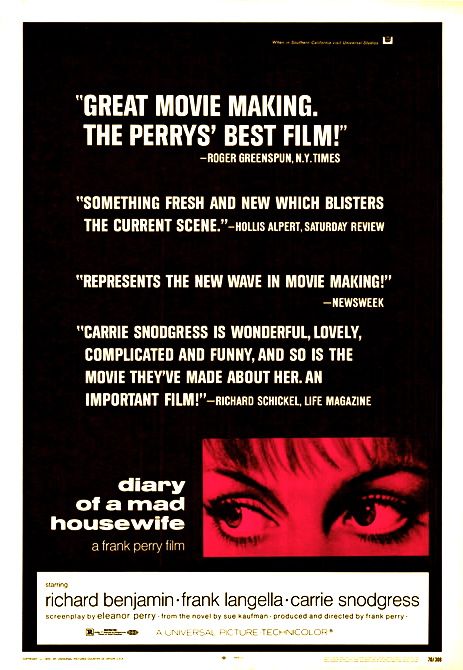
Diary of a Mad Housewife (1970)


          New York director Frank Perry’s films tended toward pretentiousness, but amid his arty flourishes he demonstrated a fine gift for guiding performances, especially by actresses. Thus, it’s no surprise that his most widely admired film, Diary of a Mad Housewife, is virtually a one-woman show for leading lady Carrie Snodgress. With Perry’s sympathetic but unflinching camera studying every nuance of her suffering, Snodgress plays Tina Balser, the underappreciated spouse of successful young attorney Jonathan Balser (Richard Benjamin). Jonathan is an asshole of the first order, a name-dropping narcissist obsessed with professional and social advancement; he alternately treats Tina as a sex toy, a shrink, a slave, a sounding board, and a subject for psychological abuse. In the film’s arresting opening scenes, Perry and screenwriter Eleanor Perry (the director’s then-wife) succinctly illustrate every aspect of the Balsers’ suffocating lifestyle—we’re so primed for Tina’s escape from Jonathan’s oppression that when she meets a potential partner for an adulterous tryst, it feels like a triumphant moment.
          Alas, Tina’s would-be paramour, writer George Prager (Frank Langella), is merely a different breed of asshole. One of those smug swingers who justifies his callous behavior with fancy language about surmounting bourgeois hang-ups, George treats Tina tenderly when they’re in bed, and abysmally when they’re not. The journey of the movie is Tina’s quest for some kind of validation—whether it’s George complimenting her lovemaking or Jonathan recognizing the work she invests keeping their household afloat—because she’s beyond desperate for evidence proving her life means something. The fascinating quality of Diary of a Mad Housewife is that Tina never really snaps, which would have been the predictable path for the story to follow; instead, even when Jonathan belittles her in front of their two impressionable daughters, Tina barks but doesn’t bite.
          Emboldened by her adultery, however, she relishes keeping a secret from her schmuck spouse, and interesting questions get raised about how deeply Tina savors the creature comforts Jonathan’s success provides—has she been co-opted by the status-symbol system that’s oppressing her?
          Benjamin is terrific here, transforming obsequiousness into an art form, and Langella, in his first feature, mostly surmounts the overwritten extremes of his role. However, since she’s in nearly every scene, it’s all about Snodgress, who came virtually out of nowhere to score in this movie—her previous screen credits comprised a handful of minor guest shots on television. Snodgress’ relatable vulnerability earned the actress a Golden Globe award and an Oscar nomination. Following a second 1970 feature and a 1971 telefilm, though, Snodgress left Hollywood for a long romance with rock legend Neil Young. She didn’t return to movies until 1978’s The Fury, the project that began her transition from leading roles to minor character roles.

Diary of a Mad Housewife: GROOVY

Monday, June 4, 2012

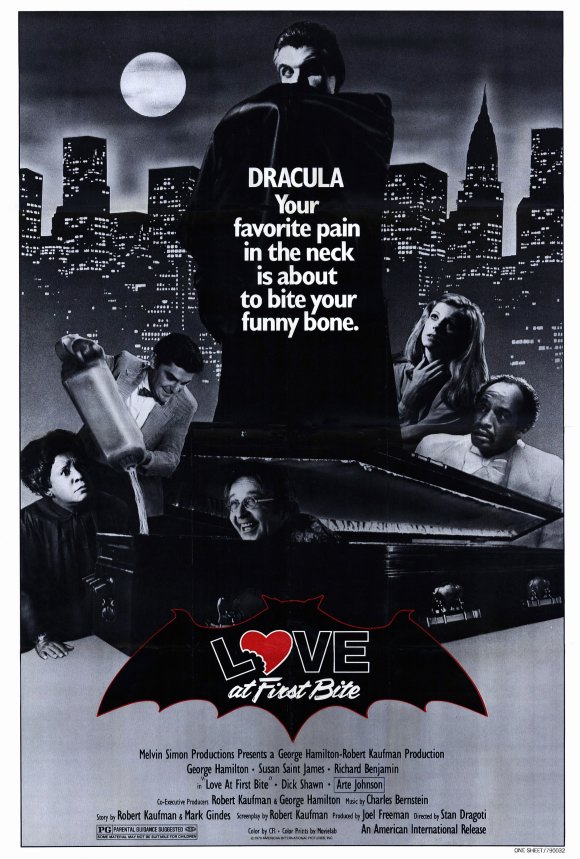
Love at First Bite (1979)


          Casting perpetually tanned smoothie George Hamilton as a pasty-faced vampire was such a droll bit of comic inspiration—and Hamilton’s ensuing performance was so unexpectedly delightful—that it’s easy to savor fond memories of Love at First Bite if one encountered the movie during its original release and avoided it thereafter. Alas, revisiting the film dispels those fond memories quickly. Hamilton is indeed quite funny, and his costars pour on the charm to infuse their thin characterizations with vitality, but the film’s comedy is so broad (and, at times, so racist) that sensible viewers will cringe as often as they chuckle. On top of insipid one-liners like “I’m going out for a bite to drink,” the picture includes awful sequences with featured players Sherman Hemsley and Isabel Sanford (better known as TV’s The Jeffersons) lampooning African-American patois.
          Anyway, here’s the good news: Hamilton, Richard Benjamin, Arte Johnson, and Susan Saint James look like they’re having a blast delivering silly jokes, so their cheerfulness makes long stretches of the movie palatable. The plot involves Count Dracula (Hamilton) relocating to New York City with his psychotic henchman Renfield (Johnson). Once in Manhattan, Dracula courts neurotic model Cindy Sondheim (Saint James), who, of course, happens to be romantically entangled with shrink Dr. Jeffrey Rosenberg (Benjamin), a descendant of Dracula’s old nemesis Abraham Van Helsing. And so it goes from there: The vampire woos the model, the doctor becomes a monster hunter, and Renfield eats bugs.
          The tone of the picture is set perfectly during the opening Transylvania scenes, because when Hamilton makes his entrance in a spooky castle to the accompaniment of baying wolves, he coos a funny twist on an old Bela Lugosi line: “Children of the night—shut up!” The gimmick is that Dracula is tired of the same old routine, so he’s eager to try new things like dancing in a disco; sure enough, the romantic boogie that Hamilton and Saint James perform to Alicia Bridges’ slinky hit “I Love the Night Life” is a highlight.
          Had director Stan Dragoti and the film’s writers been able to maintain a consistent balance of clever jokes and romance, Love at First Bite could have become an offbeat gem. Instead, it’s a mixed bag of fun sequences and stupid discursions, with the clunker gags outnumbering the successful zingers. Still, there’s a reason this was among the few unqualified triumphs of Hamilton’s career—since the actor conveys ironic self-awareness from start to finish, he’s impossible to dislike even when the movie around him is very easy to dislike.

Love at First Bite: FUNKY

Sunday, January 15, 2012

Westworld (1973) & Futureworld (1976)


           Best-selling author Michael Crichton made his feature-film directorial debut in 1973 with Westworld, based on his original script about a high-tech amusement park for adults. It’s a crudely made film, both in terms of narrative structure and production values, but the idea is so fascinating and the visuals are so rich that it’s one of the most memorable sci-fi pictures of the decade, especially since it contains a relentless villain who undoubtedly provided some inspiration for the Terminator character that Arnold Schwarzenegger first played a decade later. The story takes place at Delos, a super-expensive resort divided into three elaborate environments: Medieval World, Roman World, and Westworld. A grown-up spin on Walt Disney World, these realms are populated by lifelike robots that engage in realistic combat with guests, allowing visitors to feel as if they’re emerging victorious from gladiatorial contests, jousts, and shootouts.
            The movie follows two city-slicker businessmen, played by James Brolin and Richard Benjamin, who travel to Westworld for an exotic getaway. However, as tends to happen in cautionary tales, something goes wrong, so the robots start turning on the guests. The biggest menace is Gunslinger (Yul Brynner), a robot dressed as a black-garbed Old West outlaw, and as in the Terminator movies, part of the thrill of watching Gunslinger’s rampage is seeing his faux flesh ripped away to reveal glimpses of the technology underneath. Characterization and plotting are thin, and Benjamin struggles to infuse his role with a semblance of individuality, but the movie zooms along during 88 brisk minutes, providing just enough escapist jolts to make Westworld a fun ride.
          The movie did well enough to justify a sequel, made without Crichton’s participation. Futureworld lacks the no-nonsense gusto of its predecessor, tackling a somewhat more complex story as it sprawls over 108 leisurely minutes. Although the acting in Futureworld is much better than that in Westworld, the convoluted conspiracy-themed plot drags. Blythe Danner and Peter Fonda play reporters who travel to a new Delos attraction, Futureworld, in order to investigate why a journalist was killed when trying to expose something about the Delos organization. The movie drifts through several sorta-exciting scenes, including an unimpressive bit set in a room simulating the weightlessness of space, before becoming a straight-ahead thriller as Danner and Fonda strive to escape Futureworld with their lives. (In the movie’s weakest moment, Brynner reprises his Gunslinger role for a pointless dream sequence.) Futureworld ends on a strong note, with Fonda brandishing his signature antiestablishment attitude, and Danner is credible and lovely throughout, offering a strong counterpoint for Fonda’s easygoing persona.
          However, neither Westworld nor Futureworld truly lives up to the potential of Crichton’s underlying premise, so it’s no wonder plans for a remake of Westworld have been underway for years. (Futureworld is available as part of the MGM Limited Collection on Amazon.com)

Westworld: FUNKY
Futureworld: FUNKY

Thursday, December 8, 2011

House Calls (1978)


          A comedic piffle elevated by smart dialogue and a terrific cast, House Calls is easily one of the best romantic comedies of the ’70s. Charley Nichols (Walter Matthau) is a recently widowed surgeon who saves a patient, English divorcĂ©e Ann Atkinson (Glenda Jackson), from the incompetent ministrations of Charley’s senile boss, Dr. Amos Willoughby (Art Carney). As Charley endures the repercussions of treating another physician’s patient without permission, he also savors his newfound swinger’s lifestyle until he realizes that Ann has gotten under his skin. Ann’s thorny intelligence not only rouses Charley from his midlife-crisis stupor but also emboldens him to confront Amos, who has gotten so addled he’s endangering the lives of patients.
          Despite murky literary origins (four writers worked on the script, which was adapted from a French novel), House Calls is brisk and smooth, throwing credible obstacles between the protagonists and their inevitable happily-ever-after destiny; when it’s really crackling, the movie comes close to the frothy frizz of classic romantic comedy from the ’30s, but with a modern, liberated-woman spin. And though some might question the casting of Matthau as a romantic lead, since overpowering handsomeness was never one of his virtues, the filmmakers weave Matthau’s wiseass humor into the persona of his character, depicting how easily he charms every woman he meets. Jackson matches Matthau’s pithiness perfectly, offering a feminist complement to his macho swagger, and the filmmakers do a fine job of articulating Charley’s realization that companionship trumps casual sex.
          Watching Matthau and Jackson work together is extremely pleasurable, because they’re both so confident and loose; in particular, their physical-comedy scene of trying to figure out whether a couple can copulate while each has one foot on the floor is a delightful demonstration of their vanity-free commitment to meeting any scene’s demands. Carney, at the peak of his terrific late-career revival, is funny and formidable as a man clinging to power because letting go would involve admitting he’s elderly. Additionally, several supporting players contribute fine work: Richard Benjamin gets in a few zingers as Charley’s younger colleague, Candice Azzara is droll as a pragmatic gold digger from Noo Yawk, and the always-entertaining Dick O’Neill is memorably exasperated as a hospital executive doomed to clean up messes created by Carney’s character.

House Calls: GROOVY

Monday, May 2, 2011

The Sunshine Boys (1975)


          Boasting one of Neil Simon’s best scripts, two master comedians in the leading roles, and smooth dancer-turned-director Herbert Ross behind the camera, The Sunshine Boys should be sheer pleasure from beginning to end. And indeed, the premise is wonderful: Two aging vaudeville comedians who haven’t spoken since the breakup of their world-famous duo reunite for a TV special, only to discover they still detest each other. Furthermore, Simon’s characterizations are sharp, his signature one-liners are plentiful, and the “doctor sketch” he contrives for the comedians masterfully evokes vaudeville’s mile-a-minute style of corny jokes and sight gags.
          In the story, Willy Clark (Walter Matthau) is a belligerent, self-involved senior living in Manhattan, constantly haranguing his agent/nephew, Ben (Richard Benjamin), for new work even though Clark’s memory is dodgy and his attitude is so terrible no one wants to deal with him anymore. Meanwhile, Clark’s ex-partner, Al Lewis (George Burns), has spent the last decade enjoying a quiet retirement in New Jersey. When Ben receives a lucrative offer for the duo’s TV reunion, the old partners slip into a familiar dance of hostility and recrimination—Lewis makes sport of driving Clark crazy, and Clark can’t keep his temper in check.
          The long sequences of Ben trying to coax the aging vaudevillians into doing the TV special are terrific, because Benjamin’s amiable frustration grounds the leading actors’ respective shticks. Burns is fantastic in a role that represented a huge comeback for the showbiz legend at the age of 80, and he won a well-deserved Oscar for unleashing his avuncular charm and perfectly preserved comic timing. So why doesn’t this movie go down more smoothly? These things are a matter of taste, but for me this is a rare instance of Matthau being the weak link. He’s hindered by the fact that Clark is written as an insufferable son of a bitch, a man so deeply unhappy that he attacks everyone in his path.
          To his credit, Matthau commits to the character wholeheartedly—his performance is so grating that it’s hard to trudge through the muck long enough to discover Clark’s redeeming qualities. And in the movie’s defense, the characterization is believable even though it’s not particularly entertaining. As Lewis points out, Clark is a hard-working professional who derives no joy from his work, whereas Lewis is a naturally funny individual whose professional life was a breeze. Therefore Clark is understandably embittered by the fact that he can’t practice his trade anymore, because he feels like a man without a purpose. This deeper aspect of Clark’s character is what makes The Sunshine Boys more than just a laugh machine, and the last scenes of the movie are quite poignant because Clark gets a much-needed reality check.
          Getting there, however, is more of a chore than seems absolutely necessary.

The Sunshine Boys: GROOVY