Saturday, April 7, 2012

The Romantic Englishwoman (1975)


          A closely observed character drama with a few thriller elements thrown in for added tension, The Romantic Englishwoman has all the hallmarks of director Joseph Losey’s best work: evocative European locations, immaculate performances, subtle writing, and an undercurrent of menace. So, even though the story is nominally about Elizabeth (Glenda Jackson), the dissatisfied wife of successful novelist Lewis (Michael Caine), it’s also about Thomas (Helmut Berger), a German freeloader who claims to be a poet but really makes his living as a drug courier. These characters muddle through life, the Brits narcotized by their boring routine and the German energized by the dangerous unpredictability of his existence, until their collision produces an emotional explosion with lasting repercussions.
          Elizabeth, for instance, is so tired of Lewis’ withholding quality that she does things like walking across her lawn naked in full view of a neighbor—anything to rebel against the numbing status quo. When she meets Thomas while on holiday in Germany, Elizabeth inadvertently broadcasts so much need that Thomas senses an opportunity. Then, after Thomas loses a drug shipment and flees the continent to avoid reprisal, he arrives at Elizabeth’s doorstep pretending to be a fan of Lewis’ work. Handicapped by an artist’s ego, Thomas savors the younger man’s fawning attention (well, as fawning as this cold-blooded operator can be), even though Lewis senses the physical charge sparking between his houseguest and his wife.
          Working his signature slow-burn vibe, Caine meticulously illustrates the way Lewis drives himself crazy with visions of his wife’s possible infidelity; when Elizabeth and Thomas finally consummate their attraction, it’s as if Lewis has perversely willed the event into being. Jackson, flying high during the most vibrant stretch of her career, paints a complex portrait of a woman driven by guilt, insecurity, longing, and regret—she’s a loving mother to her young son, but also a short-tempered harridan who attacks her nanny when she believes the nanny has captured Thomas’ affections.
          The Romantic Englishwoman takes its time getting where it’s going, so the first hour of the movie often seems repetitive and unfocused. However, once all the pieces are in place, the second hour gains intensity because romantic intrigue is coupled with the threat of Thomas’ drug-business associates targeting him for revenge. One might argue that Thomas Wiseman, who wrote the novel upon which the film is based and cowrote the script with Tom Stoppard, should have cut a few subplots to make the story flow more smoothly, and it’s true that Losey indulges his penchant for slow pacing by exploring narrative discursions. Nonetheless, when The Romantic Englishwoman connects, it’s quite potent, particularly in the domestic scenes of Elizabeth and Lewis pouring salt in each other’s psychological wounds.

The Romantic Englishwoman: GROOVY

Friday, April 6, 2012

Las Vegas Lady (1975)


Unless you’ve got a soft spot for one of the leading actors, or nostalgic affection for vintage footage of Sin City, there’s little reason to explore the low-budget heist thriller Las Vegas Lady. Ineptly written, poorly acted, and unattractively photographed, it’s a tedious mélange of clichés strung together by a vacuous storyline that the filmmakers can’t even bother to present coherently. The gist of the piece is that Lucky (Stella Stevens), a longtime resident of Las Vegas, agrees to rob the “bank” for a high-stakes card game on behalf of a mysterious benefactor. She recruits a trapeze artist (Linda Scruggs) and a waitress (Lynne Moody) for help, then struggles to hide her activities from her boyfriend (Stuart Whitman), a security guard at the casino Lucky plans to rob. As with most drive-in dreck from the Crown International assembly line, Las Vegas Lady makes very little sense. Since Lucky seems to be friendly with virtually everyone in Vegas, why can’t she make a regular living? And since her boyfriend just put a deposit on a ranch outside of town, why doesn’t she just leave Vegas with him to start a better life? More importantly, given that Lucky is not a career criminal, why was she recruited in the first place? (The only credential she ever mentions is that her breasts can distract men, which is true enough.) The picture’s wheezy plot is merely a set-up for a twist ending, but the twist is even more befuddling than what came before: Once you discover the identity of Lucky’s benefactor, you’ll wonder why he went to so much trouble. Anyway, everything in this movie is thoroughly dull and inconsequential, and the excitement level is dangerously low from the convoluted opening to the silly shoot-’em-up climax. Stevens looks great and Whitman provides a comfortingly macho presence, but their appeal isn’t nearly sufficient to justify enduring this movie. (The rest of the cast is forgettable, though Stevens’ son, future B-movie hunk Andrew Stevens, appears briefly.) In the vernacular of its location, Las Vegas Lady rolls a snake-eyes.

Las Vegas Lady: LAME

Thursday, April 5, 2012

Frenzy (1972)


          After losing his way in the late ’60s, when drab source material and poor health dulled his edge, Hollywood’s “master of suspense,” director Alfred Hitchcock, forcefully entered the ’70s with Frenzy. In addition to returning to familiar territory in terms of location and subject matter, Hitchcock toughened up his perverse storytelling by adding the R-rated elements of nudity and profanity. Yet while many of his old-Hollywood peers seemed desperate when they jumped onto the anything-goes ’70s bandwagon, Hitchcock’s movies had always been so infused with nastiness that the rough stuff suited his style.
          Furthermore, Frenzy demonstrates the filmmaker’s unique ability to weave black humor into sordid material, so the picture has some very funny moments in addition to sequences of concentrated fright. The movie is too long, the performances are good but not great, and the storyline sometimes meanders, but given its many strengths, Frenzy would have been a wonderful swan song for Hitchcock’s epic career. Alas, the underwhelming Family Plot (1976) was his final film, a whimper following the roar of Frenzy.
          Jon Finch, the intense leading man of Roman Polanski’s Macbeth (1971), stars in Frenzy as Richard Blaney, a London ne’er-do-well with a volcanic temper. Fired from his job as a bartender in the Covent Garden neighborhood, he accepts financial and moral support from his girlfriend (Anna Massey), his ex-wife (Barbara Leigh-Hunt), and his former military comrade (Barry Foster).
          Meanwhile, police officers including the meticulous Chief Inspector Oxford (Alec McCowen) are chasing the “Necktie Murderer,” a serial killer who rapes women and then strangles them to death with neckties. Based on a novel by Arthur La Bern and written for the screen by Anthony Shaffer (best known for his clever play/film Sleuth), Frenzy fits perfectly into the Hitchcock tradition, because as the story progresses, circumstances convince Oxford that Blaney is the Necktie Murderer. Viewers, however, learn the real identity of the criminal, and it’s wicked sport to watch Hitchcock move the characters around each other while it seems more and more likely the wrong man will get arrested.
          Hitchcock and Shaffer enliven the picture by carefully fleshing out their characters. For instance, the running gag about Oxford’s home life—his wife’s experiments with gourmet cooking lead to a procession of elaborately repulsive meals—is wonderfully droll. Plus, in classic Hitchcock style, Frenzy features a handful of riveting suspense scenes, like a lengthy sequence in which the real Necktie Murderer nearly gets caught while trying to recover evidence from a truck that’s barreling down a highway. And, in an enjoyable grace note, Hitchcock uses his camera to explore the colorful streets of Covent Garden, the neighborhood in which his parents operated a shop when Hitchcock was a boy.

Frenzy: GROOVY

Wednesday, April 4, 2012

Robin Hood (1973)


          The second animated feature that Walt Disney Productions made after Walt Disney’s death, Robin Hood commenced the decline into mediocrity that defined the company’s feature-length cartoons until 1989’s The Little Mermaid. Lacking the narrative focus of its predecessors, and woefully short of memorable songs, Robin Hood is so enervated it’s hard to believe the same company was regularly issuing classics like The Jungle Book and 101 Dalmatians just a decade prior. To be fair, Robin Hood isn’t awful, because the animation is lovingly crafted and there’s plenty of brisk action and slapstick comedy, often presented in tandem. The problems, however, are many.
          To begin with, the Robin Hood myth doesn’t really suit the Disney paradigm, because by the mid-’70s, endless cinematic treatments had defined the crusading archer of Sherwood Forest as a virile action hero—therefore, seeing him rendered as a cute little fox seems to diminish the character. Another issue is the completely random use of anthropomorphized animals for all of the characters.
          Well-conceived Disney cartoons, like The Jungle Book, create internal logic by showcasing animals that might reasonably exist alongside each other in nature. Robin Hood juxtaposes jungle and woodland critters willy-nilly, so rhinoceros soldiers chase ursine merry men while a leonine prince sneers and cuddly rabbit serfs watch in horror. Similarly, some characters speak in appropriate British accents (since the setting is explicitly defined as England), while others chatter in cornpone American patois.
          And then there’s the ineffectual storyline, which picks up years after the main action of the classic Robin Hood myth—when this picture begins, Robin and his lady love, Maid Marian, have been separated for years, and Robin courts her anew while mounting a fresh crusade against the evil Sheriff of Nottingham’s onerous taxation. Even more awkwardly, Robin Hood mostly eschews songs during the first 30 minutes of its brief running time, and then a slew of forgettable tunes get jammed into a directionless second act that feels like a cartoon concert.
          On the bright side, Robin Hood features several entertaining vocal performances. Peter Ustinov and Terry-Thomas are both wonderful as villains, with Ustinov playing a lion (royal usurper Prince John) and Terry-Thomas essaying a snake (John’s put-upon advisor, Hiss). Phil Harris is also enjoyable as the lumbering Little John, a bear with a Southern accent. As for the music, let’s just say that when ’80s Disney exec Jeffrey Katzenberg started hiring Broadway composers for cartoons, the saccharine tunes in Robin Hood were just the sort of hokey tripe he was wise to retire.

Robin Hood: FUNKY

Tuesday, April 3, 2012

The Killing of a Chinese Bookie (1976)


          Stepping outside his comfort zone of intimate character dramas, writer-director John Cassavetes took a stab at genre filmmaking with The Killing of a Chinese Bookie, which takes place in the criminal underworld of Los Angeles. Regular Cassavetes collaborator Ben Gazzara stars as Cosmo Vittelli, the proprietor of a dingy strip club. After incurring a large gambling debt he can’t repay, Cosmo agrees to murder an Asian criminal on behalf of the mobsters holding his marker, ostensibly to erase his debt. Unbeknownst to Cosmo, the mobsters plan to take him out after the hit.
          The story is simple enough to generate pulpy tension, but Cassavetes explores the narrative through his signature prism of on-the-fly filmmaking and semi-improvisational acting. In fact, the indie auteur’s first cut ran an excruciating 135 minutes, thanks to unnecessary discursions like vignettes of performances at Cosmo’s club. Cassavetes released the original version for one disastrous week in New York during 1976, then pulled it from exhibition and chopped the movie down to 109 minutes for a better-received 1978 re-release. Today, both cuts of the picture are held in high esteem, largely due to the widespread critical contention that everything Cassavettes did was surpassingly wonderful.
          Assessing the 1978 cut, The Killing of a Chinese Bookie offers an interesting spin on the usual tropes of crime pictures. Intense realism heightens the drama in pivotal scenes, because Cosmo comes across as a completely believable character. Therefore, even though he’s responsible for his own problems because he arrogantly places bets he can’t cover, it’s easy to feel sympathy for his plight. (That’s different from actually liking the character, of course, since Cosmo is a sexist pig.) Nonetheless, there’s a strange disconnect between the film’s simplistic action scenes, which include a tense foot chase in an abandoned building, and the picture’s loose conversational sequences. Every time it seems like Cassavetes is about to step on the gas, he slows down to admire the scenery.
          Another jarring element is the overpowering ugliness of the milieu. One doesn’t expect much dignity in a story about killers and strippers, but Cassavetes seems to revel in the unattractiveness of supporting actors with the same zeal he brings to close-ups of strippers’ breasts. There was always more than a bit of the voyeur in Cassavetes’ directorial style, but since the storyline of Chinese Bookie gave him license to film sleaze, one senses a lurid fascination with sex and violence. (For instance, Cassavetes cast pin-up models and strippers for key female roles instead of hiring proper actors.)
          Still, one could argue that Cassavetes was simply capturing the right atmosphere for his story, and, indeed, Chinese Bookie has a seedy vibe of which Scorsese might be envious. It’s not, however, a particularly well-made film. Seeing how poorly Cassavetes handles standard-issue scenes like shoot-outs reveals the crude nature of his visual artistry, even though his ability to create a comfortable working atmosphere for actors is on ample display.

The Killing of a Chinese Bookie: FUNKY

Monday, April 2, 2012

Dirty Dingus Magee (1970)


Grating and unfunny, this spoof of movie Westerns pales beside the inspired lunacy of Blazing Saddles (1974) and even the lighthearted silliness of Cat Ballou (1965). Worse, the movie overcompensates for its shortcomings by smothering nearly every scene in cloying music straight out of a Disney cartoon, and by relying on vulgar stereotypes like ignorant Native Americans, moronic Cavalry soldiers, and sex-crazed frontier women. In other words, rather than actually satirizing the clichés of the Western genre, Dirty Dingus Magee merely recites the clichés and adds the cinematic equivalent of lounge-comic rim shots. A bored-looking Frank Sinatra stars as small-time outlaw Dingus Magee. After robbing a bankroll from his dim-bulb pal Hoke (George Kennedy), Dingus retreats into the wilderness, where he becomes lovers with a horny squaw, Anna Hot Water (Michele Carey). Hoke seeks assistance from the mayor of a frontier town, who is also the local madam, Belle (Anne Jackson). She appoints Hoke sheriff so he can chase Dingus. However, the U.S. Army is threatening to close a nearby military base, so Belle asks Hoke to stir up an Indian uprising as a means of persuading the Army to stay. Using these plot elements, plus a few other stupid contrivances, producer-director Burt Kennedy constructs an hour and a half of noisy farce. Typical high jinks include a running gag of Hoke getting bopped on the head to the accompaniment of cartoonish sound effects, and Anna Hot Water repeatedly asking whether it’s time for her and “Din-goose” to “make bim-bam.” Sinatra wears a floppy black wig that makes him look like a middle-aged reject from Beatlemania, and Kennedy pulls so many bug-eyed faces that it’s surprising he got through production without an aneurysm. Both should have been embarrassed by their participation in this misfire. (Available at WarnerArchive.com)

Dirty Dingus Magee: LAME

Sunday, April 1, 2012

Hustling (1975)


          Based on a nonfiction book by Gail Sheehy, who interviewed and spent time with a group of real New York City hookers, the solidly assembled telefilm Hustling offers a sober look at the world of prostitution. The movie focuses on a Sheehy stand-in, sophisticated journalist Fran Morrison (Lee Remick). Curious why working girls have become ubiquitous in Times Square, and why the police seem incapable of containing the problem, Fran zeroes in on tough-talking pro Wanda (Jill Clayburgh), who is stuck in city jail. Fran pays Wanda’s bail in exchange for information, so Wanda explains her relationships with johns, pimps, and other prostitutes. This leads Fran to discover the network of city officials and slumlords making money off the sex trade, transforming Fran’s article from a color piece about hooking to an exposé about corruption. Understandably, the deeper Fran digs into the prostitution business, the more pressure Wanda feels to stop talking.
          Hustling doesn’t shy away from the dangers of streetwalking—Wanda gets beaten and raped, and another prostitute commits suicide—yet the movie illustrates how some women can survive the business long enough to sock away cash and escape with their souls intact. Directed by reliable TV-movie helmer Joseph Sargent, who also made a handful of noteworthy features, Hustling moves along at a strong pace and boasts a great sense of atmosphere. There’s a documentary-style feel to the way Sargent’s cameras observe characters in dark alleyways, grungy coffee shops, and vile hotel rooms that rent by the hour. Sargent also benefits from vibrant acting.
          Remick seethes with a believable type of rich-liberal indignation, and the supporting cast features a number of ’70s favorites, including Paul Benedict, Melanie Mayron, Dick O’Neill, Alex Rocco, and Burt Young. However, the movie’s best/worst element is Clayburgh’s performance. Spewing a cartoonish Noo Yawk accent and strutting with seen-it-all attitude, Clayburgh is compelling from start to finish even though she’s unable to blend the strong and vulnerable aspects of her role into a believable characterization. However, if the worst shortcoming of a move is an actress investing too much effort, that’s a sign everyone involved is trying to create something worthwhile.

Hustling: GROOVY

Saturday, March 31, 2012

Bad Man’s River (1972)


Spaghetti Westerns kept Lee Van Cleef busy during the decade between his breakout performance in The Good, The Bad, and The Ugly (1966) and the decline of the genre in the mid-’70s, by which point he had cranked out more than a dozen Italian-made oaters. Given this assembly-line pace, it’s unsurprising most of the flicks are awful. For instance, it’s hard to muster enthusiasm for Bad Man’s River, which has some nicely staged action but is otherwise bland and directionless. (The movie also features godawful music, like the title song whose unflattering lyrics refer to Van Cleef’s “close-set beady eyes.”) Van Cleef plays a crook named Roy King, whose new bride, Alicia (Gina Lollobrigida), commits him to an insane asylum in order to steal his money. Thanks to the machinations of a laborious plot, Roy ends up in business with a revolutionary named Montero (James Mason), who happens to be Alicia’s new husband; it seems Montero is planning an elaborate scheme involving guns and money, so Alicia, who apparently expects Roy to forget their past, asks her ex-husband to ensure Montero doesn’t swindle her out of the loot she’s been promised. Or whatever. Featuring a numbing combination of clichéd characters, confusing plotting, and whiplash tonal shifts, Bad Man’s River seems like a different movie in nearly every scene. (During one sequence, the movie’s old-timey background music is supplanted by an acid-rock tune complete with Jethro Tull-style flute solos.) If the movie possessed any artistry, it might feel like the work of a mad cinematic genius, but Bad Man’s River is just chaotic junk. For instance, Mason, the venerable British actor who spent far too much of his career slumming in easy-paycheck B-movies, can’t be bothered to muster a Spanish accent for his Mexican-born character. Bad Man’s River is just plain bad.

Bad Man’s River: LAME

Friday, March 30, 2012

Shamus (1973)


A routine detective thriller enlivened by chipper leading performances, Shamus should have initiated another crowd-pleasing Burt Reynolds franchise. Alas, the movie wasn’t interesting or successful enough to warrant a reprise, so we’ll never know how Reynolds might have built on his enjoyable turn as smartass private dick Shamus McCoy. Featuring the requisite array of comical quirks—his bed is a pool table, he looks after a stray cat, he operates his business from a dive bar—the Shamus character comes straight off the crime-fiction assembly line. Additionally, the plot of this movie is so bland it could have been the basis for an episode of Kojak. The story begins with a horrific murder, when a killer wearing a protective suit uses a flamethrower to murder victims before robbing their safe. After being hired to recover the stolen loot, Shamus uncovers a scheme to sell surplus Army weaponry on the black market. Leading lady Dyan Cannon plays the sister of someone involved in the scheme, so it takes a while for her and Reynolds to get together. Despite the blah narrative, Reynolds is charming and loose, while Cannon elevates a nothing role. When these two display their warm interplay in casual shared scenes, which isn’t often enough, Shamus nearly coalesces into something memorable. Additionally, Reynolds runs wild through the movie’s many action scenes, performing a number of his own stunts, so it’s easy to buy Shamus as a badass capable of taking on cops, criminals, and even the U.S. military. Director Buzz Kulik keeps the pace brisk, delivering the shoot-’em-up goods between vignettes of Reynolds pressuring informants and/or wooing ladies, but Shamus is merely a forgettable diversion, wasting any potential inherent to the main character. His big-screen career over, the Shamus McCoy character returned in 1976 for a TV movie called A Matter of Wife . . . and Death, with Rod Taylor taking over Reynolds’ role.

Shamus: FUNKY

Thursday, March 29, 2012

Pieces of Dreams (1970)


          Ordinary in every way, this drama explores the moral conflicts experienced by a priest who questions his faith. Specifically, young and handsome Father Gregory Lind (Robert Forster), who is assigned to a small neighborhood parish in Albuquerque, struggles with issues like the Vatican’s opposition to birth control, since a 15-year-old girl in his parish becomes pregnant and needs an abortion for medical reasons. Concurrently, Father Gregory meets Pamela Gibson (Lauren Hutton), a beautiful social worker, so temptations of the flesh compound his angst. Although the birth-control subplot is pointed and worthwhile, the romance storyline, which takes greater prominence, is predictable and trite.
          Nonetheless, Pieces of Dreams gets points for trying to tell its story in a grown-up sort of way. Father Gregory’s crisis is depicted methodically, with each step along his journey logically suggesting the next, and the revelation that his priesthood defines his relationship with his mother goes a long way toward individualizing the character. Furthermore, the subplot about Father Lind’s tense relationship with his immediate superior, Father Paul Schaeffer (Ivor Francis), provides a vivid glimpse into the everyday lives of priests. Schaeffer is a domineering, judgmental racist who expects the people around him to ignore his periodic lapses into alcoholic stupor—one can understand Father Gregory’s frustrated reactions.
          Unfortunately, for all its good intentions, Pieces of Dreams suffers from lifeless acting and writing. The screenplay’s tone is so matter-of-fact that very little dramatic heat is generated, and love story is woefully underdeveloped. Hutton, the former model appearing in only her second movie, mistakes intensity for acting, so she comes across as sullen instead of substantial. And Forster, who later became a wonderful character actor, is virtually catatonic: His performance is so restrained that everyone else around him, even the nonactors playing bit parts, is more interesting. His performance, and the movie as a whole, perk up slightly during a final exchange with a powerful bishop (Will Geer), but getting that far requires a great deal of patience on the viewer’s part. (Available as part of the MGM Limited Collection on Amazon.com)

Pieces of Dreams: FUNKY

Wednesday, March 28, 2012

The Chant of Jimmie Blacksmith (1978)


          Proving that violence, like sex, is a narrative commodity that cuts across cultural borders, some of the widest international releases afforded to Australian films in the ’70s went to brutal tales of righteously indignant outlaws. Yet while Ned Kelly (1970) and Mad Dog Morgan (1976) dramatized the exploits of real historical figures (both white) who raged against the oppressive machine of 19th-century Australian government, The Chant of Jimmie Blacksmith is a fictional story inspired by the murderous actions of a 19th-century Aborigine named Jimmy Governor.
          Writer Thomas Keneally, the Australian scribe who later penned Schindler’s List, used the basics of Governor’s story as the spine for his 1972 book The Chant of Jimmie Blacksmith, which writer-director Fred Schepisi adapted into this movie. In 1900, Governor killed an entire white family, then several more people, before getting captured and hanged. His fictional doppelganger, Jimmie Blacksmith (Tom E. Lewis), is a sweet-tempered young man willing to suffer indignities while making his way in the white-dominated world as a wandering laborer.
          In fact, Blacksmith is so determined to assimilate that he adopts Christianity and courts a white woman, Gilda (Angela Punch McGregor). Despite getting swindled by a string of employers, Jimmie patiently builds a life for himself, Gilda, and his slow-witted brother, Mort (Freddy Reynolds). However, when Gilda gives birth to a white child, proving her infidelity, Jimmie snaps and seeks out his past abusers for lethal revenge. Mort is his accomplice until realizing Jimmie’s bloodlust has become insatiable—but by that point, Jimmie’s actions have doomed both men.
          The Chant of Jimmie Blacksmith has a complex texture, because while the filmmakers clearly feel kinship with their oppressed protagonist, they don’t shy away from depicting the reckless brutality of his actions. And to the filmmakers’ credit, they mostly avoid the trap of including saintly white characters for moral contrast—white Australia ends up with as much blood on its hands, metaphorically speaking, as Jimmie has on his. At one point, when Jimmie abducts a frail teacher for a hostage, the teacher acknowledges the impact European whites have had on Australia: “You can’t say we haven’t given you anything. We’ve introduced you to alcohol, religion, influenza, measles, syphilis, school—a whole host of improvements.” Preachy, sure, but tart nonetheless.
          Like the best dramas Schepisi made once he relocated to Hollywood—Barbarosa (1982), Iceman (1984), A Cry in the Dark (1988), and so on—The Chant of Jimmie Blacksmith is a serious picture filled with careful craftsmanship and provocative ideas. It also boasts a strong sense of atmosphere, thanks to evocative music and rich location photography. Even though it doesn’t achieve the thunderclap impact Schepisi was presumably shooting for, this is still a potent rumination on race, responsibility, and revenge.

The Chant of Jimmie Blacksmith: GROOVY

Tuesday, March 27, 2012

The Last Hard Men (1976)


          An enjoyable but forgettable Western thriller, The Last Hard Men combines a string of macho clichés. Circa the early 1900s, cold-blooded criminal Provo (James Coburn) is part of a prison labor crew until he stages a violent escape, enlisting several fellow convicts to form an outlaw gang. (Fans of cheesy TV will notice Larry Wilcox, later of CHiPs fame, as the youngest member of Provo’s gang.) Although Provo claims he wants to rob banks, his real motivation is hunting down the man who sent him to jail, square-jawed peacemaker Sam Burgade (Charlton Heston). Now a retired widower, Burgade is happily occupied with getting his beautiful daughter, Susan (Barbara Hershey), married off to her affectionate beau, Hal (Christopher Mitchum). Yet when Burgade learns about Provo’s escape and subsequent crime spree, he races to intercept the train on which Provo’s gang was spotted. Unfortunately, Provo arranged the train sighting as a decoy so he could kidnap Susan and draw Burgade out to the wilderness for a showdown. There’s a smidgen more to the story than this synopsis suggests, but The Last Hard Men is essentially a macho duel preceded by foreplay.
          Director Andrew V. McLaglen demonstrates his usual sure hand for this sort of material, keeping things moving at a steady pace and ensuring that the nastiest violence leaves a mark. However, at one point he awkwardly tries to channel Sam Peckinpah—late in the movie, as a means of provoking Burgade, Provo gives his thugs permission to rape Susan, and McLaglen stages the ensuing pursuit/assault in lurid slow-motion. Artsy flourishes don’t gel with McLaglen’s meat-and-potatoes style, so the scene feels weirdly dissonant and perverse. As for the movie’s acting, Coburn is genuinely frightening when his character gets crazed with bloodlust, but Heston is on autopilot. It doesn’t help that many of Heston’s scenes are designed to showcase supporting player Mitchum (son of Robert), whom various producers spent several years trying to transform into a star despite his lack of charisma. Hershey adds welcome toughness to an underwritten role, demonstrating how quickly she was outgrowing the ingénue style of her early-’70s performances.

The Last Hard Men: FUNKY

Monday, March 26, 2012

Being There (1979)


          After spending much of the ’70s starring in schlocky comedies, British funnyman Peter Sellers doggedly pursued the lead role in this adaptation of Polish writer Jerzy Kosinski’s novel, recognizing a chance to deliver a subtle performance that would contrast his usual over-the-top silliness. The involvement of director Hal Ashby was an added incentive, since Ashby had scored with the offbeat comedies Harold and Maude (1971) and Shampoo (1975). Together, Ashby and Sellers present Kosinski’s social satire as a media-age fairy tale, to winning effect.
          When the story begins, Chance (Sellers) is the live-in gardener for a wealthy senior. Chance has never left his employer’s estate, and his main companion is television—Chance’s IQ is so low that he’s incapable of anything beyond bland remarks and mundane tasks. After his employer dies, lawyers inform a confused Chance that he must leave the estate, so he’s forced to explore the outside world for the first time in his life. Walking the streets of Washington, D.C., in a hand-be-down suit, Chance looks like a man of wealth and power though he’s actually a homeless simpleton.
           By the time night falls, Chance is bewildered and hungry, so he walks right into the path of a town car belonging to Eve Rand (Shirley MacLaine), the wife of an elderly but super-wealthy tycoon named Ben Rand (Melvyn Douglas). Accepting an invitation to receive care from the Rand family physician (Richard Dysart), Chance becomes an unexpected but welcome houseguest.
           The comic premise of Being There is that modern Americans are so narcissistic they only hear what they want to hear. Thus, whenever Chance makes childlike comments about the only thing he knows, gardening, the Rands perceive him as a guru delivering wisdom through cryptic metaphors. Taking the contrivance to a wonderfully farcical extreme, the story reveals that Rand has the ear of the U.S. president (Jack Warden), and shows the president falling under Chance’s spell. The strange and surprising paths the narrative follows thereafter are better discovered than discussed, but suffice to say the filmmakers gracefully advance from an outlandish premise to a poetic ending.
          Being There is not without its flaws, since the movie is paced quite slowly and the tone is precious (lots of tasteful classical music played over painterly shots of the lavish Rand estate). The movie also walks a fine line by asking viewers to accept the absurd concept of Chance becoming an important national figure, and also asking viewers to empathize with Chance’s plight as a lost little boy. Is he a metaphor or a character?
          Notwithstanding these issues, Ashby creates a wonderful framework for the film’s rich performances. Dysart and David Clennon (as a litigator who suspects the truth about Chance) leaven oiliness with sincerity, while Warden energizes his scenes with amiable bluster. MacLaine is charming and funny as the woman who transposes her fantasies onto Chance, and Douglas earned an Academy Award for his sly turn as an aging tycoon with an eye on his legacy. As for Sellers, the impressive thing about his performance is how little he actually does onscreen; given the frenetic nature of his usual comedy acting, it’s wild to see him pull back completely.

Being There: RIGHT ON

Sunday, March 25, 2012

Weekend With the Babysitter (1970)


An embarrassing vanity project for workaday actor and occasional low-budget producer George E. Carey, this cross-generational romance somehow manages to be lurid and bland at the same time. One of many flicks about middle-aged men exploring counterculture by having sex with hippie chicks, Weekend With the Babysitter stars Carey as Jim Carlton, a businessman whose marriage is a shambles because of his wife’s emotional difficulties. Turns out she’s a heroin addict, a fact that has somehow escaped her husband’s notice. One weekend, Jim’s wife accidentally summons the family’s nubile babysitter, Candy (Susan Romen), to the house even though she’s not needed—Jim’s wife is taking their son out of town for a weekend getaway. Jim offers to drive Candy home, but instead they head out for a groovy evening of dancing and rapping because Jim suddenly decides he needs to understand what the kids are into these days. Before long, Candy ends up in Jim’s bed, and soon the lovers decamp to Jim’s ski-chalet getaway. Meanwhile, Jim’s wife has gotten into a bad scene with her pusher. In the movie’s most extreme moment, director Don Henderson intercuts Jim’s idyllic sexcapade (mounting Candy while bouncy jazz music plays on the soundtrack) with his wife’s gutter-level travails (getting forced into a drugged-out lesbian encounter for her pusher’s amusement). Even given the diminished expectations one brings to a movie titled Weekend with the Babysitter, this one’s a turkey on every level. The acting is as bad as the writing, and though Henderson’s filmmaking is basically competent, his storytelling is so trite that he punctuates the sequence of Jim getting into Candy’s pants for the first time by cutting to a shot of an anchor plunging into the sea. Subtle!

Weekend With the Babysitter: LAME

Saturday, March 24, 2012

The Great White Hope (1970)


          When African-American boxer Jack Johnson became the heavyweight champion of the world in 1908, white people were so affronted that outrageous tactics were used against him: He was arrested, under dubious legal precedent, for crossing state lines with his white lover, and a retired white boxer was recruited to challenge Johnson in an epic slugfest. Johnson’s opponent was dubbed the “great white hope.” Outside of the ring, Johnson’s life was just as tumultuous, because his marriages were fraught with allegations of abuse, and his third wife had emotional issues culminating in suicide.
          To say that Johnson’s story begs for dramatic treatment is an understatement, so it’s no surprise writer Howard Sackler scored with his late-’60s play The Great White Hope, starring the ferocious James Earl Jones as a fictionalized character named “Jack Jefferson” and costarring the formidable Jane Alexander as his lover. Both actors won Tony awards before reprising their roles in this flamboyant film adaptation, which was written by Sackler and directed by diehard lefty Martin Ritt. The actors received matching Oscar nominations, and Jones and Alexander are the best things about this movie.
          In his first major film role (previous work included a small part in Dr. Strangelove), Jones uses all of the considerable powers at his disposal. In addition to his legendary speaking voice, a thundering instrument infused with authority and passion, Jones displays intense physicality, strutting around with a muscular frame and a shaved head that frames his burning eyes; he incarnates not just Johnson but the very soul of the African-American experience in all of its joy and rage. Alexander paints with softer colors, her role being a somewhat murky amalgam of several real-life inspirations, but she connects strongly when pushed to extremes of anguish and defiance.
          Unfortunately, the movie containing their performances is not as focused. Sackler uses Johnson/Jefferson as a prism for demonizing the white establishment, so the movie sometimes drifts from the specificity of one man’s story to the sprawl of a Major Statement. Worse, Sackler’s dialogue is pretentious and stilted, with Jefferson spewing rat-a-tat runs meshing African-American patois and pidgin English into a slangy stew that’s hard to decipher.
          The stylized writing is exacerbated by Ritt’s direction, which uses opulently fake-looking sets and weirdly affected flourishes like showing fights through quick glimpses rather than full views. Still, Burnett Guffey’s cinematography is rich, and he lights Jones so brightly the actor seems to have heat waves coming off his body. Thus, while the movie’s intentions are noble, the sum effect is middling—the leading actors do great work even as they struggle to enliven an overly politicized history lesson.

The Great White Hope: FUNKY

Friday, March 23, 2012

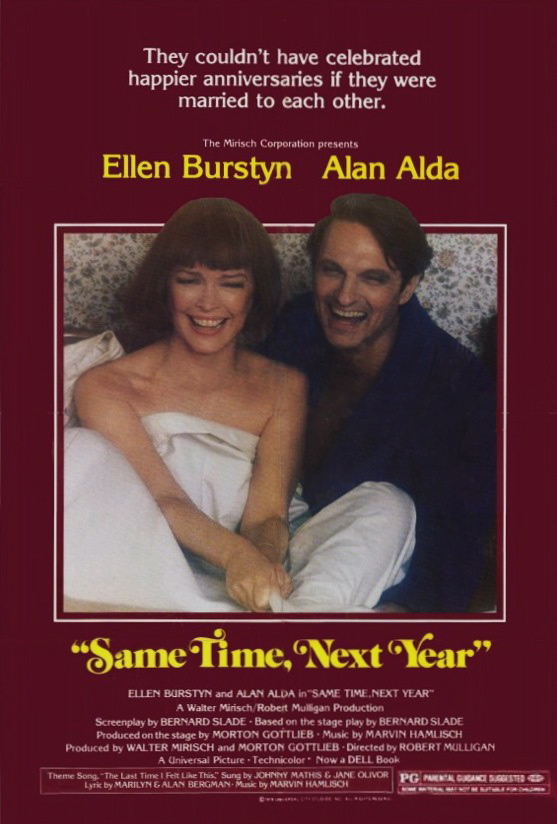
Same Time, Next Year (1978)


          A tidy romantic dramedy that’s become a staple for regional-theater revivals, Bernard Slade’s play Same Time, Next Year is built around the simple gimmick of checking in with a couple every five years over the course of the two decades in which they meet for annual adulterous trysts. Both are happily married, and we’re meant to like them because they didn’t mean to fall in love with each other during their first chance meeting, so the play gives two actors equally sized roles that are sympathetic and textured. Whether the roles are actually substantial is debatable, and the superficiality of the piece is particularly evident in the film adaptation.
          Penned by Slade with few adjustments for cinematic presentation, and directed with characteristic sensitivity by Robert Mulligan, Same Time, Next Year stars Ellen Burstyn, a holdover from the Broadway production, and Alan Alda, a replacement for the stage show’s leading man, Charles Grodin. Seen outside of the confines of a live theater, where the combination of star power and Neil Simon-esque writing probably made the play go down quite smoothly, Same Time, Next Year seems contrived and shallow, even though it’s consistently entertaining.
          Since Doris (Burstyn) and George (Alda) meet in the early ’50s and the final scene takes plays in the mid-’70s, Slade uses the characters as prisms for historical milestones: Doris goes through a hippie phase before embracing Women’s Lib, while George transitions from uptight conservatism to mind-expanding liberalism after his family is affected by the Vietnam War. Simply by virtue of how much time they spend onscreen, Doris and George emerge as (somewhat) specific individuals, but they’re also vehicles for Slade’s vanilla speechifying about the Big Issues of the ’50s, ’60s, and ’70s.
          This introduction of sociopolitical heft into the story, particularly during the second half, is helpful because the cutesy trope of Doris and George meeting for sex once a year would have lost its romantic fizz otherwise. Echoing a problem found in Simon’s work, however, Same Time, Next Year ends up in narrative limbo, neither deep enough to be meaningful nor sufficiently uproarious to be a comedy classic. It’s merely pleasant, with an endearing core of reflection and sweetness.
          That said, the piece is elevated by expert acting: Burstyn infuses the movie with femininity and warmth, illustrating the myriad ways women’s roles in American life changed in the postwar era, and Alda delivers his signature mixture of gently neurotic intellectualism and pitch-perfect comic timing. Thanks to their work and Mulligan’s careful dramaturgy, there’s enough humanity amid the slick professionalism to make this film worthwhile.

Same Time, Next Year: GROOVY

Thursday, March 22, 2012

My Name Is Nobody (1973)


          One of the best spaghetti Westerns to emerge in the latter part of the genre’s short life cycle, this strangely compelling dramedy was conceived and partially directed by the genre’s grand master, Sergio Leone. The bizarre story begins with the introduction of Jack Beauregard (Henry Fonda), an aging outlaw who wants to live out his retirement in peace and quiet. Unfortunately, Beauregard’s reputation precedes him, and young gunslingers regularly challenge him to shoot-outs. One day, Beauregard meets a mysterious young man who calls himself “Nobody” (Terence Hill).
          A lightning-fast shot and a mischievous prankster, Nobody regards Beauregard as a living legend. They share adventures together, and then Nobody says it’s his dream to see Beauregard die in a blaze of glory. (Hey, what are friends for?) Accepting that a violent death is probably his fate, Beauregard agrees to confront “The Wild Bunch,” a giant horde of 150 robbers who ride the West looking for trouble. In the movie’s outrageous finale, Beauregard and Nobody both find the destinies they seek.
          As with the best Leone movies, what makes My Name Is Nobody work is the style, not the story. Through a combination of elaborate editing, histrionic music, and mythic characterization, Leone and the picture’s credited director, Tonio Valerii, create a sense of gods walking the earth, men with gifts and problems mere mortals cannot comprehend. In Leone’s expansive worldview, the people Beauregard and Nobody kill should be grateful to enrich the outlaws’ legacies, and the West is the scroll on which the characters’ inspiring stories are being written. When this kind of hokum connects, as it does many times in this movie, the effect is intoxicating, a larger-than-life opera of bullets and testosterone.
          It helps, a lot, that regular Leone collaborator Ennio Morricone contributes one of his most demented musical scores, employing everything from cavalry charges to elegiac melodies to shrill flute solos and weird vocal shrieks. The sequences that approach surrealism—like a scene of a stilt-walker having his “legs” shot out from under him—are incredibly vivid, even though scenes like Nobody’s painstaking attempt to capture a drowning fly are merely peculiar. (With Leone, you take the bad to get the good.)
          Fonda is strong, investing his performance with a likeable flavor of world-weary bitchiness, and the vivacious Hill blends physical comedy with tough-guy heroics. Reliable supporting players including R.G. Armstrong and Geoffrey Lewis add flavor, as do a slew of Italian character actors, though the real star of the movie is actually Leone. Whether he or Valerii directed the bulk of the film is ultimately irrelevant, since this picture is unquestionably infused with Leone’s unique sensibility. More importantly, the heartfelt ending is deepened by the knowledge that My Name Is Nobody was Leone’s last major statement in a wild subgenre he dominated.

My Name Is Nobody: GROOVY

Wednesday, March 21, 2012

Don’t Play Us Cheap (1973)


After overcoming extraordinary difficulties to complete his racially charged magnum opus, Sweet Sweetback’s Baadassssss Song (1971), filmmaker Melvin Van Peebles was undoubtedly ready to tackle lighter fare, but he wasn’t about to abandon his idiosyncratic style. Originally presented as a stage play, his follow-up film Don’t Play Us Cheap explores what happens when demonic visitors try to interrupt a house party in Harlem. Van Peebles has said he was inspired to write this story by people he met in Europe whose optimism and warmth seemed unshakeable, so the idea of the piece is apparently to convey the joyous side of black life as a counterpoint to the hardship depicted in Sweetback. Unfortunately, even if the filmmaker’s intentions were good, his execution is awful. Setting aside the fact that this is more of a filmed play than an actual film, Don’t Play Us Cheap presents a tedious procession of inane dialogue, silly situations, and tepid music. The family members throwing the house party shout nearly all of their lines and punctuate conversations with foolish laughter, so Van Peebles inadvertently perpetuates some of the same racial stereotypes he tried to upend in his other work. Worse, the whole gimmick of the demonic visitors is strange and unconvincing. These characters appear in the form of devilish human-sized bats, wearing ridiculous costumes, and they declare their intentions so bluntly that one of them actually sings a number titled “I’m a Bad Character.” (Subtlety is never the watchword in Van Peebles’ movies, but still.) Predictably, the sweetness of the black family warms the hearts of the demonic visitors, prompting one of them to give an embarrassing speech about how “It’s boring being mean all the time.” The movie goes on and on and on, with Van Peebles trying to liven the visuals through the use of arty flourishes like jump cuts and superimpositions, but the storyline is so juvenile that nothing can bring it to life. The actors, including Ester Rolle of Good Times fame, do what they can, but the only moment with any mojo is Joshie Armstead’s gorgeous performance of the gospel-styled number “You Cut Up the Clothes.”

Don’t Play Us Cheap: LAME

Tuesday, March 20, 2012

Pete’s Dragon (1977)


          The last and least attempt by Walt Disney Productions to recapture the magic of Mary Poppins (1964), this bloated bore features many of the previous film’s signature elements. Like Mary Poppins, the picture combines animation with live action, features exuberant musical numbers, and showcases the bonds that form between children and their guardians. Unlike the earlier film, however, Pete’s Dragon is annoying, cutesy, dull, pandering, and unfocused. The story makes very little sense, the main special-effects gimmick is a letdown, the music is terrible, and the less said about the wall-to-wall horrible acting, the better.
          In nearly every way imaginable, this is one of the worst movies Disney released in the ’70s, even though it was among of the studio’s most expensive productions of the era. Had giant sets and legions of dancing extras been enough to compensate for an idiotic storyline, Pete’s Dragon would have been a winner. Alas, story matters, and this narrative is dumb, dumb, dumb. When the movie begins, inexplicably optimistic orphan Pete (Sean Marshall) is being chased by a group of evil rednecks, led by Lena Gogan (Shelley Winters), who “purchased” him into foster care so her family could collect government handouts. Pete evades capture with the help of his traveling companion, a dragon named Elliot (voiced by Charlie Callas). Elliot has the ability to turn invisible, so we often see only the objects he smashes into, but when he becomes visible, he’s a two-dimensional cartoon.
          One can assume (and understand) the thinking behind this aesthetic choice; in Mary Poppins and other movies, Disney put live-action characters into animated backgrounds, so why not try the reverse? In practice, however, the presentation is illogical. Since Elliot is “real,” and not a figment of Pete’s imagination, why doesn’t he have the same level of substance as everything else in the movie? And why does he communicate in grunts and mumbles that only Pete can understand? And why does he accept getting shoved into a dark cave the minute Pete finds a surrogate family in the persons of a drunken lighthouse keeper (Mickey Rooney) and his spirited daughter (Helen Reddy)? Furthermore, why does the movie introduce a con man (Jim Dale) and his assistant (Red Buttons), who want to use Elliot’s body parts for magical potions, when the story already has a villain in the underused Winters character? And why, oh why, are the songs so grating and repetitive, like the cringe-inducing “Boo Bop Bopbop Bop (I Love You, Too)”?
          Good luck solving any of these mysteries, or figuring out why this interminable cinematic leviathan received two Oscar nominations (for the music!), or discerning how Pete’s Dragon earned a respectable $36 million at the box office during 1977 before grossing an additional $4 million when it was re-released (in a shorter version) in 1984. Turning Pete’s Dragon into an Oscar-nominated financial success? Now, that’s Disney magic.

Pete’s Dragon: LAME

Monday, March 19, 2012

The Abonimable Dr. Phibes (1971) & Dr. Phibes Rises Again (1972)


          One of the most stylish horror movies of the ’70s, The Abominable Dr. Phibes combines an outlandish storyline with divine art direction and a wickedly funny star turn. Vincent Price, perfectly threading the needle between camp and fright, plays Dr. Anton Phibes, a ghoulish genius preying upon 1920s London. Some years ago, his wife died on the operating table during emergency surgery, and Phibes himself was severely injured in a car accident while racing to her side. Presumed dead and hiding in an underground lair, Phibes methodically murders members of his wife’s medical team, basing his killings on plagues from the Old Testament. For example, the victim of the “plague of frogs” is tricked into donning an ornate frog mask for a costume party, unaware that the mask is designed to tighten until the wearer’s skull is crushed.
          Much of the action surrounds the last man on Phibes’ kill list, chief surgeon Dr. Vesalius (Joseph Cotten), and the bumbling English cops assigned to protect him. However, the real fun is watching Phibes float through his surreal existence. Accompanied only by a mute assistant, the opulently costumed beauty Vulnavia (Virginia North), Phibes occupies a fortress that’s a cross between a theater and a throne room. His figure swathed in long robes, Phibes plays classical music and silly Tin Pan Alley tunes on a giant pipe organ, accompanied by a group of animatronic musicians identified as “Dr. Phibes’ Clockwork Wizards.” Left speechless by his injuries, Phibes communicates through a tube extending from his neck to a speaker, so Price gets to pull faces while his unmistakable voice reverberates on the soundtrack.
          Surrounding this eccentric protagonist is resplendent imagery created by director Robert Fuest. Whether he’s forming arch compositions with a masked Phibes in profile—or meticulously depicting how Phibes kills victims with bats, locusts, rats, and the like—Fuest treats every shot like an art project, giving the piece a rarified air that amusingly contrasts the lowbrow narrative. Brisk, funny, and completely strange, The Abominable Dr. Phibes is truly one of a kind.
          The rushed sequel, Dr. Phibes Rises Again, benefits from the return of key players Fuest and Price, but it’s less compelling than its predecessor. Without spoiling the wonderful ending of the first film, suffice to say that bringing Phibes back requires some fancy narrative footwork. Unfortunately, neither the method of Phibes’ revival nor the reason for his return is persuasive.
          Furthermore, the storyline of Dr. Phibes Rises Again is confusing and convoluted. Phibes and a mysterious explorer named Biederbeck (Robert Quarry) travel to Egypt in search of a mythical river supposedly capable of bringing the dead back to life. Phibes resumes committing elaborate murders, though his motivation is rather thin—a group of people snatched a scroll from the good doctor’s safe. Meanwhile, the inept policemen from the first movie join the hunt when they realize Phibes is back. Although Fuest’s imagery is just as kicky the second time around, the slipshod storyline disappointingly transforms Price’s character from a heartbroken romantic to a bloodthirsty bogeyman.
          Still, the sequel has wry flourishes, like the bit in which Phibes feeds a forkful of fish into his neck, “chokes,” and then retrieves a piece of bone. It seems Price had fun playing the character, and his enjoyment is contagious. Costar Quarry, known for the Count Yorga movies, unwisely plays the material straight, though he summons pathos in the climax. Horror icon Peter Cushing is wasted in a minor role, while starlets Fiona Lewis (as Biderbeck’s lover) and Valli Kemp (taking over the silent role of Vulnavia) provide attractive decoration. FYI, actors Hugh Griffith and Terry-Thomas appear in both Phibes movies, but they play different characters, adding to the murky quality of the sequel.

The Abonimable Dr. Phibes: GROOVY
Dr. Phibes Rises Again: FUNKY

Sunday, March 18, 2012

Mary, Queen of Scots (1971)


          A dense historical drama bursting with sex, treachery, and violence, Mary, Queen of Scots features enough narrative for a miniseries, so viewers not already versed in the backstory of the British royal family (myself included) might have difficulty grasping all of the picture’s nuances. That said, the broad strokes are (relatively) simple. In the year 1560, 18-year-old Mary Stuart (Vanessa Redgrave) ascends to the French throne after the death of her husband, the Gallic monarch. Stuart is also, by birthright, the queen of Scotland. Advisors send Mary to Scotland as a means of ensuring her security (female leaders were perpetually under threat in Mary’s era), but Mary’s return to Scotland alarms her cousin, England’s Queen Elizabeth I (Glenda Jackson).
          A fervent Protestant, Elizabeth recognizes that Mary’s potential claim to the English throne could make her a rallying point for Catholic factions looking to reclaim power over the British Empire. Before long, the respective queens are locked in mortal battle. Others caught in the palace intrigue include Mary’s ambitious brother, James Stuart (Patrick McGoohan), who believes he can manipulate his sister and claim Scotland for himself; David Riccio (Ian Holm), a clever representative of the Vatican who aids Mary; and Lord Damley (Timothy Dalton), an aristocrat sent by Elizabeth to tempt Mary into a marriage with political advantages for Elizabeth.
          It’s quite a lot to follow, though the principal focus is the contrast between the two queens: Elizabeth is a master strategist who remains unwed lest a husband diminish her stature, whereas Mary is a naïve optimist who tumbles into impetuous romances until time and tragedy make her wise.
          The leading performances are impeccable. Jackson rips through dialogue with wicked glee, adroitly illustrating how Elizabeth had to be smarter than every man around her simply to survive, and yet Jackson also shows intense undercurrents of longing and rage; though onscreen for less time than Redgrave, Jackson commands the picture with a deeply textured performance. Redgrave gradually introduces layers of complexity behind her luminous beauty, succinctly demonstrating the maturation of a woman in impossible circumstances. As for the men surrounding these powerful actresses, they’re a mixed bag. Dalton and Holm play their arch roles well, though each succumbs to florid excesses. McGoohan is quietly insistent in his vaguely villainous role, and Nigel Davenport (as Mary’s protector, Lord Bothwell) gives a virile turn marked by equal amounts of bluster and bravery.
          The film looks fantastic, with immaculate costumes and sets creating a vivid sense of the story’s 16th-century milieu, and composer John Barry anchors key moments with a typically lush musical score. Mary, Queen of Scots may be too arcane for casual viewers—it’s not as accessible, for instance, as the ’60s royal dramas The Lion in Winter and A Man for All Seasons—and clarity suffers because the movie barrels through so many eventful decades. But as a showcase for great acting and as an introduction to an amazing historical figure, it’s well worth examining.

Mary, Queen of Scots: GROOVY

Saturday, March 17, 2012

Pancho Villa (1972)


To say this adventure about notorious Mexican outlaw Pancho Villa gets off to a strange start is an understatement: The first scene features an imprisoned Villa getting his head shaved by gringo jailors, after which Villa savors his newly bald pate. The problem? In real life, Villa had a healthy head of hair, so, apparently, the sole purpose of filming this scene was justifying the casting of Greek-descended New Yorker Telly Savalas in the lead role. It’s no surprise Savalas was unwilling to wear a wig for his performance, since he also chose to deliver lines with his customary dese-dem-dose inflection, to preen in dandyish clothes, and to periodically giggle with the same playful malice he once brought to his role as a Bond villain. Yet the strangeness of Pancho Villa doesn’t end with Savalas’ wildly inappropriate interpretation of the title character. Later, one of Villa’s gringo adversaries, a deranged U.S. soldier played by Chuck Connors, drives his men crazy with orders to shoot and kill a fly that’s buzzing around a mess hall—while comedic music straight out of a Mack Sennett one-reeler grinds on the soundtrack. Pancho Villa is peculiar from top to bottom, waffling back and forth between high-action scenes and idiotic comedy bits. The storyline has something to do with Villa committing crimes to raise money for his revolutionary endeavors, but Villa disappears for long stretches of the movie. During these bland sequences the movie focuses on Villa’s gringo lieutenant, Scotty, who is played by amiable giant Clint Walker, the six-foot-six TV and movie actor best known for the ’50s series Cheyenne. While some of the movie’s antics are funny, like the weird vignette in which Villa believes he’s having a heart attack until he realizes a small lizard has crept into his undershirt, the movie spends so much time meandering through inconsequential silliness that it’s impossible to detect any sense of drama or momentum.

Pancho Villa: LAME

Friday, March 16, 2012

The Laughing Policeman (1973)


          Long on atmosphere but short on coherence, this ultra-American thriller was, oddly, based on a Swedish novel. Despite its foreign origins, The Laughing Policeman is one of the most persuasive police procedurals made for the big screen in the ’70s, putting across a palpable sense of realism as it depicts badge-wielding working stiffs trying to sort out the mess of a complex murder investigation. The story ultimately spirals into confusion—an argument could be made that the filmmakers tried to achieve verisimilitude, leaving the audience as confounded as the characters—but even if the destination isn’t particularly worthwhile, the journey is engrossing.
          Set in San Francisco, the picture begins with a horrific assault, when a mysterious assailant whips out a grease gun on a crowded city bus and annihilates all the passengers, including an off-duty cop. The dead policeman’s partner, taciturn detective Jake Martin (Walter Matthau), takes the lead on the investigation but shares very few of his discoveries with his replacement partner, hotshot Leo Larsen (Bruce Dern), or his irritable commanding officer, Lt. Steiner (Anthony Zerbe). Part of the reason Martin plays his cards so close to the vest is that he learns unsavory facts about his late partner, like the kinky aspects of the dead cop’s romance with a young woman (Cathy Lee Crosby), and part of the reason is because Martin senses a connection between the current crime and an unsolved case from the past.
          Director Stuart Rosenberg, a TV-trained helmer whose eclectic résumé includes the macho melodrama Cool Hand Luke (1967), shoots the hell out of scenes featuring Martin and his fellow cops pounding the San Fran pavement to shake underworld sources for clues. Rosenberg and cinematographer David M. Walsh use long lenses to surround characters with evocative details, and they drape nighttime sequences in a soft haze that suggests salty air drifting off the Bay. Every scene feels like it’s happening in a genuine place, and Rosenberg lets his actors perform in a loose style that feels improvisational; this method generates fantastic moments between motor-mouthed Dern and tight-lipped Matthau, like a vivid throwaway scene in which they rest after ascending an epic flight of stairs.
          Matthau is memorably belligerent and terse, while Dern, seizing the opportunity of his first above-the-title role in a studio picture, loads every line with energy and meaning. In addition to the colorful actors playing the cops (Louis Gossett Jr. rounds out the principal cast with an intense performance as a hot-headed detective), The Laughing Policeman showcases a cavalcade of eclectic bit players, essaying the various gamblers and informants and pimps who permeate the underworld the cops must troll for leads.

The Laughing Policeman: GROOVY