Monday, September 12, 2016

Mr. Ricco (1975)


          It’s not wrong to describe Mr. Ricco as disposable escapism featuring a past-his-prime star pandering to cinematic fashion by appearing in a gritty urban thriller with more than a little Dirty Harry in its DNA. And, indeed, very little about Mr. Ricco or leading man Dean Martin’s performance will linger in your memory after you watch the picture. So whether or not you dig this flick depends almost entirely on your appetite for that quintessential ’70s-cinema vibe. Shot in slick widescreen on dingy and glamorous locations throughout San Francisco, Mr. Ricco has a hip attitude, a jangly jazz score, lively supporting performances, plenty of violence, and a smidgen of sarcasm thanks to the title character’s wiseass dialogue. If you go for this sort of thing, you’ll devour Mr. Ricco like a hearty serving of comfort food. If not, you’ll likely—and understandably—dismiss the picture as soulless Hollywood product.
          Martin plays a defense lawyer named Joe Ricco, and the filmmakers embellish the title role with colorful flourishes. Joe’s a smooth-talking widower whose friendships with cops blur ethical boundaries, he cheats at golf, and he tolerates all the weed his young associates smoke while doing legal research, because, hey, live and let live. When the story begins, Joe gets black radical Frankie Steele (Thalmus Rasulala) acquitted on murder charges, earning adoration from the counterculture and enmity from the Establishment. After two cops are killed, Frankie emerges as Suspect No. 1, so Joe gets pulled into dual intrigue—even as he investigates whether Frankie’s really guilty, he tries to track the fugitive down before trigger-happy police find him. Notwithstanding a few subplots, the most important of which involves a mystery figure who might or might not be Frankie trying to kill Joe at regular intervals, that’s basically the plot. What Mr. Ricco offers beyond its serviceable narrative is vivacity. Future sitcom star Cindy Williams appears briefly as Joe’s spunky secretary, and future Miami Vice guy Philip Michael Thomas plays a suspect whose sister hires Joe. Reliable character actor John Quade turns up in a couple of scenes as a grinning pimp. Oh, and Frankie leads an underground group called the Black Serpents. You get the idea.
          Director Paul Bogart doesn’t drench every scene in style, but he uses well-chosen actors and locations to create a world that feels coherent, if not necessarily realistic. Accordingly, all the menacing and posturing and scheming in this movie goes down smoothly, particularly when the nocturnal, small-combo syncopation of Chico Hamilton’s score enlivens the images. Plus, every so often, the picture embraces its own cartoonishness, as in this monologue from Joe’s police-captain friend George, played with gritted-teeth crankiness by Eugene Roche: “I don’t need you to tell me my job. I’ve been doing it for 20 years—20 years of being shot at and beat up on by sick, filthy creeps whose own mothers would’ve flushed ’em down the toilet if they’d known how they were gonna turn out!”

Mr. Ricco: GROOVY

Sunday, September 11, 2016

The Naughty Stewardesses (1974) & Blazing Stewardesses (1975)


          Exploitation-flick hack Al Adamson brings the Mile High Club crashing to the ground with these awful movies about horny flight attendants. Styled after Roger Corman’s sexy-nurse movies of the early ’70s, The Naughty Stewardesses is a melodrama concerning several friends who score in the air and on the ground. The heroine is Debbie (Connie Hoffman), a nice girl from a small town who’s shocked by her big-city friends’ sexual antics. In a party scene, she recoils when a pal is presented with a man covered in frosting and candles like he’s a birthday cake, then proceeds to, ahem, blow out the candles in full view of party guests. Yet Debbie’s no prude, because when she falls for a photographer named Cal (Richard Smedley), she poses nude during a portrait session. “I feel so free,” she coos. “Perhaps by taking off my clothes, I took off my mask, too.” Oy.
          Things get complicated when Debbie accepts an invitation from an older man, Brewster (Robert Livingston), to visit his pad in Palm Springs. He’s a randy old goat, and he eventually sleeps with most of the stewardesses in the story, even getting one compliant gal to test out an elaborate sex gadget called a “Persian Penguin.” The movie jumps erratically between incompatible storylines and tonalities all the way to a pointlessly violent climax. Yet parts of The Naughty Stewardesses are strangely compelling simply because scenes go on forever. That said,  the picture’s magnetism is strictly of the traffic-accident variety. Still, Hoffman is quite lovely, even though she can’t act, so Adamson might have been able to make something luridly enjoyable from this material if he’d cut this picture down from 102 sluggish minutes to, say, 80 zippy ones.
          Blazing Stewardesses is even worse. Although the sequel features some of the same actors playing some of the same characters, the movie is largely unrelated to its predecessor. Conceived as an homage/spoof of old Western movies, the picture takes part of its title from Mel Brooks’ Blazing Saddles (1974), and the sexy-stewardess stuff shares screen time with nonsense about a frontier madam, a noble rancher, and villains on horseback. Making Blazing Stewardesses even more disjointed is the presence of past-their-prime comedy duo the Ritz Brothers, who contribute lots of embarrassing facial expressions and stale patter. At one point, costar Yvonne De Carlo, playing the madam, stops the movie dead to warble a corny song. Blazing Stewardesses is such an overstuffed mess that the stewardesses don’t spend much time blazing, so this wannabe sex comedy has a dangerously low sex quotient. Hoffman underwhelms once more, though her beauty remains arresting, but costar Regina Carrol, playing Debbie’s busty friend, gives a performance so awful, thanks to childish vocal delivery and lobotomized facial expressions, that her scenes are unwatchable. As for the overall movie, Blazing Stewardesses is so dumb that an unfunny joke about the Ritz Brothers eating a giant sandwich gets repeated as the closing gag.

Naughty Stewardesses: LAME
Blazing Stewardesses: SQUARE

Saturday, September 10, 2016

The Ballad of Billie Blue (1972)


The sort of religious picture that gives religious pictures a bad name, The Ballad of Billie Blue tells the fictional story of a pop singer who descends into a spiral of booze, ego, and violence, only to be saved by a preacher who brings the gospel to a prison work farm. According to movies like The Ballad of Billie Blue, the world outside the Christian faith is a hornet’s nest of avarice, cruelty, and lust, but the moment a fallen soul trades the secular for the sacred, all is forgiven and trouble becomes a thing of the past. That this message is delivered by way of atrocious acting and bargain-basement dramaturgy makes the whole enterprise even less appealing. Some Christian viewers may find The Ballad of Billie Blue palatable simply because of the subject matter, but others will likely find it intolerable, unless they approach The Ballad of Billie Blue as an unintentional comedy. Billie (Jason Ledger) is already famous when the movie starts, so the drama during the first half of the picture stems from his conflicts with a craven manager (Ray Danton), an opportunistic journalist (Marty Allen), and an unfaithful wife (Sherry Miles). Billie gets drunk in a bar one night and punches the journalist, who then blackmails the singer to get exclusive, unfettered access to Billie’s life. Meanwhile, the manager and the shrewish wife have an affair. When the wife kills the manager during a fight, Billie takes the fall for her, and the journalist is only too happy to bury the singer with bad press. Once in jail, Billie bonds with hot-headed convict Justin (Erik Estrada) until traveling preacher Bob (Robert Plekker) arrives with homilies about “a Jesus kind of love” and God’s “life assurance plan.” Blah, blah, blah. Among the awful cast, Miles stands out by giving a truly hideous performance comprising uncertain line readings delivered at top volume, while Allen nearly matches her ineptitude. Danton and Leger are serviceable at best, and it says a lot that Estrada does the best work of the whole bunch.

The Ballad of Billie Blue: LAME

Friday, September 9, 2016

Rain for a Dusty Summer (1971)


A clumsy retelling of historical events that were previously dramatized by director John Ford in The Fugitive (1947), this low-budget melodrama begins with the crazed ruler of a Mexican state declaring war on the Catholic Church, then tracks the journey of the last priest to evade the strongman’s grasp. Despite telling an interesting story full of intense sociopolitical themes, Rain for a Dusty Summer—also known as Guns of the Revolution—doesn’t work. The first problem stems from misleading credits, since Ernest Borgnine has top billing for his role as the brutal dictator. Borgnine appears in the movie so fleetingly that it seems as if he shot all of his material in an afternoon. (Adding to the forgettable nature of his appearance, Borgnine’s weak attempt at a Spanish accent comprises little more than pronouncing the name of his character’s country as “Me-hee-co.”) The next big problem involves tone. Scenes depicting the priest’s adventures as he moves from one hiding place to another are gentle and lighthearted, complete with chipper music that would seem appropriate accompanying circus performances. The dissonance between serious subject matter and silly style destroys the film’s credibility. Accordingly, whenever the filmmakers try to get heavy, as during the downbeat final scene, it’s as if they're rebooting the movie while it's still underway. And while Humberto Almazán is okay in the leading role—affable in a Disney-flick sort of way—his lack of dimensionality derails any efforts to render narrative complexity. In fact, it’s easier to list the many things Rain for a Dusty Summer lacks—among them a compelling secondary villain and a viable sense of urgency—than to identify praiseworthy elements. That’s why it’s probably best to stick with the Ford version of this worthwhile material, or to wait for someone else to tackle the story in the future.

Rain for a Dusty Summer: LAME

Thursday, September 8, 2016

Master of the Flying Guillotine (1976)


          Essentially an ultraviolent cartoon, this Quentin Tarantino favorite exaggerates beloved tropes of martial-arts cinema to a ridiculous degree. The title character, for instance, is a blind teacher who travels feudal China on a vengeance mission, and his chosen weapon is the “flying guillotine.” Picture a hatbox that accordions out when snapped into place atop a target’s head. The blind teacher launches the weapon from long distances, and then yanks the chain that’s attached to the device in order to spring the trap. The victim is decapitated instantly, with the head delivered to the blind teacher when he retracts the chain. All patently impossible, of course, but that’s the spirit of this movie. Master of the Flying Guillotine is entertaining in a manic and perverse sort of way, but it’s not to be taken seriously.
          Interestingly, Master of the Flying Guillotine is the rare sequel that has achieved more notoriety than the original film from which it was derived. That would be One Armed Boxer (1971), released in the U.S. in 1973 as The Chinese Professionals. Both pictures star and were written and directed by Taiwan’s Jimmy Wang Yu. In the first picture, a character known as One-Armed Boxer (Yu) killed disciples of a martial-arts school. In Master of the Flying Guillotine, the disciples’ teacher, Sheng Wu Chi (Kam Kong), seeks payback. Learning of a national martial-arts competition, Sheng travels to the site of the contest and systematically kills every one-armed martial artist he encounters until squaring off with One-Armed Boxer during the epic finale. As should be obvious, the plot is so thin it can barely sustain an entire movie, and, sure enough, Master of the Flying Guillotine loses the thread partway through.
          A good 30 minutes of the picture depict the competition, with one outlandish matchup after another, while the narrative treads water. Yet this storytelling gambit sorta-kinda works, simply because the battle scenes are outrageous. One fighter magically extends his forearms until they’re as long as spears. A brawl takes place with the combatants balancing on poles that rise above a field of sharp metal blades, so the first guy to fall gets perforated. In an unrelated but similarly silly scene, One-Armed Boxer impresses the students at a martial-arts academy by demonstrating his ability to climb walls and walk on ceilings, as if he’s Spider-Man. Perhaps the loopiest moment in Master of the Flying Guillotine is the scene where Sheng detects a one-armed man in a bar, unleashes his weapon, and lops off the schmuck’s head—without triggering more than a few raised eyebrows from onlookers.

Master of the Flying Guillotine: FUNKY

Wednesday, September 7, 2016

Bittersweet Love (1976)


           This offbeat melodrama dramatizes the repercussions of accidental incest. Directed by journeyman helmer David Miller, the picture is competent and even rather sensitive, benefiting from sincere leading performances by Meredith Baxter-Birney and Scott Hylands as lovers who discover they’re siblings. (Don’t be fooled by Lana Turner’s top billing, since she has an important but secondary role.) The question, of course, is whether the world needed a story about incest, since it’s not as if the circumstances portrayed in the narrative reflect some recurring social problem. Quite to the contrary, the filmmakers twist themselves in knots to contrive a situation resulting in a brother unknowingly marrying his own sister.
          Anyway, architect Michael (Hylands) has a meet-cute with single girl Patricia (Baxter-Birney). They fall in love quickly, arranging to wed in Canada at the home of Michael’s parents, Howard (Robert Lansing) and Marian (Celeste Holm). All the while, Patricia’s wealthy parents, Ben (Robert Alda) and Claire (Turner), are traveling overseas. Eventually, the newlyweds visit Ben and Claire with photos from their nuptials, and Claire recoils when she sees a photo of Howard. Turns out she had an affair with him while she was courting Ben, and she never told Ben their daughter was fathered by another man. She never informed Howard, either. That is, until she calls him up for a meeting and shares the sordid news. Adding urgency to the whole business is the revelation that Patricia has become pregnant. How can Claire tell Ben of her infidelity? How can both sets of parents break their children’s hearts? What will Patricia do about the baby? You get the idea.
          Even though the premise of the movie is contrived, the rest of Bittersweet Love is reasonable. The way that Claire’s secret is revealed to characters one at a time makes sense, while also creating opportunities to experience different types of shocked reactions. Howard, who hadn’t yet met his wife when he slept with Claire, responds with pragmatism and sadness, his loved ones the victims of Claire’s duplicity. Ben, conversely, reacts with the pain of betrayal. As for Michael and Patricia, their reactions comprise most of the film’s content, and it’s interesting to see how the choices the filmmakers make about who accepts and who rejects the new reality parallel traditional gender roles. One could even go so far as to say that a few grains of truth find their way into the overheated soup of the film’s various emotional confrontations.

Bittersweet Love: FUNKY

Tuesday, September 6, 2016

Derby (1971)


          At its best, the cinema-veritĂ© style of documentary filmmaking gave the world such valuable artifacts as Grey Gardens (1975), which presents the activities of fringe-dwelling eccentrics without judgmental commentary. Yet every cinematic style creates problems when taken to extremes, and the shortcomings of veritĂ© become evident while watching Derby, which is about roller derby. Since the film lacks narration or any other form of context, the parallel storylines about an aspirant and a successful player don’t connect as strongly as they should. In the aspirant storyline, wannabe Mike Snell comes across as a fool willing to quit his factory job in order to try his luck at a sport he’s never attempted, even though he has a wife and children to support. Does he have potential? Are his exploits meant to be a cautionary tale about recklessness, or an inspirational saga about following one’s dreams? Director Robert Kaylor and his collaborators withhold so much information that we don’t even know if Snell makes it to training camp, much less professional competition.
          The scenes with derby professional Charlie O’Connell are more informative, simply because O’Connell is a motor-mouthed braggart, but again the lack of context is problematic—did the filmmakers elect to follow him because he’s typical or unique? Viewers can’t even discern whether O’Connell is as talented as he proclaims, since vignettes displaying action during games move so quickly that it’s hard to tell who’s skating at any given moment. Seemingly random cuts back and forth between women’s and men’s games exacerbate the murkiness. Oh, well.
          Viewers who accept that Derby doesn’t answer its own questions can still find interesting things to watch. The sports-action scenes are photographed in an exciting way, with the camera moving at top speed alongside the players to catch every brawl, crash, and high-velocity knockdown. A clear picture is painted of fans demanding and rewarding violence, so there’s a quiet statement about the dark side of the American character. Similarly, the Snell scenes tell a grim story about the lives of uneducated laborers. For lack of a more gentle term, Mike and his intimates seem like white trash, especially when Mike’s wife and one of her gal pals hector a neighbor lady with accusations of being a slut. Today, entire reality-show franchises rest on the shoulders of people like the Snells—but it’s hard to figure out what slovenly housekeeping and vulgar tirades have to do with roller derby.

Derby: FUNKY

Monday, September 5, 2016

Been Down So Long It Looks Like Up to Me (1971)


          Based on the only novel by folksinger Richard Fariña, Been Down So Long It Looks Like Up to Me takes place in 1958, so by definition it was already a museum piece upon its release. That said, the film’s narrative has parallels to the fraught climate on America’s college campuses circa the early ’70s, so it’s not difficult to see why producers thought the picture might curry favor. Alas, the movie is aimless, episodic, and thematically murky, tracking the adventures of a young iconoclast while he bounces through friendships, clashes with administrators, a stormy romance, and finally an excursion to Cuba. Complicating matters is the participation of leading man Barry Primus. Although he handles the film's tasty period dialogue well, he was already in his thirties when he made the picture, so he's badly miscast. However, if these remarks give the impression that Been Down So Long It Looks Like Up to Me is a complete misfire, that's not the case. Better to say it's a frustrating movie infused with intelligence and a muddled sort of purpose.
          The picture revolves around freethinking Gnossos “Paps” Pappadopoulis (Primus), recently returned to campus after a disappearing act that left some of his friends convinced he was dead. Our first introduction to the character conveys his weird combination of cleverness, insouciance, and self-involvement: While chatting up an Englishwoman with a room for let, he fakes a British accent as a means of lowering her defenses so he can get laid. Throughout the movie, he uses his considerable intellectual and verbal gifts to achieve various goals, some praiseworthy and some not. At his best, he forces a friend to acknowledge the danger of joining a group of revolutionaries in Cuba, and at his worst, he treats a woman contemptuously for having the temerity to find something other than his obnoxious monologues interesting. There's also some business about the protagonist’s relationship with a drug dealer, though how that fits into the overall thematic mix isn't especially clear.
          In lieu of a properly shaped storyline, the movie has idiosyncratic flavor, as well as the aforementioned happenin' lingo, so the thing lurches forward in fits and starts, with some scenes providing a gentle kick while others merely come and go without leaving an impression. By the end of the flick, most viewers will have had their fill, and then some, of the lead character’s smug speechifying, seeing as how his primary goals appear to be gratifying his ego and satiating his somewhat indiscriminate lust. Are a few moments of amusement, some colorful patois, and a glimpse at the early days of collegiate freethinking reason enough to soldier through equal measures of consequential and inconsequential scenes all the way to the needlessly grim ending? Depends.

Been Down So Long It Looks Like Up to Me: FUNKY

Sunday, September 4, 2016

Wolf Lake (1979)


          Shamelessly borrowing elements from Deliverance (1972), Joe (1970), and Straw Dogs (1971), this violent melodrama pits a Vietnam-era deserter against an unhinged Gold Star parent, with various innocent bystanders caught in the crossfire. As written and directed by Burt Kennedy, a solid helmer of midgrade action pictures, Wolf Lake unspools smoothly, with every scene focused, purposeful, and tight. Plus, with Rod Steiger giving a relatively contained performance as the deranged dad, the movie’s intensity level never falters, even during the many, many passages when logic falls victim to narrative expediency. The plotting of Wolf Lake is similar to that of a typical horror movie, and like many films in that genre, the whole premise hinges on someone remaining in a dangerous place despite being fully aware of the danger. Which brings up interesting questions regarding what sort of thrill Wolf Lake is meant to provide viewers. The story is too far-fetched to work as social commentary, and it’s too nasty to qualify as escapism, so watching Wolf Lake requires the viewer to revel in the suffering of others. The picture is made with enough skill that it cannot be dismissed, but at the same time, it’s creepy to imagine that Kennedy and his collaborators envisioned 90 minutes of rape and murder as a fun night at the movies.
          Set in Canada circa 1976, the story opens with Charlie (Steiger) and his WWII buddies arriving at a hunting lodge for a getaway. The regular caretaker is away, so shaggy-haired twentysomething David (David Huffman) and his girlfriend, Linda (Robin Mattson), are looking after the place. Once it comes out that David deserted his Army unit, Charlie becomes enraged, because his own son died in Vietnam. Charlie tells David that he plans to kill him, but Charlie inexplicably remains until the inevitable violence explodes. First Charlie goads his men into gang-raping Linda, and then David fights back, leading to a war of attrition that leaves bodies everywhere. Kennedy’s strangest storytelling choice involves peppering the first half of the movie with flash-forwards of bloody finale. While presumably meant to juice tension, these flashes have the opposite effect, removing any mystery about what happens next. On the plus side, Kennedy manages other storytelling tasks well. In addition to staging action expertly, Kennedy keeps Steiger on a tight leash until it’s time to let the chronic overactor loose. Among the so-so supporting cast, Jerry Hardin stands out as the story’s requisite spineless toady.

Wolf Lake: FUNKY

Saturday, September 3, 2016

The Legend of Nigger Charley (1972) & The Soul of Nigger Charley (1973)


          If you watch enough Fred Williamson movies, you begin to forget how potent he was in his prime, simply because so many of the pictures that he produced and/or directed himself are unspeakably bad. That’s the context for my experience of The Legend of Nigger Charley, a decent B-picture likely consigned to obscurity because of its title. As directed by Martin Goldman, the film has a familiar storyline and a serviceable vibe, so it neither breaks new ground nor soars with artistry. That said, it has a bit of an edge, because the protagonist is a slave who becomes a folk hero by killing the white man who callously destroyed the slave’s emancipation papers. Circumstances transform the slave into a gunslinger, and he inspires awe from frontier types who’ve never seen a black man control of his own destiny.
          The picture opens in Africa, with punchy black-and-white scenes showing a baby and his family being ripped from their ancestral home amid a flurry of bloodshed. Cut to twentysomething years later, and the baby has grown into Charley (Williamson), a muscular blacksmith working on a Southern plantation. The plantation’s dying master offers to grant his favorite slave, Theo (Gertrude Jeannette), her freedom, but she asks for the favor to be given to her son, Charley, instead. Before Charley can leave, he gets into a quarrel with the master’s heir, leading to the man’s death. That’s how Charley becomes a fugitive, and he takes his friend, house slave Toby (D’Urville Martin), with him. Eventually, their gang grows in size and stature until they’re hired by farmers to protect them from an evil preacher who runs a protection racket.
          Not only does the movie’s narrative get fuzzy soon after Charley leaves the plantation—every act has a new villain, and the story never pays off threads from the vibrant opening scenes—but the wandering-avenger theme is trite. By the end of the picture, the Charley character has become so generic he could be played by, say, Lee Van Cleef. Yet every so often, the folks behind The Legend of Nigger Charley remember what makes this material unique, so, for instance, there’s a terrific scene with an old eccentric named Shadow (Thomas Anderson), who storms into a bar where Charley’s gang is under siege just so he can say he’s seen everything.
          The Soul of Nigger Charley has a less episodic script than the first picture, and it benefits from polished elements including Don Costa’s robust orchestral score. Alas, the sequel gets bogged down in routine Western-movie tropes. Charley and Toby (again played by Williamson and Martin) stumble across a town where a slaughter was committed by vicious ex-solider Colonel Blanchard (Kevin Hagen) and his criminal gang. Later, when Charley and Toby meet survivors of Blanchard’s racially driven crime spree, Charley and Toby form an all-black militia and conspire to hit Blanchard where it hurts—by beating him to the train Blanchard plans to rob of $100,000 in gold.
          The first part of the picture, during which Charley builds a surrogate family of ex-slaves trying to get by in a white world, anticipates plot devices later used by Clint Eastwood in The Outlaw Josey Wales (1976). Yet once The Soul of Nigger Charley shifts into heist mode, the lead character morphs from a righteous crusader to a run-of-the-mill outlaw. (Larry G. Spangler, who produced and co-wrote both Nigger Charley pictures but only directed the sequel, was truly gifted at squandering the franchise’s potential.) Notwithstanding its flaws, The Soul of Nigger Charley is enjoyable enough to watch because it hits all the expected notes. Williamson flexes and kills and smirks, leading lady Denise Nicholas complements her sex appeal with gravitas, and the action scenes have scope.
          Two last items worth mentioning: Williamson’s similarly titled 1975 flick Boss Nigger is unrelated to this films, and all three Williamson pictures with n-word monikers were likely among the inspirations for Quentin Tarantino’s slave-turned-gunslinger hit Django Unchained (2012).

The Legend of Nigger Charley: FUNKY
The Soul of Nigger Charley: FUNKY

Friday, September 2, 2016

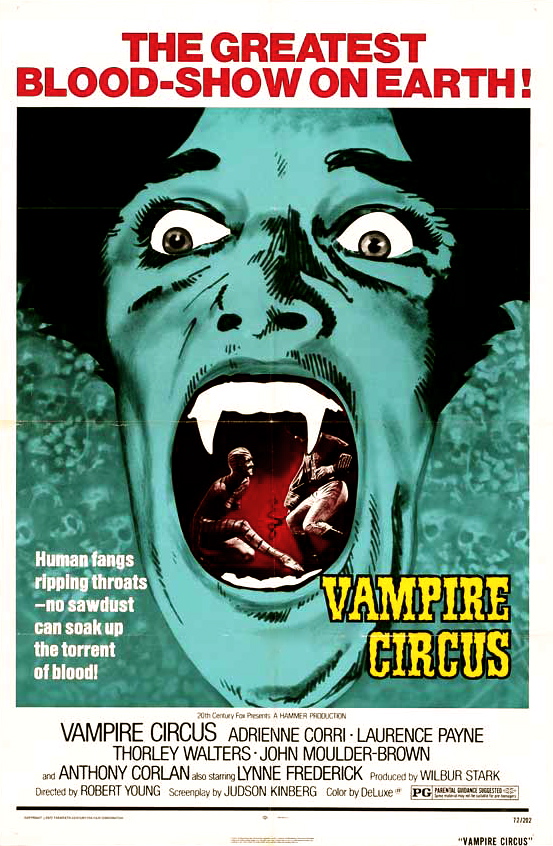
Vampire Circus (1972)


          Among the last period pieces that England’s Hammer Film Productions made during their celebrated original run of Gothic-horror flicks, Vampire Circus offers a humorless onslaught of nudity, sex, and violence. However, the best Hammer pictures have a little something extra, whether it's the swashbuckling energy of the early Lee-Cushing adventures or the brazen sexiness of, say, the so-called “Karnstein Trilogy.” To be clear, Vampire Circus has energy to burn, thanks to a veritable explosion of frenetic onscreen activity—this lurid film has everything from acrobatics to erotic dancing to outrageous gore. What it doesn’t have is distinctive characters or a memorable storyline. By stuffing in so many different elements, up to and including people who shape-shift into various animals, Vampire Circus ends up being tiresome. Voracious horror fans may enjoy consuming this picture like the fare at an all-you-can-eat buffet, but mere mortals will get their fill quickly.
          Set in 19th-century Austria, the movie starts in an appropriately sensational fashion. Villagers storm the castle where an aristocratic bloodsucker has taken a sexy local girl for a lover. With his dying breath, the vampire curses the villagers. Fifteen years later, a circus comes to town, and mayhem ensues, because the gypsies operating the circus are supernatural monsters and their mortal thralls. It’s the count’s curse coming true. Some scenes in Vampire Circus are almost hypnotically weird, notably the vignette of a sexy dance involving a bald woman who is nude except for tiger-stripe body paint. Other scenes are almost comically grotesque, including one bit with dead children and another during which various animals are slaughtered. None of it adds up to much, although fans craving lizard-brain stimulation can savor lengthy views at nubile female flesh as well as lingering looks at blood and viscera. And while the cast lacks big names, the actor playing the circus strongman is David Prowse, best known for appearing onscreen in A Clockwork Orange (1971) and for inhabiting Darth Vader’s costume in the first three Star Wars movies.

Vampire Circus: FUNKY

Thursday, September 1, 2016

Mysteries from Beyond Earth (1975)


          Let’s assume for a moment that you’ve been deprived the joys of ’70s pseudoscience documentaries, either because you weren’t alive at the time these oddities played in theaters or because your investigations into ’70s cinema haven’t taken you down this particular rabbit hole. Consider Mysteries from Beyond Earth your ideal gateway drug. While this low-budget hodgepodge doesn’t match the fervor of the enjoyably shameless pseudoscience docs that Sunn Classic Pictures made in the ’70s, Mysteries from Beyond Earth hits so many different topics that it’s like a sampler platter for the genre.
          Hosted by journeyman Hollywood actor/director Lawrence Dobkin, who imbues every line with some combination of dramatic pauses or overwrought gravitas or practiced amusement, Mysteries from Beyond Earth draws a line connecting nearly every paranormal phenomenon that caught the public’s attention in the ’70s. The reasonable notion driving the piece is that there’s more to life on Earth than humans yet understand, but, in classic pseudoscience fashion, the filmmakers go way too far by treating every loopy theory for unexplained events as if it’s credible. With more focused movies of this type, such as those from Sunn Classic, taking deep dives into specific topics makes outlandish theories seem almost persuasive thanks to the accumulation of “evidence.” Mysteries from Beyond Earth favors quantity over quality. Here’s a partial list of topics the filmmakers cover in 94 breezy minutes: ancient astronauts, Atlantis, the Bermuda Triangle, Bigfoot, biofeedback, black holes, crionics, Easter Island, the Egyptian and South American pyramids, Kirlian photography, Satanism, Stonehenge, time travel, UFOs, Uri Geller and other manifestations of psychic phenomena, voodoo, and witchcraft.
          Cobbling together newsreel footage, clips from other productions, and various and sundry interviews, the movie uses an abstract, prismatic pattern as a transitional device while hurtling from one topic to the next. Dobkin often poses questions in voiceover, with editing suggesting that on-camera speakers are responding directly to his queries, and the filmmakers tweak every element possible to achieve the desired effect of disquieting ambiguity. In a particularly laughable scene, U.S. Congressman J. Edward Roush is made to seem as if he’s validating UFOs, though what he really says is, “My imagination tells me that perhaps . . .” That’s pseudoscience in a phrase, the thrill of contemplating what might be without the hassle of collecting proof. How far into the weirdosphere does Mysteries from Beyond Earth travel? One section of the movie explores the old Jules Verne concept of a secret civilization at the Earth’s core, with Dobkin explaining theories about our planet’s “inner sun.” Trippy, man.

Mysteries from Beyond Earth: FUNKY

Wednesday, August 31, 2016

Angels Die Hard (1970)


The most amusing moment in this dreary biker flick feels like an accident. During one of the picture’s shapeless fight scenes, someone cracks two-by-four over a biker’s head, and part of the board gets impaled on the spike of the biker’s SS helmet. Conversely, the least amusing moment in the picture seems like it was envisioned as the apex of rebellious hilarity. The motorcycle gang at the center of the story kidnaps a spindly mortician, dragging him along throughout various adventures, so writer-director Richard Compton periodically cuts to the mortician calmly sipping an adult beverage while his biker acquaintances gang-rape a waitress nearby. Yuck. Shot on a meager budget and constructed with a borderline-incompetent approach to continuity, narrative logic, and screen direction, Angels Die Hard vomits its story out in chunks. Events happen that seem vaguely related, so the onus for connecting the dots falls onto the audience. Essentially, the bikers roll into a town, get into a hassle with locals, briefly redeem themselves by helping to rescue a kid who fell into a mine shaft, and then rumble with the locals. Various people get kidnapped and murdered and raped along the way. It’s never clear which character is supposed to be the protagonist, though Tom Baker and B-movie fave William Smith, both of whom play bikers, share top billing. While Baker’s character romances a local girl, Smith often stands around with nothing to do or say, a victim of the filmmakers’ ineptitude. It’s tempting to say that Angels Die Hard is for biker-movie fanatics only, but even those viewers may tire of the endless fisheye-lens shots and fuzz-rock scoring, seeing as how the movie these elements decorate is so aimless and dull.

Angels Die Hard: LAME

Tuesday, August 30, 2016

Mustang Country (1976)


          Joel McCrea, a durable star from the Old Hollywood era who was closely associated with the Western genre, signed off with the family-friendly outdoors adventure Mustang Country, in which an aging cowboy and an orphaned Indian boy work together to trap a wild horse that has outsmarted countless other wranglers. Benefiting from extensive location photography in Canada’s gorgeous Banff National Park, the picture delivers exactly what it promises—viewers get lots of scenes with animals fighting, jumping, and running—and it also serves McCrea relatively well, inasmuch as his character comes across as sweet, tough, and wise. Like many family films, Mustang Country is gentle to a fault, since the harshest thing that happens in the storyline is the death of an animal, and the picture’s young costar, Nika Mina, brings the whole enterprise down with his weak performance. Nonetheless, McCrea fans get to savor seeing a beloved personality from countless previous Westerns ride in the saddle one last time, and nature fans get to relish panoramic images of bears and horses and other critters romping through crystalline lakes and resplendent forests with the snowy peaks of the Canadian Rockies looming nearby.
          Dan (McCrea) and his trusty Rottweiler, Luke, trek through the frontier by the Canada/Montana border while trying to capture a beautiful black mustang that cowboys have named “Shoshone.” When Dan tumbles from his saddle one day and falls unconscious, he’s discovered and nursed back to health by Nika (Mina), who recently ran away from school. Dan offers to escort the lad to his grandfather’s place, but when they discover the grandfather has died, Dan forms a partnership with Nika, figuring two people will have better luck capturing the mustang than one. Notwithstanding a subplot about a vicious grizzly bear, that’s the whole story, so Mustang Country is a thoroughly predictable saga about a young man gaining maturity while an old man reclaims youthful enthusiasm. McCrea is as comfortable onscreen as ever, though his characterization is a bit one-note, what with all the homilies and humility. Still, writer-director John Champion remembers to provide some sort of spectacle every 10 or 15 minutes. In between those highlights, he occasionally pads the picture with bland montages, and don’t be fooled by the prominent billing of costars Robert Fuller and Patrick Wayne—they’re out of the story after the first sequence, and then it’s nothing but McCrea and Mina for the rest for the ride.

Mustang Country: FUNKY

Monday, August 29, 2016

Catch Me a Spy (1971)


Bland, contrived, and almost laughably unhurried, the Cold War-themed romantic comedy Catch Me a Spy—sometimes marketed as Keep Your Fingers Crossed or To Catch a Spy—is the worst sort of international coproduction. The film’s American, English, and French leading actors employ clashing performance styles, and the episodic storyline seems as if it was designed to showcase as many European locations as possible. Especially because the narrative is cobbled together from elements viewers have encountered a million times before, Catch Me a Spy is as much of a hodgepodge as its multinational DNA. A little Kirk Douglas here for the American market, a little Marlène Jobert there to keep the Gallic crowd interested, and some high-speed action skimming across the surfaces of Scottish lakes for atmosphere. So, while Catch Me a Spy technically runs just 94 minutes, it feels much, much longer. The source of the movie’s problems, of course, is a rotten script. Jobert plays a woman whose Englishman husband gets arrested by Russian agents on espionage charges and extradited to the USSR, so she entreats British officials to arrange a prisoner exchange. When that endeavor fails (in the movie’s only truly funny scene), she tries to find another spy whom the Brits can trade for her husband. After encountering him several times under strange circumstances, she believes that Douglas’ character is the guy for the job. What ensues is dull and ridiculous. Even as she negotiates for her husband’s release, Jobert’s character spends endless amounts of time hanging out with Douglas’ character, eventually surrendering to his charms. Beyond questions of logic, where’s the danger, the excitement, the urgency? Douglas grins a lot but otherwise applies a style far too heavy-handed for this sort of piffle, while Jobert’s English is so tentative as to be distracting. To no avail, supporting players Tom Courtenay, Trevor Howard, and Patrick Mower all contribute work more interesting than that of the leads.

Catch Me a Spy: LAME

Sunday, August 28, 2016

Black Heat (1976)


Even given the low expectations I have whenever encountering an Al Adamson film, Black Heat was a serious letdown, inasmuch as I feel asleep the first three times I tried to watch the thing. And while that remark could probably suffice as a review, I’ll soldier through a few lines in the same way I eventually soldiered through the movie. As the title suggests, Black Heat is a cop movie in the blaxploitation mode. Las Vegas detective “Kicks” Carter (Timothy Brown) works two cases at once, helping women escape indentured servitude as hookers while also tracking gunrunners who are trying to smuggle weapons to revolutionaries in Central America. Neither of these cases results in much onscreen excitement, and they don’t mesh together well, so Black Heat has a herky-jerky narrative rhythm that’s as annoying as the picture’s leaden pacing. One boring thing happens after another, with little in the way of transitions in between, so only the presence of Brown in most scenes gives the impression that all the pieces belong to the same puzzle. Making matters worse are Adamson’s characteristic descents into sleaze, such as a long gang-rape scene and a leering girl-on-girl vignette. As for the leading man, Brown is spectacularly uninteresting to watch, seeing as how he was something of a renaissance man offscreen; the former NFL player dabbled in singing and dancing as well as acting. About the only kind thing I can say about Black Heat—sometimes known as The Murder Gang—is that it’s photographed better than the usual Adamson fare, with many nighttime scenes benefitting from proper backlighting. But when the most compelling thing about a shot is the use of secondary illumination to separate figures from dark backgrounds—well, that pretty much says it all.

Black Heat: LAME

Saturday, August 27, 2016

Your Three Minutes Are Up (1973)


          Strong acting elevates Your Three Minutes Are Up, a tonally confused dramedy about a straight-laced dude who tries to emulate his carefree buddy, leading to catastrophe. Beau Bridges plays the uptight guy well, articulating how his character envies his friend’s ability to change sexual partners daily and live beyond his means through various financial scams, while Ron Leibman is terrific—which is to say maddening—as the loudmouth swinger leaving a trail of bad debts and hurt feelings in his wake. The point seems to be that the uptight guy could use a little of his pal’s looseness, and the swinger could use a little of his friend’s social responsibility. Unfortunately, both characters come across as jerks. The uptight guy torments his fiancĂ©e by disappearing for an adventure, and the swinger is an outright liar and thief. That being the case, it’s hard to know whether viewers are meant to feel excited or repulsed when, say, the guys stiff two young girls with the check for an expensive meal or scam a payoff from an unlucky motorist by deliberately causing a fender-bender. Is this a bummer morality tale or a kicky thrill ride?
          At the beginning of the movie, Los Angeles working stiff Charlie (Bridges) is the typical movie schmuck, the sort of character Jack Lemmon played a zillion times for Billy Wilder and other directors. He slaves away at a soul-sucking job, endures constant criticism from his betrothed, Betty (Janet Margolin), and watches wide-eyed whenever Mike (Leibman) scores with a busty Scandinavian or some other sexpot. Then Mike’s life hits a wall. His bank account runs dry, his car is repossessed, and his unemployment benefits are cancelled because he’s lied about pursuing work. Mike asks Charlie for a lift to the airport, and that leads to an endless drive up the California coast, with mischievous idylls in Santa Barbara and the Bay Area. Charlie has a blast partying with hookers and running scams, though he knows his real life will eventually catch up with him, whereas Mike seems oblivious to the idea of consequences.
          Although the filmmakers clearly meant to imbue Your Three Minutes Are Up with humorous elements, very little of what happens is funny. Bridges’ character seems more depressed than pathetic, and Leibman’s is so obnoxious it’s hard to enjoy his rapscallion excesses. Yet if the movie is viewed a melancholy character study or as a critique of the carefree swinger lifestyle, Your Three Minutes Are Up is somewhat effective. One more thing: The Oscar-winning 2004 dramedy Sideways bears such a remarkable resemblance to this picture that it’s likely Rex Pickett, author of the novel upon which Sideways is based, saw Your Three Minutes Are Up and never forgot the experience.

Your Three Minutes Are Up: FUNKY

Friday, August 26, 2016

Chino (1973)


          An oddity among Charles Bronson’s prodigious ’70s output, the melancholy, European-made Western Chino has a few brief passages of action, but mostly it’s a minimalistic character study about a principled iconoclast. In fact, one could easily see John Wayne playing a meatier version of the title role. The protagonist of Chino has a characterization as lean as Bronson’s musculature, though he’s not precisely a man of few words, since he’s capable of loquacious moments. Where his enigmatic nature surfaces, and where the film’s storytelling becomes somewhat dubious, is in the area of this hard-driving man’s relationships with others. Living alone on a horse ranch, he seems like someone who prefers his own company, and yet he takes in a young orphan with little hesitation, he confidently woos a society woman who visits his ranch to ride horses, and he maintains a neighborly bond with a local Indian tribe. The filmmakers seem to like the romantic notion that their hero is more at peace with his horses than with other humans, but the overall flow of the story challenges the credibility of the premise. Combined with sluggish pacing and some iffy supporting performances, this thematic fuzziness dooms Chino to mediocrity, even though it’s noteworthy as one of the only Bronson movies to lead with its emotional aspect.
          The plot is suitably simple. Half-breed Chino Valdez (Bronson) lives quietly until young Jamie (Vincent Van Patten) rides onto his land with nowhere else to go. Chino gives Jamie a job and becomes a kind of surrogate parent to the lad. Later, cruel landowner Maral (Marcel Bozzuffi) annexes land that Chino has used for years, setting a fight in motion; Chino dislikes constraints as much as the wild mustang the filmmakers employ as a recurring metaphor. Later still, when Maral’s sister, Catherine (Jill Ireland), falls for Chino, it’s war, because Maral doesn’t want a half-breed soiling his family line. During the picture’s most violent passages, Chino gets into brawls with thugs and Maral has Chino whipped—rough stuff, to be sure, but mild by the usual Bronson standards. Playing Chino, Bronson cuts such a formidable figure that he’s believable as a man who can endure anything in the name of his beliefs. Furthermore, the film’s bittersweet ending has a gentle kick. Yet Ireland and Van Patten are so mechanical that their scenes lack energy, and the Maral character is hopelessly one-dimensional. On the plus side, the mellow guitar-and-harmonica-led score sets a distinctive mood, and the wide-open spaces of the film’s locations convey something about the title character’s don’t-fence-me-in soul.

Chino: FUNKY

Thursday, August 25, 2016

Dawn: Portrait of a Teenage Runaway (1976)


          The little-girl-lost genre had a couple of banner years in 1979 and 1980, with sensational news stories about teen runaways inspiring numerous theatrical and made-for-TV features about young girls falling victim to psychos and sleazebags. Hence this telefilm starring Eve Plumb, famous for The Brady Bunch (1969–1974), as a sweet young thing who flees the heartland, hits trouble in Los Angeles, and becomes a hooker. Plus, as if the notion of virginal Jan Brady walking the streets wasn’t sufficiently distasteful, her character’s first john is played by William Schallert, the kindly dad from The Patty Duke Show (1963–1966). Is nothing sacred? The funny thing is that despite its salacious premise, Dawn: Portrait of a Teenage Runaway is moralistic and uptight—so many characters urge the protagonist to rejoin conventional society that the picture feels like a stern PSA. This schoolmarm quality drains the movie of its potential vitality, resulting in flat and predictable storytelling. What’s more, Plumb is unconvincing when her character becomes a tough city girl, though she conveys wholesomeness well.
          The parade of clichĂ©s begins with Dawn (Plumb) taking a bus from her hometown because her single mom is too irresponsible to provide a proper home. The second Dawn sets foot in Hollywood, she's assaulted and robbed. On the bright side, sort of, she befriends a tough black hooker, Frankie Lee (Marguerite DeLain). Later, Dawn meets sensitive street boy Alexander (Leigh McCloskey), and they move in together, but Dawn is so innocent that their relationship is platonic. When money troubles become intolerable, Dawn asks Frankie Lee for an introduction to her pimp, Swan (Bo Hopkins). Naturally, he's a sadist with a thing for mind games. How deeply will Dawn sink into the skin trade before coming to her senses? Will one of her friends suffer a gruesome fate that makes her realize the error of her ways? Will a tough-talking social worker arrive to provide condescending lectures and sobering statistics? If you've seen even one movie of this type, you know the answers to all of these questions.
         The appeal of this utilitarian melodrama, such as it is, stems from watching a familiar face in a new context. Indeed, there's something unnerving about seeing Jan Brady in skintight slutwear, and in hearing her describe her first sexual encounter: "I felt nothing—just stared at the ceiling and became a woman. What a hype." Hopkins is somewhat menacing in a role so underdeveloped that describing it as one-dimensional would be exaggerating, and TV stalwart Georg Sanford Brown provides the requisite youthful gravitas as the social worker. A sequel titled Alexander: The Other Side of Dawn followed in 1977, earning cult status by depicting gay themes frankly. Plumb returned for Alexander, this time in a supporting role.

Dawn: Portrait of a Teenage Runaway: FUNKY