Showing posts with label john carradine. Show all posts

Tuesday, January 23, 2018

Terror in the Wax Museum (1973)


          Yet another low-budget horror flick from Bing Crosby Productions, Terror in the Wax Museeum feels like a schlocky TV movie instead of a theatrical feature—and come to think of it, the storytelling would have benefited by truncation to 74 minutes, the standard duration for telefilms of the era, because Terror in the Wax Mseuem grows quite wearisome by the 90-minute mark. Still, seeing as how the movie is a derivative would-be shocker featuring several stars from yesteryear, it’s not as if the premise of Terror in the Wax Museum creates high expectations. From start to finish, the movie never tries to be anything but comfort food for fans of old-timey horror flicks, hence not only the vintage actors but also the absence of onscreen gore, nudity, and vulgarity. In short, if you can get behind a thriller that’s about as exciting as an episode of Scooby-Doo (and just as forgettable), then you might be the right viewer for this one.
          The title alone should indicate the tired plot. Sometime around the dawn of the 20th century, anguished artiste Claude Dupree (John Carradine) operates a wax museum with a chamber of horrors until he dies under strange circumstances. Afterward, interested parties including a former partner (Ray Milland), an innocent niece (Nicole Shelby), and a prospective investor (Broderick Crawford) gravitate to the museum while Dupree’s estate is resolved. Complicating matters is the presence of a serial killer who may or may not have been involved in Dupree’s death. Also involved are a domineering governess (Elsa Lanchester) and, naturally, a hunchback (Steven Marlo).
          The plot slogs along from one silly interlude to another, so the allure stems not from narrative ingenuity or even the efficacy of the film’s jolts, but rather from the generalized horror-flick vibe. Conversations about death, dark locations, spooky music—apply all the usual signifiers artlessly, and you get something on the order of Terror in the Wax Museum. Are parts of the movie laughably bad, and are other parts stiflingly bland? Sure. But, let’s be honest, the same could be said about many of the studio-era entertainments this thing was designed to emulate.

Terror in the Wax Museum: FUNKY

Saturday, December 16, 2017

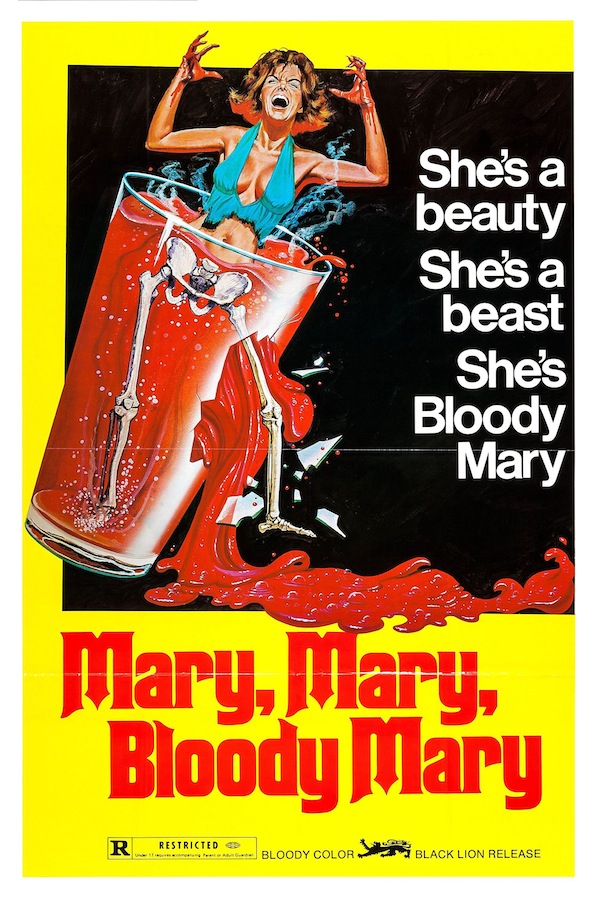
Mary, Mary, Bloody Mary (1975)


          Like George Romero’s disturbing Martin (1978), this low-budget shocker is a vampire movie without vampires. Starring the elegantly pretty Cristina Ferrare, Mary, Mary, Bloody Mary has as many weaknesses as it does strengths. On the positive side, the movie is mildly erotic and mildly spooky, with slick photography and evocative locations. On the minus side, the acting is sterile, the pacing is far too slow, and director Juan López Moctezuma lacks the breadth of visual imagination needed to put something like this across. Some viewers will lose interest partway through Mary, Mary, Bloody Mary because so much time elapses between exciting scenes, and it’s true that much of Ferrare’s appeal stems from her fashion-model beauty. Just as her performance suggests a world of emotional experience rather than properly expressing those emotions, the movie as a whole feels like a rough draft. Nonetheless, the film travels an interesting path by forcing viewers to ask whether the lead character is a supernatural monster or merely disturbed.
          Set in Mexico, the picture follows the travels of a painter named Mary (Ferrare), who has a nasty habit of murdering the men and women she meets. Specifically, she seduces them, weakens them with spiked drinks, then removes a hairpin and punctures their throats so she can drink their blood. Yet Mary feels conflicted about what she does, and she’s haunted by visions/memories of the mystery man (John Carradine) who triggered her murderous impulses. The particulars of the plot are neither clear nor significant, but the gist is that Mary falls for Ben (David Young) and tries to end her lethal cycle so she can be with him. Meanwhile, the mystery man chases Mary across Mexico, setting the stage for a final confrontation.
          In its best moments, Mary, Mary, Bloody Mary has something approaching an art-movie vibe. For instance, a long lesbian seduction scene features mirrors, striking costumes, and deliberate pacing. In its worst moments, Mary, Mary, Bloody Mary feels like drive-in schlock. One crude sequence features Mary writhing atop a lover/victim while the camera pointlessly cuts back and forth between Mary’s face and objects d’art around the room. Carradine’s appearance is especially problematic. In most scenes, his character is obviously portrayed by a stunt double. Moreover, the costuming of Carradine’s character recalls that of the old pulp character the Shadow, right down to the high collars and wide-brimmed hat. In sum, those who avoid this movie aren’t missing much—but those who give it a chance will discover an offbeat experience.

Mary, Mary, Bloody Mary: FUNKY

Saturday, October 21, 2017

Cain’s Cutthroats (1970)


          Revenge is the focus in this grubby, low-budget Western, but don’t get your hopes up for something metaphorically vital in the mode of, say, a good Clint Eastwood oater or even a pulpy Lee Van Cleef offering. This one’s strictly by-the-numbers, so were it not for the presence of R-rated sex and violence, Cain’s Cutthroats—also known as Cain’s Way—would seem like an episode of some generic TV series. The biggest name in the cast is John Carradine, who plays a supporting role, and in the movie’s only novelty factor involves seeing Carradine play a somewhat normal character. After all, he spent much of his late career playing underwritten crazies and drunks and ghouls. Despite his second billing, bland he-man Scott Brady is the film’s actual star. He portrays Justice Cain (yes, that’s really the character’s name), a former soldier who declares a vendetta against his onetime colleagues after they wrong him. Specifically, the men who previously served under Cain’s command form a criminal gang and seek his leadership. When he refuses, they retaliate by gang-raping and murdering his wife, then leaving him for dead. Predictably, he survives and sets out to balance the scales.
          The premise of Cain’s Cutthroats is okay, and more adept filmmakers could have taken the material in worthy directions, such as exploring the moral gray areas between killing for one’s country and killing for one’s personal enrichment. Instead of visiting that lofty terrain, the folks behind Cain’s Cutthroats wallow in the mud of human depravity. The criminals are portrayed as filthy idiots, spitting and swearing whenever they’re not squabbling with each other. The rape scene features sensationalistic nudie shots, as does a subplot featuring the curvy woman who travels with Cain for spell. As for how Carradine fits into the mix, he plays a preacher who is also a bounty hunter, so his character also travels with Cain. A number of far superior films tell similar stories, including Eastwood’s The Outlaw Josey Wales (1976), so while Cain’s Cutthroats is hardly the worst movie of its type, one is hard-pressed to put forth a compelling reason to watch the thing.

Cain’s Cutthroats: FUNKY

Wednesday, May 31, 2017

Horror of the Blood Monsters (1970)


Original movies directed by Al Adamson are bad enough, but his hodgepodge flicks, assembled from pieces of films for which Adamson bought the rights, are even worse. Sci-fi/horror embarrassment Horror of the Blood Monsters demonstrates why. To repurpose scenes from a black-and-white Filipino movie about cavemen fighting supernatural monsters, Adamson shot some new material and contrived an incoherent story about Earth sending a space vessel to a distant planet as a means of combating extraterrestrial vampires, or something like that. The picture opens with a lame vampire attack shot in a soundstage, then transitions to ground-control scenes featuring black curtains as backdrops, and eventually to spaceship sequences with the production values (and performance quality) of a high school musical. To mask the monochromatic nature of the Filipino footage, Adamson provides dialogue about mysterious radiation that changes the color spectrum, and the black-and-white stuff appears tinted green or red or whatever. The monsters in the recycled scenes are ridiculous, flying bat-winged little people, real lizards photographed in forced perspective, underwater crab creatures, and vampires whose fangs look like pieces of chalk. Adamson’s new scenes aren’t any better. John Carradine spews pointless exposition, a buxom blonde looks confused while, thanks to iffy dubbing, another actress’ voice emanates from her mouth, and so on. At one point, the technicians at ground control stop supervising the emergency space mission so they can make out and play with a color-spectrum gun, resulting in yet more tinted shots. Alternate titles for this crapfest include Creatures of the Prehistoric Planet, The Flesh Creatures, and Vampire Men of the Lost Planet.

Horror of the Blood Monsters: SQUARE

Sunday, May 28, 2017

Missile X: The Neutron Bomb Incident (1979)


Out of deference to the fine folks at IMDb, I’m going with their title of choice for this multinational coproduction, which has been released by so many different monikers that some artwork bears the title The Tehran Incident, while other ads have the alternate spelling The Teheran Incident. By any name, this one’s a dud. Curd Jürgens stars a super-wealthy psycho who steals an experimental missile, then conspires to shoot the weapon into Iran, thereby derailing a planned Middle East peace summit. Don’t hold your breath awaiting explanations of how doing so would benefit the villain financially or ideologically; this is one of those hopelessly murky international thrillers in which bad guys do bad things simply because it advances the plot. Peter Graves costars as an American spy tasked with finding the whereabouts of the missile and preventing its use. While tramping around (pre-revolutionary) Iran, he aligns with his Soviet counterpart, played by Michael Dante. Although there are shades of 007, notably because Jürgens played the heavy in The Spy Who Loved Me (1977), this schlocky picture exists a world apart from the razzle-dazzle of the James Bond franchise. Graves is almost laughably wooden, and it’s a gross understatement to remark that he lacks heat in scenes with various starlets. He’s so dull throughout this movie that the filmmakers might as well have hired a stand-in. The other notable player in the cast, Hollywood survivor John Carradine, phones in a non-performances as scientist in the villain’s employ. As for Jürgens, he gets the most interesting material simply because his character evinces ambiguous sexuality. He’s got the requisite female arm candy, but he’s also got a one-handed henchman, and in one scene Jürgens’ character implies he wants a three-way. Kinky! In every other respect, this movie is confusing, dull, and pointless.

Missile X: The Neutron Bomb Incident: LAME

Thursday, March 9, 2017

Bad Charleston Charlie (1973)


A rotten would-be farce about Depression-era criminals, Bad Charleston Charlie represents a failed attempt by actor Ross Hagen to create a star vehicle. In addition to playing the leading role, he cowrote the script (with Ivan Nagy, who directed) and produced the project. Set somewhere in the American heartland, the picture begins with Charlie Jacobs (Hagen) and his buddy Thad (Kelly Thordsen) quitting their jobs at a mine after one too many humiliating demands for payoffs from a corrupt union boss. Declaring their intent to become “important” people, they take inspiration from the exploits of Al Capone and begin careers as gangsters. Eventually, Charlie and his rapidly growing cadre of followers antagonize a corrupt local cop and the members of a KKK cell, so they find themselves with enemies on both sides of the law. Prostitution figures into the mix, as well, since Charlie makes most of his money peddling female flesh. Despite antiauthoritarian themes and high-spirited action, Bad Charleston Charlie is a world apart from the myriad similar films that Roger Corman produced in the ’60s and ’70s to draft off the success of Warren Beatty’s Bonnie and Clyde (1967). Even the worst of Corman’s gangster pictures has a clearly defined narrative, but this flick just trundles from one pointless episode to the next, striving for a lighthearted tone but missing the mark because the characters are repugnant and the jokes aren’t funny. Not helping matters is Nagy’s horrendous camerawork; although he later became a serviceable hack making junk for TV and the straight-to-video market, he’s out of his depth throughout this project, which was his directorial debut. On the plus side, Hagen recruited a few decent actors to play supporting roles (watch for John Carradine as a drunken reporter), and Hagen’s buddy-comedy shtick with Thordsen almost works.

Bad Charleston Charlie: LAME

Thursday, January 19, 2017

Golden Rendezvous (1977)


          Adaptations of Alistair MacLean’s pulpy adventure novels emerged regularly throughout the ’70s, though none achieved the stature of The Guns of Navarone (1961), the most successful movie yet derived from a MacLean story. Watching Golden Rendezvous offers a quick reminder of why so many of these pictures failed to generate excitement. An action saga set on the waters of the Caribbean, Golden Rendezvous has a little bit of everything—bombs, double-crosses, fist fights, gambling, gun fights, hijacking, knife fights, murder, sex, and so on. The overarching story makes sense once all the pieces fall into place, but the character work runs the questionable gamut from iffy to one-dimensional, and the gender politics belong to an earlier era. In other words, Golden Rendezvous is regressive macho silliness so determined to avoid depth and substance that whenever it seems like a moment of true human feeling is about to appear onscreen, the filmmakers introduce some element of danger and/or violence. And if there’s any meaning or theme being served here, then it’s only because the filmmakers failed in their efforts to keep such things at bay. Golden Rendezvous is pleasant enough to watch for the action scenes, and the cast is plenty colorful, but you’ll forget having watched the thing before the end credits finish rolling.
          Richard Harris stars as John Carter, first officer on a boat that hauls cargo but also includes a high-end casino. When criminals led by Luis Carreras (John Vernon) hijack the ship, Carter springs into action, forming covert alliances with trustworthy crewmen and passengers while also using sneaky tactics to eliminate thugs one by one. The plot becomes more ridiculous with each passing scene, so by the end of the picture, Golden Rendezvous involves not just the hijacking but also a blackmail scheme and even a nuclear bomb. MacLean was a whiz at generating suspenseful situations, but credibility was never his strong suit. Still, Harris is enjoyable here, all lanky athleticism and roguish charm, and several solid actors support him. Besides Vernon’s reliable villainy, the picture offers, in much smaller roles, John Carradine, David Janssen, and Burgess Meredith. As for leading lady Ann Turkel, one can’t blame Harris for trying to help his then-wife build an acting career—this was the third of four Harris movies in which she costars. As went their marriage, alas, so too did her run in big-budget movies.

Golden Rendezvous: FUNKY

Wednesday, September 21, 2016

The Killer Inside Me (1976)


          One of several deeply flawed ’70s films containing an Oscar-worthy performance by Stacy Keach, The Killer Inside Me is the first of two movies, thus far, adapted from the Jim Thompson novel of the same name. (A 2010 version starring Casey Affleck received a more favorable critical response.) The material is strange, tracking the adventures of a small-town cop who secretly harbors homicidal tendencies, so the storyline asks viewers to take an unusual ride from wholesome Americana to deviant ultraviolence. Getting the tone of this one right would have challenged even the subtlest of filmmakers, a group to which rough-and-tumble action guy Burt Kennedy most certainly does not belong. Accordingly, the 1976 version of The Killer Inside Me is a mess from a tonal perspective, because it’s unclear whether the movie is a straight drama, a thriller disguised as a lighthearted character piece, a satire of American values, or some combination of all of those things.
          Keach finds a peculiar sort of true north, both in his onscreen performance and in his wry narration track, so his characterization tells a fatalistic but darkly funny story about a guy trying to make murder a part of his everyday life. Alas, the movie around Keach isn’t nearly as surefooted, even though some of the supporting performances are tasty and even though cinematographer William A. Fraker shrouds the film in evocative shadows. Those excited about exploring weird pockets of Hollywood cinema will be more inclined to cut The Killer Inside Me slack than those looking for straightforward escapism.
          Set in a small Montana town, the story follows Deputy Sheriff Lou Ford (Keach) through a colorful period in his life. To the casual eye, he seems like Mr. Nice Guy, because he romances a local schoolteacher, evinces great skill at de-escalating conflicts, and gets along with people on every rung of the social ladder. Secretly, however, Lou begins an affair with a local floozy, thereby entering into a triangle with his buddy Elmer (Don Stroud), son of rich landowner Chester (Kennan Wynn). All the while, viewers glimpse Lou’s demons thanks to flashes from childhood trauma, so when Lou freaks out and kills two people, we have an inkling why.
          The first half of the picture is all setup, and the second half is all repercussions. Throughout, the filmmakers provide colorful details and grim humor. In one entertaining scene, Lou welcomes a con artist (John Carradine) into his home and proceeds to scare the bejesus out of the guy, seemingly just for sport. In another vivid bit, Lou’s boss, Sheriff Bob Maples (John Dehner), employs unique vernacular to lament his poor marksmanship: “I can’t hit a bull in the ass with a banjo.” Although the movie never coheres, The Killer Inside Me is interesting and odd from moment to moment. Beyond Keach’s beautifully deranged performance, the picture boasts strong work from Carradine, Stroud, Wynn, Tisha Steriling (as the schoolteacher), and—reuniting Keach with a costar from John Huston’s Fat City (1972)—Susan Tyrell (as the floozy).

The Killer Inside Me: FUNKY

Tuesday, June 7, 2016

Moonchild (1974)


One of a handful of ’70s features that began as film-school thesis projects, writer-director Alan Gadney’s Moonchild is ambitious to a fault. Not only did Gadney secure impressive locations and the participation of Hollywood actors, but he also attempted to tell an intricately allegorical story about existential and metaphysical subjects. Had Gadney been able to pull this one off, it would have been such a miraculous achievement that we’d still be talking about his audacity today, because Moonchild would have launched a singular filmmaking career. Alas, Gadney botched things so badly that Moonchild was his last directorial endeavor as well as his first. The murky storyline goes something like this: A young artist (Mark Travis) realizes that he’s been reincarnated in some otherworldly realm, where supernatural figures including the Maitre’D (Victor Buono) battle for control of his soul while an impartial observer called Mr. Walker (John Carradine) both comments upon and observes the momentous events. At first, the scenario unfolds like the setup for a horror movie, with the leading character trapped inside a weird playground for godlike lunatics. Later, once Gadney indulges himself with religious imagery, the story veers into a kangaroo-court situation with spiritual implications. (“If death is a dream," Buono coos, "then what is life? Is life God or Man?”) Some of what happens in Moonchild is borderline interesting, but the movie’s style is insufferable, particularly the hyperactive editing. Worse, the blurring of hallucinations and reality creates long stretches of incoherence. Eventually, it’s all way too much, so the viewer’s inevitable reaction is best summarized by an exclamation the protagonist makes somewhere around the 33-minute mark: “What is this? What are you people talking about?” Exactly.

Moonchild: LAME

Monday, February 29, 2016

Hell’s Bloody Devils (1970)


Even by the bottom-feeding standards of director Al Adamson’s usual fare, Hell’s Bloody Devils is unwatchable garbage. Apparently a slapped-together compendium of footage from two (or more) incomplete features, the movie is part biker flick, part espionage caper, part romance, and part brain-melting sludge. Watching this picture is like staring at a TV that changes its own channels, because scenes stop abruptly, characters drift in and out the picture, and the vibe toggles between clean-cut ’60s (some of the footage was shelved for years) and sleazy ’70s. At its weirdest, the movie stops dead when two characters visit a Kentucky Fried Chicken franchise for lunch and Colonel Sanders himself enters frame to ask the characters how they’re enjoying their meal. Familiar actors John Carradine and Broderick Crawford make fleeting appearances in Hell’s Bloody Devils—or, to put a finer point on it, in The Fakers, the espionage picture that Adamson commenced in the ’60s and repurposed for about half the footage of Hell’s Bloody Devils. Whatever. Hell’s Bloody Devils cuts from pointless vignettes of bikers festooned with Nazi regalia to a truly bewildering storyline about an Israeli secret agent teamed with a U.S. operative to do—something. Eventually, the spy stuff leads to a chase scene through a theme park, which comprises drab shots of people running through crowds to the accompaniment of overbearing music. Presumably, diehard schlock archivists have catalogued the components of this disastrous film’s ironic appeal, but for mere mortals, this is about as wretched as grade-Z cinema gets.

Hell’s Bloody Devils: SQUARE

Wednesday, February 24, 2016

Shock Waves (1977)


          The lingering image from this low-budget shocker depicts a squad of expressionless zombies wearing goggles and World War II SS uniforms as they emerge from bodies of still water, intent on spreading bloody mayhem. As one of the film’s supporting characters notes, “The sea spits up what it can’t keep down.” Utterly loopy in conception, and yet compelling because of its no-nonsense execution and the unnerving synthesizer music on the soundtrack, Shock Waves is reminiscent of John Carpenter’s early work. What the film lacks in depth and logic, it makes up for with menace and mood. And while writer-director Ken Wiederhorn is no John Carpenter, as evidenced by the unimpressive nature of Wiederhorn’s subsequent career, Shock Waves works quite well as an offbeat horror show.
          The picture begins when the crew of a sea vessel discovers Rose (Brooke Adams) floating alone on the ocean in a battered dingy. In voiceover, Rose describes the ordeal she just experienced. Along with several other folks, she took a pleasure cruise on a low-rent boat skippered by Captain Ben Morris (John Carradine). One night, Morris’ boat encountered the wreck of a massive ship. Soon thereafter, strange things started happening, culminating with the death of Captain Morris under mysterious circumstances and the scuttling of Morris’ boat. The passengers found refuge on a remote island, the only resident of which was a mystery man (Peter Cushing) with a scar across his face. Revealed as a former SS commander, the man explained the nature of the ship the passengers encountered. During World War II, the commander oversaw the “Death Corps,” a squad of genetically engineered zombie soldiers capable of breathing air and water. Deemed too dangerous for deployment, the “Death Corps” were decommissioned, and the commander sunk the boat containing his inhuman soldiers. For some reason, the “Death Corps” resurfaced at the moment that Morris’ boat arrived, and carnage ensued.
          The plot is ridiculous, and Weiderhorn succumbs to a few lowbrow impulses (such as squeezing Adams into a bikini for most of the picture). Nonetheless, Weiderhorn delivers a fair measure of creepy weirdness. Zombies stalk people through swamps. Survivors struggle to find hiding places in an old mansion, adding claustrophobia to the mix. Cushing unfurls the requisite expositional monologue. And so on. Thanks to its eerie music, familiar actors, grainy photography, and gruesome premise, Shock Waves could either haunt you or strike you as silly, depending on your receptivity to this type of dark fantasy. Either way, it’s vivid stuff.

Shock Waves: GROOVY

Tuesday, January 26, 2016

Vampire Hookers (1978)


Cheaply made, ridiculous, and tacky, this comedy/horror hybrid contains a few entertainingly awful sequences, and in fact the whole picture verges on so-bad-it’s-good splendor. For instance, the title song, which is set to a zippy ’60s-rock groove, features the outrageous lyric, “Vampire hookers—blood is not all they suck!” While on shore leave in the Philippines, U.S. sailors meet prostitutes who lure the sailors, one by one, to a crypt. Turns out the ladies are vampires in the thrall of Richmond Reed (John Carradine), a centuries-old monster. Each time a sailor disappears, his friends search for him, eventually leading to a showdown. Instead of playing this scenario for thrills, screenwriter Howard R. Cohen and director Cirio H. Santiago opt for campy jokes. The vampire brides bitch about how their master never takes them anywhere. Carradine’s character whines that his ladies are too high-maintenance. The vampires’ half-human henchman, a dim-witted thug played by Filipino-cinema stalwart Vic Diaz, mopes because he wants to become a vampire, punctuating most of his remarks with flatulence. (In one scene, he stinks up his own coffin so badly that he gags.) Some of the actors try to make the comedy elements work, including amiable Texas-born character actor Trey Wilson, who later found a niche in the ensemble of Bull Durham (1987). Unfortunately, starlets were cast for their looks and their willingness to disrobe rather than for their talent, and Carradine was decades past his prime when he made this picture. Still, the truly bizarre stuff in Vampire Hookers makes an impression, like the running gag of debating whether Shakespeare was a vampire, or the aforementioned title song. Vampire Hookers also includes one of the most excessive sex scenes you’ll ever encounter outside of a porno, not because it’s graphic but because it goes on forever, with a particularly virile sailor servicing all three vampire brides for a good 10 minutes of screen time 

Vampire Hookers: LAME

Saturday, August 22, 2015

Honey Britches (1971)


From a purist’s perspective, the movie Honey Britches doesn’t exist anymore. The low-budget crime/horror picture was produced and released in 1971 before falling into obscurity. Then, in the mid-’80s, schlockmeister Fred Olen Ray bought the movie, shot one new scene (more on that later), and recut the picture, selling the resulting atrocity to Z-movie distributor Troma Entertainment. Since that time, Troma has exhibited the re-edited flick under various titles, including Demented Death Farm Massacre. Yet it’s not as if some minor classic was lost in the process. Based upon the available evidence, Honey Britches was, is, and always will be awful. The movie concerns four criminals who escape New York with $1 million worth of stolen diamonds, then run out of gas in the rural south. After hiding their getaway car, the quartet walks to a farm operated by dim-witted religious nut Harlan P. Craven (George Ellis). An overweight slob in middle age, Harlan is married to a curvaceous young woman named Reba Sue (Ashley Brooke), whom Harlan bought from Reba Sue’s father in order to settle a debt of “almost $200.” What ensues between the country folk and the criminals is a Desperate Hours-type hostage situation punctuated with betrayal, lust, and murder. Featuring endless scenes about nothing and spellbindingly bad acting, Honey Britches (judging from the original scenes that remain intact) is exploitation cinema for the lobotomized, offering only a few nudie shots and some laughably cheap-looking gore as compensation for insufferable tedium. Fred Olen Ray’s ’80s additions are feeble. In addition to oppressive horror scoring that Ray uses to juice dull scenes of people wandering around the woods, the ’80s version features a frail John Carradine (who filmed his bit near the end of his life) reading perhaps three minutes of “ironic” commentary from cue cards. Carradine’s single shot is spliced into the movie at erratic intervals.

Honey Britches: SQUARE

Thursday, July 30, 2015

The Bees (1978)


While the most enduring pop-culture artifact stemming from widespread mid-’70s paranoia about killer bees is undoubtedly the recurring sketch on Saturday Night Live depicting the striped insects as Mexican banditos, Hollywood cranked out a few overheated horror pictures on the subject, as well. Disaster-flick titan Irwin Allen was responsible for The Swarm (1978), a big-budget flop starring Michael Caine, and Roger Croman’s low-budget factory New World Pictures was responsible for this dud starring John Saxon. In fact, according to a book about New World, Warner Bros. paid New World to delay the release of The Bees until after The Swarm passed through theaters. In any event, The Bees is just as silly as the Allen production, only without the redeeming values of a kitschy cast and a melodramatic narrative. The Bees opens in Brazil, where crossbred bees attack their keepers at a ranch owned by an international conglomerate. (The murky setup tries to involve both accidental and intentional blending of insect species, resulting in a super-aggressive hybrid.) Soon after the deadly incident in Brazil, a scientist named Sandra Miller (Angel Tompkins) smuggles killer bees into New York, where she reports to John Norman (Saxon), head of a company angling to get a monopoly on the world’s honey supply. Or something. The plot is so stupid and turgid that parsing details isn’t worth the effort, and even trying to watch the movie for the “exciting” scenes is pointless. Once killer bees start rampaging across the United States, director Alfredo Zacarías employs cheap animation to show massive swarms passing landmarks, and he uses grainy stock footage to illustrate the military response. Meanwhile, Saxon gives stilted line readings and John Carradine, in a supporting role, speaks in some amateurish hodgepodge of European accents. The whole pathetic enterprise concludes (spoiler alert!) with the protagonist realizing the bees have learned to communicate, then addressing a general assembly of the UN with this urgent message: “You have to listen to what the bees have to say!” Sadly, just when the movie reaches campy terrain, it ends instead of going full-bore into craziness.

The Bees: LAME

Sunday, May 31, 2015

Nocturna: Granddaughter of Dracula (1979)


          Blending comedy, disco music, sex, and vampirism with some of the worst acting ever captured on film, Nocturna: Granddaughter of Dracula is entertainingly abysmal. Not a single frame of the movie works as intended, and that’s what makes watching Nocturna so perversely pleasurable. Cowritten and coproduced by Vietnamese belly-dancing star (!) Nai Bonet, who plays the leading role and spends a fair amount of screen time slathering her own nude body with bath oil, Nocturna is a vanity project gone terribly, terribly wrong.
          Sharing many elements with the George Hamilton comedy Love at First Bite (1979), which was filmed around the same time as Nocturna, this movie opens in Transylvania, where Dracula (John Carradine) encounters difficulty adjusting to disco-era society. Things have gotten so bad that parts of his castle have been opened to the public as a resort called Hotel Transylvania, which, naturally, includes a disco. Yet instead of following the famous bloodsucker’s adventures, as happens in Love at First Bite, this movie tracks the count’s lissome granddaughter, Nocturna (Bonet).
          While dancing in the disco with an American stud named Jimmy (Antony Hamilton), Nocturna discovers that she casts a reflection—quite a surprise for a vampire. Realizing that she becomes mortal on the dancefloor, Nocturna follows Jimmy to New York City, where she looks for a way to live as a human permanently. A peeved Dracula soon follows her, hoping to lure Nocturna back to the homeland.
          Nocturna is filled with cringe-inducing one-liners and puns, to say nothing of stupid scatological references. As Dracula muses at one point: “If I’m alive, why am I here, but if I’m dead, why do I have to wee-wee?” (Elsewhere, Dracula proclaims, “All the ladies would say I was hung like a walrus!”) Bonet is a spectacularly bad actress, smiling lifelessly through every scene as if she’s a Price Is Right model presenting a washer-dryer set, and her line deliveries are so empty that they’re unintentionally hilarious. Describing an ecstatic moment, she says “It loved it—it was fantastic” with all the energy of a postal worker explaining how much it will cost to mail an envelope.
          Similarly, Bonet’s dancing is dull and unimaginative, which becomes a considerable problem whenever the movie stops cold to watch her twirl repetitively across a dancefloor. Even the aforementioned nude scene has a strange quality, because it seems powered by exhibitionism rather than exploitation. Clearly, Bonet wanted the world’s attention just as badly as the world wanted to ignore her. Still, she did this to herself, so adventurous viewers can hate-watch Nocturna free of guilt.
          Plus, every so often, the germ of a real idea pokes through the smog of ineptitude. For instance, Nocturna hooks up with a gang of NYC vampires who bitch about modern problems, such as the trouble of finding victims whose blood isn’t tainted by processed food. This particular angle leads to a campy scene of a black vampire, dressed like a pimp, offering powdered blood—which prompts an affronted woman to say, “I’d rather suck than sniff any day.” Wow. To complete the effect, throw in a slumming Yvonne De Carlo, as Dracula’s old flame, a pulsing disco soundtrack featuring tunes by artists including Gloria Gaynor and Vickie Sue Robinson, and a supporting actor who does a solid Boris Karloff impersonation. Can a movie be amazing and atrocious at the same time? If the movie’s title is Nocturna: Granddaughter of Dracula, the answer is yes.

Nocturna: Granddaughter of Dracula: LAME

Saturday, March 28, 2015

Silent Night, Bloody Night (1972)


Despite a few creepy flourishes and the presence of horror-cinema icon John Carradine in a minor role, Silent Night, Bloody Night is more like a lump of coal than a brightly wrapped Christmas present. Not to be confused with the slasher flick Silent Night, Deadly Night (1984), which sparked controversy by featuring a murderer in a Santa Claus costume, Silent Night, Bloody Night is a discombobulated piece about tragedies occurring in a Massachusetts home that once served as an insane asylum. (The title refers to a Christmas Eve murder spree.) Clearly cobbled together during editing from scattershot footage, the picture uses the weak framing device of Diane Adams (Mary Woronov) moping around the central location while delivering somber voiceover about past events, thus triggering extensive flashbacks. According to Diane, the trouble began in 1950 when a man named Wilfred Butler died at the home. Amid questions about whether his demise was an accident or suicide, survivors honored Wilfred’s wish that the house remain abandoned. Thus, when Wilfred’s grandson Jeffrey (James Patterson) hires lawyer John Carter (Patrick O’Neal) to arrange the sale of the house, those tampering with Wilfred’s wishes meet the business end of an axe. Silent Night, Bloody Night takes quite a while to get going, and long stretches of dull conversation elapse between fright scenes. Worse, the slapped-together structure of the piece ensures confusion and tedium, problems compounded by indifferent acting and muddy photography. Some minor historical interest stems from the presence of actors with Andy Warhol associations (including Woronov), while pretty starlets including Astrid Heeren provide eye candy. However, if there’s anything genuinely interesting or unique about Silent Night, Bloody Night, it’s buried beneath lots of superficial atmospherics, and obscured by needlessly befuddling plot machinations.

Silent Night, Bloody Night: LAME

Wednesday, February 4, 2015

Blood Legacy (1971)


Also known as Legacy of Blood and Will to Die, this lifeless shocker shamelessly recycles the basic premise of the 1922 play The Cat and the Canary, which was legitimately adapted for the screen several times, spanning 1927 to 1979. Alas, the durable narrative is rendered here to desultory effect. As in The Cat and the Canary, the storyline involves several heirs to a fortune being forced to spend time together in a house, where rules of succession motivate them to murder each other in order to seize more cash. There’s also some nonsense about a killer on the loose (as in The Cat in the Canary), although the viewer never doubts that one of the principal characters will be revealed as the true culprit. Presented somewhat in the mode of a soap opera, with lots of talky bits during which relatives complain about and/or scheme against each other, Blood Legacy takes forever to get started. The character played by horror-cinema icon John Carradine, the only name actor in the cast, is dead before the opening credits, and 25 minutes of this very short 82-minute feature elapse before the first kill. Beyond the illogical narrative and the leaden pacing, the movie’s acting and dialogue exist on an Ed Wood level of awfulness. One character laments that, “Instead of loving her, dear old dad turned on the hate machine.” Another says, “You may have married into a screwball family, but this guy’s got all his marbles.” Occasionally, director Carl Monson tries to spruce up the movie with a gory shot of a corpse or a violent attack scene, but the special effects are as anemic as every other aspect of the production. Even Monson’s meager attempts at titillation fail to generate excitement—although attractive starlet Brooke Mills spends most of the movie wearing a low-cut negligee, she mostly just lays in bed and whines. Worse, costars Richard Davalos and Buck Kartalian give comically atrocious performances. FYI, this picture is not to be confused with the 1978 release Legacy of Blood, helmed by trash-cinema icon Andy Milligan.

Blood Legacy: SQUARE

Monday, January 5, 2015

Shinbone Alley (1971)


          What was it about the ’70s that made filmmakers think audiences wanted to see adult-oriented cartoons about felines? Two years before the release of the X-rated Fritz the Cat, moviegoers were subjected to the strangeness of the PG-rated musical Shinbone Alley. Parts of the movie are too grown-up for the kiddies who normally enjoy animated features, and other parts of the movie are too juvenile for the adults capable of understanding the sexualized subject matter. In fact, it’s hard to imagine what target audience the makers of Shinbone Alley had in mind, seeing as how the narrative includes a human poet who commits suicide and is reincarnated as a cockroach, an unrequited-love story involving creatures from different species, a slutty heroine who contemplates drowning her children because they’re inconvenient, a proposed insect revolution against humanity, and Shakespeare performed as beat poetry.
          Making matters worse, the film’s tunes are croaked and screeched by performers with ghastly singing voices, including Eddie Bracken, John Carradine, and the insufferable Carol Channing. It says a lot about Shinebone Alley that the most entertaining singing comes from Alan Reed, best known as the voice of Fred Flinstone.
          Shinbone Alley has a peculiar pedigree. The main characters, cockroach Archy and alley cat Mehitabel, first appeared in whimsical newspaper columns written by Don Marquis beginning in 1916. Bracken and Channing entered the picture in 1954, performing on a comedy/musical concept album titled archy and mehitabel. The album was then adapted into a 1957 Broadway musical, titled Shinbone Alley, with Bracken and, replacing Channing, Eartha Kitt. Mel Brooks contributed new material when the album was adapted for stage presentation. Bits of all of the versions were merged into this animated feature, which reunited Bracken and Channing.
          The style of the feature is strange, because the raggedy background drawings and sketchy figure renderings are a long way from the sleek textures of Disney ’toons. Yet the edgy graphics and the subversive storytelling don’t mesh with the obnoxious music. On one level, Shinbone Alley is a loud attempt at a crowd-pleaser complete with wannabe show-stopping numbers. On nearly every other level, the piece is just bizarre. Some scenes are dark, while others are trippy. The language and themes exist way over the heads of children (sample dialogue: “Your predilection for tomcats is the scandal of the neighborhood”), and the narrative wanders through episodes that have little connection to each other.
          In Carradine’s big sequence, his character tries to seduce Channing’s character by browbeating her into becoming an actress, resulting in a hideous scene of the two frog-voiced actors brutalizing lines from Romeo and Juliet while scatting them to a jazz beat. And in another dissonant bit, Bracken’s character has a sex dream about Channing’s character that’s illustrated by still photographs with cat heads superimposed over the bodies of human women. Adding to the bewildering nature of the movie, the big takeaway seems to be that that the hero should be content basking in the glow of the heroine, even though she plans to continue her promiscuous ways and has no interest in romance with her most devoted admirer. But at least viewers know that Archy can always attend to his carnal needs with a set of characters described as “Ladybugs of the Evening.”

Shinbone Alley: FREAKY

Sunday, January 26, 2014

Superchick (1973)


One has many choices when trying to identify the strangest element of this low-budget sex comedy, but the title is a strong contender. Although one would naturally assume that a movie called Superchick is about a woman who gains extraordinary powers, Superchick is instead about a big-breasted flight attendant who uses a demure secret identity to avoid attention between sexual liaisons with lovers in various cities. Yes, the titular lass actually sneaks into phone booths to change costume, Superman-style, when shifting from her disguise as a mousy brunette into her genuine persona as an Amazonian blonde. Joyce Jillson stars as Tara B. True, who keeps boyfriends in Los Angeles, Miami, and New York—but also makes time for quickies with interesting strangers she meets along the way. In dialogue and voiceover, Tara describes herself as a paragon of liberation, making sexual choices without the hangups of normal societal expectations. As in so many creepy ’70s smutfests, however, the high ideals of women’s lib get transmogrified into dubious justifications for sex scenes and topless shots. (Despite her bluster, Tara seems more liberated from her clothes than from anything else.) The movie’s attempts at ribald comedy are painfully stupid, so Tara says things like, “Last one in bed gets no head,” and she ends up in such insipid predicaments as her visit to the sex dungeon of an old man (John Carradine) who gets off on being whipped by ladies. Putting further lie to the notion of Superchick as a statement about liberation are scenes that make Tara seem like a garden-variety nymphomaniac. When she meets a soldier who hasn’t gotten laid in two years, she drags him into a bathroom and all but rapes him, explaining her motives in voiceover: “I was never a super patriot, but there comes a time to lie down and be counted.” Anyway, if the preceding hasn’t been sufficient to save you from suffering through Superchick, be warned that the movie also contains incompetently staged karate scenes and a tacky use of Ravel’s “Bolero.” In fact, the only interesting thing about Superchick is the subsequent career of the star—Jillson later became a celebrity astrologer, reportedly helping to advise client Nancy Reagan on Ronald Reagan’s choice of George W. Bush as vice president.

Superchick: LAME