Showing posts with label alan alda. Show all posts

Monday, August 14, 2017

Jenny (1970)


          Thanks to a one-night stand, small-town girl Jenny is pregnant. Confused and naïve, she moves to New York, hoping to figure things out at some undetermined point in the future. Then she has a meet-cute with Delano, a self-assured filmmaker who makes arty independent projects when he isn’t directing commercials for rent money. Turns out he’s got a problem, too. He’s eligible for the draft, and doesn't much like the idea of dying in Southeast Asia. After they spend some time together, Delano proposes a pragmatic suggestion: marriage. That way, her baby-to-be gets a father with a good income, and Delano gets a chance at persuading the government his domestic obligations preclude military service. Never mind that Delano has a girlfriend and zero romantic interest in sweet, sheltered Jenny. That’s the basic setup for Jenny, a slight but well-observed dramedy starring Marlo Thomas, then at the height of her success in the sitcom That Girl, and Alan Alda, two years before his own sitcom success with M*A*S*H. Both actors imbue their roles with nuance and sensitivity, and the direction and screenplay give them interesting emotional terrain to explore.
          In many ways, Jenny is a respectable character piece touching on weighty social issues. However, the film falls into two easy traps. First, it uses lightheartedness to wriggle out of tricky narrative situations, and second, it cops out with a fashionably ambiguous ending. The most ambitious elements of the picture demand serious treatment for the issues they raise, and the sincere work by the leading actors warrants a proper conclusion. That’s why watching Jenny is as frustrating as it is rewarding.
          Nonetheless, Thomas deepens a potentially simplistic role with real emotion, so we feel her character’s anguish at being used by Delano, even though she entered into the sham marriage fully aware of its parameters. Similarly, Alda does a fine job of playing a heel whose conscience nags at himAlda sketches the vivid picture of a sophisticate who has difficulty reconciling emotions and intellectualism. Also noteworthy is Vincent Gardenia, who appears as Jenny’s father in a brief but effective sequence. With a few simple moves of behavior and physical carriage, he speaks volumes about the Generation Gap, expressing the pain straight-laced parents felt watching their children experiment with new and untried social structures. There’s much to like here, not least being the imaginative camerawork by director George Bloomfield and cinematographer David L. Quaid. Ultimately, however, Jenny falters by not seeing its premise through.

Jenny: FUNKY

Monday, July 20, 2015

The Moonshine War (1970)


          Among the many reasons why fans of the pithy novelist Elmore Leonard celebrated the wonderful ’90s movies adapted from his books—Get Shorty, Jackie Brown, Out of Sight, and so on—is the fact that Leonard had been poorly served by Hollywood in previous decades. Consider The Moonshine War, for which Leonard received screen credit as the adapter of his own novel. Whether because of studio interference, weak direction, or other unknown factors, the movie that reached theaters bears little of Leonard’s distinctive stamp. Some of the characterizations are colorful and some of the dialogue is tasty, but otherwise the movie is murky and tepid, unremittingly artificial, and weighed down by colossal miscasting. (Playing the film’s principal Kentucky rednecks are a pair of corn-fed Midwesterners and a pair of urbane New Yorkers.) While The Moonshine War is basically tolerable, not a single frame of the film can be taken seriously.
          Set during Prohibition, the convoluted plot begins with federal agent Frank Long (Patrick McGoohan) arriving in Kentucky to visit an old Army buddy, Son Martin (Alan Alda). Son is a successful moonshiner, and Frank reveals an audacious scheme to extort money from Son in exchange for keeping Son’s operation secret from the government. Son, backed by an army of hillbilly goons including the cheerfully corrupt Sheriff Baylor (Will Geer), refuses Frank’s overture. Then Frank calls in the heavy artillery—a psychotic former dentist named Dr. Taulbee (Richard Widmark), who travels with a trigger-happy sidekick. Frank wages war against Son’s people until tragedies reveal to Frank that he’s gone too far. Directed without any comprehension or flair by journeyman Richard Quine, The Moonshine War is as hard to follow as it is to believe. For the first hour of the movie, it’s unclear whether Frank is the hero or the villain, and because he never clearly articulates his agenda to anyone, it’s hard to shake the sense that maybe he’s running some elaborate sting on behalf of the government. The movie’s buttery-soft Metrocolor look is a problem, too, since bright lighting and eye-popping colors make most of the film’s scenes feel as sprightly as musical numbers. Together, the problems of look and tone make it difficult to discern whether The Moonshine War is supposed to be a comedy or a drama or both.
          Yet it’s bad casting that ultimately dooms The Moonshine War. McGoohan, with his crisp diction and snobbish demeanor, is absurdly out of place in every single scene, to say nothing of the fact that he seems cold and cruel. Alda, such a fine interpreter of the Sensitive American Man, does his best to sell an illusion of illiteracy and primal emotion, but he, too, is not where he belongs. Widmark fares slightly better as a smiling psycho, perhaps because he played versions of the same role for decades, and Geer seems perfectly at home chugging white lightning from Mason jars and spewing down-home aphorisms. It’s also worth noting the random folks who play small roles, including Harry Carey Jr., Teri Garr, Bo Hopkins, John Schuck, Tom Skerritt, and jazz singer Joe Williams.

The Moonshine War: FUNKY

Sunday, May 3, 2015

To Kill a Clown (1972)


          Given that Alan Alda’s role as compassionate surgeon “Hawkeye” Pierce on the 1972-1983 TV series M*A*S*H cemented the actor’s public persona as a paragon of decency, it’s interesting that some of the film roles he played before M*A*S*H were downright dastardly. In the middling thriller To Kill a Clown, for instance, Alda plays an unhinged Vietnam vet who torments the young couple renting a house on his beachfront property. The movie doesn’t completely work, mostly for reasons to do with the muddy storyline, but it’s a hoot to watch Alda play a full-on villain. In the movie’s best moments, Alda accentuates the gulf between his nice-guy demeanor and the gonzo extremes of his character’s creepy comportment.
          Set on a remote beach somewhere in New England, the movie begins by introducing viewers to man-child artist Timothy Frischer (Heath Lamberts). Working in the isolation of a quiet bungalow, Timothy does freeform paintings using traditional media as well as chewing gum and cigarettes. At first, Timothy’s only companion on the beach is his beautiful wife, Lily (Blythe Danner), who’s near the end of her patience with Timothy’s adolescent antics. In fact, she tries to leave him, but he woos her back with promises to behave more responsibly. Into this uneasy situation steps Major Evelyn Ritchie (Alda), a seemingly affable bachelor who walks with two canes because his knees were injured during combat, and who always travels with his two loyal Doberman Pinschers at his side.
          During the movie’s drab first hour, Evelyn plays the perfect host to his tenants, even as he evinces eccentricity. One evening over drinks, Evelyn says Timothy couldn’t hack a single day of military discipline. Timothy drunkenly takes the dare, and he’s surprised when Evelyn shows up at dawn the next morning, demanding that Timothy “report for duty” and perform menial labor. This very, very slow burn of a story finally explodes about 40 minutes before the movie ends, because Evelyn sics his dogs on Timothy to prove he’s serious about playing soldier. A weird psychodrama/thriller scenario ensues, with Evelyn using the threat of the dogs to hold the young couple hostage, regularly demeaning Timothy while implying that he wants Lily sexually.
          Cowritten and directed by George Bloomfield, from a novel by Algis Budrys, To Kill a Clown fails to offer a credible explanation for Evelyn’s villainy, just as it fails to make Timothy sympathetic. (He’s the clown of the title, because prior to painting, he studied circus arts and mime.) That said, the quality of the film’s acting, combined with the cool confidence of Bloomfield’s minimalistic camerawork, help keep To Kill a Clown watchable. Complementing the supple textures of Alda’s performance, Danner is wonderfully sexy and smart and vulnerable, while Lamberts takes an energetic crack at a murkily conceived character. Better still, the last half-hour of the picture builds genuine suspense, even though To Kill a Clown fizzles at the end.

To Kill a Clown: FUNKY

Sunday, August 25, 2013

Plaza Suite (1971) & California Suite (1978)


          During the ’70s, it seemed as if playwright/screenwriter Neil Simon was an industry rather an individual—every year except 1978, he unveiled a new play, and from 1970 to 1979 no fewer than 11 features were released with Simon credited as writer. When the man slept is a mystery. In fact, he even managed to crank out a quasi-sequel to one of his own hits. Plaza Suite premiered on Broadway in 1968 before hitting the big screen in 1971, and its follow-up, California Suite, debuted onstage in 1976 before becoming a movie in 1978. Neither project represents the apex of Simon’s artistry, but both are rewarding. The title of Plaza Suite is a pun, because the film comprises a “suite” of three mini-plays, each of which takes place within the same suite at the Plaza Hotel in New York City.
          In order of appearance, the vignettes concern a middle-aged couple breaking up when the husband’s infidelity is revealed; a tacky Hollywood producer inviting his childhood sweetheart, now married, to his room for a tryst; and another middle-aged couple going crazy when their adult daughter won’t leave the suite’s bathroom even though guests are waiting downstairs to watch her get married. The first sequence is a bittersweet dance, the second is bedroom farce with a touch of pathos, and the third is an explosion of silly slapstick. Plaza Suite grows more entertaining as it spirals toward its conclusion, finally achieving comedic liftoff during the third sequence, which is by far the most fully realized.
          Walter Matthau somewhat improbably plays the lead roles in all three sequences, and he’s terrific—chilly as the adulterous husband, smarmy as the producer, enraged as the would-be father of the bride. His primary costars are a poignant Maureen Stapleton in the first sequence, a delicately funny Barbara Harris in the second, and an entertainingly frazzled Lee Grant in the third. Plaza Suite drags a bit, and it’s tough to get revved up for each new sequence, but the fun stuff outweighs everything else.
          California Suite wisely takes a different approach—although the play of California Suite featured four separate stories, in the style of Plaza Suite, the film version cross-cuts to create momentum. And while Matthau is back (in a new role), California Suite benefits from a larger cast and more use of exterior locations. The film is primarily set in the Beverly Hills Hotel, but Simon (who wrote the screenplays for both adaptations) includes many places beyond the hotel. One thread of the story involves a New York career woman (Jane Fonda) bickering with her estranged screenwriter husband (Alan Alda) over custody of their daughter. Another thread concerns a British actress  (Maggie Smith) in town for the Oscars, accompanied by her husband (Michael Caine), a gay man she wed in order to avoid gaining a reputation as a spinster. The silliest thread involves a Philadelphia businessman (Matthau) trying to keep his wife (Elaine May) from discovering the prostitute in their room. And the final thread depicts the deteriorating friendship between two Chicago doctors (Bill Cosby and Richard Pryor), who bicker their way through a catastrophe-filled vacation.
          Smith won an Oscar for California Suite, and her storyline benefits from the way Caine and Smith expertly volley bitchy dialogue. The Alda/Fonda scenes are more pedestrian, and they’re also the most stage-bound pieces of the movie; still, both actors attack their roles with vigor. Matthau’s vignettes are quite funny, with lots of goofy business about trying to hide the hooker behind curtains, under beds, and so forth. Plus, as they did in A New Leaf (1971), May and Matthau form a smooth comedy duo. Only the Cosby/Pryor scenes really underwhelm, not by any fault of the actors but because both men have such distinctive standup personas that it seems limiting to confine them within the light-comedy parameters of Simon’s style. Unlike its predecessor, California Suite eventually sputters—the funniest scenes occur well before the end.
          As a final note, it’s interesting to look at both pictures and see how two very different filmmakers approached the challenge of delivering Simon’s work to the screen. For Plaza Suite, Arthur Hiller simply added close-ups and camera movement to accentuate the rhythms of the stage production, and for California Suite, Herbert Ross took a more holistic path toward realizing the work as cinema. Yet in both cases, of course, Simon’s wordplay is king.

Plaza Suite: GROOVY
California Suite: GROOVY

Tuesday, November 6, 2012

The Seduction of Joe Tynan (1979)


          Only a curmudgeon could truly dislike Alan Alda’s work. A smooth actor equally adept at comedy and drama, a deft writer with compassionate narrative impulses, and a sensitive observer of the human condition, he easily qualifies for national-treasure status. That said, it’s easy to find fault with Alda’s handful of original screenplays, the first of which was this intelligent but timid political drama. Whereas Alda found a perfect vessel for his literary gifts when penning episodes of M*A*S*H, following the genius framework set by series developer Larry Gelbart, Alda’s big-screen stories succumb to excessive tendencies: He undercuts serious tales by going for jokes at the wrong times, and he diminishes credibility by making every character likeable. Peculiar as it may sound, Alda’s desire to please his audience is his biggest impediment as a movie storyteller.
          All of which is context for The Seduction of Joe Tynan, an admirable but frustrating movie. Alda stars as Tynan, a U.S. senator from New York seemingly on a path to the White House. Over the course of the movie, Tynan grows estranged from his wife, emotionally troubled Ellie (Barbara Harris); pursues a reckless affair with Southern political operative Karen (Meryl Streep); and tackles a headline-generating cause that alienates him from an aging mentor, Sen. Birney (Melvyn Douglas). The gist, obviously, is that one can’t make ethical compromises without becoming compromised on other levels, and that balancing personal responsibility with political ambition is a risky endeavor. In fact, the whole movie is as bluntly literal as the title. Consider this speech by one of Joe’s fellow senators, Edward Anderson (Maurice Copeland): “After a while, you start to forget what you’re here for. And then getting clout and keeping it is all there is. You start lying to your constituents, your colleagues, to everybody. And you forget what you thought you cared most about in life.” (Cut to a meaningful shot of Tynan looking out a window, because he’s, y’know, thinkin’ about stuff.) Given such clunky moralizing, The Seduction of Joe Tynan fails as a political story even though it’s pretty good as a character piece.
          Director Jerry Schatzberg—the former photographer whose ’70s output includes sensitive art pieces like 1973’s Scarecrowcontributes proficient but impersonal work, delivering Alda’s vision to the screen without the counterpoint of an additional artistic perspective. In the lead role, Alda wisely plays against his decent-guy persona by engaging in questionable behavior, while Streep imbues her underwritten part with engaging intelligence and luminous sexuality. Yet it’s the second-string supporting actors—Douglas, Harris, and Rip Torn—who get the most interesting scenes. Douglas essays his character’s slide into senility with grace and pathos, Harris poignantly captures a political wife’s ambivalence, and Torn energizes the movie with his character’s boisterous vulgarity. Thanks to qualities like these strong performances, The Seduction of Joe Tynan is worthwhile even though it never rises above mediocrity. (Available as part of the Universal Vault Series on Amazon.com)

The Seduction of Joe Tynan: FUNKY

Monday, October 15, 2012

The Mephisto Waltz (1971)


          Despite falling well short of greatness, The Mephisto Waltz is an above-average supernatural-horror flick with evocative atmosphere, strong acting, and a unique hook—it’s built around the world of classical music. It should also be noted that the movie stars Jacqueline Bisset at her most ravishingly beautiful, so the eye-candy quotient is considerable. At the beginning of the movie, we meet angsty Myles Clarkson (Alan Alda), a mediocre pianist relegated to interviewing better players in his role as a music journalist. Accompanied by his wife, Paula (Bisset), Myles travels to a sprawling estate for an audience with Duncan Ely (Curt Jurgens), a legendary virtuoso. Although Paula gets a bad vibe off Duncan and his twentysomething daughter, Roxanne (Barbara Parkins), Myles quickly falls under Duncan’s spell—because Duncan claims he can train Myles to become a world-class pianist. It turns out the Elys are Satan worshippers, and Duncan has designs on U-Hauling his soul into Myles’ healthy young body, since Duncan is terminally ill but determined to preserve his genius.
          It’s not giving anything away to say that Duncan succeeds, because the real thrills begin when Paula starts to realize her husband isn’t her husband anymore. Produced by prolific TV guy Quinn Martin (whose output included The Fugitive and The Streets of San Francisco), the picture is capably directed by Paul Wendkos from a script by Ben Maddow (which was adapted from Fred Mustard Stewart’s novel). The execution is stylish even when the story gets convoluted and silly, and the film benefits tremendously from spooky music by composer Jerry Goldsmith. Additionally, the locations are consistently credible, especially the shadowy expanses of the Ely mansion. Yet it’s the acting that really propels the piece. Alda is poignantly narcissistic as Myles, and then appropriately aloof once Duncan’s spirit inhabits Myles’ body, while Jurgens makes a strong impression as a domineering diva during his few scenes. Parkins, whose dark beauty complements Bisset’s natural look, has fun playing a scheming witch, and Bisset lends a certain measure of emotional credibility to her various scenes of anguish and panic. Best of all, the movie twists and turns toward a perverse ending that almost justifies the movie’s overlong, 115-minute running time.

The Mephisto Waltz: GROOVY

Friday, March 23, 2012

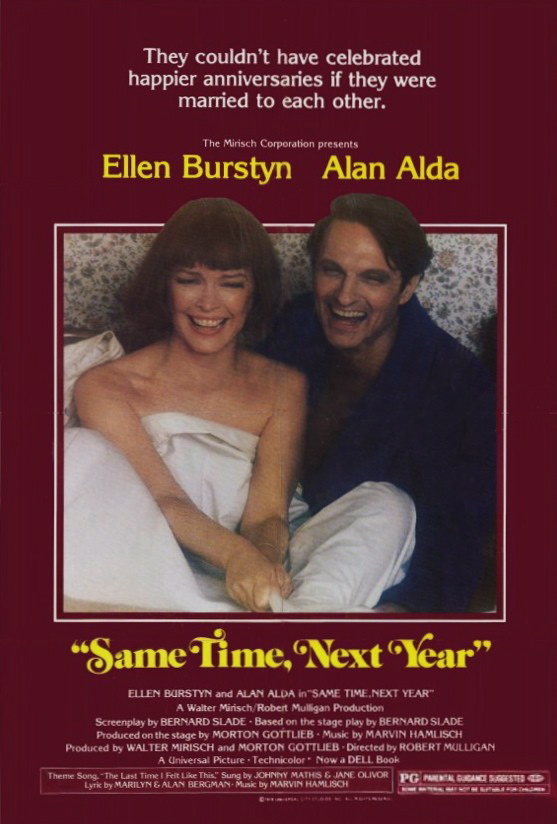
Same Time, Next Year (1978)


          A tidy romantic dramedy that’s become a staple for regional-theater revivals, Bernard Slade’s play Same Time, Next Year is built around the simple gimmick of checking in with a couple every five years over the course of the two decades in which they meet for annual adulterous trysts. Both are happily married, and we’re meant to like them because they didn’t mean to fall in love with each other during their first chance meeting, so the play gives two actors equally sized roles that are sympathetic and textured. Whether the roles are actually substantial is debatable, and the superficiality of the piece is particularly evident in the film adaptation.
          Penned by Slade with few adjustments for cinematic presentation, and directed with characteristic sensitivity by Robert Mulligan, Same Time, Next Year stars Ellen Burstyn, a holdover from the Broadway production, and Alan Alda, a replacement for the stage show’s leading man, Charles Grodin. Seen outside of the confines of a live theater, where the combination of star power and Neil Simon-esque writing probably made the play go down quite smoothly, Same Time, Next Year seems contrived and shallow, even though it’s consistently entertaining.
          Since Doris (Burstyn) and George (Alda) meet in the early ’50s and the final scene takes plays in the mid-’70s, Slade uses the characters as prisms for historical milestones: Doris goes through a hippie phase before embracing Women’s Lib, while George transitions from uptight conservatism to mind-expanding liberalism after his family is affected by the Vietnam War. Simply by virtue of how much time they spend onscreen, Doris and George emerge as (somewhat) specific individuals, but they’re also vehicles for Slade’s vanilla speechifying about the Big Issues of the ’50s, ’60s, and ’70s.
          This introduction of sociopolitical heft into the story, particularly during the second half, is helpful because the cutesy trope of Doris and George meeting for sex once a year would have lost its romantic fizz otherwise. Echoing a problem found in Simon’s work, however, Same Time, Next Year ends up in narrative limbo, neither deep enough to be meaningful nor sufficiently uproarious to be a comedy classic. It’s merely pleasant, with an endearing core of reflection and sweetness.
          That said, the piece is elevated by expert acting: Burstyn infuses the movie with femininity and warmth, illustrating the myriad ways women’s roles in American life changed in the postwar era, and Alda delivers his signature mixture of gently neurotic intellectualism and pitch-perfect comic timing. Thanks to their work and Mulligan’s careful dramaturgy, there’s enough humanity amid the slick professionalism to make this film worthwhile.

Same Time, Next Year: GROOVY

Wednesday, August 10, 2011

The Glass House (1972)


          For an early-’70s social-issue telefilm, The Glass House has an impressive pedigree: Truman Capote co-wrote the story, and ace scribe Tracy Keenan Wynn (The Longest Yard) wrote the teleplay. Alan Alda stars as Jonathan Paige, a college professor convicted of manslaughter for inadvertently killing the man who injured Paige’s wife in a car accident. He’s sent to prison on the same day that an idealistic guard, Brian Courtland (Clu Gulager), starts work at the institution, and as these unsuspecting men fall into the web of corruption and violence spun by prison overlord Hugo Slocum (Vic Morrow), a brutal killer incarcerated for life, the heroes come to realize the hopelessness of escaping, much less changing, the merciless status quo inside the big house.
          Paige’s descent is tied to the abuse visited upon a sweet-faced young man (Kristoffer Tabori) whom Paige fails to protect, and Courtland’s disillusionment stems from his realization that the aged warden (Dean Jagger) is content to let inmates kill each other. Unobtrusively directed by journeyman helmer Tom Gries, the picture moves at a strong pace from the bleak opening sequence to the horrific finale, making a simple statement about the seeming impossibility of retaining humanity inside a maximum-security lockup.
          Abetted tremendously by Alda’s characteristically sensitive performance, the script does a strong job of depicting Paige as a man who can’t win: Keeping to himself doesn’t steer the professor clear of danger, and neither does taking a principled stand. What’s more, the script expertly weaves together various strong personalities, with Morrow commanding the screen as a predatory monster, and Tabori giving a poignant turn as innocent doomed by circumstance. Billy Dee Williams shows up in an important featured role, and the film slyly employs his super-cool swagger to present a complex character who’s part peacenik, part revolutionary, and part straight-up badass. Depressing but focused and purposeful, The Glass House is solid stuff.

The Glass House: GROOVY