Showing posts with label frank perry. Show all posts

Wednesday, August 2, 2017

Man on a Swing (1974)


          Using a murder mystery to draw viewers into the peculiar life of a factory worker who claims to have ESP, Man on a Swing is among the most unusual detective films of the ’70s. Although clairvoyance was not uncommon as a plot device in cop shows of the same era, Man on a Swing offers multiple levels of psychological weirdness, depicting not only the strangely contoured existence of the self-proclaimed psychic but also the ways that his presence affects the tightly wound policeman investigating the murder. Perhaps the most noteworthy aspect of the picture is Joel Grey’s performance as the mentalist—this was Grey’s most significant screen work in the immediate aftermath of his Oscar-winning turn in Cabaret (1972). Although Grey’s portrayal is not wholly compelling, it’s interesting to watch this film and wonder where his career might have gone if his focus had been screen work, rather than stage acting. Whether he’s creepily riding a swing while talking about murder or throwing himself against walls during trances, Grey seems game for just about anything.
          Allegedly based on a true story, the movie begins with police detective Lee Tucker (Cliff Robertson) investigating the murder of a young woman. Clues lead nowhere until Franklin Wills (Grey) comes forward, claiming he’s psychically aware of helpful information. What ensues is a bizarre dance between the characters, because even as Lee wrestles with frustration over the slow-moving investigation and marital tensions at home, he grows to believe that Franklin knows about the murder not for supernatural reasons but because Franklin was involved. Concurrently, Lee experiences harassing phone calls, so he becomes convinced that Franklin is playing some sort of mind game.
          In its best moments, Man on a Swing is eerie and offbeat, with flashes of unnerving saw music by composer Lalo Schifrin juicing the mood. In its worst moments, of which there are many, the movie becomes tedious. Long passages elapse with nothing much happening, creating the impression that Lee sits around waiting for Franklin to make the next move—not exactly the formula for exciting cinema. Director Frank Perry, partway through a unique run that includes The Swimmer (1969), Diary of a Mad Housewife (1970), and Rancho Deluxe (1975), displays his usual knack for unexpected moments, but his failure to render the satisfying rhythms of a whodunit is a fatal flaw. Not helping matters is Robertson’s somnambulistic leading performance, because his low energy compounds the problems of a poorly conceived characterization. Grey ends up dominating Man on a Swing by default, but even he is trapped by the limitations of the script.

Man on a Swing: FUNKY

Saturday, July 20, 2013

Rancho Deluxe (1975)


          Because novelist/screenwriter Thomas McGuane’s literary voice was such an enjoyably eccentric component of ’70s cinema (his big-screen work tapered off in subsequent decades), it doesn’t really matter that ’70s films bearing his name have weak stories. What the pictures lack in narrative momentum, they make up for in personality. Rancho Deluxe, written by McGuane and directed by the adventurous Frank Perry, is an offbeat modern Western that’s a comedy by default—which is to say that while the movie has amusing elements, it’s primarily a character study. Jeff Bridges and Sam Waterston play Jack and Cecil, low-rent cattle rustlers plaguing a ranch owned by the vituperative John Brown (Clifton James). Eventually, John gets fed up with losing livestock and hires thugs to apprehend the rustlers. First come inept ranch hands Burt (Richard Bright) and Curt (Harry Dean Stanton), both of whom are too horny and lackadaisical to devote much energy toward criminal investigation. Then John brings in a thief-turned-detective, Henry (Slim Pickens), whose idiosyncratic approach mostly involves setting traps and waiting for the rustlers to stumble across his path. Also thrown into the mix are John’s short-tempered wife, Cora (Elizabeth Ashley), and Henry’s hot-to-trot daughter, Laura (Charlene Dallas).
          McGuane mostly eschews dramatic tension, opting instead for closely observed scenes of quirky characters behaving in ways that reveal their nature. There’s a great bit, for instance, when Jack and Cecil kidnap a car and shoot it full of holes, partially to make a point and partially to pass the time. In moments like this, McGuane’s script captures the slow rhythms of rural life, as well as the bedrock Western virtue of rugged individualism. In scene after scene, McGuane ensures that his characters evince surprising dimensions. Consider party girl Mary (Maggie Wellman), who reveals unexpected cultural sophistication with her comment about a dinner spread: “This is a weird mixture of yin and yang—so many animal karmas have bit the dust here.” Elsewhere, Stanton’s character tries to look macho while standing outside John’s mansion and running a vacuum over an Indian rug per instructions from the lady of the house. Virtually every minute of Rancho Deluxe is interesting in some way or another, but that’s not quite enough to compensate for the generally aimless feel of the piece. Nonetheless, there’s a lot to enjoy thanks to McGuane’s quirky writing and the generally lively performances. Pickens and Stanton are the standouts, with Pickens’ down-home bluster and Stanton’s laconic vibe suiting the material especially well, though Bridges, James, and Waterston each provide likeable characterizations.

Rancho Deluxe: FUNKY

Monday, December 3, 2012

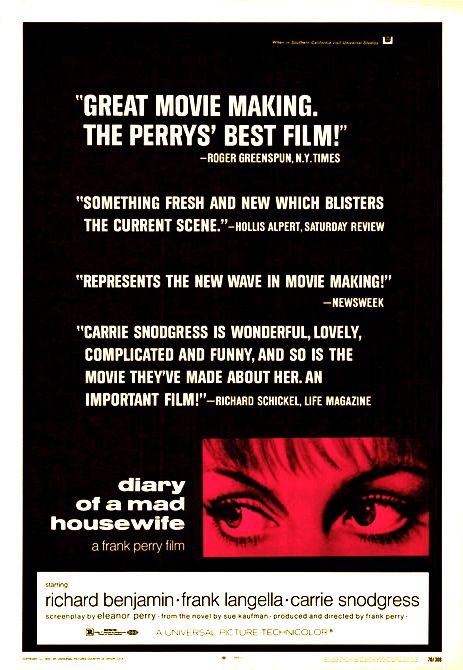
Diary of a Mad Housewife (1970)


          New York director Frank Perry’s films tended toward pretentiousness, but amid his arty flourishes he demonstrated a fine gift for guiding performances, especially by actresses. Thus, it’s no surprise that his most widely admired film, Diary of a Mad Housewife, is virtually a one-woman show for leading lady Carrie Snodgress. With Perry’s sympathetic but unflinching camera studying every nuance of her suffering, Snodgress plays Tina Balser, the underappreciated spouse of successful young attorney Jonathan Balser (Richard Benjamin). Jonathan is an asshole of the first order, a name-dropping narcissist obsessed with professional and social advancement; he alternately treats Tina as a sex toy, a shrink, a slave, a sounding board, and a subject for psychological abuse. In the film’s arresting opening scenes, Perry and screenwriter Eleanor Perry (the director’s then-wife) succinctly illustrate every aspect of the Balsers’ suffocating lifestyle—we’re so primed for Tina’s escape from Jonathan’s oppression that when she meets a potential partner for an adulterous tryst, it feels like a triumphant moment.
          Alas, Tina’s would-be paramour, writer George Prager (Frank Langella), is merely a different breed of asshole. One of those smug swingers who justifies his callous behavior with fancy language about surmounting bourgeois hang-ups, George treats Tina tenderly when they’re in bed, and abysmally when they’re not. The journey of the movie is Tina’s quest for some kind of validation—whether it’s George complimenting her lovemaking or Jonathan recognizing the work she invests keeping their household afloat—because she’s beyond desperate for evidence proving her life means something. The fascinating quality of Diary of a Mad Housewife is that Tina never really snaps, which would have been the predictable path for the story to follow; instead, even when Jonathan belittles her in front of their two impressionable daughters, Tina barks but doesn’t bite.
          Emboldened by her adultery, however, she relishes keeping a secret from her schmuck spouse, and interesting questions get raised about how deeply Tina savors the creature comforts Jonathan’s success provides—has she been co-opted by the status-symbol system that’s oppressing her?
          Benjamin is terrific here, transforming obsequiousness into an art form, and Langella, in his first feature, mostly surmounts the overwritten extremes of his role. However, since she’s in nearly every scene, it’s all about Snodgress, who came virtually out of nowhere to score in this movie—her previous screen credits comprised a handful of minor guest shots on television. Snodgress’ relatable vulnerability earned the actress a Golden Globe award and an Oscar nomination. Following a second 1970 feature and a 1971 telefilm, though, Snodgress left Hollywood for a long romance with rock legend Neil Young. She didn’t return to movies until 1978’s The Fury, the project that began her transition from leading roles to minor character roles.

Diary of a Mad Housewife: GROOVY

Tuesday, June 28, 2011

Doc (1971)


Yet another in the string of revisionist Westerns designed to upend romantic myths about legendary gunfighters, this soft-spoken drama takes a fresh look at tubercular outlaw “Doc” Holliday and his fateful friendship with lawman Wyatt Earp. Stacy Keach, seething with the quiet intensity that made him one of the most interesting leading men of the ’70s, stars as Doc, and Harris Yulin, better known for the character parts he’s played in countless movies and TV shows, costars as Earp. (A miscast and ineffectual Faye Dunaway appears as Katie Elder, Doc’s lover.) Although Doc covers the same events as most Earp stories—he ruthlessly wields his power as the lawman of Tombstone, Arizona, until a showdown with the violent Clanton clan becomes inevitable—the picture examines the events surrounding the notorious “Gunfight at the O.K. Corral” from a new perspective. Yulin plays Earp as a cold-blooded opportunist using his badge to build a petty empire, and Doc is the thoughtful but troubled friend drawn into Earp’s grudge match. Written by celebrated newspaper columnist and novelist Pete Hamill, the script for Doc is probably too probing and sensitive for its own good—it’s one thing to strip archetypal heroes of their mythic power in order to reveal the flesh-and-blood people behind the legends, but it’s another thing to make them so blandly ordinary that they’re not interesting enough to sustain a feature-length narrative. Matters are not helped by the fact that director Frank Perry is calling the shots. At his best orchestrating pretentious oddities like The Swimmer (1968) and Play It As It Lays (1972), Perry offers no special flair for straight drama or, for that matter, the unique demands of the Western genre. So while admirable for its intentions, Doc isn’t exciting to watch or even particularly memorable, even though the richly textured performances by Keach and Yulin hint at what the movie could have been.

Doc: FUNKY

Thursday, June 9, 2011

Play It As It Lays (1972)


          A pretentious mood piece about a movie star experiencing and recovering from a mental breakdown, this adaptation of Joan Didion’s acclaimed novel is like a high-art version of a Jacqueline Susann novel: The only difference between Susann’s trashy showbiz stories and Didion’s take on sleazy Hollywood is that Didion examines the milieu from a sophisticated psychological perspective.
          Tuesday Weld, one of the fiercest actresses to ever grace the screen, tries valiantly to sculpt a complete character from the discombobulated narrative shards of an unnecessarily arty script by Didion and her husband, novelist John Gregory Dunne, but Weld is held back by the ponderous direction of art-house mainstay Frank Perry (The Swimmer). Similarly, a poignant performance by costar Anthony Perkins is squandered because the film is so preoccupied with European-style abstract editing and overt symbolism that it forgets to simply tell a story.
          Buried amid the auteur-ish muck is a standard-issue Hollywood tragedy about fragile actress Maria (Weld) suffering through a marriage to overbearing film director Carter (Adam Roarke). Maria’s traumas include an abortion; the mental problems of her young daughter, who is institutionalized; and her intense friendship with bisexual producer BZ (Perkins), a doomed drug addict.
          Didion’s book is highly regarded for capturing a moment when promiscuity, psychoanalysis, recreational drugs, and tremendous wealth allowed a generation of Hollywood professionals to indulge themselves to the brink of insanity, but even with Didion and her spouse penning the script, the film version lacks effective cinematic equivalents for Didion’s literary tropes. Therefore, scenes gasp for air while they’re being suffocated with “significance” that viewers can sense but not really understand; it’s easy to envision the sort of Bergman-esque angst that Perry was trying to capture, but he doesn’t have sufficient control over the material to hit that elusive target.
          Amid this slog of a movie, Weld comes off the best, since she has so many opportunities to reveal Maria’s inner demons, and Perkins runs a close second, personifying world-weary soulfulness. Roarke, a cult-fave actor known for offbeat flicks like Psych-Out (1968), gives a credible performance as a domineering artiste, but the script lets him down even worse than it does Weld and Perkins. Play It As It Lays is admirable for what it tries to accomplish, and deeply disappointing for how badly it fumbles the attempt.

Play It As It Lays: FUNKY