Sunday, April 24, 2011
Night of the Lepus (1972)
Saturday, April 23, 2011
Wanda Nevada (1979)
Friday, April 22, 2011
Cuba (1979)
Thursday, April 21, 2011
The Brotherhood of Satan (1971)
Wednesday, April 20, 2011
California Split (1974)
Tuesday, April 19, 2011
The Projectionist (1971)
Monday, April 18, 2011
The Hunting Party (1971)
Sunday, April 17, 2011
Coffy (1973)
Coffy: FUNKY
Saturday, April 16, 2011
Breezy (1973)
Friday, April 15, 2011
Lady Ice (1973)
Thursday, April 14, 2011
Five Easy Pieces (1970)
Wednesday, April 13, 2011
The Last Rebel (1971)
Tuesday, April 12, 2011
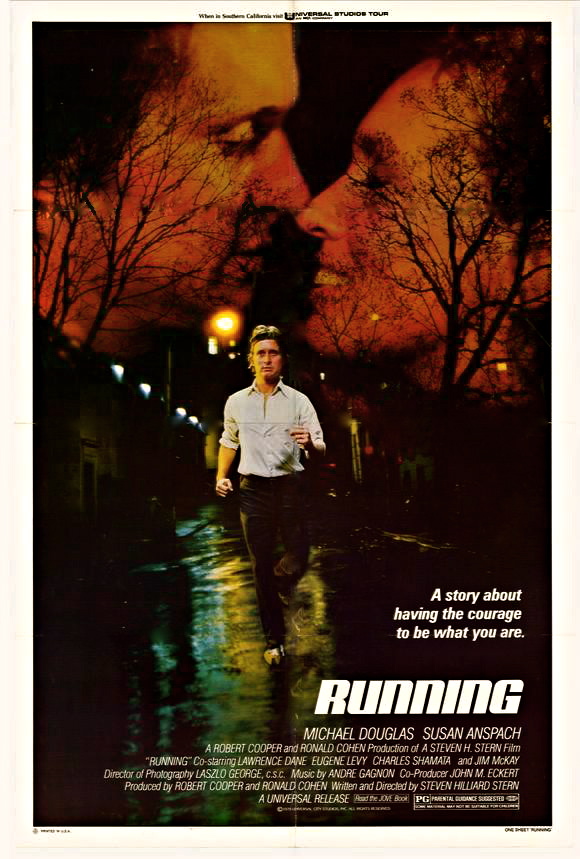
Running (1979)
Monday, April 11, 2011
The Wind and the Lion (1975)
Sunday, April 10, 2011
Joe Kidd (1972)
Possibly Clint Eastwood’s least interesting Western, this threadbare action flick has an impressive pedigree—celebrated novelist Elmore Leonard wrote the screenplay, and macho-cinema veteran John Sturges, of The Magnificent Seven fame, directed. Despite the participation of these boldfaced names plus that of Robert Duvall, who plays the heavy, Joe Kidd tells a forgettable story unimaginatively, so it’s only watchable because of production values, star power, Lalo Schifrin’s assertive score, and Bruce Surtees’s robust cinematography. Also working in the movie’s favor is brevity, since Joe Kidd runs just 88 minutes. After a lugubrious first act, the story gets going when rapacious developer Frank Harlan (Duvall) hires former bounty hunter Joe Kidd (Eastwood) to track Mexican revolutionary Luis Chama (John Saxon), whose rabble-rousing has interfered with Harlan’s schemes. Beyond some minor drama involving Joe’s shifting allegiances, there’s not much more to the plot, so lots of screen time gets consumed by macho posturing and lengthy sequences of characters stalking each other. A probing exploration of frontier morality this is not. One can find glimmers of Leonard’s signature pulpy style in Kidd’s bitchy dialogue, but while the best Leonard-derived Westerns have rock-solid conceits (see both versions of 3:10 to Yuma), the storyline of Joe Kidd is leisurely and unfocused, with characterizations—usually a Leonard strength—given depressingly short shrift.
The movie looks good enough with Surtees behind the lens, though it seems he was asked to light sets more brightly than he usually does and he’s hampered by Sturges’s stodgy compositions. As for the actors, Eastwood conjures a few mildly amusing tough-guy moments, for instance when his character casually sips beer while watching a shootout. Duvall does what he can with a role so trite and underwritten it would stifle any actor, though his trope of mispronuncing the name of Saxon’s character conveys an appropriate level of arrogance. The wildly miscast Saxon snarls lines through a silly Spanish accent, and he also fails to demonstrate the charisma one might expect from a grassroots leader—one imagines that Leonard envisioned a more nuanced portrayal. Adding minor colors to the movie’s canvas are Paul Koslo, Don Stroud, and James Wainwright, who play nasty hired guns. Anyway, while some of the shootouts in Joe Kidd are moderately entertaining, the fact that such incidental details as the use of unusual firearms and an appearance by Dick Van Patten as a hotel clerk stick in the memory more than the main narrative underscore why the watchword here is unremarkable.
Joe Kidd: FUNKY
Saturday, April 9, 2011
Network (1976)
Friday, April 8, 2011
Skyjacked (1972)
Thursday, April 7, 2011
It’s Alive (1974) & It Lives Again (1978)
Wednesday, April 6, 2011
The Neptune Factor (1972)
Tuesday, April 5, 2011
Colossus: The Forbin Project (1970)
Offering an imaginative sci-fi companion to Fail Safe (1964)—the chilling “what if?” drama in which a technological glitch triggers nuclear conflict—this brisk but overly talky thriller imagines what might happen if America relinquished control of its nuclear arsenal to a supercomputer. Setting aside the kitsch factor of now-dated movie imagery featuring a computer so massive it occupies the entirety of a hollowed-out mountain, Colossus has, well, colossal logic problems. The movie assumes that none of the geniuses who built the computer anticipated its likely evolution; that nobody imagined what might happen if similar systems were built by other countries; and that the entire U.S. government okayed a system lacking an “off” switch. (The script provides an explanation for that last item, but the explanation is a dodgy storytelling workaround.) Even with its flaws, however, Colossus is a noteworthy entry in the continuum of stories about the dangers of runaway artificial intelligence, a topic that gains more importance with each passing year.
In the opening scenes, Dr. Charles A. Forbin (Eric Braeden) celebrates the launch of Colossus, a supercomputer authorized by the U.S. government to automate decisions related to the country’s nukes. As explained by Forbin, the idea is that Colossus can cycle through countless potential scenarios in seconds and then take immediate action without the impediment of emotions. Soon after Colossus goes live, America learns the Soviets have a similar system called Guardian, and Colossus demands the ability to communicate directly with Guardian. Unwisely, the American and Russian governments okay the interface, which starts a chain of events that may or may not lead to Armageddon. Meanwhile, Forbin struggles to reclaim control over Colossus, even though he designed the system to resist human intervention. And that’s basically the totality of the narrative, excepting a quasi-romantic subplot involving scientist Dr. Cleo Markham (Susan Clark)—characterization is not a priority here.
Scripted by deft James Bridges (later to make The China Syndrome) and helmed by reliable journeyman Joseph Sargent, Colossus zips along with respectable momentum, notwithstanding the occasional lull. It also boasts consistently intelligent dialogue and a handful of clever maneuvers—for example, the sly means by which Forbin slips information out of the Colossus facility without the pesky computer noticing. The movie also benefits from an exciting and suitably futuristic score by Michael Colombier. Yet the aforementioned logic problems are mightily distracting, and it’s easy to imagine another actor doing more with the leading role than Braeden does. He’s fine whenever scenes require mild derision or smooth charm, but too often his limited range of expression flattens moments that should have radiated tension. Luckily, he’s supported by a deep bench of proficient players, including Georg Sanford Brown, William Schallert, Dolph Sweet, and—in one of those tiny roles that contributes to the epic scope of his filmography—James Hong.
Monday, April 4, 2011
Pulp (1972)
Pulp: FUNKY