Thursday, October 13, 2016

Gang Wars (1976)


The best thing about this wretched hybrid of crime, horror, and martial arts is the name of the leading actor, because it’s hard to top “Warhawk Tanzania.” Incompetently cowritten (with four other people!) and directed by Barry Rosen, the flick opens in China circa 200 B.C., with fanatics performing a deadly ritual near a deep pit. Cut to the present, where Luke (Tanzania) is a martial-arts master in New York City. His student, Rodan (Wilfredo Roldan), gets into a hassle with Chinese gangsters in Manhattan before traveling, with Luke, to Hong Kong for advanced kung-fu training. Rodan stumbles onto the pit from the ritual and accidentally releases a demon, which follows him and Luke back to New York and sets up housekeeping in the city’s subway system. If you’re already confused, join the club. The demon starts murdering folks in the subway, which causes police to suspect gangsters are responsible and eventually leads detectives to Luke and Rodan. None of this makes any more sense onscreen than it does on paper, and Gang Wars—also known as Devil’s Express, hence the above poster—has production values commensurate to its storytelling. Scenes smash together without transitions, repetitive funk grooves make fight sequences feel tedious, and the filmmakers periodically replace production sound with voiceover, which merely adds to the overall awkwardness. The demon bits are ridiculous, culminating with Tanzania kung-fu fighting some dude in a rubber suit, and the highlight—as far as horror goes—is a vignette of a fellow ripping off his own skin while the demon possessing him breaks free. Too infrequently, glimmers of droll weirdness poke through the sludge. NYC freakazoid Brother Theodore plays a priest in one scene, and, in the most enjoyable moment, a crazed bag lady (Sarah Nyrick) harangues strangers on the subway before she’s attacked by the demon. You may find yourself wishing the movie was about the bag lady.

Gang Wars: LAME

Wednesday, October 12, 2016

The Triple Echo (1972)


          Adapted from a short story by H.E. Bates, offbeat WWII drama The Triple Echo would be easier to swallow had it been extrapolated from real events, because the central premise is as far-fetched as the relationships that drive the storyline. Set in the English countryside, the picture concerns Alice (Glenda Jackson), the lonely wife of a soldier being held prisoner overseas by the Japanese. One day, a young solider named Barton (Brian Deacon) wanders onto her remote farm, so she offers him food and lodging. He’s a deserter. Over the course of several weeks together, they fall in love, but Alice worries that neighbors might discover Barton’s presence and shatter their romantic idyll. She contrives the peculiar idea of disguising Barton as her sister, “Jill,” by way of cross-dressing. This works until yet another soldier wanders onto the farm. Arriving astride a tank, he’s a bearish sergeant played by Oliver Reed. (The character never gets a proper name.) Improbably, the sergeant becomes obsessed with “Jill,” and even more improbably, “Jill” accepts an invitation to a military party even though it’s plain the sergeant expects more from “her” than a dance. All spongy narrative contrivances and inorganic motivations, he story wends its way toward a strange type of romantic tragedy, with the gloomy pastures of the hilly countryside serving as some sort of visual metaphor representing loneliness.
          As directed by Michael Apted, whose work is always competent, The Triple Echo moves along as well as it can, given the episodic and incredible storyline. One feels the strain of screenwriter Robin Chapman stretching Bates’ vignette to feature length, and what might have seemed believable on the page is less so onscreen. Jackson attacks behavior and dialogue with her usual consummate skill, but she’s far too chilly to provide the level of emotion necessary for putting the illusion of The Triple Echo across. Likewise, Deacon is a cipher at best and a simpering twit at worst, because his performance gets more and more unsteady as the stakes of the narrative rise. Reed, as was sometimes his wont, barrels through the picture with more energy than nuance, so while he’s credible as an overbearing monster, he steamrolls past the central problem of making viewers believe the sergeant can’t see that “Jill” is a man. Other shortcomings include pedestrian camerawork and some truly atrocious music during upbeat passages—overwrought and twee was not the way to go for scoring what is essentially a tragic chamber piece.

The Triple Echo: FUNKY

Tuesday, October 11, 2016

Fox and His Friends (1975)


          Rainer Werner Fassbinder’s Fox and His Friends offers the sad parable of a simple man who realizes his dreams, only to suffer unexpected consequences. The director plays the starring role, and he occupies an effective performance space blending unaffected looseness with subtle strains of pathos. As the protagonist falls deeper and deeper into a humiliating abyss, with those around him forever preying on his naïveté, we, the viewers, aren’t asked to weep for the character but rather to empathize. This distinction is key, for while Fox and His Friends follows a somewhat conventional narrative path, Fassbinder strives for docudrama realism instead of manipulative melodrama. One could argue the film suffers for this choice, since the ending could have had greater impact, but one could also argue that restraint is what makes the familiar storyline palatable. That is, for viewers who aren’t put off by the story’s gay themes and copious amounts of male full-frontal nudity.
          In modern Germany, Fox (Fassbinder) works as a sideshow attraction in a carnival run by his boyfriend. When the boyfriend is arrested, Fox casts about for his next situation. First he seeks shelter with his alcoholic sister, and then he turns prostitute for men prowling public bathrooms. Optimistic to an almost delusional degree, Fox buys a lottery ticket one day, certain he’ll win. He does, scoring a prize of 500,000 deutsche marks. Most of the film explores how acquaintances react to Fox’s newfound wealth, and because many people behave in predatory ways, a maudlin theme emerges. Fox represents those who believe financial windfalls can fix every problem, but never take the time to learn how money works. Fox’s fortune begins to slip from his hands virtually the moment he takes possession. Also woven into Fassbiner’s depressing story are issues of class. Fox’s first rich patron, Max (Karlheinz Böhm), treats Fox as a sexual plaything barely worth contempt until Fox becomes rich. The protagonist’s second patron, Eugen (Peter Chatel), behaves even more callously, convincing Fox to make a huge business investment. Desperate to find a place among the sophisticated set, Fox plays along until he realizes he’s being used, but by that point, his self-image has suffered irreparable harm.
          In the merciless way of his best stories, Fassbiner takes Fox’s decline to a logical conclusion, so viewers shouldn’t look for the glimmers of hope a Hollywood version of similar material would surely provide. The aforementioned homoerotic content provides more than titillation, because the othering of gays in West German society circa the mid-’70s is an important component of the storytelling. Fox discovers how those above his social station mask themselves in the name of assimilation, and he also discovers what happens when straight society sees through those masks. Additionally, a sequence set in Morocco reinforces the trope of sex workers desperate to escape, or at least survive, poverty by any means possible.

Fox and His Friends: GROOVY

Monday, October 10, 2016

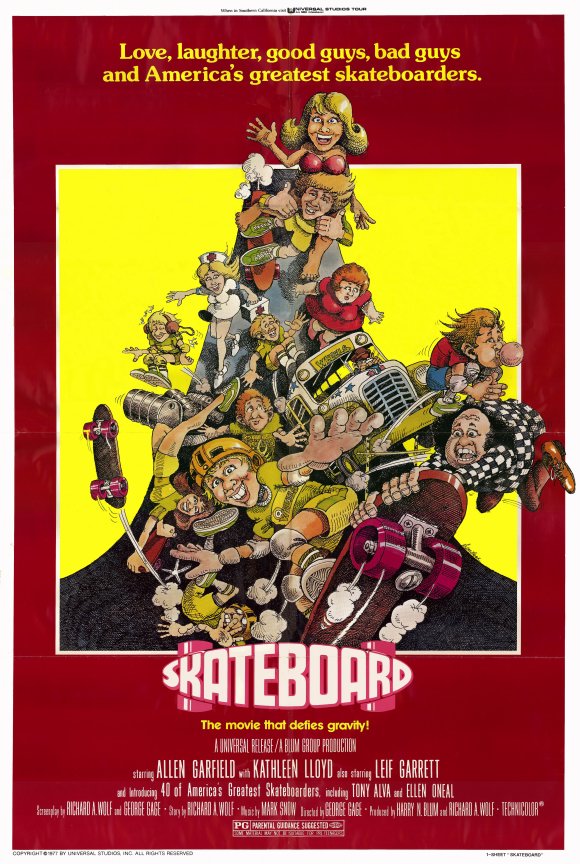
Skateboard (1978)


Cheap-looking, derivative, and superficial, Skateboard borrows myriad elements from The Bad News Bears (1976), but fails to mimic that picture’s nuanced characterizations. Instead, Skateboard tells a drab seriocomic story about a shady talent representative exploiting talented teenagers. And because cowriter/director George Gage uses lengthy scenes of kids performing skateboard tricks to pad the movie’s running time, he’s in the exploitation business, too—he seems to believe that fans of skateboarding should be satisfied with any old movie containing ramp rides and walking-the-dog routines. The cast mostly comprises unskilled juvenile actors, abrasive character actor Allen Garfield plays the leading role. He’s a poor substitute for Bad News Bears star Walter Matthau. Whereas Matthau leavened his cantankerous characterization with glimmers of empathy, Garfield spends so much time hurling invective at his costars that he’s unpleasant to watch. And at the risk of body-shaming, he looks like a predator when he’s surrounded by gleaming California kids, seeing as how he’s a pasty blob of a man with a horrific combover. The gist of the piece is that low-rent agent Manny Bloom (Garfield) owes money to a crook, so when he spots kids skateboarding in his neighborhood, he abruptly forms a team called the Los Angeles Wheels. Predictable complications ensue. Star athlete Jason (Richard Van der Wyk) rebels, an injury sidelines another player, and Manny has trouble keeping the kids under control while traveling. Eventually, he hires an attractive nurse, Millicent (Kathleen Lloyd), resulting in a dubious romantic subplot. Underscoring the tedium is lots of shrill pop/rock music, with several songs shrieked by future Jefferson Starship vocalist Mickey Thomas.

Skateboard: LAME

Sunday, October 9, 2016

The Garden of the Finzi-Continis (1970)


          Winner of the Academy Award for Best Foreign Film, stately drama The Garden of the Finzi-Continis explores tensions among wealthy Italian Jews during the run-up to World War II, when Benito Mussolini escalated an ethnic-cleansing campaign in lockstep with the anti-Semitic purge wrought by the Nazis in Germany. Adapted from a novel by Giorgio Bassani and directed with rarified style by Vittorio De Sica, The Garden of the Finzi-Continis is a melodrama with a social purpose, so every scene of interpersonal friction and romantic strife is shot through with foreshadowing. Some characters see where things are headed while others play ostrich, so viewers get a close view at what happens when citizens rebel against totalitarianism and what happens when citizens spend too long ignoring the storm clouds gathering overhead. Many, many films explore similar terrain, and some—notably Bob Fosse’s Cabaret (1972)—inject the American perspective for a broader geopolitical view. Perhaps because of its narrow focus on the moneyed class, The Garden of the Finzi-Continis lacks gut-punch impact. Nonetheless, the question of how societies allow demagogues to gain power is one of timeless importance, and De Sica dramatizes issues with intelligence and precision.
          At the beginning of the story, young adults from throughout the city of Ferrara meet in the sprawling private estate of the Finzi-Contini family for leisurely games of tennis. (Among the story’s central metaphors is the notion of a walled-in compound as a island of tolerance in a sea of hateful madness; it’s the familiar binary argument of involvement versus isolation.) Though he inhabits a slightly lower social station, Giorgio (Lino Capolicchio) is in love with Micòl (Dominique Sanda), eldest daughter of the Finzi-Contini family and also his friend since childhood. Yet she’s drawn the handsome and politically expedient Malnate (Fabio Testi), and the situation is complicated by Micòl’s concern for her frail brother, Alberto (Helmut Berger), another childhood friend of Giorgio’s. Adding more layers to the narrative are scenes set in Giorgio’s home, since his father (Romolo Valli) champions Mussolini. In fact, the father joins the Fascist Party, somehow believing he can stop the spread of anti-Semitism from within the political machine.
         Those with a strong grasp of world history will get more from The Garden of the Finzi-Continis than others, since the movie’s philosophical debates occur on an elevated plane. Similarly, the narrative’s symbolism is intricate and subtle, so those looking to be lead by the hand toward one viewpoint or another will be lost. The broad strokes are plainly evident, but The Garden of the Finzi-Continis explores incremental differences between people who share many common values, rather than outright conflict between oceans-apart enemies. Undoubtedly, that’s why the picture enjoys its enviable reputation. By surgically extracting a sample of diseased tissue, De Sica and his collaborators explore something even more troubling than the rise of tyrants—the ease with which tyrants can seize control while those with the most cultural and economic influence are distracted by petty strife. 

The Garden of the Finzi-Continis: GROOVY

Saturday, October 8, 2016

The Class of Miss MacMichael (1978)


          Offering a seriocomic look at troubles plaguing a British school for maladjusted students, The Class of Miss MacMichael touches on issues to which viewers anywhere can relate, such as the challenges of working for autocrats and the difficulty of inserting individualism into inflexible institutions. Glenda Jackson, all fire and idealism, plays Conor MacMichael, one of the school’s teachers. She’s a caring educator who embraces the radical idea that treating young people with respect might compel them to work hard, so her natural enemy is Terence Sutton (Oliver Reed), the school’s unfeeling headmaster. He views students as little more than discipline problems, so he uses intimidation and punishment to quell rebelliousness. There’s never much doubt where the filmmakers’ sympathies lie, and Reed plays his role in such a flamboyant style that the headmaster is too cartoonish to take seriously. Given this imbalance, The Class of Miss MacMichael doesn’t offer many real insights or surprises. It’s a position paper with a few jokes and some melodrama. That said, Jackson, as always, is a commanding screen presence, so she imbues the movie with humor, ferocity, and passion.
         As for the plot, don’t expect much, since The Class of Miss MacMichael has an episodic structure. Conor bonds with her students, counseling a promiscuous girl about sex and trying to keep a mentally challenged boy out of trouble, even as the headmaster imposes strict rules and threatens Conor’s job security. Meanwhile, Conor blends her personal and professional lives by involving her American boyfriend, Martin (Michael Murphy), in activities with her students. Among Conor’s few allies at work is Una (Rosalind Cash), an American teacher with a knack for managing the mentally challenged boy’s periodic meltdowns. Although The Class of Miss MacMichael feels longer than its 94 minutes thanks to the lack of a compelling overarching storyline, most of the film’s vignettes are interesting. Scenes with Jackson overseeing controlled chaos feel credible, and Murphy’s affability adds a pleasant color whenever he’s onscreen. Reed, however, seems as if he’s in a different movie, though he shares blame for his over-the-top performance with director Silvio Narizzano, who should have recognized that Reed’s campy style clashes with the straightforward work of the other actors. In one scene, for instance, Reed’s character literally knocks the heads of two students together.

The Class of Miss MacMichael: FUNKY

Friday, October 7, 2016

Going Places (1974)


          In some ways, the loathsome protagonists in French director Bertrand Blier’s gonzo dramedy Going Places are cousins to the madman played by Malcolm McDowell in A Clockwork Orange (1971). Like McDowell’s character Alex, the hedonists in Going Places move through the world on pure instinct, stealing anything they want, destroying property when the mood strikes them, and using women as unfeeling receptacles for their hateful lusts. Yet while Alex occupies a world of consequences, the buddies in Going Places roam free, so it’s difficult to understand what sort of statement Blier, who adapted the movie from his own novel, wanted to make. Similarly, it’s tough to accept the notion that Going Places elevated Gérard Depardieu to star status. He’s extraordinarily loose and naturalistic in Going Places, so it’s not as if the film fails to showcase his talents. The question is why audiences responded to such a deeply unsympathetic character. De gustibus non est disputandum.
          Jean-Claude (Depardieu) and Pierrot (Patrick Dewaere) travel through France looking for adventures, sex, and thrills, usually making their way from one place to the next by robbing pedestrians or stealing unattended vehicles. One night, while burglarizing a shop that belongs to a pimp, they kidnap a prostitute named Marie-Ange (Miou-Miou). During the crime, Pierrot gets shot in the testicle, though he later rallies his energy to rape Marie-Ange. Afterward, he complains that she’s sexually unresponsive. Inexplicably, she finds the abuse endearing, so before the boys release her, she obliges their request to “touch her ass hairs” for luck. And this is only the first half-hour of the picture, which gets more depraved with each passing moment. In one scene, the degenerates pay a sexy young mother to let them suck her breasts for milk, and in another, Jean-Claude rapes Pierrot because, they, that’s what friends are for. Following a strange and tragic episode with a recently paroled criminal, played by the great Jeanne Moreau in an affront to her cinematic dignity, the boys reconnect with Marie-Ange, since they want to provide her as a sexual plaything for a young man of their acquaintance. Oh, and at some point the lads kindly deflower a virgin, played by Isabelle Huppert in an early role, and, naturally, she thanks them for the courtesy.
          In nearly any other movie, characters behaving this way would be portrayed as sociopaths, but given the lightness of touch he applies to his storytelling, Blier seems determined to portray his vile protagonists as playful anarchists. While it’s dangerous to view Going Places through the narrow prism of conventional American morality, whatever that phrase means, the sheer amount of damage inflicted by the men in Going Places is shocking, so the movie begs for contexualization.
          Setting aside larger questions, the film has virtues that surpass its bizarre narrative. Some of the performances are lively, while others, including Moreau’s, are intriguingly stylized. Peppy jazz-guitar musical interludes by Stéphane Grappelli add bounce, particularly when coupled with Blier’s technique of using scene transitions to create visual punchlines. Furthermore, cinematographer Bruno Nuytten’s lovingly crafted images exude warmth. It’s possible there’s a provocative satire buried somewhere inside Going Places, and the film unquestionably skewers the cosmic joke known as the male animal. (The original French title translates to The Testicles.) Yet even though Going Places is weirdly compelling thanks to jaunty pacing and provocative events, it’s nauseating to watch two hours of men cheerfully abusing women. Make what you will of the fact that Depardieu, notorious in real life for boorish behavior, later made seven more movies with Blier.

Going Places: FREAKY

Thursday, October 6, 2016

A Labor of Love (1976)


          Analyzing the documentary A Labor of Love is a tricky business. Brief but focused and interesting, it’s a movie about movies, tracking production of a low-budget indie called The Last Affair that was made in Chicago, and the documentarians capture elements of artistic obstacles, cast misbehavior, financial pressure, sudden production problems, and the tedium of creating films one camera angle at a time. None of that, however, suggests the film’s main hook and the reason why it’s so complicated to discuss. Prior to principal photography on The Last Affair, backers told director Henri Charr to include hardcore sex scenes or else kiss his budget goodbye—so by the time documentarians Robert Flaxman and Daniel Goldman began filming life on the set of The Last Affair, they had become journalists tracking the creation of pornography.
          This turn of events created two problems, both intermingled with aesthetic and social considerations. Firstly, because A Labor of Love concerns a “real” movie that morphed into porn, A Labor of Love isn’t truly a documentary about the “porn chic” movement that thrived during the early ’70s. There’s a big difference between this film’s squirm-inducing scenes of uninhibited men and women screwing on camera and, say, fly-on-the-wall coverage of professional adult-film stars grinding away on a soundstage in Southern California. A Labor of Love illustrates the surreal working conditions of porn sets without saying anything about the porn industry. Secondly, the documentarians cross enough lines of decorum and good taste to become pornographers themselves. During its theatrical release, A Labor of Love carried an X-rating because it features countless closeups of female genitalia, as well as male-gaze favorites including female masturbation and attractive women receiving oral sex. Yet there’s barely more than a fleeting glimpse of male frontal nudity, suggesting the documentarians felt the true value of their work wasn’t satisfying intellectual curiosity, but rather inspiring hard-ons.
          The most frustrating thing about A Labor of Love is that it’s made well. The on-set footage is steady and vivid, no easy feat given all the chaos and varying lighting patterns of an active film set, and the sit-down interviews are revelatory, with Charr discussing his anguish about the porn requirements and actresses sharing regret after filming exploitive scenes. Parsing the respectable documentary buried inside the skin show, the best moments involve a hopped-up stud failing to rouse—necessitating the use of a stand-in—and the use of liquid soap to create a skeevy cinematic illusion. Although A Labor of Love lacks all sorts of important context, including postmortem interviews exploring what happened with The Last Affair, it conveys some truth, as when a crew member remarks that filming coitus is like making an industrial film, all numbing repetition. Heavy on the labor, light on the love.

A Labor of Love: FUNKY

Wednesday, October 5, 2016

The Inheritance (1976)


          Despite Anthony Quinn’s top billing, this trashy melodrama is a vehicle for glamorous French actress Dominique Sanda, who plays a money-hungry vixen sleeping her way through a dysfunctional family while trying to seize control of a fortune. Produced in Italy and shown on American screens with some iffy dubbing transforming supporting players into English-language speakers, the picture evokes novelist Harold Robbins style of sexualized upper-class intrigue, although it’s a period piece instead of a modern story. Together with gauzy cinematography, extensive location photography, and relatively ornate production design, the vintage setting gives the piece a deceptive quality-cinema veneer. For while the characters are credible, the narrative is logical, and the themes are serious, the movie slides into the gutter at regular intervals. Director Mauro Bolognini spends almost as much time pointing his camera at Sanda’s naked body as he does recording her actual performance, and the way her character uses sex ensures that most of the movie feels lurid. Sure, Robbins often took similar material to even sleazier places, but it’s really just a matter of degrees.
          Set in the late 19th century, the film begins abruptly, with cruel patriarch Gregorio (Quinn) announcing that he’s dissolving the family business, a huge commercial bakery, and giving his three adult children their inheritances while he’s still alive. Long-suffering elder son Pippo (Gigi Proietti) gets a pittance, handsome Mario (Fabio Testi) receives only repayment of his massive gambling debts, and daughter Teta (Adriana Asti) gets nothing because Gregorio dislikes the man she married. Set adrift, Pippo starts a hardware business and marries the beautiful Irene (Sanda), who seems like a saint at first blush, given how she mediates various squabbles between the siblings. Alas, Pippo discovers her true character once he realizes that Irene is sleeping with Mario. Later, she makes her way into Gregorio’s bed, though it’s never clear whether that was her plan all along or whether she simply pursued an opportunity once it became visible. Although it’s made skillfully, The Inheritance is forgettable. Among other problems, it’s impossible to root for any of the characters, who run the gamut from avaricious to entitled. Moreover, while Sanda possesses a certain kind of regal allure, she’s too much of an ice queen to generate empathy. Go figure that she won the Best Actress prize at the 1976 Cannes Film Festival for her work in The Inheritance

The Inheritance: FUNKY

Tuesday, October 4, 2016

Sometimes Aunt Martha Does Dreadful Things (1971)


          This low-rent Floridian exploitation flick presents an offbeat pastiche of crime, gore, melodrama, and same-sex relational dynamics. Yet Sometimes Aunt Martha Does Dreadful Things isn’t quite as weird a viewing experience as you might imagine. Instead, it’s alternately droll and tedious and unpleasant. Scenes of two male criminals bickering at each other like an old married couple approach camp, even though the conflict between a repressed psychopath and a slovenly thug is quite grim; drab sequences of cops searching for clues chew up screen time without adding much; and bloody murder vignettes, often tweaked with solarization effects, repulse in typical grindhouse fashion. Cheap production values, some shoddy performances, and ugly cinematography add to the generalized sleaziness of the piece. While Sometimes Aunt Martha Does Dreadful Things tells the creepy story of a dysfunctional relationship triggering a string of murders, it’s exaggerating to say there’s a real movie in here somewhere. Nonetheless, the filmmakers exhibit a small measure of curiosity and imagination, even if they lack skill.
          Paul (Abe Zwick) and Stanley (Wayne Crawford) killed someone up north and fled to Florida, where Paul put on women’s clothes and assumed the identity of Stanley’s “Aunt Martha.” The idea is to create the illusion of a quiet suburban existence until they can slip back into society as themselves, but problems emerge. A pesky neighbor tries to make friends with the reclusive Martha, and Stanley is too undisciplined to maintain the ruse. He refuses to cut his hair or ditch his counterculture wardrobe, he slips out of the house on a regular basis to chase local chicks, and he treats Paul/Martha like a nagging spouse. Stanley’s sex life is of particular interest, since the filmmakers make a point of showing his inability to go all the way with compliant lovelies, and they also show him in bed with Paul/Martha. Therefore, the dreadful things of the title come across as manifestations of Paul’s jealous rage. Things get extreme during the climax, which involves a C-section, sadomasochism, and a van covered with pastel-colored peace signs.
          Is Sometimes Aunt Martha Does Dreadful Things yet another wrongheaded movie presenting the stereotype of gays as deviants? Yes and no. Somehow, the picture is simultaneously a misguided attempt at telling a serious story, an unfunny pass at comic material, a transgressive spin on familiar B-movie tropes, and a vulgar blast of sex and violence. As such, it’s uncommon without actually being special.

Sometimes Aunt Martha Does Dreadful Things: FUNKY

Monday, October 3, 2016

Savages (1974)


          Months after playing a howling-mad psycho in the telefilm Pray for the Wildcats, Andy Griffith took more subdued approach to playing a killer in another telefilm, Savages. Slight but unnerving, Savages was based upon a novel by Robb White, and it tells the threadbare story of a hunter who accidentally kills an innocent man, then tries to frame his guide for the crime. Since the story lacks the element of mystery—viewers never doubt whether Griffith’s character was responsible—the vibe is more pressure cooker than whodunit, so the material might have worked better as, say, a one-hour episode of Night Gallery. Even though Savages runs just 74 minutes, it feels padded, especially during the long, long sequences of the guide struggling to survive in the desert while the hunter plays cat-and-mouse games. Extending the story to full telefilm length also exposes some iffy narrative mechanics to scrutiny. The trick for telling stories about villains toying with victims involves providing a persuasive explanation for why the villain doesn’t simply kill his or her adversary, and Savages never does that. As a result, Savages is merely disposable escapism.
          Griffith plays Horton Madec, a big-city lawyer with a bum leg. After using is influence to get a license for killing a big-horn sheep, he travels to the California desert only to find that the guide he originally hired is unavailable. Lucky for Horton, Ben Campbell (Sam Bottoms) has time on his hands. A young animal enthusiast who strikes locals as eccentric because of his fixation on vultures and other desert critters, he knows the land but doesn’t groove on killing protected animals, no matter the circumstances. Yet Horton twists his arm with cash, so off they go. The minute Horton spots a ram on a hilltop, he gets carried away and fires blindly, hitting and killing an old hermit. When Ben refuses to help cover up the death, Horton forces Ben to flee at gunpoint, the idea being that Ben will die of exposure before reaching civilization, allowing Horton to spin a yarn about Ben committing the murder and going crazy afterward. As directed by the experienced Lee H. Katzin, Savages is workmanlike at best, with some sequences suffering for lack of narrative excitement and visual creativity. However, the picture starts well and ends well, its third act effectively complicating the storyline. Better still, Bottoms complements Griffith’s restrained villainy with sweet vulnerability, so watching Savages conjures images of Sheriff Andy Taylor torturing Opie. Sometimes, casting against type works wonders.

Savages: FUNKY

Sunday, October 2, 2016

The Twist (1976)


Recalling the production of this obscure European sex comedy in his memoirs, Bruce Dern admits “I didn’t really get what the movie was getting at until about two-thirds of the way through.” In fact, most of the chapter Dern devotes to The Twist concerns meals, Parisian weather, director Claude Chabrol’s preoccupation with complicated camera movements, and a weird episode with Ann-Margret and her husband at a nightclub. Watching The Twist, you’ll quickly understand why the circumstances of the picture are more interesting than the picture itself. A dull would-be farce about rotten people cheating on each other, the movie concerns an American writer (Dern), his French wife (played by Chabrol’s real-life spouse, Stéphane Audran), and their various extramarital entanglements. Ann-Margret plays the writer’s mistress. The wife fantasizes about killing the mistress, and the husband has a fever dream about all the women in his life—including his hot stepdaughter—molesting him before the wife shows up to cut off his manhood with a pair of scissors. (Not exactly Mr. Subtlety, Chabrol juices this sequence with a closeup of a fake penis becoming engorged, lest the audience somehow misread the wife’s intentions when she shows up with the scissors.) The Twist is not wholly negligible, because Dern plays his role with intensity (perhaps too much so); the production values are slick; and there’s a lot of fodder for the male gaze, with Sybil Danning as a flirty secretary and Sydne Rome as the stepdaughter. Additionally, scenes depicting the marital dynamic between the main characters exude believable hostility, with the husband coming across as a self-involved prick while the wife comes across as a shrew desperate to be tamed. (Wait, you’re surprised that a sex farce from a French director born in 1930 has gender politics from the Stone Age?) Nonetheless, beyond those eager to see everything Chabrol or Dern ever made, it’s hard to imagine many viewers finding the stamina to endure all 107 minutes of The Twist.

The Twist: LAME

Saturday, October 1, 2016

Three Tough Guys (1974)


          Partly a blaxploitation thriller but mostly a failed attempt to give European star Lino Ventura some international crossover appeal, Three Tough Guys—sometimes known as Tough Guys—contains about two-thirds of a moderately entertaining movie. The first stretch of the picture, setting up a convoluted plot involving various parties connected to stolen loot, is murky and tedious, too many disconnected events and not enough character development. Things pick up during the second stretch, when an ex-cop allies with a rough-and-tumble priest to search for clues. And then, in a case of too little too late, things finally resolve into proper thriller mode during the last stretch, when the ex-cop and the priest square off against a swaggering criminal. Typical of the movie’s shortcomings is the number of scenes without musical scoring, because the producers hired Isaac Hayes as both composer and costar, then failed to fully utilize his talents for manufacturing industrial-strength funk. It says a lot about Three Tough Guys that the most enjoyable sequence is a nothing vignette of a car driving across town, simply because that’s when Hayes gets to unleash a thumping R&B theme without any interruptions. Costar Fred Williamson is squandered, too, since he’s barely the first hour.
          Set in Chicago, the picture revolves around the theft of $1 million, the murder of an insurance investigator, and various other narrative threads that fail to generate much interest. For reasons that are never particularly clear, Father Charlie (Ventura), an ex-con and ex-prizefighter, defies his monsignor’s directives by investigating the theft/murder/whatever. Over the course of several days, he sees a mysterious black dude watching him, and the dude, Lee (Hayes), asserts himself just in time to rescue Father Charlie from certain death. They bond, again for reasons that are never particularly clear, though it’s amusing to watch Lee iron the priest’s pants and cook him eggs by using the still-hot iron as a griddle. Caught in the middle of the intrigue is Fay (Paula Kelly), a gangland moll connected to slick crook Joe Snake (Williamson). Blah, blah, blah. Three Tough Guys has some colorful fights, the filmmakers use Chicago locations well, and Hayes and Ventura both exude the same sort of casual cool. There’s some vibe here. But will you remember a single thing about Three Tough Guys after it’s over? Not likely.

Three Tough Guys: FUNKY

Friday, September 30, 2016

2.5 Million Page Views!


It’s always a pleasure to break from the routine of everyday posts with a special update about good news, so I’m happy to report that Every ’70s Movie has reached yet another readership milestone that far exceeds any expectations I might have had when I began this project in October 2010. As of this week, the blog has accrued over 2.5 million views. Thank you! Given the occasion, and the fact that the end of this massive project is in sight, please forgive one of my periodic requests for assistance. As always, donations are more than welcome, because we’re well into the phase of this project that involves expenses for tracking down obscure films. (If you’re able to contribute, please use the PayPal button on the homepage.) While I harbor no illusions of finding every single picture that meets my criteria, as some times are legitimately lost, my plan is to get as close to saturation coverage as possible. To that end, I’m happy to report a behind-the-scenes milestone as well, since I recently crossed the 2,000 mark in my tally of feature films reviewed for the blog. (In actuality, hundreds more have been reviewed, counting TV movies, 1980 releases, and some titles that were written up before I refined the criteria—you’ve got to crack a few eggs, etc.) My best guess is that Every ’70s Movie will end sometime in early 2018, though the final post could arrive sooner if I hit a wall in terms of finding obscure releases. That’s where your assistance, dear readers, is so important. The more resources I have, the closer I can get to making the title of this blog a declaration of fact rather than a metaphor. Meantime, thanks as always for your loyal readership, don’t be shy about comments and suggestions, and keep on keepin’ on! 

Promise at Dawn (1970)


Clearly imagined as a tribute to a colorful sort of woman whose zest for life is eclipsed only by her steadfast belief in her son, Promise at Dawn instead plays out as a disjointed hybrid, part character study, part melodrama, part nostalgia piece. Worse, the key character of the woman comes across not as formidable and idiosyncratic but as delusional and obnoxious. Watching Greek screen icon Melina Mercouri overact for 99 minutes is torturous, and enduring the anything-goes directorial flourishes rendered by her real-life husband, Jules Dassin, makes Promise at Dawn even less palatable. One gets the sense that Dassin and Mercouri found this story charming or even magical, but it is neither. Based on a semiautobiographical novel by Romain Gary, the film covers many years before, during, and after World War II. Polish actress Nina Kacewa, played by Mercouri, has an illegitimate child with fellow thespian Ivan Mosjukine, who is played by Dassin. For various reasons, some political and some related to Nina’s erratic nature, Nina takes her young son from Poland to France, living an nomadic lifestyle while pummeling her boy with peculiar life lessons. “If someone insults your mom,” she says at one point, “they must bring you home on a stretcher.” Nina pushes him to excel at random activities, such as dancing and ping-pong, giving a kid a complex about being destined for greatness. At her most demented, Nina decides that Romain (played as an adult by Assi Dayan) must kill Hitler. Promise at Dawn is lavishly produced and pictorially impressive, but it’s a mess in terms of tone, with heavy political discourse in one scene and idiotic comic business in the next. How the conversations about incest and rape fit into the mix is anyone’s guess. As for the acting, Dayan gives a forgettable performance and Mercouri gives one you’ll wish you could forget.

Promise at Dawn: LAME

Thursday, September 29, 2016

The Bird with the Crystal Plumage (1970) & The Cat o’ Nine Tails (1971) & Four Flies on Grey Velvet (1971)


          Around the same time that Alfred Hitchcock’s career began to wane, potential successors for his “Master of Suspense” title emerged in Hollywood and abroad. In America, director Brian De Palma laced several films with overt homages to Hitchcock. Overseas, Italian director Dario Argento won a fleeting sort of international fame with his first three pictures, all of which have unmistakably Hitchcockian elements.
          Argento’s debut, The Bird with the Crystal Plumage, benefits not only from the self-assurance of a youthful talent eager to strut his stuff but also from extraordinary collaborators. Having proven himself as a screenwriter on pictures including Sergio Leone’s Once Upon a Time in the West (1968), Argento secured the services of composer Ennio Morricone and cinematographer Vittorio Storaro. Their unnerving music and stately photography elevate the contrivances of the script Argento adapted from a 1949 novel by Fredrick Brown. The film opens with a bravura visual flourish—while living in Rome, American writer Sam Dalmas (Tony Musante) happens upon an attack inside an all-white art gallery, so he watches from behind the gallery’s glass façade as a beautiful woman struggles to survive a stabbing. Luckily, he’s able to call for help. Afterward, police detective Morosini (Enrico Maria Salerno) confiscates Dalmas’ passport and forces the writer to remain in Italy until the investigation concludes. Dalmas then starts an investigation of his own, even as the killer attacks others who get too close to the truth.
          Despite myriad lapses in credibility and logic, The Bird with the Crystal Plumage moves along fairly well. Unfortunately, so many scenes feature the brutalization of women that Argento left himself vulnerable to charges of misogyny, just as De Palma did with his Hitchcockian shockers. That said, most of The Bird with the Crystal Plumage is vivid. Expertly staged jump scares complement unpleasant scenes including a horrific razor-blade attack.  Salerno’s world-weary portrayal, while clichéd, is fun to watch, though Musante is far less impressive. In his defense, he’s burdened with some wretched dialogue (“What’s happening to me? This damn thing’s becoming an obsession!”). All in all, The Bird with the Crystal Plumage is an impressive first effort, its rough edges attributable to inexperience and its highlights indicative of promise.
          Argento’s follow-up, The Cat o’ Nine Tails, is made with just as much confidence but slightly less panache. Morricone returns, but the movie suffers for Storaro’s absence, because the imagery in Argento’s second film is pedestrian instead of painterly. Also miring The Cat o’ Nine Tails in mediocrity are distasteful themes of child endangerment, homophobia, and incest. Once again, Argento uses the device of a witness who becomes an amateur sleuth. This time, blind typesetter Franco Arnò (Karl Malden) overhears a suspicious conversation and then makes a connection when he learns about a murder that happened near where the conversation took place. Franco enlists the help of newspaperman Carlo Giordani (James Franciscus), and they search for the killer’s identity. Things get convoluted fast, because the plot involves, among other things, cutting-edge genetic research and the use of a whip as a metaphor. Still, the plotting of The Cat o’ Nine Tails is no more ridiculous than that of the typical Hitchcock picture, except perhaps for the sheer number of McGuffins pulling the story down blind alleys.
          Logic is even more of a problem in Argento’s sophomore effort than it was in his debut, since the police in The Cat o’ Nine Tails seem both ineffective and weirdly tolerant of amateur detectives. Like Musante in The Bird with the Crystal Plumage, Franciscus cuts a handsome figure but offers little else to the proceedings, though Malden’s avuncular charm makes all of his scenes watchable. Argento’s apparent desire to out-Hitchcock Hitchcock gets a bit tiresome, as during a long scene involving poisoned milk, but Morricone saves the day with his offbeat score, all eerie wails and spidery syncopation. Furthermore, Argento comes through with a fun chase at the end as well as a colorful final death. So even though The Cat o’ Nine Tails doesn’t make a whole lot of sense, it’s the most entertaining installment of Argento’s so-called “Animal Trilogy.”
          Four Flies on Grey Velvet lacks the elegance of The Bird with the Crystal Plumage and the pulpy energy of The Cat o’ Nine Tails. Worse, Four Flies on Grey Velvet tacks in a grotesque direction by fetishizing violence with close-ups of foreign objects penetrating skin. It’s as if Argento, upon reaching maturity as a storyteller, suddenly forgot the lessons about understatement he’d learned from Hitchcock’s work. Anyway, Four Flies on Grey Velvet gets underway when rock-music drummer Roberto Tobias (Michael Brandon) confronts a man he perceives as a stalker, then accidentally kills the man while another person photographs the incident. Blackmail ensues, so Roberto half-heartedly investigates with the assistance of artist friends and a PI. Meanwhile, Roberto navigates romances with two women. Four Flies on Grey Velvet is one of those befuddling thrillers in which the protagonist seems fearful of mortal danger in one scene, then seems untroubled in the next. Further muddying the viewing experience are brief attempts at comedy, such as a scene featuring Italian-cinema funnyman Bud Spencer. It’s hard to reconcile the lighthearted stuff with scenes of slow-motion mutilation, especially since the plot deteriorates into endless explanations of far-fetched motives sprinkled with cut-rate psychobabble.
          After making Four Flies on Grey Velvet, Argento took a break from the rough stuff and made an outright comedy, which flopped. Thereafter, he doubled down on gore and weirdness with Deep Red (1975) and Suspiria (1977). Exit the would-be Master of Suspense, enter the Master of Horror. While none of Argento’s early thrillers remotely approaches the quality of Hitchcock’s best work, all three are creepy and imaginative, with moments that would have made the master proud.

The Bird with the Crystal Plumage: GROOVY
The Cat o’ Nine Tails: GROOVY
Four Flies on Grey Velvet: FUNKY

Wednesday, September 28, 2016

Patrick (1978)


          An above-average shocker from Down Under, Patrick employs the creepy premise of a seemingly comatose character using supernatural means to terrorize those around him. Specifically, Patrick (Robert Thompson) has been a resident in a special hospital for several years, ever since he murdered his mother and his lover. Patrick’s cynical caretaker, Doctor Roget (Robert Helpmann), refers to the inert patient as “160 pounds of limp meat hanging off a comatose brain,” but sensitive nurse Kathy Jacquard (Susan Penhaligon) treats Patrick with compassion and respect. This being a horror movie, things don’t go well for her. Yet the plot, which also includes some romantic-triangle stuff involving Kathy’s estranged husband and her new would-be boyfriend, is of secondary importance, even though Everett De Roche’s script is logical, suspenseful, and tight. What makes Patrick exciting to watch is the way Aussie director Richard Franklin, who cut his teeth on episodic TV and raunchy comedy features, builds a sense of realism around fantastical events.
          Franklin and his collaborators get things started with a good jolt, then take their time developing characters, locations, and mood before unleashing the heavy pyrotechnics. The filmmakers also lace the picture with unsettling details, all of which feel germane to the world they’ve created. A good example is the central location of the hospital where Patrick resides. Instead of using the predictable visuals of an antiseptic, institutional building, the filmmakers set the action inside a large Victorian house, complete with soaring gables and a wraparound porch. Juxtaposed against the welcoming décor of the building is the cold behavior of the doctor and his head nurse. This combination of seemingly disparate elements creates both specificity and the necessary quality of uneasiness—something feels fundamentally off even before violent things happen. Similarly, the psychic-phenomena stuff starts slowly and builds steadily, giving the viewer time to accept wild notions of telekinesis and the like. It also helps that Franklin and his collaborators spice the movie with grounded gross-out moments, such as the fate of an unfortunate frog used in a scientific demonstration.
          Helpmann is the obvious standout among the cast, giving an urbane quality to the role of a healer hiding horrible tendencies, and Penhaligon acquits herself well as a damsel in distress. Still, much credit is due to Thompson, whose intense gaze makes the title character memorable even though he’s motionless and speechless. An unauthorized sequel, the Italian production Patrick Still Lives, was released in 1980, and a remake, again produced in Australia and again titled Patrick, hit theaters in 2013.

Patrick: GROOVY

Tuesday, September 27, 2016

No Drums, No Bugles (1972)


          Given his lifelong commitment to humane causes, it’s no surprise Martin Sheen agreed to star in this sincere melodrama about a conscientious objector during the Civil War. As a personal and political statement, the film is highly commendable. As an entertainment experience, not so much. The only actor onscreen for most of the 90-minute movie, Sheen spends most of his screen time foraging for food and shelter in the wilderness. Weirdly, the filmmakers elected not to create a narration track, which would have illuminated the protagonist’s inner life and utilized Sheen’s glorious speaking voice. Bereft of this obvious element, No Drums, No Bugles is a slog, though an argument could be made that the minimalistic storytelling suits the narrative, which was extrapolated from lore that has survived through generations in the Appalachian mountains of West Virginia. Written and directed without Clyde Ware, the movie starts awkwardly, because when we meet him, Ashby Gatrell (Sheen) is already on the run. One gets the vague impression that the opening scene is supposed to represent Asbhy’s first, horrifying experience of combat, with fellow Southerners laid to waste while cruel Northerners pick the bodies clean for loot, but Ware doesn’t sufficiently orient viewers.
          Thereafter, the movie transitions to repetitive scenes of Ashby making a primitive life for himself. He builds a torch to scare a bear out of the cave that Ashby claims for his home, he picks up scraps left behind by hunters, and he often hides by roadsides so he can parse people’s conversations for clues about the status of the war. In what should be the movie’s emotional high point, Ashby sneaks into his own home to visit his sleeping wife and children, not daring to wake them lest they share the dangerous secret of his whereabouts. No Drums, No Bugles is redeemed by its clear thematic focus, and Ware strives for lyricism by using twee folk songs to bridge sequences together. Yet No Drums, No Bugles is ultimately a better idea for a movie than it is an actual movie, because even though Sheen’s performance is infused with honesty and passion, Ware’s storytelling is dull and flat.

No Drums, No Bugles: FUNKY

Monday, September 26, 2016

The Night of the Strangler (1972)


Employment options for ex-Monkees being what they were, it’s understandable that Micky Dolenz had to venture outside the mainstream to find onscreen work. Shot on a meager budget and telling a far-fetched story about a string of murders, The Night of the Strangler is comprehensively underwhelming. For instance, Dolenz’ leading performance is way too cutesy and upbeat to sustain the ominous mood this sort of material requires. Set in New Orleans, The Night of the Strangler depicts a family beset by tragedy. Easygoing youth Vance (Dolenz) rebels against the dictatorial manner of his older brother, wealthy lawyer Dan (James Ralston), especially when their sister, Denise (Susan McCullough), announces she’s pregnant with a black man’s child. Unapologetically racist Dan cuts her off from family money, and she kills herself. Meanwhile, Vance prepares to wed his girlfriend, so he listens to counsel from his clergyman friend Jesse (Chuck Patterson), who suggests Vance mend family ties. That’s easier said than done once local police discover clues suggesting Denise was murdered. Amateurish in terms of acting, directing, production values, and writing, The Night of the Strangler wobbles between melodrama and horror, with clashing performance styles exacerbating narrative dissonance. Ralston goes way over the top as the film’s main villain, while Ed Brown and Harold Sylvester veer into light comedy playing world-weary cops. Even the title is a misnomer, since only one of the film’s myriad kill scenes involves strangulation. Similarly, the picture’s alternate title—Is the Father Black Enough?—overplays the race-relations angle, since the film is a potboiler rather than a polemic.

The Night of the Strangler: LAME