Showing posts with label james b. sikking. Show all posts

Saturday, February 19, 2022

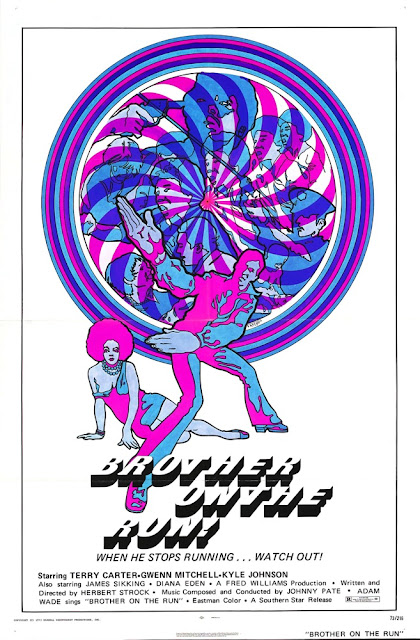
Brother on the Run (1973)


          Minor blaxploitation melodrama Brother on the Run doesn’t come anywhere close to fulfilling the promise of its fantastic title, and the reasons why begin with the premise. After an attempted robbery goes awry, leaving a shopkeeper dead, small-time crooks Billy (Kyle Johnson) and Frank (Gary Rist) become the targets of a police dragnet. For story reasons, it’s important to note that Billy is black. In scenes intercut with the robbery storyline, Brother on the Run sets up that college professor Grant (Terry Carter), who is also black, lives next door to a hooker named Maud (Gwenn Mitchell), with whom he’s casually acquainted. Maud is Billy’s older sister, so the fugitives try hiding at her place until the police come knocking. Grant gets hip to what’s going on, so he meets the crooks and becomes sympathetic to their plight. Then, once the manhunt resumes, Grant promises Maud that he’ll try to find Billy before the cops. All of this raises questions. Since Billy is guilty of at least being an accomplice, why does Grant get involved? Since Billy makes it clear at Maud’s place that he’s against surrendering to the cops, what is Grant’s plan once he tracks Billy down? And why does Grant stop in the middle of his search for Billy to service a horny white lady?
           One assumes the filmmakers neither thought these questions through nor expected theatergoers to do so—more likely, the goal was to generate cheap thrills by exploiting the provocative notion that any black suspect running from white cops has a target on his back. Several passable blaxploitation flicks arose from that same notion, so the failure of Brother on the Run to generate excitement seems attributable to behind-the-camera carelessness as well as shortfalls in production resources. Cowritten and codirected by veteran TV guys Edward J. Lasko and Herbert L. Strock, the movie feels choppy, rushed, and under-budgeted; characterizations are laughably thin, the storyline is riddled with dopey coincidences, and the movie’s attempts at sociopolitical messaging are pathetic. (If only the filmmakers had leaned into bizarro moments such as the bit during which Maud provides gentle BDSM fun for a cross-dressing client.)
          Offering marginal interest is the presence of actors better known for work they later did on the small screen. Playing the lead is Terry Carter, subsequently a regular on the original Battlestar Galactica series, and playing the main cop is James B. Sikking, who eventually found minor fame on Hill Street Blues. Even with a handful of watchable elements, however, Brother on the Run adds little to the blaxploitation experience.

Brother on the Run: FUNKY

Friday, February 15, 2013

The Magnificent Seven Ride! (1972)


Continuity among sequels to The Magnificent Seven (1060) is a dodgy matter, which is probably to be expected seeing as how The Magnificent Seven was an Americanized spin on the Japanese action classic The Seven Samurai (1954)—it’s silly to complain about the lack of artistic integrity when discussing sequels to a remake. Therefore, suffice to say that by the time this fourth entry arrived, changes had been made. None of the original film’s actors is present, and the lead role of honorable gunfighter Chris Adams is occupied by Lee Van Cleef, the third actor in the series to play Adams. (Yul Brynner originated the part.) The storyline for The Magnificent Seven Ride! is, predictably, a retread of the series formula—Adams reluctantly agrees to help the citizens of a border town repel a violent invasion. To achieve this goal, Adams gathers a group of gunmen, and he enlists the citizens of the town, nearly all of whom are women, as helpers. Considering that it’s telling such a trite story, The Magnificent Seven Ride! takes quite a while to get going; the movie is nearly halfway over before preparations for the big battle get underway. Furthermore, the picture has an exceedingly ordinary visual style, looking more like an episode of a TV Western than a proper feature. Yet The Magnificent Seven Ride! is basically watchable, at least for undemanding viewers. Van Cleef’s cruel persona is compelling even in this drab context, and the reliable character actors surrounding him contribute solid work—the cast includes such familiar faces as Luke Askew, Ed Lauter, James B. Sikking, and Ralph Waite. (A young Gary Busey appears in a small role, too.) The women in the movie don’t fare as well, with Mariette Hartley disappearing quickly and Stefanie Powers pouting through her bland turn in the underdeveloped love-interest role. All in all, though, the movie is a fair trade: It promises little and delivers exactly that.

The Magnificent Seven Ride!: FUNKY

Thursday, December 23, 2010

Capricorn One (1978)


Peter Hyams’ loopy conspiracy thriller has the American government faking a Mars landing to score political points, a storyline so ’70s it almost hurts. The outrageous concept is rich with visual and narrative potential, only some of which writer-director Hyams mines in his entertaining but inconsistent narrative. The main problem with the movie is also its main contrivance: After participating in the hoax, three astronauts learn that the government expects them to crash during their spaceship’s staged return to terra firma, because they’ve got to disappear for real in order to sell the illusion. Quick question No. 1: If the astronauts can’t be trusted, then how can the dozens of technicians involved in mounting the conspiracy be trusted? Quick question No. 2: How does a crash landing give the government the PR win they’re seeking by staging a fake Mars landing in the first place? Don’t look for answers, because logic takes a backseat to pulpy fun as plot twists slam into place so quickly they cause cinematic whiplash. The bits depicting the actual fabrication of the Mars landing are colorful, but oddly enough a long sequence of leading man James Brolin trapped in the deserts of the American Southwest is more vivid. Hal Holbrook shines as the main conspirator, delivering an epic monologue toward the beginning of the picture that lays out the particulars of the plot; with his mesmerizing scowl and lilting voice, Holbrook’s one of the few actors who can make that many minutes of unbroken speech compelling. Elliot Gould plays a combination Woodward and Bernstein as the intrepid reporter who tracks the case, doing his amiable bumbling-schnook routine, and the endangered astronauts at the heart of the story are portrayed by a truly eclectic trio: Brolin, O.J. Simpson, and Sam Waterston. They’re so mismatched that they represent of sliding scale of American acting, from Simpson’s cheerful incompetence to Brolin’s vapid professionalism to Waterston’s earnest skillfulness. Ace character players James B. Sikking and Robert Walden are in the mix too, as is Telly Savalas in a gonzo cameo that adds gleeful absurdity to the climax.

Capricorn One: GROOVY