Showing posts with label lincoln kilpatrick. Show all posts

Friday, November 18, 2016

Honky (1971)


          Race-relations melodrama Honky is an indie production with all the slickness of a Hollywood feature, including a sprightly score by Quincy Jones. The movie starts out innocently enough, tenderly depicting the unexpected romance between a white high-school athlete, Wayne (John Neilson), and his sexy black classmate, Sheila (Brenda Sykes). Very quickly, however, Will Chaney’s script—adapted from a novel by Gunard Solberg—takes a weird left turn. Eager to make quick cash dealing grass, Sheila announces to her new boyfriend that she needs money to buy a supply of weed. In a long scene that’s staged like the climax of a heist movie, Wayne uses a forged signature to get the money from his small trust account at a local bank. More crimes follow, including breaking and entering and grand theft auto, so eventually the couple decides to leave their small New Jersey town for California. During their travels, they become victims of crime instead of perpetrators. By the time it’s over, Honky peppers its dubious storyline with stereotypical portrayals of blacks, conservatives, gays, and transvestites. Try finding another picture that features a gentle interracial love scene, violent rednecks, and the startling vision of future Happy Days mom Marion Ross complaining about “coons.”
          Like so many clumsy pictures about race from the ’60s and ’70s, Honky tries so hard to convey progressive attitudes that it ends up becoming inadvertently offensive. It’s defeated by its own aspirations to significance. The way the movie derails is a shame, because in many ways, Honky is impressive. Director William A. Graham and his collaborators give the picture a glossy look and, when the plot isn’t wandering off on pointless detours, a zippy pace. Leading lady Sykes is beguiling, though she was already in her 20s when she made the picture. Supporting players including John Fiedler, Lincoln Kilpatrick, and William Marshall deliver strong work in tiny roles, while Matt Clark lends his reliable brand of rural villainy to the climax. What’s more, that Jones music is pretty sweet. Alas, the central relationship stretches credibility just as much as the plot does, a problem exacerbated by the filmmakers’ tenuous grasp on with-it lingo. For example, Honky contains the following exchange. “Don’t get hung up on my hangup.” “I’m getting caught in your hangup?” “Your ego is.” Wow. Honky is alternately exciting, involving, and sexy, but, seeing as how the crux of the picture involves a white guy learning about the black experience, it’s hard to reconcile the film’s meritorious elements with the filmmakers’ backwards-looking portrayal of African-American characters as criminals, freaks, Uncle Toms, victims, and vixens.

Honky: LAME

Friday, January 16, 2015

Chosen Survivors (1974)


          A gonzo hybrid blending creature-feature elements with the tropes of post-apocalyptic melodrama, Chosen Survivors features a doozy of a plot—several individuals who were unknowingly handpicked by the government to restart the human race get kidnapped, drugged, and stashed inside an underground fallout shelter just before a devastating nuclear attack, only to discover that the shelter is infested with vicious vampire bats. Predictably, the pressure of the horrific situation brings out the best in some people and the worst in others, so Chosen Survivors ends up borrowing narrative DNA from a third major genre, the disaster movie. Given the far-fetched premise, it should come as no surprise to say that Chosen Survivors fails to achieve anything resembling credibility. This thing is outrageous and even a little bit silly from start to finish. Nonetheless, what Chosen Survivors lacks in quality, in makes up for in vibe. The picture is dark, fast, and nasty, so it feels a bit like an early John Carpenter movie, right down to the lean and ominous musical score. Enjoying the movie requires that viewers ignore major lapses in logic, but it’s a fun ride for those willing to follow Chosen Survivors down its bizarre path.
          The movie begins enigmatically, with helicopters landing in a remote site and discharging the principal characters, who are then roughly escorted into an elevator shaft by military personal. The drugged states of the characters are depicted with distorted slow-motion images, jarring edits, and weird music, so the long trip the characters take from the surface to their new subterranean home is fairly trippy. Eventually, the caretaker of the fallout shelter, Major Gordon Ellis (Richard Jaeckel), explains that the “chosen survivors” were doped because there wasn’t time to risk the participants refusing to cooperate. According to Ellis, the surface of America has been obliterated by nuclear bombs, so the “chosen survivors” must live underground and procreate until it’s safe to emerge from the shelter. Among the eclectic gang are scientists Lenore Chrisman (Barbara Babcock), Alana Fitzgerald (Diana Muldaur), Peter Macomber (Bradford Dillman), and Steven Mayes (Alex Cord); wealthy businessman Raymond Couzins (Jackie Cooper); and Olympic athlete Woody Russo (Lincoln Kilpatrick).
          Friction between these people materializes even before the first bat attack, with Cooper’s unhinged character trying to bribe others into releasing him because he doesn’t believe a nuclear attack occurred. Then, once the bats start biting, people go completely off the deep end. Cooper’s character tries to rape one of the female doctors, Dillman’s character retreats into analytical mode by observing the dissipation of the group instead of helping solve problems, and Cord’s character becomes morbidly philosophical. (In one of the movie’s most quintessentially ’70s moments, Cord purrs hippy-dippy musings about the inherent faults of the human race: ‘”The world’s too big. People don’t have time. People don't even have time for people. That's why I got so hyped on this place. It’s not too big.”
          Interspersed with the quiet scenes are wild action/horror sequences, some of which gain a surreal quality thanks to the use of cheesy and unconvincing special effects. In fact, whenever Chosen Survivors hits a groove of optically inserted bats chomping victims to the accompaniment of jittery electronic music, the picture becomes cartoonishly nihilistic—think Saturday-matinee action viewed through the prism of a nightmare. Further, the movie is stylishly shot, with lots of claustrophobic compositions and dense color filters and oppressive shadows, while the cast of mostly B-level actors contributes appropriately over-the-top acting. Dillman is enjoyably twitchy, and Kilpatrick has a great moment when his character makes a sweaty climb up the elevator shaft while besieged by bats.

Chosen Survivors: GROOVY

Thursday, December 5, 2013

Soul Soldier (1970)


Originally titled The Red, White, and Black—but also marketed under the name Buffalo Soldier—this awful Western seems as if it was conceived to be an ensemble story about the exploits of free black men fighting for the Union Army in the American frontier circa the years immediately preceding the Civil War. Unfortunately, the film’s amateurish storytelling treats this worthwhile subject like grist for the melodramatic mill, substituting clichés and nonsense for meaningful narrative. Much of the picture comprises an uninteresting romantic triangle involving two enlisted men and the beautiful seamstress who is married to one of the men but trysts with another; there’s also a lot of screen time devoted to patrols in Indian country, which generates a few limp action sequences. Characterization is in short supply, because the people in Soul Soldier (or whichever of the film’s many titles one prefers) are all paper-thin contrivances. The basic plot involves ladies’ man Eli (Robert DoQui), who enlists in the Army to avoid the wrath of jealous husbands. Eli’s sent to a fort commanded by Col. Grierson (Cesar Romero), where Eli meets Julie (Janee Michelle), with whom he falls in love. Later, Julie’s dalliance with Eli’s friend and fellow solider, Sgt. Hatch (Lincoln Kilpatrick), causes strife. Yawn. Shot in the flat, ugly style of late ’60s/early ’70s television—and edited so aggressively (and haphazardly) that the whole discombobulated thing runs just 77 minutes—Soul Soldier provides a few fleeting moments of vapid entertainment, mostly owing to the diligence of actors DoQui and Kilpatrick, who try valiantly to surmount the lifeless material. (Athlete/political activist Rafter Johnson appears, inconsequentially, in a supporting role, so his star billing is deceptive.) Despite DoQui’s and Kilpatrick’s endeavors, a few well-delivered lines and some effectively simulated camaraderie are hardly reason enough to romp through this slag heap of random scenes, especially when cheap production values and a horrifically bad score—which wobbles between bleak motifs and inappropriately exuberant horn statements—accentuate the shoddiness of the enterprise.

Soul Soldier: LAME

Friday, January 25, 2013

Together Brothers (1974)


          The inner-city drama/thriller Together Brothers brings together a number of disparate elements, and though the picture doesn’t hold together well, it makes for an oddly memorable viewing experience. When the story begins, we meet Mr. Kool (Ed Bernard), an African-American beat cop who uses a human touch while patrolling a tough black ghetto. Fair and hip, he’s respected even by criminals and street kids. Yet one night, Kool is murdered—right before the eyes of grade-schooler Tommy (Anthony Wilson). Kool’s assailant flees, and the police are slow to follow up on leads, so Tommy’s older brother, teenager A.J. (Ahmad Narradin), and his pals decide to track down Kool’s killer. Among other things, they’re afraid the murderer might track Tommy down to eliminate a witness. After this interesting set-up, the movie drifts into a lively section during which A.J. and his buddies seek aid from their rivals, a Hispanic street gang led by Vega (Richard Yniguez). So far, so good, right? Well, we’ve reached the point where Together Brothers becomes offensive—the killer is revealed to be a flamboyant homosexual named Billy (Lincoln Kilpatrick), who goes back and forth between brutal rage and prissy crying jags.
          Yes, Together Brothers continues the vile tradition of stereotyping gay men as unstable freaks. And that’s a bummer, because up until Together Brothers goes wrong, it’s thoroughly arresting. Director William A. Graham shoots the hell out of the picture’s grimy urban locations, depicting vibrant souls living in defiance of crushing poverty. Furthermore, the action scenes are taut, and while the juvenile performances are spotty, adult players Bernard, Kilpatrick, Yniguez, and Glynn Turman (who plays a therapist in one scene) deliver strong work. And we haven’t even mentioned the secret weapon of Together Brothers, R&B superstar Barry White, who composed the picture’s lively score and a handful of songs—including the thumping groove “Somebody’s Gonna Off the Man.” With his imaginative arrangements and lush strings, White kicks some Together Brothers scenes into full-on blaxploitation funkiness, even though the picture is, generally speaking, bereft of blaxploitation clichés. So, while it’s difficult to recommend Together Brothers too heartily given its flaws and its ugly portrayal of homosexuality, this is an interesting picture offering small rewards for adventurous viewers.

Together Brothers: FUNKY

Wednesday, August 22, 2012

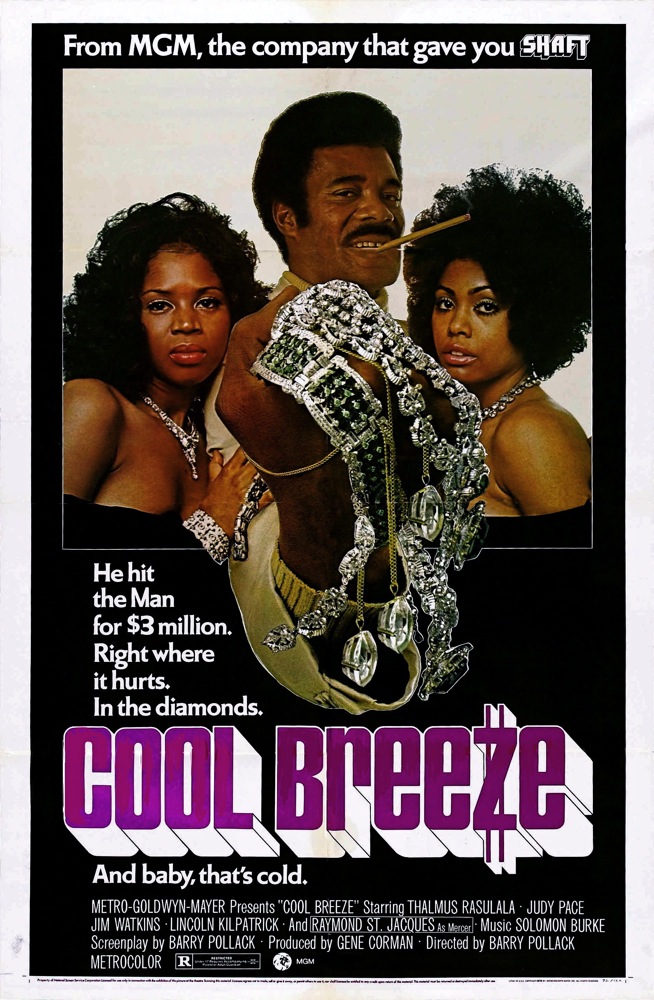
Cool Breeze (1972)


          A blaxploitation take on W.R. Burnett’s classic crime novel The Asphalt Jungle—previously filmed as a 1950 film noir by director John Huston—Cool Breeze nearly works. The intricate story about a criminal mastermind gathering cohorts for a jewel heist is filled with betrayal and danger, so the narrative fits comfortably into the blaxploitation milieu. Furthermore, the film’s acting is generally very strong. However, first-time writer-director Barry Pollack’s inexperience shows. He fails to reveal exposition clearly, so it’s hard to track who’s doing what to whom, and nearly every scene has the same level of intensity, which creates tonal monotony. That said, the picture has a gritty look and a thumping soul-music soundtrack, so what it lacks in narrative polish, it makes up for in tough atmosphere.
          The antihero of the piece is Sidney Lord Jones (Thalmus Rasulala), a slick thief who just bribed his way out of prison. Planning the robbery of a vault containing diamonds worth millions of dollars, Sidney gets into business with Bill Mercer (Raymond St. Jacques), a wealthy crime boss who agrees to bankroll the job. Sidney then hires accomplices including a priest who moonlights as a safe-cracker and a ne’er-do-well Vietnam vet who provides muscle. Also lurking around the story are various cops—some corrupt, some honest—including the unhinged Lt. Brian Knowles (Lincoln Kilpatrick).
          The movie toggles between subplots at weird rhythms, as if Pollack can’t decide whether he’s making an ensemble piece or telling Sidney’s story, but many vignettes are vivid. On the lurid side of the spectrum, the always-ravishing Pam Grier shows up for one sexy scene as a hooker servicing Sidney, and on the character-driven side of the spectrum, supporting actor Stewart Bradley entertainingly chews through his role as an exasperated police captain. (Discovering that Mercer has a young mistress, Bradley goes off on a rant: “I can tolerate a little masturbation. I can tolerate a little sodomy. Let him cavort with a cow! But an old man with a nice, pretty, young girl—that’s too much.”)
          Playing a bookie helping Sidney set up his team, Sam Laws gives the movie’s most amusing performance, because his character is likeable, flabby wimp who whines whenever danger is near. As for Rasulala, he’s appropriately cocky and smooth throughout the picture. Had Pollack’s skills been sharper, this same cast and story could have coalesced into something really memorable; as is, Cool Breeze is entertaining but frustrating. (Available at WarnerArchive.com)

Cool Breeze: FUNKY

Monday, March 12, 2012

The Master Gunfighter (1975)


          Thanks to his work as the creator and star of the four-film Billy Jack franchise, Tom Laughlin remains one of the most weirdly fascinating figures of ’70s cinema. On the plus side, he’s a maverick with deeply sincere political convictions. On the negative side, his hallmarks are confused ideology and sloppy storytelling. As a case in point, consider the only movie Laughlin made in the ’70s outside of the Billy Jack franchise, notwithstanding a couple of small acting roles in other directors’ pictures. Like the Billy Jack flicks, The Master Gunfighter is a strange mishmash of bleeding-heart politics, extravagant action, and murky philosophy derived from indigenous cultures. Yet while the Billy Jack movies sprang forth from Laughlin’s turbulent id, The Master Gunfighter is a pastiche of influences.
          The plot was taken from a 1969 Japanese movie called Goyokin, and Laughlin added a smattering of episodes from the history of 19th-century California. Reflecting the story’s Asian origin, all of the principal male characters wear a six-gun on one hip and a Japanese blade on the other. And reflecting the Latin influence on old California, the characters prance around in flamboyant Spanish-style costumes of embroidered bolero jackets, form-fitting bell-bottomed slacks, and puffy white shirts.
          The storyline is as jumbled as the aesthetic. Finley (Laughlin) is a solider at a coastal hacienda whose de facto leader is a fellow warrior, Paulo (Ron O’Neal). In a confusing prologue that writer-producer-director Laughlin spends the rest of the movie explaining and rehashing, Paulo robs gold from a U.S. government sailing ship, and then slaughters a village of local Indians who accidentally come into possession of the loot. After extracting a promise that Paulo never commit another atrocity, Finley leaves the hacienda in shame. Yet while Finley wanders the Mexican wilderness (working, of course, as a sideshow performer), Paulo contrives plans to repeat his infraction, forcing Finely to return home for a showdown—and for a reunion with his wife, Eula (Barbara Carrera).
          As in all of Laughlin’s pictures, unnecessary subplots make the picture feel meandering and vague. Furthermore, Laughlin’s reiteration of tropes from his best-known characterization make Finley seem like Billy Jack in a beard: Laughlin sighs and speechifies before dispatching bad guys, repeatedly expressing the dubious notion that he’d prefer not to kick ass. The funny thing is that Laughlin’s actually a pretty good actor, though he’s his own worst enemy when working behind the camera; melodramatic staging and stiff dialogue undercut the quiet intensity that Laughlin generates simply by occupying the camera frame.
          Just as Laughlin the director subverts Laughlin the actor, Laughlin the producer subverts the whole movie with poor casting. Untalented amateurs are featured in minor roles, Carrera is pretty but vapid, and O’Neal (best known for the Superfly pictures) is truly awful. Only suave African-American player Lincoln Kilpatrick, as a warrior with shifting allegiances, delivers a consistently credible performance. Worse, while some of the movie’s action scenes are exciting, Laughlin’s camera often seems to be in the wrong place, and many scenes end too abruptly. However, Laughlin and veteran cinematographer Jack Marta make great use of the beautiful Monterey, California, coastline and nearby inland forests, so the movie often looks great even if what’s happening onscreen is bewildering.

The Master Gunfighter: FUNKY