Showing posts with label susan saint james. Show all posts

Saturday, January 16, 2016

1980 Week: How to Beat the High Co$t of Living


          Cut from the same financial-panic cloth as Fun With Dick and Jane (1977) and 9 to 5 (1980), this adequate comedy depicts the extreme measures that three suburban women take in order to keep up with inflation even as their respective incomes fluctuate. Competently made and filled with strong actors, the piece ambles its way through uninspired episodes punctuated with weak jokes. Every actor in the cast has done better work elsewhere, and with all due respect to her terrific work on the small screen, How to Beat the High Co$t of Living quickly proved that Saturday Night Live alumna Jane Curtin was not destined to be a movie star. She’s droll and sexy in what amounts to the film’s leading role, but her costars—Jessica Lange and Susan Saint James—eclipse her in terms of glamour and pithiness, respectively. It says a lot about the picture that the most dynamic performances actually come from two supporting players, Richard Benjamin and Dabney Coleman.
          Cowritten and coproduced by Robert Kaufman, the movie takes a mosaic approach to explaining why three female friends end up in the same desperate situation at the same time. After Elaine (Curtin) is dumped by her husband, she’s left in a financial lurch because of her extravagant lifestyle. Meanwhile, divorcĂ©e Jane (Saint James) tries in vain to cover expenses for herself, her kids, and her aging father (Eddie Albert). And Louise (Lange) fares so poorly operating an antique store that her husband, a veterinarian named Albert (Benjamin), sues her in order to compel her into personal bankruptcy. Together, the women hatch a scheme to rob a “money ball” that’s on display in a local shopping center, so predictable shenanigans result from amateurs attempting a heist.
          Most of what happens in How to Beat the High Cost of Living is mildly amusing at best. Worse, the movie’s would-be sexy subplot—Elaine’s various encounters with a horny cop named Jack (Coleman)—culminate in a tacky scene of Elaine performing a striptease in the middle of the shopping center. Yes, the sexual politics of How to Beat the Cost of Living are so creaky that one of the film’s heroines saves the day by flashing her breasts. Curtin does well in edgy scenes but lacks warmth, Lange looks gorgeous but seems bored with the trite material, and Saint James fares best of the three by playing light comedy well. Unfortunately, the three women never quite gel into a cohesive unit.

How to Beat the High Co$t of Living: FUNKY

Monday, June 4, 2012

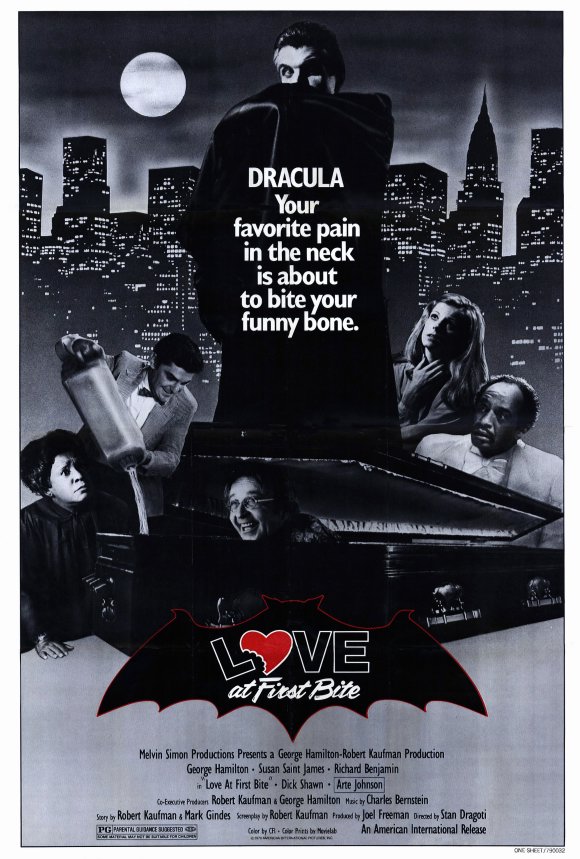
Love at First Bite (1979)


          Casting perpetually tanned smoothie George Hamilton as a pasty-faced vampire was such a droll bit of comic inspiration—and Hamilton’s ensuing performance was so unexpectedly delightful—that it’s easy to savor fond memories of Love at First Bite if one encountered the movie during its original release and avoided it thereafter. Alas, revisiting the film dispels those fond memories quickly. Hamilton is indeed quite funny, and his costars pour on the charm to infuse their thin characterizations with vitality, but the film’s comedy is so broad (and, at times, so racist) that sensible viewers will cringe as often as they chuckle. On top of insipid one-liners like “I’m going out for a bite to drink,” the picture includes awful sequences with featured players Sherman Hemsley and Isabel Sanford (better known as TV’s The Jeffersons) lampooning African-American patois.
          Anyway, here’s the good news: Hamilton, Richard Benjamin, Arte Johnson, and Susan Saint James look like they’re having a blast delivering silly jokes, so their cheerfulness makes long stretches of the movie palatable. The plot involves Count Dracula (Hamilton) relocating to New York City with his psychotic henchman Renfield (Johnson). Once in Manhattan, Dracula courts neurotic model Cindy Sondheim (Saint James), who, of course, happens to be romantically entangled with shrink Dr. Jeffrey Rosenberg (Benjamin), a descendant of Dracula’s old nemesis Abraham Van Helsing. And so it goes from there: The vampire woos the model, the doctor becomes a monster hunter, and Renfield eats bugs.
          The tone of the picture is set perfectly during the opening Transylvania scenes, because when Hamilton makes his entrance in a spooky castle to the accompaniment of baying wolves, he coos a funny twist on an old Bela Lugosi line: “Children of the night—shut up!” The gimmick is that Dracula is tired of the same old routine, so he’s eager to try new things like dancing in a disco; sure enough, the romantic boogie that Hamilton and Saint James perform to Alicia Bridges’ slinky hit “I Love the Night Life” is a highlight.
          Had director Stan Dragoti and the film’s writers been able to maintain a consistent balance of clever jokes and romance, Love at First Bite could have become an offbeat gem. Instead, it’s a mixed bag of fun sequences and stupid discursions, with the clunker gags outnumbering the successful zingers. Still, there’s a reason this was among the few unqualified triumphs of Hamilton’s career—since the actor conveys ironic self-awareness from start to finish, he’s impossible to dislike even when the movie around him is very easy to dislike.

Love at First Bite: FUNKY

Wednesday, February 9, 2011

Outlaw Blues (1977)


          A studio picture offering a breezy take on the criminals-on-the-run formula more commonly encountered in exploitation films, Outlaw Blues combines a solid premise, plentiful action, and melodic original songs to render enjoyably disposable entertainment. Notably, the picture is one of the few purely mainstream star vehicles that Peter Fonda made during the erratic period that followed his 1969 breakout hit Easy Rider; whereas most of Fonda’s ’70s flicks reek of sleaziness, Outlaw Blues is comparatively wholesome even though it’s about a recidivist criminal. An amiable blend of Southern mayhem and music-industry satire, the picture has all the noise and speed of a Corman production while also benefitting from better production values and the willingness to eschew overly lurid elements.
          Imaginatively scripted by Bill L. Norton and unobtrusively directed by Richard T. Heffron, the movie lets Fonda’s rebel-hero persona manifest as mischievous charm instead of violent anarchy. It also helps that Fonda is paired with leading lady Susan Saint James, whose ballsy attitude and throaty voice provide a Type A complement to Fonda’s laconic vibe. Fonda plays Bobby Ogden, a jailed musician who performs his song “Outlaw Blues” during a soundcheck when country star Garland Dupree (James T. Callahan) prepares for a concert at the big house. Although Garland pretends to be unimpressed, he subsequently records a hit version of “Outlaw Blues” and claims to have written the song. When Bobby gets paroled, he confronts Garland, who accidentally shoots his own foot during the resulting scuffle, then blames his injury on the ex-con. Suddenly a fugitive, Fonda aligns with Tina Waters (Saint James), a backup singer with loads of music-industry savvy. She arranges for Bobby to record “Outlaw Blues,” and that version becomes an even bigger hit than the first one, elevating Bobby to country-music stardom even though hes on the run from police.
          Norton’s amiable script features several lively characterizations, so whenever the picture focuses on such obnoxious Nashville types as Garland and sleazy label executive Hatch (Michael Lerner), Outlaw Blues becomes a rollicking travelogue of Fonda’s odyssey through a world of rampant amorality. Scenes of Fonda performing music are so casual and warm that it’s easy to believe his character’s popularity, and the catchiness of the title song adds credibility. (The tune was written by John Oates, of Hall and Oates fame.) Fonda is his usual mellow self, letting the storyline do most of the heavy lifting, while Saint James adds sparks as a liberated woman who’s a sucker for a hard-luck case. And even if the chase scenes (involving boats, cars, and motorcycles) drag on endlessly, they don’t totally overwhelm the film’s low-key charm.

Outlaw Blues: GROOVY