Showing posts with label vera miles. Show all posts

Sunday, July 6, 2025

Smash-Up on Interstate 5 (1976)


          Offering a slight twist on the disaster-flick formula, bland telefilm Smash-Up on Interstate 5 begins with the titular catastrophe—a 39-vehicle accident in Southern California—then rolls back to the clock 48 hours. This structure sidesteps the fact that a car accident, by its nature, precludes conventional narrative tension. After all, it’s impossible to anticipate a freak occurrence, whereas if an ocean liner is sinking, a skyscraper is burning, or an earthquake and its aftershocks are happening, characters have time to contemplate impending doom. Smash-Up at Interstate 5 makes a reasonable effort to contrive drama between the setup and payoff, and to create empathy for a spectrum of characters played by a typically hodgepodge TV-movie cast.
          The nominal protagonist is California Highway Patrol Sergeant Sam (Robert Conrad), an adrenaline junkie whose girlfriend, nurse Laureen (Donna Mills), worries she can’t build a life with such a reckless man. Laureen’s sister, Barbara (Sian Barbara Allen), is married to another cop, Jimmy (Tommy Lee Jones), and they’re expecting a child. You get the idea—per the template for this sort of thing, Smash-Up invents lots of ticking-clock plotlines to give the accident as much impact as possible. Other threads include an elderly couple (Buddy Ebsen and Harriet Nelson) dealing with terminal illness, a middle-aged woman (Vera Miles) swept off her feet by a younger man (David Groh), and a small-time crook (Scott Jacoby) taken hostage by a robber on a killing spree. It’s all quite pedestrian, of course, but the ensemble approach ensures that whenever a scene starts to drag, the film is just a cut away from something livelier.
          Directed by small-screen workhorse John Llewelyn Moxley, Smash-Up on Interstate 5 delivers the requisite mixture of romance, pathos, schmaltz, and tragedy. As with most such telefilms, whether any particular scene commands the viewer’s interest depends largely on the viewer’s enjoyment of particular actors—Conrad does his stoic bit, Ebsen provides folksy warmth, Miles lends a touch of elegance, and so forth. (Points to Herb Edelman for his brief but pungent appearance as a swinger.) Alas, the element the movie handles least effectively is the big accident—despite giving a solid blast of crashes and explosions and stunts, the movie rushes through the aftermath too quickly, denying viewers the carnage they’ve been promised for more than 90 minutes.
 
Smash-Up on Interstate 5: FUNKY

Tuesday, June 21, 2022

The Strange and Deadly Occurrence (1974)


          The verbose title of this mildly spooky telefilm suggests a supernatural angle, but The Strange and Deadly Occurrence is really a crime thriller with horror-flick flourishes. Approached with the right mindset, the picture provides pleasantly undemanding distraction. Robert Stack, rendering the same sort of blandly American masculinity he brought to countless movie/TV endeavors before diversifying his brand with self-parody in Airplane! (1980), stars as Michael Rhodes, the head of a small family that moves in to a new home. Soon after Michael, his wife Christine (Vera Miles), and their daughter Melissa (Margaret Willock) take occupancy, peculiar things start to happen—power outages, weird noises, etc. The family also receives persistent visits from Dr. Wren (E.A. Sirianni), an odd fellow inexplicably determined to buy their house. Soon Michael grows to believe that Dr. Wren has something nefarious in mind, unaware that a bigger threat exists.
          Whereas slight narratives are often shortcomings in ’70s telefilms, less is more in this case because the focus is on atmosphere rather than intricate storytelling. Director John Llewellen Moxey and writers Sandor Stern and Lane Slate achieve adequate results while generating low-grade tension and dramatizing how the Rhodes family reacts to upsetting circumstances. The filmmakers also succeed in misdirection, allowing a third-act shift in the narrative to land with enjoyable impact. An effectively seedy performance by a familiar character actor is better discovered than described, given that his appearance is key to the third-act twist, but everyone who appears onscreen in The Strange and Deadly Occurrence understood the assignment. Costar L.Q. Jones is suitably condescending as a local lawman, Sirianni twitches well, Miles lends welcome muscle to her role, and Stack, as mentioned earlier, supplies exactly what he was hired to supply.
          Does The Strange and Deadly Occurrence suffer the usual flaws of dubious contrivances and characters who make conveniently stupid decisions? Of course. But if you’ve read this deep into the write-up of a ’70s made-for-TV thriller, then warnings about such flaws are unlikely to diminish your enthusiasm. Have at it.

The Strange and Deadly Occurrence: FUNKY


Thursday, December 28, 2017

Run for the Roses (1977)


          Made somewhat in the Disney mode but nowhere near as imaginative or slick as films from the Mouse House, modestly budgeted sports saga Run for the Roses has many of the problems that plague subpar family films. The storyline is manipulative and predictable, as if younger viewers are too simple to track real plotting; the syrupy moments are plentiful, as when a little boy prays to the accompaniment of weepy guitar/harmonica music; and the themes are skewed toward a pandering vision of people always rising to their better nature. That said, proficient Hollywood actors play important supporting roles, giving key scenes the illusion of emotional weight, and extensive location photography provides a helpful sense of place, especially during scenes set at the Kentucky Derby. So while none would ever contend that Run for the Roses rises to the level of, say, The Black Stallion (1979), it’s a harmless tale espousing wholesome values. The notion that being selfless is its own reward may not resonate with what most of us encounter in everyday reality, but it’s a hopeful sentiment to put across—as is the idea of being compassionate toward animals.
          Rich widow Clarissa Stewart (Vera Miles) owns a horse farm in Kentucky, but always comes up short in the Derby. Concurrently, she clashes with her adult nephew, Jim (Sam Groom), a ne’er-do-well whom she hopes might one day take over the family business. Jim is friendly with Clarissa’s horse trainer, Charlie (Stuart Whitman), who lives on the Stewart farm with his Puerto Rican wife and her young son, Juanito (Panchito Gómez). One night, a mare gives birth to a lame foal sired by a horse that came in second in the Derby. After Clarissa orders the foal destroyed, Juanito begs for mercy and Clarissa gives him the animal on a whim. Overjoyed, he names the horse “Royal Champion” and raises it to adulthood. Then Juanito’s buddy Flash (Teddy Wilson), a friendly African-American guy who works on the farm, agrees to bankroll surgery on the horse’s bad leg It’s not difficult to guess what happens next—the minute Clarissa realizes Royal Champion has racing potential, she angles to retake possession.
          Were it not for the presence of Miles, Whitman, and Wilson in their roles, Run for the Roses would be quite tedious to watch. As is, scenes featuring only Gómez and the horse are slow going, since Gómez is a typical pose-and-pout Hollywood child actor. Yet Miles is so formidable, Whitman is so imposing, and Wilson is so likeable that they sell their characterizations as hard as they can. (Groom and ingénue Lisa Eilbacher, who plays his love interest, lend little more than earnestness and youthful attractiveness.) Although getting through Run for the Roses requires overlooking lots of problems, from clunky exposition to graceless photography, the picture is so innocuous and kindhearted as to be mostly palatable.

Run for the Roses: FUNKY

Tuesday, May 30, 2017

The Wild Country (1970)


          Appraised strictly for technical execution, from cinematography to performances to production values, frontier adventure The Wild Country is impeccable. Wide-open locations convey the beauty and toughness of the story’s Wyoming setting, while sincere work from a cadre of proficient actors puts across the simple story of an earnest family in conflict with nature and an unscrupulous neighbor. Furthermore, smooth direction by Robert Totten allows the story to unfold at a steady but unhurried pace over 100 minutes. Yet originality matters, and that’s where The Wild Country has problems. Every single moment is a cliché or a platitude, if not both, so The Wild Country represents some of the worst inclinations of the folks at Walt Disney Productions. Those seeking a fresh take on the travails of homesteading circa the Wild West era should look elsewhere. That significant disclaimer having been provided, there’s a lot to enjoy here for viewers who accept the picture’s limitations. Steve Forrest and Vera Miles make a handsome pair of pioneers, and it’s a hoot to see real-life brothers Clint and Ron Howard acting together as the homesteaders’ children. (The juvenile performers’ father, Rance Howard, appears in a tiny supporting role.) The Wild Country also benefits from beautiful images of animals and wilderness.
          The story begins with the Tanner family arriving in rural Wyoming after a long journey from Philadelphia. At first, Jim (Forrest), Kate (Miles), teenaged Virgil (Ron Howard), and young Andrew (Clint Howard) seem ill-prepared for their new life on a small farm, but they summon enthusiasm and grit while whipping the spread into shape. Enter one-dimensional villain Ab Cross (Morgan Woodward), who owns a cattle outfit in the mountains overlooking the Tanner place. He’s built an illegal dam cutting the flow of water to the Tanners’ property, so Jim tries every means available to remedy the situation, even if that involves  bare-knuckle brawling with mean old Ab. Everything about The Wild Country is predictable, but the picture gains a certain toughness as it proceeds toward an intense climax during which circumstances force Virgil to become a man. That said, The Wild Country is hopelessly retro, an expression of 1950s values that must have seemed pathetically unhip when the film was released in 1970. In that regard, it’s quintessential live-action Disney.

The Wild Country: FUNKY

Wednesday, May 10, 2017

Molly and Lawless John (1972)


          A decade before he became a moustachioed fixture in small-screen westerns, a clean-shaven Sam Elliott starred in this quiet but respectable oater, a frontier love story exploring the complicated relationship between an outlaw and a sheriff’s wife. Featuring long stretches of silence and very little music, Molly and Lawless John is all about the energy that transfers between people thrown into close proximity at vulnerable moments. While Ellott’s performance is a bit obvious, blustery one moment and weepy the next, costar Vera Miles works a more nuanced groove, sketching various shadings of loneliness and naïveté before her character grows armor thanks to challenging circumstances. The tension between their different performance styles helps compensate for the generic quality of the film’s direction and writing. In many important ways, Molly and Lawless John fails to show viewers anything new, because the same sensitive-gunslinger dynamics permeate countless previous movies and TV shows. Yet the picture realizes its humble goals adequately, and the intimate narrative—most scenes feature just the title characters—helps conjure a degree of depth and warmth. Moreover, the storyline provides just enough complications to keep things interesting all the way to the grim but satisfying ending.
          Captured following his participation in a violent bank robbery, Johnny Lawler (Elliott) gets thrown in jail by foul-tempered Sheriff Marvin Parker (John Anderson). Parker’s put-upon wife, Molly (Miles), is tasked with providing the inmate’s meals while Parker is away on business, and she finds herself fascinated by the handsome prisoner. Sharing his fears about being executed, he touches her heart, so she reveals painful truths about her loveless marriage. Convinced they’ve bonded, she helps John escape, and their next adventure begins. Revealing more would diminish what little surprise the film offers. Suffice to say that life on the run isn’t what either of them expected, especially when they happen upon a stranger in trouble and become unlikely caretakers for an innocent. Despite being a fairly gentle movie, Molly and Lawless John plays rough on occasion, as when John appraises Molly’s looks: “You ain’t much, but you’re a hell of a lot better than nothin’.” Moments like that one get to the core of what makes the picture (mildly) rewarding—Molly and Lawless John explores the limited choices available to both criminals and women in the Wild West, thereby telling a story with aspects of class and gender, rather than the typical Western themes of male identity and personal honor.

Molly and Lawless John: FUNKY

Sunday, February 12, 2017

Cannon (1971)


          Investigators with offbeat gimmicks were a staple of mystery fiction long before television came along, but by the ’70s, Hollywood had perfected the art of repackaging the same old whodunit storylines by featuring unusual protagonists. Columbo hid his wit behind a façade of simple-mindedness, McCloud was a cowpoke in the big city, Ironside was confined to a wheelchair, Kolchak solved paranormal mysteries, and so on. Yet some of these gimmicks were so threadbare as to be almost laughable. The most notable attribute of private investigator Frank Cannon, who fought crime during five seasons spanning 1971 to 1976 and returned for a 1980 telefilm, is girth. Yep, he’s big. Corpulent, fat, morbidly obese, rotund—take your pick. The character has other traits, but his size is a point of conversation from his first appearance forward. Thanks to smart scripting and a winning performance by star William Conrad, Cannon spends the enjoyable pilot movie that preceded his weekly series coming across as clever and dogged and resourceful. He even gets into brawls and foot chases. Characters remark on his weight, as does Cannon himself, but mostly he gets down to the tricky business of solving a murder and untangling a conspiracy. Particularly because this pilot has such a fine supporting cast of versatile character actors, it’s unsurprising the movie connected well enough with audiences to trigger a series. But, still, the sheer laziness of the whole enterprise—this one’s different, see, because he’s fat! There’s a reason they used to call TV a vast wasteland.
          One day, ex-cop Cannon gets a letter from Diana Langston (Vera Miles), the widow of an old friend. Traveling to the small desert town where she runs a motel, Cannon investigates the man’s death and gets stonewalled by local cops including Lt. Redfield (J.D. Cannon) and Deputy Magruder (Earl Holliman). Turns out the whole small town is under the thumb of crime boss Virgil Holley (Murray Hamilton), and things get even more complicated once Cannon discovers that Lt. Redfield’s sexy wife, Christie (Lynda Day George), has dangerous romantic ties outside her marriage. Despite several attempts on his life as well as threats of incarceration, Cannon helps Diana learn how and why her husband died, cleaning up Diana’s town in the process. Written by series creator Edward Hume, the Cannon pilot has the same qualities as other series from Quinn Martin Productions (The Fugitive, The Streets of San Francisco, etc.), notably crisp characterizations and strong visual interest, so even when the story gets garbled—a common trap for mystery shows—the action, locations, and performances command attention. (Also featured in the cast are Norman Alden, John Fiedler, Lawrence Pressman, Barry Sullivan, and Keenan Wynn.) Is the story about anything? No. And excepting a few twists, is the story genuinely fresh or surprising? No again. But detective shows are comfort food, and in that regard, Cannon is a hearty meal, suitable for the appetite of its protagonist.

Cannon: GROOVY

Sunday, May 29, 2016

Baffled! (1973)


          Following three years each as an ensemble player on Star Trek and Mission: Impossible, Leonard Nimoy apparently took just one stab at becoming the lead of his very own TV series, notwithstanding multiyear runs hosting the nonfiction shows In Search of . . . , Ancient Mysteries, and History’s Mysteries. (Don’t fix it if it ain’t broke!) Nimoy’s wannabe star vehicle, Baffled!, could just as easily have been titled Baffling!, seeing as how it’s confounding that anyone thought the concept could sustain an entire series. Even just watching the feature-length pilot episode, the only installment that was made, requires patience. Adding to the offbeat nature of the project is the sheer Englishness of Baffled!, which was photographed in the UK and coproduced by the British company ITC. Even the pilot’s costar, Susan Hampshire, is British. (One version of Baffled! was released theatrically in Europe, and a slightly different cut aired on American TV.)
          Yet the peculiarity of the project’s geographical origin pales next to the strangeness of the storyline: Nimoy plays a racecar driver who suddenly manifests psychic abilities, then teams with a paranormal specialist to solve supernatural crimes in Europe. Quite frankly, even Nimoy’s presence is odd, thanks to the actor’s aloof demeanor and lanky appearance—fascinating as he could be in the right role, Nimoy was not the matinee-idol type this sort of project requires. In any event, Baffled! opens during a race, when daring driver Tom Kovack (Nimoy) has a series of weird visions that cause him to ride off the road. For no good reason, he explains what happened on TV, attracting the attention of Michelle Brent (Hampshire). Tracking Tom down, she determines that his visions relate to a particular manor home in England, so away the two go for an adventure filled with danger and intrigue. The plot has something to do with a blowsy innkeeper (Rachel Roberts) tormenting an American movie star (Vera Miles), with the movie star’s teenaged daughter (Jewel Blanch) caught in the middle.
          Baffled! hits viewers with lots of hokey old-dark-house stuff, plus listless sequences of attempted violence; the bit of Nimoy falling off a cliff and safely landing in deep water is about as exciting as it gets. The acting is indifferent, the plotting is turgid, and the supernatural element—mostly comprising shots of Nimoy squinting while he has visions—adds little. Through it all, tinny music that could have been copped from  a trove of Avengers outtakes—as in Steed & Peel, not Captain America and Iron Man—honks and tweets on the soundtrack. Nearly the only rewarding aspect of watching Baffled! is listening to Nimoy croak lines in a ridiculous UK approximation of American slang. “I like you,” he says to Hampshire. “You’re warm, enthusiastic, and—why shouldn’t I use the word—you’re a great-lookin’ chick.”

Baffled!: FUNKY

Sunday, June 24, 2012

Flood! (1976) & Fire! (1977)


          After the success of his lavish blockbusters The Poseidon Adventure (1972) and The Towering Inferno (1974), producer Irwin Allen tried to keep the disaster-movie momentum going, but most of his subsequent flicks ended up getting made for television on pathetic budgets. Therefore, it’s not surprising that Allen refused onscreen credit for producing the first of these also-ran projects, Flood!—the exclaiming title of which promises more excitement than the movie delivers.
          A random gang of actors, most of whom were on their way down the Hollywood ladder at the time, portray residents of a small town called Brownsville, which gets submerged when the local dam succumbs to pressure after heavy rainfall. Since the movie features an idiot politician who refuses to acknowledge the potential for danger until it’s too late, calling Flood! trite would be giving the thing too much credit. Furthermore, the special effects, normally Allen’s hallmark, are laughable. One silly gimmick involves placing a container of water in front of the camera, then shooting over the container toward a nearby building, as if this bargain-basement illusion can persuade viewers they’re beholding a catastrophe of Biblical proportions. Worst of all, the movie is dull and slow, despite the hearty efforts of actors including Richard Basehart, Robert Culp, Barbara Hershey, Martin Milner, Cameron Mitchell, and Poseidon Adventure survivors Carol Lynley and Roddy McDowall.
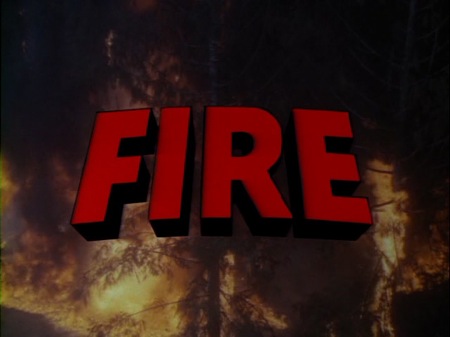
          Allen’s next TV endeavor, for which he actually did take onscreen credit, nearly earns its exclamation point. Fire! stars Poseidon Adventure veteran Ernest Borgnine, whose campy acting style always enlivens silly movies, and the simplistic plot gets the job done: When a convict on a labor crew working in a mountaintop forest starts a fire to obscure his escape attempt, the conflagration spreads toward a resort town, forcing guests and locals to flee. Meanwhile, easygoing local Sam (Borgnine) sticks around to help with the evacuation because he’s in love with the local hotelier (Vera Miles). The cast is unimpressive (Alex Cord, Patty Duke, Erik Estrada, Donna Mills, Lloyd Nolan), but Allen and his director, Earl Bellamy (who also helmed Flood!), get the formula right in terms of meshing melodrama with nature-gone-wild tragedy. It helps that the movie relies on practical effects, with real buildings and trees burning on camera, rather than chintzy tricks. Fire! is terrible, of course, but it delivers the goods.
          Clearly, however, the bloom was off the rose, so even though Allen oversaw three additional made-for-TV disaster flicks, they suffered ignoble fates. With C-listers like Bert Convy starring, Allen’s production Hanging by a Thread, in which people flash back to their pasts while trapped in a cable car, aired to no acclaim as a two-night miniseries in late 1979. Next, the self-explanatory The Night the Bridge Fell Down was shot in 1979 but not broadcast until 1983. Then, after Allen’s final big-screen disaster movies, The Swarm (1978) and When Time Ran Out . . . (1980), the end of his cycle finally came with Cave-In, a long-winded TV movie about just what the title suggests, which aired in 1983, shortly after The Night the Bridge Fell Down. (All made-for-television titles available at WarnerArchive.com)

Flood!: LAME
Fire!: FUNKY

Wednesday, March 7, 2012

One Little Indian (1973)


          In a strange little career blip between his big-screen heyday in the late ’60s and his return to television with The Rockford Files, beloved leading man James Garner headlined a pair of inconsequential Disney movies. One Little Indian is darker and deeper than the company’s usual fare, telling the story of how a condemned man becomes the surrogate father for an orphaned child, and the feather-light The Castaway Cowboy is an offbeat romance. Were it not for the presence of colorful animal scenes in both flicks, it would be difficult to realize these titles came from the Mouse House.
          Written and directed, respectively, by old hands Harry Spalding and Bernard McEveety, One Little Indian is surprisingly respectable given the slightness of its storyline. Garner plays Keyes, a post-Civil War cavalryman sentenced to hang for treason. As we discover late in the story, Keyes tried to prevent fellow soldiers from conducting a Sand Creek-type massacre on an Indian village. Meanwhile, Mark (Clay O’Brien) is a white youth who has been raised by Indians. When a cavalry unit rounds up Mark’s tribe for relocation to a reservation, Mark tries repeatedly to escape. Through the magic of Disney coincidence, Keyes and Mark discover each other and become traveling companions.
          Adding novelty to their journey is the fact that their steeds are camels rather than horses; the animals are leftovers from an Army experiment in using dromedaries for desert transportation. Over the course of their journey together, man and boy bond with a frontier widow (Vera Miles) and her young daughter (Jodie Foster). They also engage in high jinks and shoot-outs as they evade capture. Excepting some silliness with the camels, One Little Indian is basically a straight drama, and rather a somber one, so Garner is able to sink his teeth into a few solid dramatic scenes. (He and Miles, who reteamed in The Castaway Cowboy, make an attractive screen couple.) O’Brien is a passable child actor, neither greatly adding to nor detracting from scenes, and reliable supporting players like Pat Hingle, Andrew Prine, and Morgan Woodward fill out the rest of the story. One Little Indian won’t linger very long in your memory, but it’s pleasant viewing.

One Little Indian: FUNKY

Saturday, November 19, 2011

The Castaway Cowboy (1974)


One can only marvel at the imagination the team at Walt Disney Productions brought to the plotting of the studio’s live-action films back in the day, because the stories for some of these movies are so bizarre and elaborate they seem like transcriptions of fever dreams. In the offbeat Western The Castaway Cowboy, James Garner plays Lincoln Castain, an amiable Texan who gets dumped from a vessel crossing the Pacific and drifts to shore near the struggling Hawaiian plantation of plucky widow Henrietta McAvoy (Vera Miles). In the course of working to earn money for passage home, Lincoln discovers that Henrietta’s estate is home to a sizable cattle herd, which would fetch a handsome price on the mainland. The only problem is that the rocky shores of the island of Kauai make it impossible to get cows from the beach to cargo ships. As Lincoln ponders this issue, he (of course) falls for Henrietta and (of course) gets into a hassle with his rival for her affections, one Calvin Bryson (Robert Culp). Calvin’s a competing landowner intent on ruining Henrietta’s farm, so when Lincoln comes up with a way around the transportation problem—using small boats to guide swimming cows through ocean waters right up to the sides of waiting ships—Calvin mucks up the works with tricks like persuading a crazy local to use island magic against Lincoln. As with many Disney pictures of the same vintage, The Castaway Cowboy is as exhausting to watch as it is to describe, because character development and logical credibility get smothered by nonstop plot twists. Garner’s innate charm cuts through the overwrought narrative, and the location photography is impressive. There’s also minor novelty in watching the bovines swim through crystal-clear Hawaiian waters, but that only goes so far. Still, The Castaway Cowboy is hard to match for sheer randomness: A would-be cattle baron kickin’ it Hawaiian-style? Whatever.

The Castaway Cowboy: FUNKY