Showing posts with label bernard slade. Show all posts

Tuesday, April 18, 2017

Stand Up and Be Counted (1972)


          In what should be a standout moment during the feminism-themed comedy Stand Up and Be Counted, ladies meet for a rap session about their encounters with sexism. Participants include Dr. Joyce Brothers (as herself), future Jeffersons star Isabel Sanford, and a nun. Alas, comedic sparks never fly, because like the rest of this flat-footed studio picture written and directed by men, the scene devolves into oversimplifications and slogans. Progressive-minded producer Mike Frankovich and his collaborators, director Jackie Cooper and screenwriter Bernard Slade, seem as if they perceived the women’s-lib movement as a whimsical fad. To a one, the feminists in this movie are portrayed as shrill whiners whose only real accomplishment is alienating the men in their lives. The picture ends on a fairly hip note, so it’s not quite as dunderheaded an affair as the preceding remarks might suggest. Nonetheless, there’s a reason Stand Up and Be Counted is not remembered as a milestone in Equal Rights Amendment-era propaganda.
          Jacqueline Bisset stars as Sheila, a fashion reporter assigned to do a magazine story on the burgeoning women’s movement. To do so, she flies to her hometown of Denver. (The script pathetically explains Bisset’s English accent by saying she spent time in London.) During the flight, Sheila rekindles her romance with an ex, Elliot (Gary Lockwood). In Denver, Sheila discovers that her mother is part of a “Senior Women’s Liberation” organization, and that her ultra-feminist younger sister, Karen (Lee Purcell), wants to hire a man to impregnate her. Torn between new and old ideas about gender roles, Sheila moves in with Elliot, only to discover he’s a patronizing chauvinist. Other threads involve a housewife rebelling against her domineering husband, and a trophy wife demanding respect for the work she does at her husband’s bra factory.
          Stand Up and Be Counted is one of those bad movies that isn’t really a bad movie. In its clumsy way, the film means well, but problems compound problems. Sheila is a hopelessly passive character, thus draining the movie of momentum, and supporting players deliver livelier work than Bisset, causing her presence to seem ornamental. (She’s simultaneously breathtaking and uninteresting.) Lockwood’s performance is lifeless, Purcell is feisty but underused, and minor turns by comic pros including Hector Elizondo, Steve Lawrence, Loretta Swit, and Nancy Walker offer only fleeting relief from the overall mediocrity. FYI, although Helen Reddy’s anthem “I Am Woman” plays during the closing credits, it was not composed for the picture. After releasing the tune a year before, Reddy re-recorded “I Am Woman” for Stand Up and Be Counted, and the second version became a hit.

Stand Up and Be Counted: FUNKY

Friday, March 23, 2012

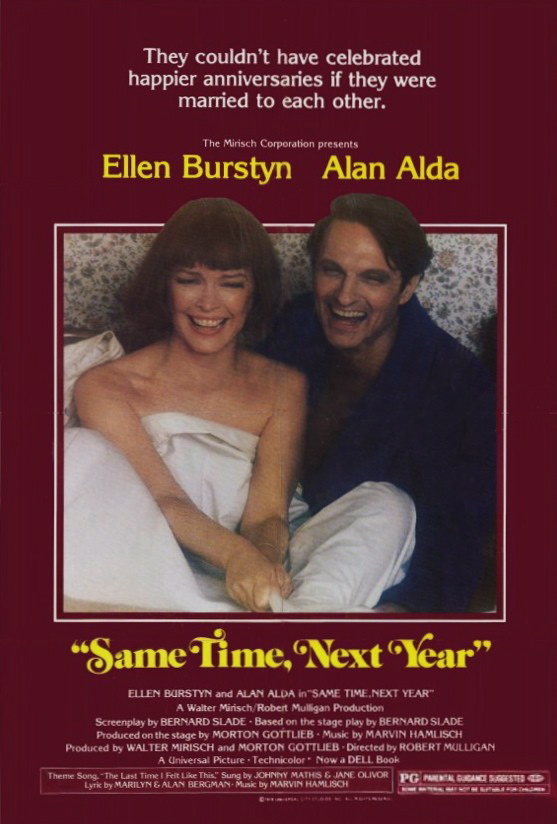
Same Time, Next Year (1978)


          A tidy romantic dramedy that’s become a staple for regional-theater revivals, Bernard Slade’s play Same Time, Next Year is built around the simple gimmick of checking in with a couple every five years over the course of the two decades in which they meet for annual adulterous trysts. Both are happily married, and we’re meant to like them because they didn’t mean to fall in love with each other during their first chance meeting, so the play gives two actors equally sized roles that are sympathetic and textured. Whether the roles are actually substantial is debatable, and the superficiality of the piece is particularly evident in the film adaptation.
          Penned by Slade with few adjustments for cinematic presentation, and directed with characteristic sensitivity by Robert Mulligan, Same Time, Next Year stars Ellen Burstyn, a holdover from the Broadway production, and Alan Alda, a replacement for the stage show’s leading man, Charles Grodin. Seen outside of the confines of a live theater, where the combination of star power and Neil Simon-esque writing probably made the play go down quite smoothly, Same Time, Next Year seems contrived and shallow, even though it’s consistently entertaining.
          Since Doris (Burstyn) and George (Alda) meet in the early ’50s and the final scene takes plays in the mid-’70s, Slade uses the characters as prisms for historical milestones: Doris goes through a hippie phase before embracing Women’s Lib, while George transitions from uptight conservatism to mind-expanding liberalism after his family is affected by the Vietnam War. Simply by virtue of how much time they spend onscreen, Doris and George emerge as (somewhat) specific individuals, but they’re also vehicles for Slade’s vanilla speechifying about the Big Issues of the ’50s, ’60s, and ’70s.
          This introduction of sociopolitical heft into the story, particularly during the second half, is helpful because the cutesy trope of Doris and George meeting for sex once a year would have lost its romantic fizz otherwise. Echoing a problem found in Simon’s work, however, Same Time, Next Year ends up in narrative limbo, neither deep enough to be meaningful nor sufficiently uproarious to be a comedy classic. It’s merely pleasant, with an endearing core of reflection and sweetness.
          That said, the piece is elevated by expert acting: Burstyn infuses the movie with femininity and warmth, illustrating the myriad ways women’s roles in American life changed in the postwar era, and Alda delivers his signature mixture of gently neurotic intellectualism and pitch-perfect comic timing. Thanks to their work and Mulligan’s careful dramaturgy, there’s enough humanity amid the slick professionalism to make this film worthwhile.

Same Time, Next Year: GROOVY