Showing posts with label bill conti. Show all posts

Thursday, February 1, 2018

Uncle Joe Shannon (1978)


          The success of Rocky (1976) created opportunities for nearly everyone involved in the project, among them supporting player Burt Young, who played the title character’s volatile brother-in-law in the first movie and several sequels. After broadening his skillset to include screenwriting by penning a TV episode and a telefilm, Young wrote a star vehicle called Uncle Joe Shannon and teamed with Rocky’s producers to make the film. That Young neither blossomed into a marquee name nor wrote another feature correctly indicates that Uncle Joe Shannon is an underwhelming picture. Formulaic, manipulative, and sentimental, it feels like a throwback to the cornpone weepies of the 1930s, and Young fails to deliver a properly dimensional performance—his tonalities range from addled to cranky to violent to weird, with his attempts at warmth seeming forced and mawkish. Yet Uncle Joe Shannon is surprisingly tolerable, and periodically more than that, because of the polish provided by cinematographer Bill Butler and composer Bill Conti. The movie’s look has that same appealing combination of grit and gloss as the Rocky movies, and Conti’s penchant for over-the-top scoring has never found a more suitable storyline.
          In the opening scenes, Joe (Young) is a successful trumpet player, playing sold-out concerts and scoring big-budget movies. Home life is wonderful, too, because he has a beautiful wife and a sweet son. After a fire claims their lives, Joe becomes a derelict, drinking himself into oblivion until circumstances make him responsible for a young boy named Robbie (Doug McKeon). This relationship follows roughly the contours you might expect, with Joe struggling to play the father-figure role while Robbie pushes Joe to get well. Then Young, in his capacity as the film’s writer, throws an absurd twist into the narrative, transforming the picture from a character study to a tearjerker.
          Given the rickety storyline and Young’s tendency to wail like an animal through emotional scenes, Uncle Joe Shannon should be cringe-inducing, but somehow it never sinks to that level. Even during the stupidest stretches of plotting, Butler’s photography is glorious and Conti’s music (which often calls to mind Chuck Mangione’s smooth-jazz vibe) is immersive. Moreover, it’s not as if Young’s performance is a complete bust—he channels despair believably, he gets humiliation right, and he’s loose and real even when the situations he’s playing are absurdly contrived. Complementing Young is McKeon, later to become a fine teen actor in the early and mid-’80s. Eschewing the cute-kid theatrics of, say, Ricky Schroeder, McKeon credibly manifests bitter rage in many scenes.

Uncle Joe Shannon: FUNKY

Wednesday, September 9, 2015

A Man, a Woman, and a Bank (1979)


          Elevated by a charming leading performances but weighed down by a sleepy storyline, the Canadian-made heist comedy A Man, a Woman, and a Bank is pleasant to watch even though it lags frequently and leaves only the faintest impression on the viewer’s memory. Donald Sutherland, all bright smiles and twinkling eyes, plays Reese, an ambitious schemer with an idea for casing a construction site in order to rob the bank that’s being built there as soon as the bank opens to the public. Actor/director Paul Mazursky, participating here only as a performer, plays Reese’s doughy sidekick, Norman, a computer programmer experiencing a midlife crisis. Rounding out the main cast, offbeat beauty Brooke Adams plays Stacey, an ad-agency photographer who stumbles into a romantic relationship with Reese that threatens to complicate the robbery. Orchestrating these inconsequential shenanigans is director Noel Black, whose all-over-the-map career arguably peaked with his first feature, the acidic murder story Pretty Poison (1968). Set to bouncy music by Bill Conti, A Man, a Woman, and a Bank was obviously envisioned as a frothy romantic caper, with the buddy-comedy antics of Norman and Reese providing a counterpoint to the love-struck interplay between Reece and Stacey. Alas, the script by Bruce A. Evans, Raynold Gideon, and Stuart Margolin misses the mark again and again.
          The obstacles related to the robbery are too easily surmounted. The friction between Norman and Reese is too soft, because instead of challenging each other, the characters support each other almost unconditionally. Most problematically, the romance between Reese and Stacey fails to generate suspense—Reese’s lies about his activities endanger the relationship, but Stacey doesn’t learn enough secrets to imperil Reese’s plans, at least not until the very end of the story. Because of these narrative issues, long stretches of A Man, a Woman, and a Bank unfold without any dramatic conflict. Yes, the bit of Norman and Reese hiding from security guards in an elevator shaft has a smidgen of suspense, and yes, it’s possible to become sufficiently invested in the Reese/Stacey relationship to worry about the union’s survival. Overall, however, A Man, a Woman, and a Bank is frustratingly bland, and it doesn’t help that Mazurky plays his sad-sack role so credibly he engenders more empathy than amusement. While Black’s slick style ensures that every scene is polished, Adams’ warmth and Sutherland’s charm are the best reasons to overlook the picture’s mediocrity.

A Man, a Woman, and a Bank: FUNKY

Wednesday, October 22, 2014

1980 Week: The Formula


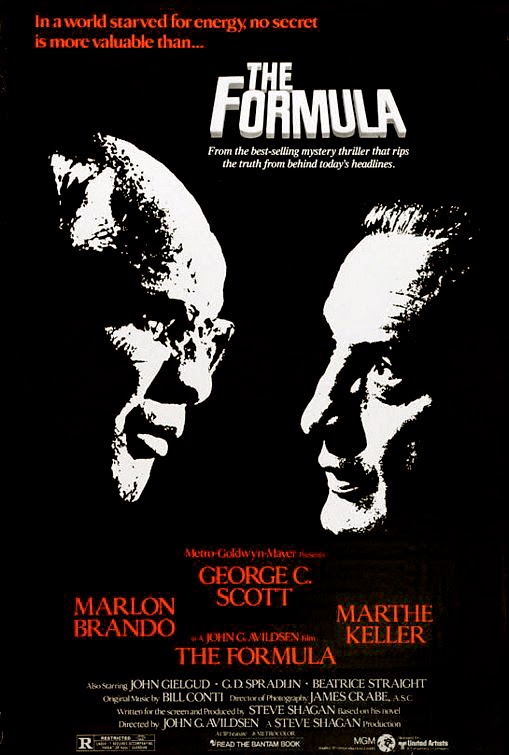
          While it would be exaggerating to describe this conspiracy thriller as a massive waste of talent, it’s fair to say that the luminaries involved in the project should have been able to generate something more exciting. After all, stars Marlon Brando and George C. Scott both had Oscars to their names by the time they costarred in The Formula, and director John G. Avildsen had recently scored a major hit with Rocky (1976). Even the movie’s deep bench of supporting actors is impressive: John Gielgud, Marthe Keller, Richard Lynch, G.D. Spradlin, Beatrice Straight. Yet The Formula is talky instead of thrilling, and the mano-a-mano faceoff between the top-billed actors that’s promised by the film’s poster never really materializes. On the bright side, The Formula is a handsome-looking movie that benefits from intricate plotting and (no surprise) skillful acting.
          Written and produced by Steve Shagan, the picture begins with a prologue set in Germany during the final days of World War II’s European action. A Nazi general is entrusted with a shipment of valuable papers that Third Reich officials hope to trade for protection after Germany falls, but U.S. soldiers seize the shipment before the Nazi general can escort the papers to a safe place. Next, the movie cuts to the present, where LAPD Detective Barney Caine (Scott) begins investigating the murder of a former LAPD chief. Caine uncovers connections between the dead man and oil magnate Adam Steiffel (Brando), and he also links the dead man to various mysterious people in Europe. Despite skepticism from his superiors, Caine treks to Germany and discovers that the dead man was part of a conspiracy involving a World War II-era formula to convert coal into oil. The ramifications are huge, since replacing petroleum as the world’s primary source of fuel would change the global economic map. Intrigue follows as Caine chases leads with the help of Lisa Spangler (Keller), a German model whose uncle has a tragic connection with the conspiracy.
          The premise of The Formula is interesting and workable, so the problem with the picture is one of execution. Nearly all of Caine’s investigative work takes the form of personal interviews, and there’s a numbing repetitiveness to the way people get shot and killed by unseen assassins immediately after giving Caine vital information. Worse, since the hit men never seem to aim at Caine himself, there’s not much real tension. By the time the movie climaxes in a lengthy (and surprisingly casual) chat between Caine and Steiffel—one of only two scenes shared by Brando and Scott—a general sense of lethargy has taken hold. Still, nearly everyone contributing to The Formula does solid work, from the way Brando hides his character’s evil behind an avuncular façade to the way composer Bill Conti accentuates scenes with robust flourishes. However, because the story never reaches a boiling point, The Formula ends up feeling like an episode from a well-made TV detective show, albeit with fancier actors and more elaborate location photography.

The Formula: FUNKY

Sunday, December 2, 2012

Paradise Alley (1978)


          While Paradise Alley is unmistakably a major ego trip for Sylvester Stallone—he wrote, directed, and stars in the picture, and he even (over)sings the theme song—his onscreen presence is more muted than one might expect, given the circumstances. A cornball ensemble piece about three Italian-American brothers living in Hell’s Kitchen circa the late ’40s, the film as much a showcase for costars Armand Assante and Lee Canalito as it is for Stallone. In fact, Canalito gets the showiest part because he spends much of the movie in a wrestling ring, playing the same sort of undereducated underdog that Stallone did in Rocky (1976) and its endless sequels. Yet if Stallone demonstrated restraint by ensuring that Paradise Alley wasn’t entirely about his character, that’s the only restraint he demonstrated—in every other regard, Paradise Alley is florid, overwrought, and schmaltzy.
          Our hero, Cosmo Carboni (Stallone), is a street hustler who anachronistically wears long hair and an earring while he pulls one scheme after another because he doesn’t want to work for a living. His brother Victor (Canalito) is a gentle giant who hauls ice up apartment-building stairs for a living—which means that, of course, we get an epic, sweaty scene of Victor lugging ice, only to have it fall down and shatter (in slow motion). Their other sibling, Lenny (Assante), is a haunted war veteran with a limp who works as an undertaker. Because, you see, he’s dead inside. Subtlety, thy name is not Stallone. As the turgid narrative unfolds, Cosmo courts Lenny’s ex, dancehall girl Annie (Anne Archer), and Cosmo gets into hassles with local mobster Stitch (Kevin Conway, giving the film’s most cartoonish performance). Eventually—which is to say, halfway through the movie, once Stallone remembers to generate a plot—Cosmo asks Victor to become a wrestler so the family can get rich. Inexplicably, this decision transforms Lenny into an avaricious prick, allowing Stallone to twist the story so his character can grow a conscience. 
          After several diverting but pointless sequences—Lenny decides he wants Annie back, Cosmo bonds with a broken-down wrestler (Frank McRae), and so on—the movie climaxes in an interminable wrestling match that is set, for no reason except that Stallone wanted a visual flourish, during a rainstorm. Cue repetitive shots of Canalito and his sparring partner flipping each other into puddles for maximum slow-mo splashing! The great cinematographer László Kovács shoots the hell out of Stallone’s absurd scenes, making the movie look better than it deserves, and the acting is so flamboyant that many scenes have energy. However, Paradise Alley is both clichéd and confusing—it’s as if Stallone couldn’t decide which old movies he wanted to pillage, so he copped something from all of them. Combined with the excessive storytelling style, the haphazard cribbing from vintage cinema turns Paradise Alley into an unappealing jumble.

Paradise Alley: LAME

Sunday, October 23, 2011

F.I.S.T. (1978)


          Jimmy Hoffa, Action Hero. If that sounds unlikely, then you’ve intuited why F.I.S.T. is such a peculiar movie. The team behind the picture clearly ached to tell the (fictionalized) story of Hoffa, the notorious labor leader whose alleged mob ties made him the target of a government investigation before he disappeared, but with Sylvester Stallone involved as leading man and co-screenwriter, a subtle approach to the material was impossible. Stallone, rewriting an original script by another man allergic to restraint, Joe Ezsterhas, imbues Hoffa doppleganger Johnny Kovak (played by Stallone) with qualities ranging from easygoing charm to operatic guilt to rugged idealism to social consciousness; he’s not just an everyman, he’s literally, it seems, every man Stallone could imagine, placing Johnny among the most absurdly overstuffed characterizations in American cinema.
          One suspects the problem was Stallone’s anxiety about potentially alienating viewers who loved him as underdog Rocky Balboa, but whatever the case, the effort to make Johnny heroic and likeable leads to weird tonal shifts. At the beginning of the picture, he’s a factory worker who mouths off to his odious boss about unfair working conditions, only to get fired for his impudence. Hired by an idealistic union boss (Richard Herd) as a recruiter for the Federation of Inter State Truckers (F.I.S.T.), Johnny quickly rises through the ranks because he’s good at motivating blue-collar workers. Seemingly overnight, Johnny evolves from the union’s hired hand to its most passionate advocate—and it simply doesn’t make sense that he cares about F.I.S.T. more than life itself, especially since the movie repeatedly affirms that Johnny isn’t even a trucker.
          Thus, as the movie gets more and more epic in scale, trying to beat The Godfather at its own game with a decades-spanning story of a man corrupted by power, the nonsensical underpinnings of the central character become so illogical that it’s hard to believe anything that happens. That’s a shame, since everything except Stallone’s characterization is solid. As directed by the versatile Norman Jewison, who obviously had a significant budget at his command, the movie has an impressive scope and vibrant energy; scenes of labor unrest, with picketing workers fighting union-busting thugs, are particularly exciting.
          There’s some enjoyable stuff with Peter Boyle as a union boss who talks a good game about serving the men but ends up dipping into union funds for personal luxuries, and Rod Steiger gets to showboat entertainingly as an ambitious Congressman who puts F.I.S.T. in his crosshairs. Supporting player Kevin Conway’s performance as a low-level mobster who gets his hooks into Johnny offers an amusing throwback to old-school cinematic criminality, and Tony Lo Bianco lays on the marinara as the Mafioso who drags Johnny even deeper into the organized-crime muck.
          Unfortunately, this two-and-a-half-hour opus is all about Stallone, and his performance is as unwieldy as his characterization. He speechifies like every scene is the finale of Rocky, complete with wildly inappropriate musical fanfare by Rocky composer Bill Conti, and his romantic scenes with Melinda Dillon feel like rehashes of the wonderful Rocky interactions between Stallone and Talia Shire. It’s true that all of this is quite watchable—the story covers so much ground, moves so fast, and reaches so many manipulative heights that it’s impossible not to be at least somewhat entertained. But does F.I.S.T. deliver a knockout thematic punch? Not so much.

F.I.S.T.: FUNKY

Tuesday, December 14, 2010

Rocky (1976) & Rocky II (1979)


          In many respects, cinema history has not been kind to Rocky, the feel-good hit that turned Sylvester Stallone into a superstar and an Oscar-nominated screenwriter. The film’s detractors dismiss Rocky as pandering hokum, and Stallone has been dogged for years by rumors that he didn’t really write the script. Further resentment is fueled by the fact that Rocky won the Best Picture Oscar for 1976, defeating such acclaimed competitors as Network and Taxi Driver. And of course the film’s biggest impediments are the many gratuitous sequels that cheapen the Rocky brand. Yet when the muck is pushed aside, one quickly rediscovers a gem of a movie, which isn’t so much pandering as old-fashioned. The story follows low-rent boxer Rocky Balboa (Stallone), who supports his going-nowhere pugilistic career by working as a muscleman for a Philadelphia gangster, even though Rocky’s too inherently decent to inflict much damage on his employer’s enemies. A simple soul with zero self-esteem, Rocky’s in love with a meek pet-shop clerk, Adrian (Talia Shire), whose brother is foul-tempered drunk Paulie (Burt Young). The other key figure in Rocky’s life is a crusty manager, Mickey (Burgess Meredith), who doesn’t think Rocky will ever amount to anything. But when the reigning heavyweight champ, Apollo Creed (Carl Weathers), agrees to a publicity-stunt fight in which he’ll give a “nobody” a shot at the title, Rocky’s life changes overnight.
         Yet Rocky isn’t so much about boxing as it is about a small man learning his value in the world, so the filmmakers employ time-tested storytelling gimmicks to put viewers squarely in the underdog hero’s corner. The narrative’s pervasive optimism is leavened by a gritty visual style, courtesy of director John G. Avildsen, who uses working-class neighborhoods and other evocative locations to create a tangible sense of place, so in its best moments Rocky has a level of docudrama realism that sells the contrived storyline. Avildsen also created the definitive sports-training montage, often imitated but never matched—Rocky at the top of the steps! Stallone’s ambition infuses his performance, from the intensity of the boxing scenes to the sweetness of the romantic interludes, and the whole cast meshes perfectly, like the players in a well-oiled stage play. Bill Conti’s thrilling music, especially the horn-driven main theme and the exciting song “Gonna Fly Now,” kicks everything up to epic level, and Rocky boasts one of the all-time great movie endings.
          Three years after the first film became a blockbuster, Stallone starred in, wrote, and directed the first of many unnecessary sequels. Rocky II is the most irritating installment in the series, because shameless crowd-pleaser Stallone undercuts the impact of the original movie with a trite denouement that essentially erases the climax of the previous film. Rocky II features all of the principal players from the first movie, and it’s made with adequate skill, but it’s a hollow echo at best. What’s more, the next two sequels, both released in the ’80s, dispatched with credibility in favor of super-sized entertainment, so Rocky II represents the juncture at which the series enters guilty-pleasure territory.

Rocky: OUTTA SIGHT
Rocky II: FUNKY