Showing posts with label bob balaban. Show all posts

Tuesday, April 5, 2016

1980 Week: Altered States


          Unquestionably one of the trippiest movies ever released by a Hollywood studio, the sci-fi/horror saga Altered States was an odd swan song for Paddy Chayefsky. Following a celebrated career during which his melodramas and social satires earned the writer three Oscars—for Marty (1955), The Hospital (1971), and Network (1976)—Chayefsky penned his first and only novel, Altered States (1978). Suggested by the experiments of “psychonaut” John C. Lilly, who used hallucinogens and sensory-deprivation tanks to explore the furthest recesses of the human mind, Altered States was a far cry from Chayefky’s usual fare.
          Nonetheless, Chayefsky wrote the screen adaptation of his own book and prepared to make the movie with director Arthur Penn. Disagreements pushed Penn off the project, and his replacement was Ken Russell, a British maverick known for boundary-pushing imagery and puerile fascinations. Chayefsky didn’t click with Russell, either, but this time it was the writer who left the project, replacing his name on the script with a pseudonym. Watching Altered States, it’s possible to see why Chayefsky distanced himself from the movie—which is forever on the verge of self-parody—and yet it’s also possible to see what made the underlying material so fascinating in the first place. The protagonist of Altered States tries to scientifically identify the fundamental nature of the human species.
          Psychology professor Edward Jessup (William Hurt) spends time in sensory-deprivation tanks, treating his visits like exploratory journeys into the outer realms of consciousness. Even as he clumsily attempts to build a “normal” life with a beautiful colleague named Emily (Blair Brown), Edward remains obsessed with his research. That’s why he follows a lead and visits South America, consuming a powerful drug that elicits mind-expanding hallucinations. Returning to the U.S., Edward combines the drug and the sensory-deprivation tank, with shocking results.
          By about halfway through its running time, Altered States becomes an out-and-out fantasy film, complete with elaborate special effects. Seeing as how the picture is loaded with hyper-articulate dialogue and persuasive scientific jargon, the introduction of paranormal phenomena makes for a heady shift. Accordingly, many critics and viewers have dismissed Altered States as a lark with a great pedigree, even though it arguably belongs on the same continuum of existential sci-fi as 2001: A Space Odyssey (1968) and Solaris (1972). Chayefsky’s style is evident, pseudonym be damned, because no one else writes lines like this one: “She prefers the senseless pain we inflict on each other to the pain we would otherwise inflict on ourselves—but I’m not afraid of that solitary pain.”
           Similarly, only Russell could manufacture the out-there imagery of Edward’s hallucinations: bloody bibles, mutant animals, spewing volcanoes, naked bodies transforming into sand sculptures that blow away when attacked by vicious winds. Composer John Corigliano, contributing his first-ever music score, energizes Russell’s crazy images with an extraordinary score defined by avant-garde flourishes, insinuating rhythms, and an almost primal energy. Vivid performances elevate the film, as well. Making his movie debut, theater-trained William Hurt channels his über-WASP persona into the spectacularly alive portrayal of a seeker chasing the one thing he finds hardest to grasp—true human connection. Blair Brown matches him in terms of intelligence and passion, while also adding a layer of sensuality, and costars Bob Balaban and Charles Haid lend comic relief playing, respectively, the believer and the skeptic in Edward’s social circle.
          Yet perhaps the most interesting aspect of Altered States is that whenever he’s not overseeing whackadoodle hallucination scenes, Russell provides crackerjack storytelling clarity. He handles dramatic scenes with restraint and taste, manufacturing fast but disciplined pacing. One can only imagine what shape Altered States would have taken if Chayefsky and Russell had been simpatico.

Altered States: GROOVY

Thursday, December 4, 2014

Girlfriends (1978)


          Director Claudia Weill made enough of a critical splash with Girlfriends, her award-winning debut fictional feature, that she seemed poised to become one of the few successful female directors in Hollywood. Yet after her second feature, the studio comedy It’s My Turn (1980), failed to generate excitement, Weill retreated into directing for television. Revisiting Girlfriends, it’s easy to see why she found a home in TV, since Weill is best at capturing the miniscule details of human interaction. Yet it’s also fair to suggest that had Weill come along a few years earlier, she might have thrived during the heyday of the New Hollywood. In any event, Girlfriends is appealing but slight, a character study about a young woman trying to find herself personally and professionally.
          Other filmmakers of the same era, notably Paul Mazursky, explored identical subject matter in pictures that were funnier and slicker than Girlfriends. However, Weill’s movie has a unique sort of intimacy, partially because it was shot on grungy 16mm film stock. Starring the decidedly unglamorous Melanie Mayron, the movie has the aesthetic of a modern indie flick, with humdrum locations and self-involved characters and an unresolved climax. In other words, it’s like life, whereas similar films from studios—even Mazursky’s fine efforts—tended to wrap the experiences of women in neat, I-am-woman-hear-me-roar bows.
          Written by Vicki Polon, Girlfriends concerns Susan Weinblatt, a meek photographer who makes her living shooting bar mitzvahs and weddings for Rabbi Gold (Eli Wallach). After moving through unsatisfying trysts with men, as well as thorny relationships with two very different gal pals—conformist Annie (Anita Skinner) and hippie Ceil (Amy Wright)—Susan grows a spine and starts demanding respect in the bedroom and the workplace. The small beauty of Weill’s movie is that it doesn’t reduce people to stereotypes. For instance, Susan’s boyfriend throughout most of the story, Eric (Christopher Guest), exhibits macho control issues while also manifesting sensitivity and understanding. Similarly, the married Rabbi Gold seems like a lech when he makes a pass at the much-younger Susan, but then a scene featuring his domineering wife reveals that he’s simply emasculated and lonely. One of the movie’s themes, therefore, relates to Susan learning how to provide her own compass for navigating a complex world, since no one else can offer sufficient guidance.
          Although the film is unfocused—despite the title, friendship is only one of many threads holding the story together—Weill and her collaborators compensate for the meandering narrative with scenes that ring true emotionally. The picture also benefits from amiable performances, with Mayron the obvious standout and Wallach lending brand-name credibility. Future comedy star Guest gives a solid dramatic turn (with hints of his signature deadpan humor), while Bob Balaban, subsequently to become a member of Guest’s quasi-repertory company, appears in a secondary role. Among the less familiar names, Skinner and Wright both deliver believable work.

Girlfriends: FUNKY

Sunday, June 2, 2013

Bank Shot (1974)


          To get a sense of the endearingly fluffy humor that pervades this caper flick, consider a moment when bumbling FBI agent Streiger (Clifton James) shows his team surveillance footage of master criminal Walter Upjohn Ballantine (George C. Scott). First, the surveillance camera is angled away from Ballantine because the cameraman is ogling a pretty girl’s figure, and second, Ballantine reveals he’s aware of the surveillance camera by dabbing the lens with the tip of an ice cream cone. Gritty realism this is not. Yet while some other adaptations of lighthearted crime books by author Donald E. Westlake spiral into stupidity, the Westlake adaptation Bank Shot comes awfully close to cooking that most delicate soufflé of pure farce, especially during sequences of epic-proportioned slapstick. It helps, of course, to have a leading actor of consummate skill, since Scott plays every single scene perfectly straight, no matter how absurd the circumstances. Together with an adept supporting cast and the confident direction of Gower Champion (a former dancer and choreographer), Scott’s performance makes Bank Shot highly entertaining.
          The plot is a standard Westlake lark. Career thief Ballantine, whom Scott portrays with comically bushy eyebrows and a pronounced lisp, is stuck in a prison work farm until his excitable accomplice, A. G. Karp (Sorrell Booke), visits with news that a bank has been identified as vulnerable for robbery. Ballantine stages a ridiculous escape by hijacking an earthmover and bulldozing his way through prison walls. Then he meets the unimpressive crew Karp has gathered. These offbeat theives include a nebbish ex-FBI agent (Bob Balaban), a jittery goodfella (Don Calfa), and a sexy society dame (Joanna Cassidy) who’s moonlighting as a crook for thrills. Karp’s undercooked plan involves robbing a bank that’s temporarily housed in a mobile home, so Ballantine arrives at an audacious method—hook the mobile home to a truck, cart it away to a safe location, and crack the bank’s vault later.
          Even though the movie is very brief (83 minutes), Bank Shot includes a string of goofy running gangs, like the trope of Ballantine dosing himself with saltpeter in order to resist the advances of Cassidy’s character, lest he get distracted from his task. (Cassidy, playing one of her earliest major film roles, enlivens the picture with her carefree spirit and throaty laugh.) The picture is handsomely shot and quickly paced, though it slows down, appropriately, during moments displaying the thieves’ careful technique; watch for the bit when an explosives man gets more and more frustrated each time a charge proves insufficient for blowing a safe open. Bank Shot gets very cartoonish toward the end, with Streiger and his men chasing after a runaway mobile home—c’mon, you knew that was going to happen—but the charm of the main performances and the cheerful unpretentiousness of the whole enterprise compensate for a lot of rough edges.

Bank Shot: GROOVY

Friday, December 28, 2012

Report to the Commissioner (1975)


          Back in my college days, when I lived in Manhattan, I was friendly with an NYPD homicide detective who was also a movie buff, and he hipped me to this little-seen drama, praising it as one of the most accurate depictions he’d ever seen about how ugly the gamesmanship within a police force can get. And, indeed, even though Report to the Commissioner is fictional—it’s based on a novel by James Mills—the picture radiates authenticity. Extensive location photography captures the dirty heat of summertime New York City; intense performances burst with streetwise attitude; and the vicious storyline is driven by cynicism, duplicity, and politics. Told in flashback following some sort of terrible clusterfuck of a shootout at Saks Fifth Avenue, the picture reveals how an ambitious undercover detective and a rookie investigator cross paths, with tragic results.
          Michael Moriarty, appearing near the beginning of his long career, stars as hapless Detective Bo Lockley, a newcomer to the NYPD investigative squad who gets paired with a seen-it-all partner, African-American Richard “Crunch” Blackstone (Yaphet Kott0). In a telling early sequence, Lockley watches Blackstone lean on black suspects, even going so far as to spew racial epithets, which clues Lockley into the level of moral compromise required of NYPD lifers. Meanwhile, unbeknownst to Lockley, undercover narcotics cop Patty Butler (Susan Blakley), a pretty blonde WASP who uses her looks to undercut suspicions that she’s a police officer, gets a lead on a well-connected dealer named Thomas “Stick” Henderson (Tony King). Smelling an opportunity for a high-profile bust that will help his career, Butler’s commanding officer, Captain D’Angelo (Hector Elizondo), approves a dangerous plan for spying on Stick. Soon afterward, Lockley gets pulled into the situation—without being given crucial information—and things go to hell. The movie climaxes with a tense hostage situation inside Saks, during which high-ranking cops put more energy into covering their asses than saving innocent victims.
          This is dark stuff, making Report to the Commissioner a fine companion piece to Sidney Lumet’s various ’70s pictures about cops and criminals in New York City. And while Report to the Commissioner is far from perfect—the script meanders into subplots and some of the characters could have been consolidated for the purpose of clarity—the movie has myriad virtues. The atmosphere sizzles, with cinematographer Mario Tosi using haze filters and wide lenses to depict grungy exteriors and sweaty interiors. Director Milton Katselas, best known as an acting teacher, demonstrates a real gift for integrating actors into spaces and thereby creating verisimilitude. Best of all, though, are the film’s potent performances. Blakely’s sharp in a smallish role, King is physically and verbally impressive, and Moriarty’s weirdly twitchy energy is compelling. Furthermore, it’s hard to beat the roster of eclectic supporting players—beyond Elizondo and Kotto, the picture features Bob Balaban, William Devane, Dana Elcar, Richard Gere (in his first film role), and Vic Tayback. (Available as part of the MGM Limited Collection on Amazon.com)

Report to the Commissioner: RIGHT ON

Thursday, September 27, 2012

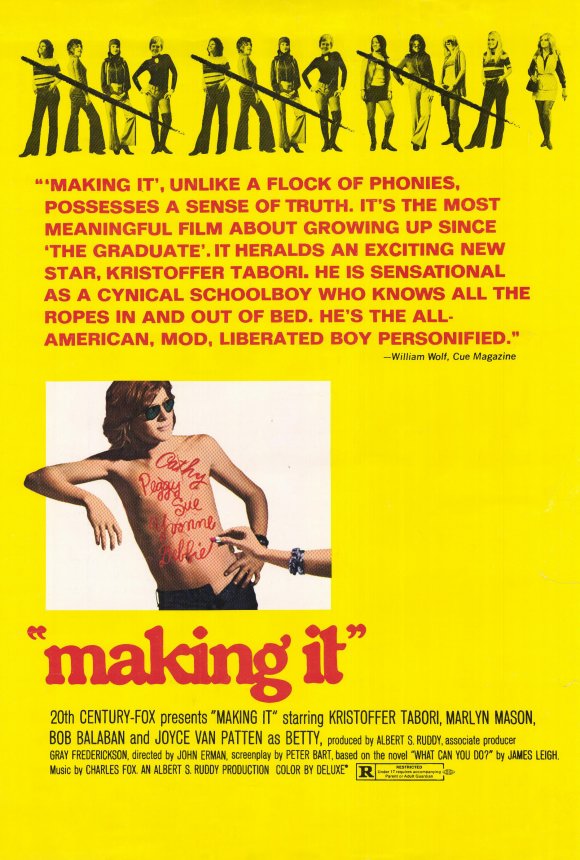
Making It (1971)


          When the lyrics of a movie’s opening theme proclaim, “Everybody’s busy learning yesterday, but I’m into tomorrow—that’s a better way,” you know you’re in for a dated Generation Gap story about a hip kid showing uptight adults what it’s all about, man. And while many movies of this stripe are unwatchable today, thanks to arrogant leading characters and pretentious themes, Making It is more worthwhile than its lurid title might suggest. The hero of the piece is Phil (Kristoffer Tabori), a high-school schemer who’s juggling sexual affairs with Debbie (Sherry Miles), a dim-bulb classmate, and Yvonne (Marlyn Mason), the horny wife of his gym coach. Meanwhile, Phil’s mom, Betty (Joyce Van Patten), is a lonely divorcée looking to start over with bland but reliable businessman Warren (Dick Van Patten), who happens to be married to another woman. The depiction of Phil’s home life explains why he finds monogamy overrated, but as the story progresses, Phil discovers the consequences of cocksmanship—he gets Debbie pregnant, runs into a hassle with Yvonne’s husband, and so on.
          Until his comeuppance, Phil is a self-aware operator who talks the talk of a disaffected ’70s rebel in order to court older women (sample pickup line: “That’s where it’s at, being honest with each other”). Yet the filmmakers ensure that we can always see the naïve young man beneath the swaggering façade. All of this may sound rather ordinary, and, indeed, Making It is a minor film in every way. However, the picture’s acting, direction, and writing are so smooth that Making It ends up exemplifying the entire post-Graduate genre. More importantly, the film follows its storyline to a logical conclusion instead of merely stirring up unresolved ambiguity.
          Tabori, the son of B-movie director Don Siegel, is strong in the leading role, effectively blending innocence with sass, and the supporting players are solid—the cast also includes Bob Balaban, as Phil’s snide crony, and David Doyle, as an exasperated administrator. Prolific character actor Lawrence Pressman is especially good as a teacher who sarcastically challenges Phil’s vision of kids leading the charge for social change: “I propose a new flag,” the teacher says at one point, “no stars, just acne.” A little much, sure, but it gets the point across. Interestingly, the film’s screenplay was penned by then-studio executive Peter Bart, who later gained fame as the editor-in-chief of Variety and as the host of various TV shows about showbiz. Nice to know he made a respectable effort during his brief tenure in the trenches of Hollywood’s creative scene.

Making It: GROOVY

Friday, January 21, 2011

Close Encounters of the Third Kind (1977)


          Steven Spielberg’s second career-defining megahit in a row, following 1975’s Jaws, is in some ways an even more extraordinary demonstration of his gifts than its predecessor, because for much of the film Spielberg has to create excitement around unseen phenomena. Utilizing an arsenal of camera tricks, sophisticated special effects, and pure storytelling wizardry, Spielberg manufactures a vivid sensation that something unprecedented is unfolding, which generates relentless tension as viewers wait for the payoff. And then, in the jaw-dropping finale, he unleashes an onslaught of visual spectacle so overpowering that it justifies all the intense foreshadowing. One of the few films for which Spielberg received sole screenwriting credit, Close Encounters grew out of the director’s fascination with the idea of extraterrestrial life, and more specifically the idea of what might happen upon first contact between humankind and beings from another world.
          Although this subject had already been explored in countless films and TV shows, Spielberg approached the concept with such reverence that Close Encounters remains the definitive movie of its type, even though it’s really just a feature-length prelude to an unknown adventure that happens after the closing credits. Abetted by a masterful production team, Spielberg shapes the story (to which writers including Hal Barwood, Matthew Robbins, and Paul Schrader made significant but uncredited contributions) to include meticulous detail extrapolated from reports of real-life UFO sightings, as well as a plausible illustration of how the world’s military and scientific communities might react in the event of “close encounter,” to say nothing of imaginative depictions of how aircraft flown by outer-space visitors might manifest.
          Tying the film together is the character of Roy Neary (Schrader’s invention, according to some reports), an everyman who becomes obsessed with finding the truth after his pickup truck has an astonishing run-in with an alien craft. Richard Dreyfuss plays Neary to wrenching effect, depicting how the character’s quest for facts is a desperate need to prove he hasn’t gone insane—and a search for personal identity greater than that of an anonymous working stiff. Melinda Dillon and Teri Garr, as the two women in his life, provide earnest counterpoint and sharp comic relief, respectively, while Bob Balaban and iconic French filmmaker Francois Truffaut stand out among the scientific types who cross Neary’s path. Close Encounters includes some of the most exciting scenes Spielberg ever filmed, like Dillon and Dreyfuss busting through a military barrier to reach the natural wonder of Devils Tower in Wyoming, and it also features some of the funniest, like Dreyfuss’ experiments with a mound of mashed potatoes. So while Close Encounters is not for every taste (some fret the ending doesn’t go far enough, others complain it goes way too far), it’s a remarkable experience for those who, like Neary, want to believe.

Close Encounters of the Third Kind: OUTTA SIGHT