Showing posts with label carol lynley. Show all posts

Wednesday, March 2, 2016

Bad Georgia Road (1977)


While some viewers might enjoy huffing Bad Georgia Road as a straight shot of clichéd moonshine-cinema stupidity, the picture is unimpressive even by the low standards of its drive-in-friendly genre. Yes, Bad Georgia Road has betrayal, brawls, chases, drunkenness, sex, shotguns, skinny-dipping, and nearly every other signifier associated with ’70s redneck flicks. What it lacks, however, is spunk. Whereas the best moonshine flicks roar through the backwoods on overdrive, Bad Georgia Road ambles through the same territory in a frustratingly low gear. Carol Lynley plays bitchy New Yorker Molly Golden, who inherits an estate in rural Georgia. Told she can cash out the estate for $100,000 if she shows up in person to sign papers, Molly quits her job and drives to Georgia. Upon arrival, Molly realizes she’s been duped—a lawyer persuades her to sign over the $100K to creditors, so her real inheritance comprises a decaying house, a few acres of land, and a ramshackle moonshine operation. Left with no options, Molly takes over the operation and clashes with her driver, Leroy Hastings (Gary Lockwood), an alcoholic womanizer. Predictably, other local moonshiners declare war on Molly’s operation. As B-movie setups go, this isn’t bad. Unfortunately, Lynley is shrill and uninteresting in the leading role, while Lockwood is questionable as her loutish compatriot. His accent is dodgy, his mannerisms are cartoonish, and he seems bored in most scenes. Everything in Bad Georgia Road feels trite, and the Taming of the Shrew dynamic between the leading characters is so retrograde as to seem grotesque. After all, Bad Georgia Road is one of those icky “lighthearted” movies in which the hero seduces the heroine by raping her. Thanks, but no thanks.

Bad Georgia Road: LAME

Thursday, December 18, 2014

The Cat and the Canary (1978)


          John Willard’s 1922 play The Cat and the Canary, which blends comedic and horrific elements while telling the story of would-be heirs trying to survive an evening in a spooky house, has enjoyed a long cinematic afterlife. The first screen adaptation was a 1929 silent picture, and two additional versions were filmed in between the silent movie and a successful 1939 remake starring Bob Hope. (The 1939 movie did so well that costars Hope and Paulette Godard reteamed for another funny/scary romp, 1940’s The Ghost Breakers, which, incidentally, was among the inspirations for the 1984 blockbuster Ghostbusters.) By the time this 1978 version of the story was produced, social mores had changed considerably. As helmed by Radley Metzger—who spent most of the ’70s directing hardcore porn flicks—the 1978 Cat and the Canary is rougher than its predecessors, and, not coincidentally, a lot less charming.
          Whereas the Hope Cat and the Canary blends gentle suspense with lighthearted laughs, the 1978 Cat and the Canary tries to spruce up old material by adding gore, sex, and torture. Yet the underlying material is so fundamentally old-fashioned that it doesn’t gel with Hammer Films-style extremes. Instead of seeming bold and shocking, the 1978 Cat and the Canary comes across as desperate, disjointed, and even a bit vulgar. The movie is watchable, thanks to the fun storyline and a parade of familiar actors, but it does not improve upon its predecessors.
          Set in a grand English mansion, the story concerns a group of relatives who gather for the reading of a will. The deceased party is a rich eccentric named Cyrus West (Wilfrid Hyde-White), who attaches weird conditions to his bequests. After naming a sole beneficiary, the will states that if the beneficiary is ruled insane within 30 days, the fortune will pass to a successor. These conditions, naturally, prompt everyone but the initial beneficiary to attempt mischief. Adding to the macabre mix is a visit from a psychiatrist who says that a maniac recently escaped from a nearby mental hospital.
          When this storyline works, as in the Hope classic, the narrative is a ghoulish lark. In the hands of Metzger and his collaborators, the narrative is artificial and stilted. Worse, nearly all the humor is drained from the material by flat performances; only Hyde-White and pithy costar Wendy Hiller lock into the right jovial groove. Leading lady Carol Lynley is amateurish, leading man Michael Callan is forgettable, and costars Honor Blackman and Olivia Hussey are merely ornamental. The X factor is Edward Fox, who camps it up after a plot twist reveals a new side of his character. Speaking of camp, this version of The Cat and the Canary has overt gay content (including a pair of lesbian characters), which adds a certain novelty.

The Cat and the Canary: FUNKY

Tuesday, June 12, 2012

Norwood (1970)


          After achieving success on the pop charts, velvet-voiced Arkansas native Glen Campbell displayed a comfortable onscreen presence in the John Wayne movie True Grit (1969), so it was inevitable that some enterprising producer would test Campbell’s viability as a leading man. (Hey, it worked for Elvis, so why not?) In Norwood, Campbell plays upbeat war veteran Norwood Pratt, a good ol’ boy from Texas who bums around the country with his acoustic guitar, crooning innocuous tunes and spewing redneck patois (“Think I’ll mosey on over to the roller rink, see if I can’t pick up a little heifer lookin’ for a ride home”).
          Upon returning from Vietnam to his tiny hometown of Ralph, Texas, Norwood works in a garage and endures sitcom-style quarrels with his sister (Leigh French) and her idiot husband (Dom DeLuise). Eager for escape, Norwood agrees to help a slick used-car salesman (Pat Hingle) transport cars to New York City. He also agrees to transport a sexy would-be performer (Carol Lynley), leading to arguments in which she calls him “peckerwood” and he calls her a “damn squirrel-headed dingbat.” Yeah, it’s like that.
          Eventually, Norwood discovers the cars he’s moving are stolen, so he dumps the vehicles and heads to New York anyway, where he gets laid with a spunky hippie (Tisha Sterling). Sated, he hops on a bus for the long trip back home. Along the way, he forms a bizarre surrogate family with Rita (Kim Darby), a redneck runaway bride; Edmund (Billy Curtis), a little person raised in the carny world; and a chicken. Yes, a chicken.
          To call Norwood inconsequential would be to overstate its value, but some scenes are so random they command attention, like the bit of costar Joe Namath tossing around a football with the dwarf in the backyard of a Southern estate. (Despite his prominence on the poster, former gridiron star Namath has a tiny role.) As for Campbell, he strikes a clean-cut figure with his helmet of shiny hair and his lantern-jawed good looks, but he’s more of a personality than an actor, so assessing his performance is pointless.
          Incredibly, this slight movie was adapted from a novel by True Grit author Charles Portis, though the vapid storyline of Norwood exists a universe apart from the unforgettable narrative of True Grit. Norwood is also notable, if that’s the right word, as one of the gentlest Vietnam-vet stories ever, since the easygoing Norwood seems as if he just came back from a country club instead of surviving a tour in Southeast Asia.

Norwood: FUNKY

Friday, November 4, 2011

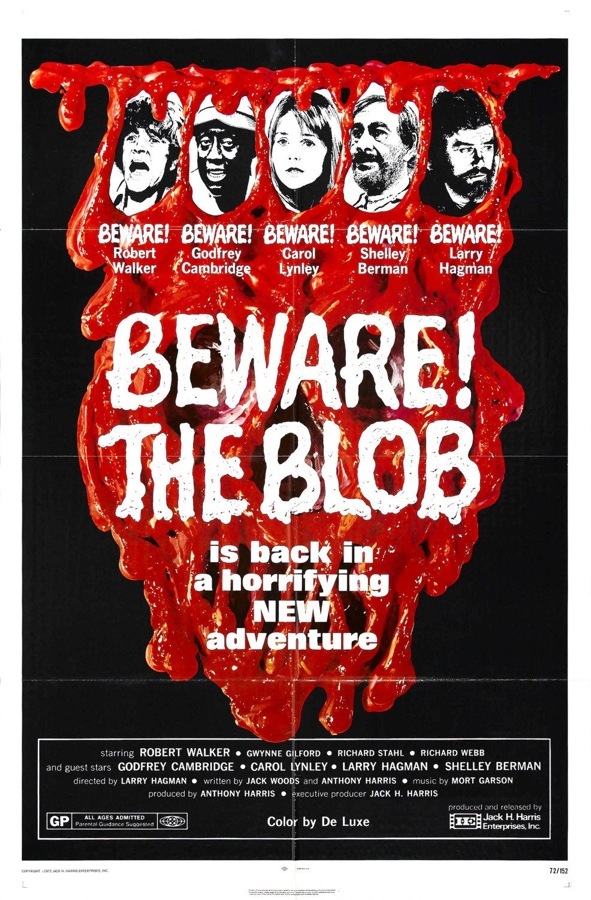
Beware! The Blob (1972)


The 1958 drive-in movie The Blob is fondly remembered for its absurd premise—a giant mass of radioactive goo invades a city, eating everyone in its path—and for the presence of future superstar Steve McQueen in his first leading role. However, the world probably wasn’t crying out for a sequel, much less one that hit theaters more than a decade after the original. Fitting the lack of marketplace excitement that preceded its arrival, Beware! The Blob is a genuinely terrible movie, noteworthy only for the participation of several familiar Hollywood names. Inexplicably, the picture was directed by Larry Hagman, who was at the time best known for starring in the ’60s sitcom I Dream of Jeannie. Hagman makes a very brief appearance in the picture, as do fellow cameo players Shelly Berman, Godfrey Cambridge, Carol Lynley, and Burgess Meredith; principal roles are played by second-stringers including Richard Stahl, Dick Van Patten, and Robert Walker Jr. The plot, which couldn’t matter less, involves the blob escaping captivity and attacking another town until our valiant young hero (Walker) traps the gelatinous beastie in an ice-skating rink. The picture was obviously envisioned as a spoof of horror movies, but insultingly cheap special effects and numbingly stupid jokes kill any humor potential, as does the movie’s tendency to wander off on tangents by introducing minor characters who appear onscreen just long enough to get consumed by the Blob. In one particularly pointless bit, a stoned hippie wanders into a barber shop, where the barber toys with him thusly: “I don’t cut hair, I sculpt it. Do you want a hair sculpt? It will be four hundred dollars.” As the saying goes, are we having fun yet? There’s a reason Hagman never directed another feature, and there’s a reason Hollywood ignored this misbegotten flick when it rebooted the Blob franchise more than a decade later with a gory remake of the original movie. Beware, indeed.

Beware! The Blob: SQUARE

Friday, August 5, 2011

The Four Deuces (1976)


An awful gangster-themed comedy/thriller featuring Jack Palance at his all-over-the-map worst, The Four Deuces has a few interesting flourishes that are worth noting, if not necessarily worth watching. The movie uses comic-book text panels during transitions between sequences, plus actual comic-book drawings that morph into live-action photography, so the idea is apparently to present a ’30s-era newspaper strip come to life—if, in fact, “life” is the right word for a movie so utterly lacking in vitality. The story is standard stuff about a mob boss whose main squeeze two-times him while he’s trying to win a bloody conflict with a rival hoodlum, and the generic quality of the picture is accentuated by costumes and props that all look they’re fresh off the rack; one gets the impression that dodgy producers rented everything instead of buying or manufacturing. As for the alleged comedy elements of the movie, not a single funny thing happens, unless enduring sped-up Kesystone Kops-style chases or watching the ghoulish Palance laugh hysterically while he kills people hits your sweet spot. Seeing Palance bounce between cringe-worthy over-acting and limp under-acting is nothing new; nor is watching leading lady Carol Lynley, of The Poseidon Adventure fame, demonstrate an utter lack of dynamism. Thus, the only disappointment is watching Adam Roarke spin his wheels in yet another pointless role: A handsome, intense player from ’60s exploitation flicks who never found his breakthrough role, he’s a cipher as the hotshot reporter who tags along with Palance’s gang and hops into the sack with Palance’s moll (Lynley). Especially since the movie’s only novel element, the comic-book stylization, was used more effectively in other pictures, like the exceedingly weird 99 and 44/100% Dead (1974), it’s safe to say The Four Deuces is not a winning hand.

The Four Deuces: LAME

Thursday, January 13, 2011

The Shape of Things to Come (1979)


Scads of shameless producers pounced on the success of Star Wars (1977) by cranking out low-budget crap stuffed with robots and spaceships, so there’s a lot of competition for the title of worst Star Wars rip-off. By most measures I can summon to mind, however, the misbegotten Canadian turkey The Shape of Things to Come may be the winner in this particular sweepstakes. Clumsily adapted from an H.G. Wells novel and boasting not only a profoundly awful screenplay but also a completely halfhearted approach to acting, directing, production design, and storytelling in general, this is the sort of dorky tedium that gives space opera a bad name. Set in the standard sci-fi milieu of the postapocalyptic future, the movie details a battle between government officials in New Washington, a human HQ on the surface of the moon, and cape-wearing megalomaniac Omus (Jack Palance), who uses his army of robots (Palace pronounces the word as “row-butts”) to hoard supplies of a life-giving medicine found only on his remote outpost of Delta 3. Several heroic types from New Washington launch an experimental new vessel to overthrow Delta 3, leading to battles between interchangeable human characters in goofy bodysuits and cheaply constructed robots who look like dudes waddling around in tricked-out garbage cans (actually, they probably are dudes waddling around in tricked-out garbage cans). The rudimentary musical score is produced so badly that it sounds like it’s being played off a warped LP, and the producers believe that shooting everything with cheap gimmicks like star filters will make images look otherworldly. The acting is consistently atrocious, from Palance’s usual phoned-in ghoulishness to Carol Lynley’s bland earnestness, and it’s hard to appreciate the handful of decent spaceship shots since they’re repeated ad nauseum and intercut with hopelessly static interiors. Lethargic, stilted, and uninvolving, The Shape of Things to Come is pure spacejunk.

The Shape of Things to Come: SQUARE