Showing posts with label carrie snodgress. Show all posts

Friday, September 11, 2015

Rabbit, Run (1970)


          Adapted from John Updike’s celebrated 1960 novel about an American everyman whose existential crisis leads him to flee the confines of an unsatisfactory domestic situation, Rabbit, Run is undoubtedly an example of how things get lost in translation when a project leaps from one medium to another. The filmmakers depict the protagonist’s irresponsible behavior without clearly articulating the reasons why he can’t build lasting connections with other people. (One presumes that Updike’s novel was more successful than the film at delineating the leading character’s psyche.) When the movie begins, Harry “Rabbit” Engstrom (James Caan) reaches a breaking point in his marriage to alcoholic Janice (Carrie Snodgress), even though the couple has one child and another is on the way. Following an argument, Harry leaves home and tracks down his former coach, Marty (Jack Albertson), who is now a sad old drunk. Marty introduces Harry to a hooker, Ruth (Anjanette Comer), with whom Harry falls in love. Meanwhile, an overbearing priest, Rev. Eccles (Arthur Hill), encourages Harry to return home. (Meandering subplots involve Harry’s golf games with the priest, as well as Harry’s sexual tension with the priest’s alluring wife.) Betrayals, tragedies, and twists ensue. By the end of it all, Harry’s the same perplexed individual he was at the beginning of the story, even though he’s caused and suffered a lot of pain.
          Caan’s casting is a major detriment. Although he looks the part of a former athlete and unquestionably possess formidable dramatic abilities, his innately macho quality clashes with the role of a sensitive character who is intimidated by life’s petty humiliations. Caan excels at playing men who fight, which means that seeing him portray a man who runs strikes a false chord. In fact, “false” is a suitable adjective for most of this film’s content. From the stilted dialogue to the weird sex scenes (in which footage is optically rocked back and forth while fuzzy guitars and pounding drums reverberate on the soundtrack), nearly all of the stylistic touches that producer/screenwriter Howard B. Kreitsek and director Jack Smight employ are contrived and ineffective. Other than implying that men are entitled to pursue anything they want in life, no matter the circumstances, and that women who fail at motherhood are loathsome, it’s hard to know what the filmmakers meant to say here. Worse, the way they chose to put across their murky thematic statements isn’t especially compelling to watch.

Rabbit, Run: FUNKY

Monday, December 3, 2012

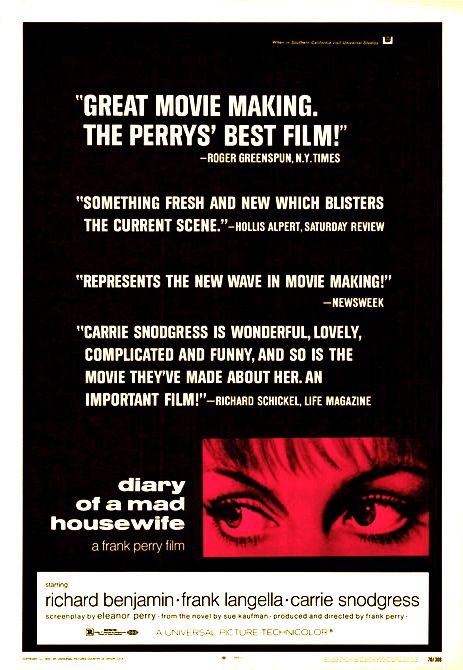
Diary of a Mad Housewife (1970)


          New York director Frank Perry’s films tended toward pretentiousness, but amid his arty flourishes he demonstrated a fine gift for guiding performances, especially by actresses. Thus, it’s no surprise that his most widely admired film, Diary of a Mad Housewife, is virtually a one-woman show for leading lady Carrie Snodgress. With Perry’s sympathetic but unflinching camera studying every nuance of her suffering, Snodgress plays Tina Balser, the underappreciated spouse of successful young attorney Jonathan Balser (Richard Benjamin). Jonathan is an asshole of the first order, a name-dropping narcissist obsessed with professional and social advancement; he alternately treats Tina as a sex toy, a shrink, a slave, a sounding board, and a subject for psychological abuse. In the film’s arresting opening scenes, Perry and screenwriter Eleanor Perry (the director’s then-wife) succinctly illustrate every aspect of the Balsers’ suffocating lifestyle—we’re so primed for Tina’s escape from Jonathan’s oppression that when she meets a potential partner for an adulterous tryst, it feels like a triumphant moment.
          Alas, Tina’s would-be paramour, writer George Prager (Frank Langella), is merely a different breed of asshole. One of those smug swingers who justifies his callous behavior with fancy language about surmounting bourgeois hang-ups, George treats Tina tenderly when they’re in bed, and abysmally when they’re not. The journey of the movie is Tina’s quest for some kind of validation—whether it’s George complimenting her lovemaking or Jonathan recognizing the work she invests keeping their household afloat—because she’s beyond desperate for evidence proving her life means something. The fascinating quality of Diary of a Mad Housewife is that Tina never really snaps, which would have been the predictable path for the story to follow; instead, even when Jonathan belittles her in front of their two impressionable daughters, Tina barks but doesn’t bite.
          Emboldened by her adultery, however, she relishes keeping a secret from her schmuck spouse, and interesting questions get raised about how deeply Tina savors the creature comforts Jonathan’s success provides—has she been co-opted by the status-symbol system that’s oppressing her?
          Benjamin is terrific here, transforming obsequiousness into an art form, and Langella, in his first feature, mostly surmounts the overwritten extremes of his role. However, since she’s in nearly every scene, it’s all about Snodgress, who came virtually out of nowhere to score in this movie—her previous screen credits comprised a handful of minor guest shots on television. Snodgress’ relatable vulnerability earned the actress a Golden Globe award and an Oscar nomination. Following a second 1970 feature and a 1971 telefilm, though, Snodgress left Hollywood for a long romance with rock legend Neil Young. She didn’t return to movies until 1978’s The Fury, the project that began her transition from leading roles to minor character roles.

Diary of a Mad Housewife: GROOVY