Showing posts with label dan haggerty. Show all posts

Monday, December 27, 2021

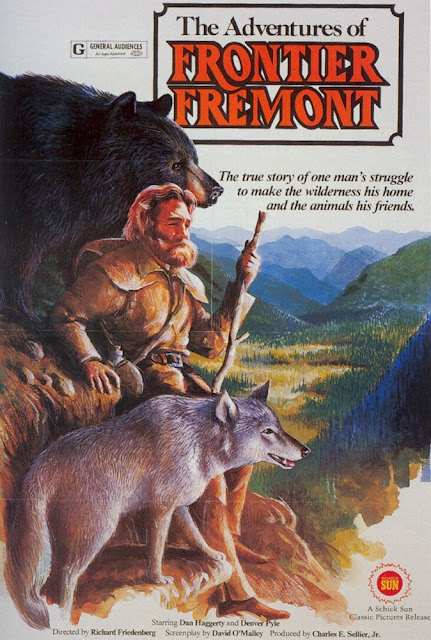
The Adventures of Frontier Fremont (1975)


          A year after they scored a box-office hit with The Life and Times of Grizzly Adams, star Dan Haggerty and the same behind-the-scenes team reconvened for The Adventures of Frontier Fremont, which rehashes elements from the previous film. Once again, the story concerns a man who ventures into the wilderness of the American West circa the mid-1800s, and once again, the narrative focuses on the main character’s special relationships with animals. As always, Haggerty seems as if he was born for playing this type of role, not only because he cuts a formidable figure with his bulky frame and glorious mane of golden hair, but because he began his film career as an animal handler. Few actors look as comfortable interacting with frontier critters as Haggerty did. Where Frontier Fremont differs from Grizzly Adams is that it’s closer to being a proper movie. Grizzly Adams didn’t feature synchronized dialogue, so the piece was awkwardly smothered with folksy voiceover. In Frontier Fremont, viewers actually get to hear Haggerty and his fellow cast members speak. The presentation of conventional scenes makes Frontier Fremont flow more smoothly than its predecessor, even though the filmmakers can’t help but include folksy voiceover here and there.
         To call the movie’s story slight would require exaggeration. Jacob Fremont (Haggerty) departs civilization because living in the wilderness promises new experiences. On his way to the frontier, he meets a grumpy mountain man (Denver Pyle), who subsequently becomes a minor recurring character and also provides the aforementioned narration. Jacob’s odyssey follows a predictable course. He loses his supplies in an accident, so he must learn to live off the land. He befriends various animals, including a bear cub and a wolf cub, thus becoming a surrogate parent to furry foundlings. He clashes with hunters who encroach upon terrain that Jacob becomes determined to protect. Over time, Jacob evolves from an adventurer to a woodland messiah, inspiring awed reactions from white men and Native Americans alike.
          All of this is cloying hogwash, of course. Pyle’s character says things like “Holy jumpin’ squirrel fish!” and “Well, I’ll be kicked and dragged through a bucket of lard!” Haggerty and Pyle sing a cutesy song during a cabin-building montage. Adorable baby animals frolic. Panoramic shots capture magnificent scenery. It’s the same formula that made the Grizzly Adams movie a hit, and it’s the same formula that permeated the ensuing Grizzly Adams TV series (again starring Haggerty), which ran from early 1977 to late 1978. If you like ogling nature and don’t mind cornpone sentimentality, all of this stuff works for you. If not, none of it does.

The Adventures of Frontier Fremont: FUNKY

Wednesday, September 27, 2017

When the North Wind Blows (1974)


          Director Stewart Raffill spent the ’70s making sincere adventure movies with family-friendly themes. While it’s easy to slag these pictures as manipulative hokum, Rafill approached his material rigorously, capturing beautiful nature shots while conveying worthwhile notions of honor and individualism and loyalty. The worst of these pictures are cutesy and maudlin, but the best of them, including When the North Wind Blows, strive for the scope and weight of literature—so even though When the North Wind Blows never quite hits the target, it’s a respectable attempt. Furthermore, compared to other nature dramas released under the Sunn Classic Pictures banner during the Me Decade, When the North Wind Blows is unusual inasmuch as it’s not about Americans. Instead, it’s about Russians living near Siberia.
          Following a prologue that sets up one particular character as the narrator, the movie proper begins by introducing the relationship between Avakum (Henry Brandon), a reclusive mountain man, and Boris (Herbert Nelson), a shopkeeper in a small village. Once a year, Avakum descends from his hunting grounds in the high mountains to sell wares and buy supplies. Circumstances lead to a misunderstanding after the accidental death of a local boy, so villagers blame Avakum for the tragedy, turning him into a fugitive. The story follows his quest to survive in the mountains during a brutal winter, with predators including lions and tigers prowling around him, then shifts into melodramatic mode once Boris realizes that newly uncovered facts have exonerated his friend, necessitating a wilderness trek to deliver word of salvation.
          The humorless plot trudges along without much momentum, though Rafill generates some vivid episodes. When the North Wind Blows looks good, with rugged locations and terrific animal footage, but the characterizations are so thin that only very sympathetic viewers will form any emotional attachment to the people onscreen. It doesn’t help that the movie periodically drifts into pointless subplots, as when another mountain man (Dan Haggerty) recalls his magical encounter with a white tiger. Still, Rafill renders a fairly consistent mood, all hushed and wintry, while celebrating the iconoclastic nature of men willing to brave the elements if doing so removes them from the trivialities of civilization. When the North Wind Blows falls well short of the standards set by the similarly themed Jeremiah Johnson (1972), but folks who enjoyed that picture’s core values might find modest pleasures here.

When the North Wind Blows:  FUNKY

Tuesday, September 13, 2016

Bury Me an Angel (1971)


Sometimes the poster is better than the movie. Beyond the kicky graphic of a curvy woman brandishing a shotgun, the one-sheet for Bury Me an Angel offers this priceless copy: “A howling hellcat humping a hot steel hog on a roaring rampage of revenge.” If you insist on learning whether Bury Me an Angel lives up to his hype, don’t say I didn’t warn you. Although the film’s underlying plot is serviceable—after a biker kills her brother, badass mama Dag (Dixie Peabody) hops on a scooter and hunts down the killer—the execution is atrocious. From the first scene, which depicts aimless debauchery in a garage, writer-director Barbara Peeters displays pure ineptitude, failing to give scenes focus while also failing to define characters. It even takes a while to realize that the victim was Dag’s brother and not her boyfriend. Given the sloppy start, it’s no surprise the movie regularly veers off course. Dag recruits two male bikers, Bernie (Clyde Ventura) and Jonsie (Terry Mace), to accompany her on the road, but the scenes involving the trio lack purpose and urgency. About the only cogent fact to emerge is that Dag has some sort of sexual hang-up. (Scuzz-cinema fans can rest assured that Dag’s hang-up doesn’t prevent Peeters from filming Peabody in the altogether.) In the dullest sequence, Dag interacts with a biker artist named Ken, who’s played by Dan Haggerty, the biker-movie regular who later found fame playing mountain man Grizzly Adams. Also of minor interest is an appearance by gangly character actor Alan DeWitt, previously seen as an undertaker in the biker flick Angels Die Hard (1970). Anyway, you can see the problem—not only is the poster for Bury Me an Angel more interesting than the movie, even the IMDB credits of the supporting actors are more interesting than the movie. Sure, there’s a kinky twist at the end, but it’s so sudden and unearned that, like everything else about Bury Me an Angel, it’s not worth investigating.

Bury Me an Angel: LAME

Thursday, December 17, 2015

Hex (1973)


          On paper, this one sounds like a sure winner—a supernatural thriller set on the American prairie in the early 20th century, with motorcyclists and witches fighting against each other. Oh, and the cast includes Gary Busey, Keith Carradine, Scott Glenn, Dan Haggerty, and stunning model/actress Cristina Raines. On film, however, Hex is a perplexing misfire, neither pedestrian enough to work as a run-of-the-mill genre piece nor weird enough to qualify as so-bad-it’s-good cult fare. The movie is amateurish and muddled and slow, with an offbeat premise and a few somewhat exciting scenes. At its worst, Hex becomes utterly silly (especially when cornpone music kicks into gear on the soundtrack) and that’s not exactly the vibe one looks for in a supernatural thriller.
          The picture opens at a remote farm occupied by beautiful sisters Acacia (Hilarie Thompson) and Oriole (Raines), who seem like Old West eccentrics. They drift into a nearby frontier town, where they see a traveling motorcycle gang led by Whizzer (Keith Carradine), who claims to be an ex-World War I flyer, interacting with the locals. After the sisters leave town, Whizzer and his pals get into a hassle with a redneck named Brother Billy (Haggerty), so the bikers flee the town and discover the farm, taking the sisters hostage at gunpoint. Soon Whizzer falls into a romantic triangle, because even though he’s involved with fellow biker China (Doria Cook), he finds Oriole irresistible. Meanwhile, Acacia takes a liking to soft-spoken mechanic Golly (Mike Combs). But when biker Giblets (Busey) tries to rape Acacia, Oriole uses magic that she learned from her Native American father to get revenge. The movie them spirals into the hippy-dippy-’70s equivalent of a slasher flick, with members of the biker gang esuffering gruesome deaths until the final showdown between Oriole and Whizzer.
          Very little of this stuff makes sense, either in terms of basic logic or recognizable human behavior, and choppy editing exacerbates the myriad script problems. (For instance, what’s with all the material featuring the very white Robert Walker Jr. as some sort of ethnic/spiritual martial artist?) The actors playing bikers give spirited performances, but Raines’ lifeless work drains the picture of vitality, and it’s odd whenever the movie drifts into comic terrain. (Someone insults a woman by yelling, “Up yer skeeter with a red-hot mosqueeter!”) On the plus side, Raines gets to wear a creepy bear costume during the climax, and that’s something one doesn’t get to see every day. FYI, Hex is sometimes marketed on video under the titles Charms and The Shrieking.

Hex: LAME

Tuesday, December 1, 2015

The Life and Times of Grizzly Adams (1974)


          Thanks to its mixture of gorgeous images of the American West and heartwarming themes, watching The Life and Times of Grizzly Adams is a bit like living inside a John Denver song for 93 minutes, which is to say that the movie conveys a deeply attractive vision of frontier life without the burden of realism. Like the transcendent mountains in Denver’s songs, the wilderness of The Life and Times of Grizzly Adams is a place where Indians and wild animals are simply friends whom the protagonist has not yet met, where every day is a new opportunity for wholesome adventures in picturesque valleys, and where any sort of hardship can be resolved in the space of a montage set to gentle music. This sort of wish-fulfillment storytelling may be silly, but The Life of Times of Grizzly Adams meshed with the back-to-nature idealism of the early ’70s. Produced for a reported $140,ooo, the independent feature grossed a remarkable $65 million and spawned a TV series with the same star, Dan Haggerty, which ran for two seasons.
         Based upon the adventures of real-life figure James Adams, who lived in the California wilderness during the 19th century and demonstrated a remarkable facility for taming animals, including grizzly bears, the movie was produced by Sunn Classic Pictures, a company primarily known for its “pseudoscience” documentaries about the Bermuda Triangle, Bigfoot, and the like. True to form, The Life and Times of Grizzly Adams shamelessly blends fact and fiction. In this telling, Adams (Haggerty) flees civilization when he’s accused of a crime he did not commit, which never happened to the real Adams. The movie then presents episodes depicting Adams’ assimilation into the mountain-man lifestyle. He rescues a bear cub and names the cub Benjamin Franklin. He rescues a wounded Crow warrior, Nakoma (Don Shanks), who teaches Adams survival techniques. Adams endures a raft ride down whitewater rapids, escapes close encounters with black bears and mountain lions, and so on. At various intervals, the story stops dead for cutesy vignettes depicting animal behavior, such as the amusing sequence of a raccoon trying to navigate a branch hanging over a river. The whole piece is presented with wall-to-wall narration delivered in folksy style by Bill Woodson, who also provides the speaking voice that emanates from Haggerty’s mouth during the film’s few dialogue scenes.
          In terms of credibility and weight, The Life and Times of Grizzly Adams is quite shoddy, basically the low-budget equivalent of a Disney nature film. Nonetheless, the Utah locations are spectacularly beautiful, and Haggerty cuts a believable figure with his massive frame, flowing blond hair, and bushy beard. The filmmakers also cleverly frame the piece with scenes about Adams’ feelings toward the daughter he left behind when he ventured into the mountains, giving The Life and Times of Grizzly Adams the illusion of being a properly structured narrative.

The Life and Times of Grizzly Adams: FUNKY

Thursday, January 9, 2014

Pink Angels (1972)


          A truly bizarre artifact from the era when homosexuals were still viewed as society’s freaks, this “comedy” depicts the misadventures of a motorcycle gang comprised exclusively of transvestites as they travel from northern California to Los Angeles for a drag “cotillion.” Although the six bikers disguise themselves as Hell’s Angels, wearing fake facial hair as well as denim-and-leather ensembles tricked out with Confederate and Nazi paraphernalia, the dudes are as flamboyant as the day is long, so the would-be humor of the film stems from incidents during which they drop their butch façades to discuss dresses and makeup in fey lisps. Part of what makes Pink Angels such a confusing film is that it’s hard to decide whether the portrayal of gays is affectionate, derisive, of satirical—or even some queasy combination of all three.
          After all, the bikers are only shown doing two mildly “bad” things: inflicting damage on some property when they’re putting on their tough-guy routine, and playfully applying makeup to the men in a rival gang while those men are passed out from drinking. Considering that many films of the ’70s depicted gay men as homicidal psychopaths, the vision of homosexuality in Pink Angels is positively genteel by comparison. That’s not to say, of course, that Pink Angels is any kind of a worthwhile movie. Quite to the contrary, Pink Angels is an amateurish mess with very little characterization or plot. Furthermore, the movie is burdened with a nonsensical running gag about a maniacal military general whose climactic encounter with the gay bikers inexplicably spins the movie in a downbeat direction. Therefore, the best way to watch Pink Angels—presuming one is masochistic enough to do so—is to marvel at the sheer weirdness of the enterprise.
          For one thing, Pink Angels is far from subtle. In one early scene, the bikers hit a roadside food joint, and then lasciviously consume hot dogs while making double-entendres about phallic-sounding motorcycle parts including “ram shafts.” Later, the bikers tromp through a grocery store looking for items like “man-handler” soup. (At the time the film was made, the phrase “man-handler” was used in ads for the Hungry Man line of frozen foods.) Sometimes, screenwriter Margaret McPherson’s attempts at gay patois are clichéd (“What did you have in mind, fancy pants?”), and sometimes McPherson conjures lines that are merely strange (“I’m sick and tired of you, you fickle pringle!”) Every so often, however, McPherson lands a genuinely amusing line, as when the lead biker brazenly tells a cop that his motorcycle’s storage compartment is filled with drugs and “an 8-by-10 of Robert Goulet.”
          Adding to the overall surrealism of Pink Angels is the appearance in the cast of he-man actor Dan Haggerty, who spent most of the ’70s portraying mountain man Grizzly Adams in movies and TV shows. For Pink Angels, he plays a member of the straight gang that parties with the gay bikers (don’t ask), so Haggerty makes out with a black hooker, wakes up to discover he’s wearing makeup (and bows in his hair!), and hits on a transvestite whom he believes is a woman. Even though Pink Angels is actually quite dull to watch all the way through—the picture feels much, much longer than its 81-minute running time—it’s difficult to look away from things as peculiar as the Haggerty scenes. Plus, because Haggerty and tough-guy character actor Michael Pataki (playing the leader of the straight gang) are the only familiar performers in Pink Angels, the illusion of the movie having emerged from some ’70s-cinema dreamscape is nearly complete. In fact, even after watching the whole thing, it’s still challenging to believe that that Pink Angels exists. Seriously, how many other drive-in movies were made about gay bikers?

Pink Angels: FREAKY