Showing posts with label frank finlay. Show all posts

Sunday, April 26, 2015

Sitting Target (1972)


          Intense, minimalistic, and taut, the UK thriller Sitting Target showcases the singular British actor Oliver Reed at his most primal. Playing a man seething with rage and yet ultimately driven by deeper passions that don’t become evident until the very end of the story, Reed maintains an amazing level of ferocity from the first frame to the last. Make no mistake, Sitting Target is a violent revenge saga filled with chase scenes, explosions, and shootouts. Within those parameters, however, it’s credible and effective. Freddie Jones, Ian McShane, and Edward Woodward deliver excellent supporting performances while director Douglas Hickox and cinematographer Edward Scalfe employ consistently imaginative camera angles and film editor John Glen (a frequent participant in 007 movies) creates expert pacing. Best of all, the film seems quite straightforward until the aforementioned ending, which casts everything that came before in a new light. In sum, Sitting Target is more than just adrenalized escapism.
          Reed stars as Harry, a career criminal serving a long term in jail alongside fellow crook Birdy (McShane). The filmmakers introduce Harry perfectly, showing him performing a brutal exercise regimen in his dark cell—he’s perpetually ready for action. One day, Harry’s wife, Pat (Jill St. John), visits him in jail with terrible news. He’s lost his appeal, meaning he’ll be imprisoned for years. Making matters worse, Pat reveals that she’s leaving Harry for another man, whose baby she now carries. Harry responds by smashing his hand through the glass separating him from Pat and nearly strangling her to death. Determined to exact revenge for her betrayal, Harry arranges to break out of jail with Birdy and wealthy crook MacNeil (Jones). The escape sequence is terrific, generating real danger and tension while illustrating fundamental differences between the escapees. Once news of Harry’s jailbreak spreads, policeman Milton (Woodward) assumes responsibility for Pat’s safety. A cat-and-mouse game ensues, because for Harry, it’s not enough to destroy Pat. He wants her to know what’s coming.
          Sitting Target is far from perfect. A subplot of Birdy and Harry harassing a former colleague for money chews up screen time, and one scene hinges on Harry shooting a target from an enormous distance with a pistol, which seems iffy. That said, the pros outweigh the cons, no pun intended. The action scenes are strong, the overall atmosphere is believably grim, and the sheer level of testosterone surging through the movie’s veins is incredible. St. John is the weak link, giving a decorative performance and rendering a questionable British accent, though she doesn’t diminish the overall impact. FYI, UK actor Frank Finlay shares a few scenes with Reed. Not long afterward, the players joined forces for Richard Lester’s superlative adventure films The Three Musketeers (1973) and The Four Musketeers (1974).

Sitting Target: GROOVY

Wednesday, October 16, 2013

Murder by Decree (1979)


          Presumably inspired by the success of The Seven-Per-Cent Solution, a 1974 novel by Nicholas Meyer about Sherlock Holmes teaming up with Sigmund Freud—and by the favorable reception for the terrific 1976 movie adaptation of Meyer’s book—this ambitious mystery film pits Holmes against a real-life murderer, Jack the Ripper. That’s where things get a little complicated. First off, Meyer was not involved with Murder by Decree, but he made a wholly separate 1979 movie about Jack the Ripper called Time After Time. Furthermore, Murder by Decree is based on two separate books. They are Murder by Decree, a 1975 tome that Elwyn Jones and John Lloyd adapted from their own 1973 BBC miniseries Jack the Ripper, and Jack the Ripper: The Final Solution, a 1976 book by Stephen Knight. Oh, and neither of those books features Sherlock Holmes. Confused? Me, too. Moving on!
          Murder by Decree is predicated on two gimmicks. First is the novelty of pairing Holmes with a real-life mystery, and second is the conspiracy theory detailed in the books upon which the film is based. Without giving away anything that isn’t hinted at by the title, the theory holds that Jack the Ripper was a member of the British aristocracy who had official sanction for his horrific crimes. Murder by Decree has many fans—deservedly so, since it’s a consistently intelligent and sophisticated film—though one wishes the producers had demonstrated more confidence in the source material, since the Holmes contrivance makes the whole picture feel a bit fluffy. After all, it’s hard to buy into a conspiracy theory when it’s presented in tandem with one of world literature’s most famous fictional characters. In other words, the story can only be so persuasive since it contains a made-up protagonist. Anyway, notwithstanding the credibility gap (and an overlong running time), Murder by Decree is solid entertainment for grown-ups.
          The cast is terrific, with an urbane Christopher Plummer playing Holmes opposite a snide James Mason as Dr. Watson. Supporting players include Frank Finlay and David Hemmings as policemen, plus John Gielgud as the British PM. (Geneviève Bujold and Donald Sutherland also appear.) Orchestrating the whole film is eclectic director Bob Clark, who at this point in his career had just escaped the ghetto of low-budget horror pictures; appropriately, he cloaks Murder by Degree with enough shadows and smoke to fuel a dozen frightfests. The movie comprises lots of skulking about in dark places, as well as interrogating suspects in ornate rooms, so the contrast between posh and seedy locations serves the story well. Still, it’s all a bit long-winded, and Plummer’s quite chilly, making it difficult to invest much emotion while watching the picture. Accordingly, how much you dig Murder by Decree will depend on how intriguing you find the central mystery—and how satisfying you find the ending, which might tie things up a bit too neatly for some tastes.

Murder by Decree: GROOVY

Thursday, February 21, 2013

Gumshoe (1971)


          A peculiar byproduct of the ’70s film-noir revival, this British picture stars Albert Finney as a Liverpool everyman who works at a nightclub but aspires to be a private eye in the Chandler/Hammett mode. As a result, he regularly slips into a stilted American accent, talking about “dames” and “heaters” and such even though everyone around him speaks in normal early-‘70s British vernacular. Gumshoe is sort of a spoof, but because the storyline gets convoluted and dark, it’s also sort of a thriller and sort of a whodunnit. Oh, and sort of a character study, too. However, it’s worth noting that Gumshoe was the directorial debut of Stephen Frears, who has made a career out of mixing genres in such offbeat movies as The Grifters (1990) and Dirty Pretty Things (2002)—so it’s possible Gumshoe was deliberately conceived as self-reflexive satire. Whatever the intentions, the result is the same—Gumshoe is sluggish and unfocused, with a number of interesting scenes contributing to an underwhelming sum effect.
          Finney plays Eddie Ginley, a bitter man whose true love, Ellen (Billie Whitelaw), left him for his own brother, William (Frank Finlay). Worse, William is a successful businessman with influence at Eddie’s nightclub, so even though the siblings hate each other, Eddie depends on William’s goodwill for continued employment. When the movie begins, Eddie half-jokingly places a newspaper ad offering his services as a private eye. Soon afterward, a client shows up and gives Eddie a package containing a gun, money, and a photo of a woman—instructions for a paid murder? At first, Eddie thinks his brother is playing a cruel joke, but then he realizes he’s been drawn into a strange mystery involving debauchery, deceit, and drugs. Unfortunately, the mystery is nearly impenetrable, and Eddie’s not a sufficiently interesting character to justify the effort of slogging through the plot. (The actors’ thick blue-collar accents make comprehension even more difficult.) Finney’s performance is low-key to a fault, despite flashes of cynical charm, so Finlay’s seething malice and Whitelaw’s pained ambivalence command greater attention—a considerable problem since they’re only in the movie periodically, whereas Finney is in nearly every scene.

Gumshoe: FUNKY

Sunday, June 5, 2011

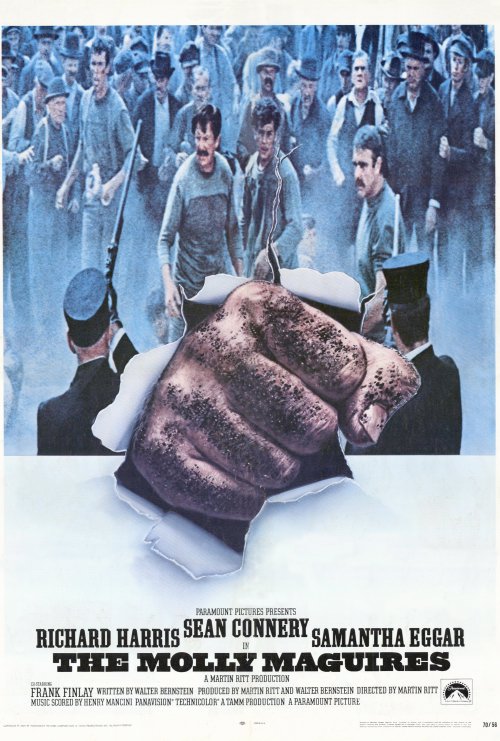
The Molly Maguires (1970)


          An old-fashioned morality tale somewhat in the vein of John Ford’s classic film The Informer (1935), The Molly Maguires offers a fictionalized take on a group of real-life Irish immigrants who worked in Pennsylvania’s coalmines during the late 19th century. When a group of fed-up miners led by Jack Kehoe (Sean Connery) lashes out at their oppressive employers through a covert campaign of bombings and murders, the police send an Irish-born detective, James McParlan (Richard Harris), to infiltrate and expose Kehoe’s group, causing McParlan to experience a crisis of conscience: The more he learns about the secret guerilla organization called “The Molly Maguires,” the more he sympathizes with them.
          As scripted by once-blacklisted Hollywood lefty Walter Bernstein and as directed by sensitive humanist Martin Ritt, The Molly Maguires takes an unusually nuanced view of radical politics. The picture lays out the reasons why the workers rebel—dangerous work conditions, a usurious pay structure in which the mining company withholds nearly all wages through outrageous “deductions”—yet the filmmakers don’t paint the Maguires as heroes. Instead, the Maguires are depicted as desperate men who resort to violence when pushed beyond reasonable limits.
          This distinction puts viewers squarely inside McParlan’s conflicted psyche, and the melancholy nature of Harris’ screen persona suits the story well. The actor is believable as a working-class bruiser and as a man who realizes he’s selling his soul for career advancement. The betrayal inherent to the story is accentuated by Connery’s tightly controlled performance, since the Kehoe character is acutely self-aware; especially toward the end of the picture, Connery does a strong job of demonstrating that Kehoe values his life less than the goal of making his oppressors understand his rage.
          Fittingly for a story about the Irish, there’s a darkly lyrical quality to The Molly Maguires; in particular, the tin whistles of Henry Mancini’s score and the lilting accents of the various players make the gloomy mines and rolling hills of Pennsylvania seem like lost colonies of the Emerald Isle. Several strong supporting players add muscle to the picture as well. Frank Finlay is odiously pragmatic as McParland’s superior officer, while Anthony Costello, Art Lund, and Anthony Zerbe are fierce as Kehoe’s accomplices. Female lead Samantha Eggar, making the most of an underwritten role, is quietly principled as the local girl who falls for McParland without knowing his true identity.
          Although too conventionally made and slow-moving to qualify as any sort of classic, The Molly Maguires is intelligent, sincere, and thought-provoking.

The Molly Maguires: GROOVY

Tuesday, January 4, 2011

Shaft (1971) & Shaft’s Big Score (1972) & Shaft In Africa (1973)


          Richard Roundtree’s lead performance is a triumph of super-cool swagger, director Gordon Parks shoots the streets of New York City with a keen eye for grungy detail, and Isaac Hayes’ Oscar-winning music is nuclear-powered funk/soul, but Shaft thrives on style over substance, because despite these considerable surface pleasures, the quasi-legendary flick is a dramatic washout. Still, it was zesty enough to trigger a slew of sequels and to inspire the blaxploitation craze, so it must be ranked as of the most significant B-movies of the ’70s even though it’s not exceptional cinema. The storyline is standard stuff about tough-talking private dick John Shaft (Roundtree) getting hired to rescue a gangster’s kidnapped daughter, so what makes the picture significant is the characterization of a cocksure black superhero operating outside the law and doing whatever he damn well pleases; in the defining moment, Shaft exits a conference with a pushy white cop by announcing that he’s off “to get laid.”
          Roundtree cuts a great figure with his immaculate facial hair, black turtleneck, and black leather suit, so when he shoots his way through an action scene—or even just strolls through the city to the accompaniment of Hayes’ pulsating music—he’s such an appealing vision of African-American empowerment that he gives the movie more vitality than it probably deserves. Excepting the tasty ’70s lingo and atmospheric Harlem settings, Ernest Tidyman’s script is quite old-fashioned, the sort of convoluted crime story Hollywood has cranked out since time immemorial, so the granddaddy of blaxploitation films doesn’t really have all that much kitschy flava: It’s merely a conventional thriller that happens to feature an memorable lead character and a predominantly black cast.
          The ordinariness is even more evident in the first sequel, Shaft’s Big Score, which finds our hero stuck in the middle of a war for control over a lucrative numbers racket. Shaft gets laid, kills a few people, and lays on the ’tude, but the narrative is so utilitarian that it’s more like a run-of-the-mill TV episode than a theatrical sequel. About the only novelty is that director Parks took over as composer for Shaft’s Big Score, copying Hayes’ style down to the theme song “Blowin’ Your Mind,” which is a shameless rip of the original film’s unforgettable “Theme from Shaft.” Shaft’s Big Score is solid meat-and-potatoes ’70s action, but nothing more.
          The franchise’s last ’70s theatrical entry, before Roundtree took the Shaft character to the small screen for a brief run of telefilms, is the energetic Shaft in Africa. Boasting the most interesting (and logic-defying) storyline of the series, Shaft in Africa gets the main character out of his Harlem comfort zone for a 007-style international adventure in which he busts up a modern-day slavery ring—and with all due respect to the venerable Parks, Shaft in Africa helmer John Guillermin has a more polished approach to action and storytelling, using slick widescreen photography to give the modestly budgeted threequel more lush imagery than its predecessors. Shaft in Africa is also considerably more violent than the other two pictures, including some brutal hand-to-hand combat, so it’s the most intense entry, and Frank Finlay (The Three Musketeers) is an effectively perverse villain.
          Roundtree’s charismatic portrayal is consistently watchable throughout all three movies, so checking out at least one of the Shaft pictures is a necessity for any ’70s completist, but many of the outrageous blaxploitation flicks that followed in Shaft’s wake improved on the prototype.

Shaft: FUNKY
Shaft’s Big Score: FUNKY
Shaft in Africa: FUNKY