Showing posts with label john mills. Show all posts

Saturday, July 15, 2017

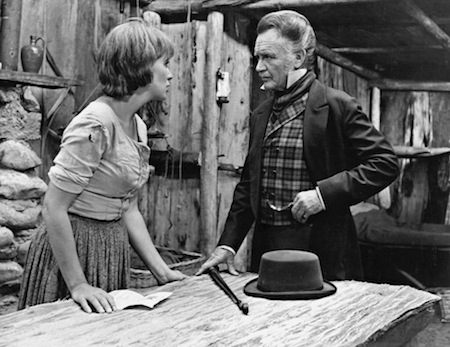
Adam’s Woman (1970)


          Offering an interesting look at sociopolitical dynamics impacting Australia during the era when the island nation was used by the British empire as a penal colony, Adam’s Woman tells the eventful story of a convict offered land and a dowry in exchange for marrying a “fallen” woman. Extrapolated from historical events but heavily fictionalized, the picture depicts a humanistic British nobleman, Sir Philip MacDonald (John Mills), serving as Australia’s governor. Through an experimental rehabilitation program, he offers property to hardy prisoners as a means of compelling them to abandon criminality. Not unimportantly, the program also serves the crown’s goal of colonizing remote areas. Adam Beecher (Beau Bridges) is an American serving a two-year term on assault charges, and his incarceration gets extended by seven years following an escape attempt. Sympathetic to Adam’s claim that he was innocent of the original crime, Sir Philip selects Adam for the dowry experiment, giving the inmate his pick of several jailed women. He chooses Bess (Jane Merrow), a willful convict from Ireland. They establish a homestead in a rugged valley, but conflict emerges with gangs of criminals seeking to exploit and terrorize the homesteaders.
          Had Adam’s Woman been written with more care and sophistication, the picture would have been a valuable piece of historical fiction, using the dowry system to explore myriad aspects of this complicated chapter in Australia’s history. Alas, the filmmakers simultaneously attempt too little and too much. Characterizations are thin, and the politics are mostly reduced to easily digestible slogans. More problematically, the narrative has an epic sprawl despite a running time of just 115 minutes; to properly service all the subplots and themes on display, three hours would have been a more ideal duration. The picture bursts with provocative ideas, and the production values are generally excellent, but everything feels rushed and superficial. Regarding the performances, Merrow and costar Andrew Keir (who plays a merciful prison guard) are the standouts, melding grit with heart. Mills is as mannered as usual, though he speaks beautifully, and Bridges applies more blunt-force intensity than precision or skill. Adding to the movie’s ho-hum quality are the fruity folk songs on the soundtrack, such as the opening-credits number that overdramatically describes harsh sentences given to prisoners exiled from Britain to Australia.

Adam’s Woman: FUNKY

Sunday, September 7, 2014

Oklahoma Crude (1973)


          John Huston and Elia Kazan, among many others, have been credited with the quote that “90% of directing is casting.” To understand what this remark means, check out Oklahoma Crude, a handsomely produced but frustrating period drama about a belligerent woman operating a wildcat oil well in the early 20th century. The picture has four main characters, but only one is cast perfectly. The protagonist, Lena Doyle, is a tough-as-nails loner who works with her hands and dislikes people so much that she expresses a wish to be a third gender, complete with a matched set of sex organs, so she can tend to her own carnal needs. Improbably, she’s played by Faye Dunaway, a cosmopolitan beauty who seems more suited to a Paris fashion runway than a rugged work site. Further, because Lena rarely speaks during the first half of the picture, the role requires a performer with expressive physicality. Dunaway’s greatest gifts are her face and voice, so she’s wrong for the part on every level, even though it’s easy to understand why she relished a chance to try something different.
          The next important character is Noble Mason, a scrappy rogue whom Lena reluctantly hires as a laborer/mercenary once representatives from an oil company try to seize her well by force. Since the Lena/Noble relationship has a Taming of the Shrew quality, the obvious casting would be a handsome rascal along the lines of Steve McQueen or Paul Newman. Instead, Noble is played by George C. Scott, unquestionably one of the finest actors in screen history but not, by any stretch, a romantic lead. Rounding out the troika of casting errors is the presence of dainty English actor John Mills as Cleon Doyle, Lena’s estranged father. Seeing as how he plays the role with an American accent, why didn’t producer-director Stanley Kramer simply cast an American? Well, at least Kramer got the villain right, because Jack Palance is terrific as Hellman, the sadistic enforcer whom the oil company sends to menace Lena.
          The intriguing plot of Marc Norman’s script revolves around Lena’s ownership of a nascent well, which gains Lena unwanted attention once clues indicate the well might produce oil. Hellman makes a cash offer that Lena refuses, so Hellman simply steals the well, in the process ordering his people to beat Lena and her employees nearly to death. Then, with the assistance of ex-soldier Noble, Lena reclaims the well, sparking a lengthy standoff that culminates in a bittersweet combination of tragedy and victory.
          Oklahoma Crude gets off to a rocky start, because the first 20 minutes—in which the Lena/Noble relationship is established—simply don’t work, largely because of the aforementioned miscasting. Things pick up once Palance arrives, and the last hour of the picture is fairly exciting. Legendary cinematographer Robert Surtees contributes his usual vigorous work, and composer Henry Mancini’s music keeps things bouncy. (Occasionally too much so.) As with most of Kramer’s pictures, the tone rings false at regular intervals, since the filmmaker can’t decide whether he’s making a dramedy or a serious picture. The novelty of the story and the strength of the primal good-vs.-evil conflict ultimately sustain interest, but it’s a bumpy ride—especially when the syrupy, Anne Murray-performed theme song, “Send a Little Love My Way,” gets played on the soundtrack for the zillionth time.

Oklahoma Crude: FUNKY

Sunday, September 4, 2011

The Human Factor (1975)


          Watching the meat-and-potatoes terrorism thriller The Human Factor, one can’t help but wonder which actor the producers originally envisioned in the lead role, because George Kennedy just doesn’t have the stuff this movie needs. Playing a civilian computer specialist working on a top-secret military project in Italy, he’s fine as a lumbering bear of an American out of step with continental types—but the minute the story kicks into gear, Kennedy is asked to summon degrees of anguish and intensity he just can’t muster, undercutting key scenes so badly they inch toward self-parody.
          This is a shame, because the story is solid: A group of terrorists begins killing randomly selected American families who are living in Europe, and Kennedy’s wife and child are the first victims. Using the technology at his disposal, an espionage database designed to predict enemy activity, Kennedy goes the vigilante route, determined to get revenge and upset the killers’ plans. Predictably, his intrusion makes the situation worse. There are several exciting run-ins with terrorists, plus a useful subplot about a European cop trying to stop Kennedy from waging his one-man war. So, with a stronger actor in the lead, this material could have connected quite nicely. Though tough guy Charles Bronson comes to mind as an obvious casting alternative, a version of The Human Factor starring, say, everyman Jack Lemmon could have been quite powerful, since a skilled actor would have grounded the concept in believable emotion.
          Unfortunately, with Kennedy in place, the rest of The Human Factor unfolds in as workmanlike a manner as the lead performance. Studio-era director Edward Dmytryk, helming the last feature of his epic career, puts the story together capably, showing mild flair during action scenes, but he’s not able to muster sufficient on-camera energy. Englishman John Mills, cast somewhat randomly as Kennedy’s co-worker/friend, exacerbates problems with an amateurish performance, though Italian star Raf Vallone is impassioned as the cop pursuing Kennedy, and stalwart American Barry Sullivan provides effective work as an overwrought diplomat driven to drink by the terrorism crisis.

The Human Factor: FUNKY

Thursday, March 3, 2011

Ryan’s Daughter (1970)


          The only film that venerable director David Lean made in the ’70s, Ryan’s Daughter disappointed people who were expecting something similar to Lean’s previous successes, the blockbuster epics Lawrence of Arabia (1962) and Doctor Zhivago (1965). Although Ryan’s Daughter has echoes of both earlier films, Ryan’s Daughter neither coheres as organically nor achieves the same cumulative power as Lean’s ’60s smashes. Seen with fresh eyes, however, it’s an impressive but flawed film that deserved a better reception. Set in Ireland during World War I, the picture follows the emotional journey of Rosy Ryan (Sarah Miles), a small-town girl who gets everything she ever wanted and then decides she wants more, with disastrous consequences.
          In the tiny village of Kirray, Rosy marries the much-older schoolteacher Charles Shaughnessy (Robert Mitchum), only to discover that marriage isn’t full of the magical romance she expected. Anguished, dissatisfied, and guilty, Rosy becomes even more confused when she meets Major Doryan (Christopher Jones), the new commandant of the British force occupying Kirray. A beautiful creature scarred with war wounds and tortured by PTSD, he’s a kindred spirit to Rosy in that neither of them feels synchronized with the rest of society, so they commence a torrid affair. Their indiscretion leads to trouble when Doryan confronts Tim O’Leary (Barry Foster), a charismatic revolutionary who enlists the aid of Kirray’s entire population for a gun-smuggling operation.
          The original screenplay by frequent Lean collaborator Robert Bolt spins an absorbing yarn, and while it’s tempting to lament that the movie is excessive at its full length of three and a half hours (including entrance, exit, and intermission music), nearly everything onscreen during those three and a half hours is artful and interesting. Lean’s methodical storytelling is wondrous, because he conveys subtle mental shifts through expert juxtapositions of images and sounds; for instance, the myriad nuances contained in the wedding-night scene with Charles and Rosy are excruciating and specific. Additionally, the Oscar-winning cinematography by Freddie Young is indescribably beautiful. Whether he’s shooting a delicately lit interior scene or a spectacular panorama of the wild Irish coast, Young fills the screen with such masterful interplays of light and texture that each shot is like a timeless painting. Even more impressively, Lean manages to make Mitchum, the quintessential macho movie star, believable as a soft-spoken pacifist.
          Having said all that, the picture has significant problems. Inexplicably, John Mills won an Oscar for his vigorous but cartoonish performance as Kirray’s village idiot, and composer Maurice Jarre opts for a distractingly arch style in several of the film’s musical themes. Worse, the characterization of Rosy’s father, Thomas Ryan (Leo McKern), is muddy at best; the second half of the story turns on one of Thomas’ actions, and his motivation is woefully unclear.
          Still, for every shortcoming, the picture has a virtue—while Thomas Ryan is poorly conceived, Kirray’s hard-driving minister, Father Collins (Trevor Howard), is a complex figure who evolves from stern to nurturing. Plus, Ryan’s Daughter has not one but two believable love stories: Rosy’s marriage to Charles is illustrated as effectively as her dalliance with Major Doryan. Ultimately, the fact that Ryan’s Daughter isn’t an unqualified masterpiece shouldn’t detract from the fact that it’s a compelling drama writ large.

Ryan’s Daughter: GROOVY