Showing posts with label terry carter. Show all posts

Saturday, February 19, 2022

Brother on the Run (1973)


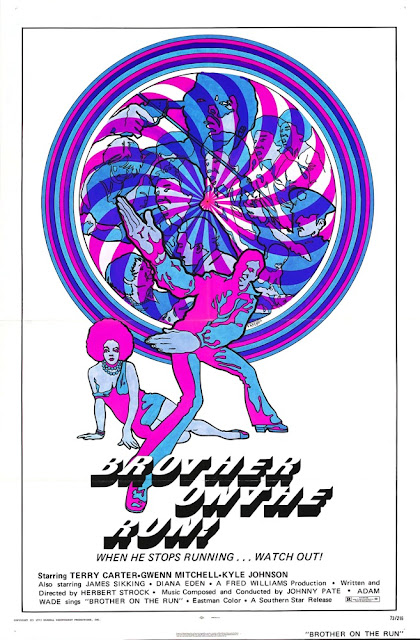
          Minor blaxploitation melodrama Brother on the Run doesn’t come anywhere close to fulfilling the promise of its fantastic title, and the reasons why begin with the premise. After an attempted robbery goes awry, leaving a shopkeeper dead, small-time crooks Billy (Kyle Johnson) and Frank (Gary Rist) become the targets of a police dragnet. For story reasons, it’s important to note that Billy is black. In scenes intercut with the robbery storyline, Brother on the Run sets up that college professor Grant (Terry Carter), who is also black, lives next door to a hooker named Maud (Gwenn Mitchell), with whom he’s casually acquainted. Maud is Billy’s older sister, so the fugitives try hiding at her place until the police come knocking. Grant gets hip to what’s going on, so he meets the crooks and becomes sympathetic to their plight. Then, once the manhunt resumes, Grant promises Maud that he’ll try to find Billy before the cops. All of this raises questions. Since Billy is guilty of at least being an accomplice, why does Grant get involved? Since Billy makes it clear at Maud’s place that he’s against surrendering to the cops, what is Grant’s plan once he tracks Billy down? And why does Grant stop in the middle of his search for Billy to service a horny white lady?
           One assumes the filmmakers neither thought these questions through nor expected theatergoers to do so—more likely, the goal was to generate cheap thrills by exploiting the provocative notion that any black suspect running from white cops has a target on his back. Several passable blaxploitation flicks arose from that same notion, so the failure of Brother on the Run to generate excitement seems attributable to behind-the-camera carelessness as well as shortfalls in production resources. Cowritten and codirected by veteran TV guys Edward J. Lasko and Herbert L. Strock, the movie feels choppy, rushed, and under-budgeted; characterizations are laughably thin, the storyline is riddled with dopey coincidences, and the movie’s attempts at sociopolitical messaging are pathetic. (If only the filmmakers had leaned into bizarro moments such as the bit during which Maud provides gentle BDSM fun for a cross-dressing client.)
          Offering marginal interest is the presence of actors better known for work they later did on the small screen. Playing the lead is Terry Carter, subsequently a regular on the original Battlestar Galactica series, and playing the main cop is James B. Sikking, who eventually found minor fame on Hill Street Blues. Even with a handful of watchable elements, however, Brother on the Run adds little to the blaxploitation experience.

Brother on the Run: FUNKY

Saturday, August 9, 2014

Abby (1974)


          Lest there be any doubt, Abby is a truly awful movie—even given the low expectations set by the premise, since Abby is nothing but a shameless riff on The Exorcist (1973) featuring an all-black cast. The scares are nonexistent, the script is schlocky, and the special effects are pathetic. However, the movie has one minor saving grace: William Marshall, the stentorian-voiced actor who lent unexpected dignity to the role of Blacula in two cheesy horror movies, plays the exorcist in Abby. Marshall’s elegant presence isn’t nearly enough to make Abby respectable, but his appearance is sufficient to make the movie watchable, at least periodically. It’s also worth noting that Abby was directed by William Girdler, who later made a string of colorful horror flicks—Grizzly (1976), Day of the Animals (1977), and the completely insane supernatural epic The Manitou (1978). Abby isn’t as slick as the later films, but it’s just as brazen and zippy.
          The story, naturally, involves a young woman being possessed by a demon. Specifically, after Bishop Garnet Williams (Marshall) accidentally releases an evil god named “Eshu” while exploring in Nigeria, Eshu invades the body of Garnet’s daughter-in-law, Abby (Carol Speed), who lives back in the U.S. with Garnet’s son, Emmett (Terry Carter). Violence, vomiting, and vulgarity follow, until Garent returns from Africa for a supernatural showdown. Giving the material a blaxploitation vibe, cowriter/director Girdler features the wholesome Abby speaking in crude street slang while possessed—for instance, before kicking Emmett in the crotch, she squeals, “Shit, you ain’t got enough to satisfy me!” In another scene, Abby experiences an orgasm while handling a piece of raw chicken on a kitchen counter. (Make your own “finger-lickin’ good” jokes.)
          While it’s all exactly as derivative and silly and tacky as it sounds. Marshall does what he can to play the material straight, especially when he performs with Austin Stoker (Assault on Precinct 13), who plays Abby’s brother. Alas, neither Speed nor costar Terry Carter (a regular on the original Battlestar Galactica series) rise to the same level. Still, what’s not to like about a quasi-camp drive-in distraction that kicks off with Marshall releasing a demon by recklessly twisting the tiny wooden penis of a figurine that’s carved into the shell of wooden box? Safe to say Girdler harbored no illusions of making great art.

Abby: FUNKY

Sunday, June 26, 2011

Foxy Brown (1974)


After scoring at the box office with Coffy (1973), writer-director Jack Hill and blaxploitation queen Pam Grier delivered more sexed-up crime drama with Foxy Brown, a nasty flick about a woman taking on the mob. Yet while Coffy has force and momentum, Foxy Brown gets mired in a murky storyline. It’s also much more unpleasant than the previous film, thanks to a gruesome sequence in which the heroine is bound, drugged, and repeatedly raped. The storyline gets off to a bad start, because it’s never clear what Foxy does for a living or how she came to know Michael (Terry Carter), her lawman boyfriend. Plus, how does Foxy balance her relationship with a cop and her tight bond with a drug-dealing sibling (Antonio Fargas)? For that matter, when the hell did she learn how to fly a plane? To cut Hill some slack, Foxy Brown apparently began life as a Coffy sequel, and the director was instructed to transform Foxy Brown into a stand-alone film so late in the game that he wasn’t able to properly reconfigure key elements. Notwithstanding these issues, Foxy Brown has built a huge cult audience over the years. Much of the appeal, of course, stems from Grier’s formidable physical presence. She looks fantastic, whether she’s glammed up in a silky wig and evening dress or down-and-dirty in a giant Afro and head-to-toe leather, and she’s a relentless killing machine. The moment when she coils a wire hanger into a claw and gouges out a scumbag’s eye is memorable, as is the bit when she introduces a thug to the business end of a plane’s propeller. Fargas is almost as entertaining as Grier, jive-talking through a campy performance, and Coffy costar Sid Haig shows up briefly to infuse the picture with a welcome burst of nutjob energy. Yet while some elements are watchable, the movie as a whole is distasteful, and the main villain is awful: Every scene featuring the startlingly amateurish Kathryn Loder, as conniving madam Miss Katherine, is excruciating.

Foxy Brown: FUNKY