Showing posts with label chuck connors. Show all posts

Monday, October 30, 2023

The Horror at 37,000 Feet (1973)


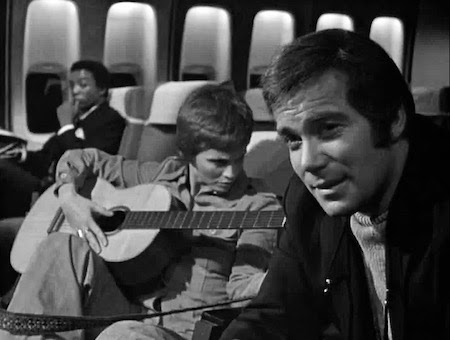
          Even though The Horror at 37,000 Feet is a terrible made-for-TV supernatural thriller distinguished by a dumb storyline, a motley cast, and sketchy production values, the movie provides enjoyable viewing for a certain stripe of ‘70s crap-cinema masochist. To put an even finer point on things, the emotional center of the movie is William Shatner’s portrayal of a former priest seemingly determined to drink himself to death until a faceoff with otherworldly forces compels him to test whether he’s got anything left in the tank, spiritually speaking. If that sounds appealing, then you’ve got the stuff to power through this silly picture’s dull stretches and laughable excesses. However, if you find the prospect of Shatner wrestling with angst unattractive, then you would be wise to forget you ever heard of The Horror at 37,000 Feet. Speaking now to those brave and/or foolish souls willing to learn more, it’s time to meet some of the other miscellaneous actors who wander through this flick. We’re talking Chuck Connors as a square-jawed pilot who delivers this actual line: “We’re caught in a wind like none there ever was!” We’re talking Buddy Ebsen as an obnoxious millionaire who thinks he knows more about planes than a flight crew. We’re talking the strangely cast Paul Winfield as an upper-crust British doctor. And we’re talking Russell Johnson—the Professor from Gilligan’s Island—in a small role as a flight engineer. The picture seems as if was cast by someone opening an old TV Guide to random pages and pointing at names.

          As for the dopey plot, here goes. Rich architect Alan O’Neill (Roy Thinnes) pays to have a passenger flight carry the altar from an English druidic temple because he plans to use the altar for a project in America. As the flight proceeds, strange phenomena manifest until the crew believes claims from strident activist Mrs. Pinder (Tammy Grimes) that the cargo hold is filled with evil energy. Who will live? Who will die? Who cares? Using the familiar device of fusing the disaster-movie formula with supernatural-thriller elements, The Horror at 37,000 Feet is so drably made, so mechanically written, and so slowly paced that it’s unlikely to elicit frightened reactions. Instead, the picture generates a mildly eerie vibe that occasionally captures the imagination because one of the actors does something committed or earnest or flamboyant. Shatner is unquestionably the center of attention given his signature overwrought acting style, but Grimes gets points for playing her harbinger-of-doom role so fervently, and Winfield classes up the joint even with his stilted attempt at a British accent. For those who make it through the movie’s sluggish first 45 minutes or so, the reward is a climax filled with goofy special effects, from giggle-inducing shots of green goo seeping through surfaces to the laugh-out-loud staging of the Shatner character’s final confrontation with the forces bedeviling his fellow passengers. 


The Horror at 37,000 Feet: FUNKY


Tuesday, June 11, 2019

Embassy (1972)


          Watching the political thriller Embassy is frustrating not just because the picture is mediocre, but also because it wouldn’t have taken much to elevate the piece above mediocrity. The source material for this British production, a novel by Stephen Coulter, provides a solid premise—the arrival of a Russian defector at the U.S. embassy in Beirut sparks an international incident. As scripted by William Fairchild and directed by Gordon Hessler, Embassy is blandly photographed, drably paced, and filled with performances as uninspired as the corresponding characterizations are unimaginative. Yet it’s easy to imagine a crackerjack version of the same basic storyline with, say, Sidney Lumet at the helm, abetted by an edgier screenwriter. Even without that level of behind-the-scenes firepower, Embassy has a few credible moments, mostly thanks to leading man Richard Roundtree (appearing in one of his first projects after becoming a star with 1971’s Shaft) and supporting player Max von Sydow, who portrays the defector. Roundtree’s appealing swagger smooths over some of the movie’s rough spots, and von Sydow gives a genuinely multidimensional performance.
          Alas, too much time gets wasted on nonsense. Roundtree plays a mid-level diplomat who shares responsibility for the safety of von Sydow’s character, but the movie also gives Roundtree a drab romantic subplot that adds nothing. Similarly, perfunctory acting by Ray Milland (as the pragmatic ambassador), Broderick Crawford (as a security officer at the embassy), and Chuck Connors (as a KGB enforcer) diminishes the experience. Especially when combined with Hessler’s lifeless shooting style, watching actors who are past their best days give paycheck performances makes Embassy feel like a disposable TV movie, notwithstanding impressive production values acquired while shooting on location in the Middle East. As to the question of whether Embassy has anything meaningful to say, the answer is sorta-yes and sorta-no. The movie isn’t a completely vacuous potboiler, but most of its cynical assertions about the morality of political expediency are trite. Embassy only really sparks when von Sydow’s character talks about his reasons for defecting, and when the same character snaps after too many days in captivity.

Embassy: FUNKY

Saturday, February 11, 2017

The Deserter (1971)


          Part spaghetti Western and part Dirty Dozen ripoff, this Italy/US/Yugoslavia coproduction has a serviceable premise, then loses its way thanks to a forgettable leading performance and an overly mechanical plot. Along the way, several colorful actors are subsumed by the overall mediocrity of the piece, delivering half-hearted interpretations of underdeveloped roles. Even the action highlights are ho-hum. Those who want nothing more from adventure pictures than a steady flow of death-defying bravery and tight-lipped macho posturing will be able to consume the picture like a serving of empty calories, but those who expect anything more will get bored fairly quickly. In the Wild West, U.S. Cavalry soldier Kaleb (Bekim Fehmiu) completes a fortnight-long patrol and discovers that while he was away, Apaches raided the outpost where he lives and killed his wife. Kaleb blames the death on his superior officer, Colonel Brown (Richard Crenna), so Kaleb tries to quit the service and devote his life to killing Apaches. When Brown refuses Kaleb’s resignation, Kaleb shoots the colonel and becomes a fugitive from military justice. Two years later, blustery General Miles (John Huston) arrives on the scene, demanding that Brown illegally cross the Mexican border to slaughter a band of Apache raiders. What’s more, Miles demands that Brown’s men bring Kaleb in from the wilderness, because during the intervening period, Kaleb has made good on his vengeance pledge by slaughtering Apaches heedlessly, thereby becoming the ideal man to lead the mission into Mexico.
          Once all the narrative pieces are in place, Kaleb finds himself supervising a band of soldiers, including Kaleb, who would just as soon kill the notorious deserter as kill Apaches. Among those playing soldiers are Ian Bannen, Chuck Connors, Ricardo Montalban, Slim Pickens, and Woody Strode. (Naturally, Crenna’s character is along for the ride, too.) With this much talent at their disposal, producer Dino De Laurentiis and director Burt Kennedy should have been able to come up with something much more interesting than The Deserter, which is sometimes known as The Devil’s Backbone. Alas, the script is unrelentingly clichéd, predictable, and superficial, and the filmmakers miscalculated, badly, by casting Yugoslavian stud Fehmiu in the leading role. Just one year previous, Paramount tried to make Fehmiu into an international star by toplining him in the epic melodrama The Adventurers (1970), so this picture presumably represented the completion of a two-picture deal. A European equivalent to, say, James Franciscus, Fehmiu is suitably brooding and athletic, but he’s got the depth and range of a statue. With his performance creating a vacuum at the center of The Deserter, the movie is doomed to disappoint from its very first frames.

The Deserter: FUNKY

Saturday, November 14, 2015

The Mad Bomber (1973)


          Bottom-feeding director Bert I. Gordon is best known for his various movies about giant monsters—such as the execrable H.G. Wells adaptation The Food of the Gods (1976)—but he occasionally brought his dubious storytelling skills to bear on more conventional subjects. As the cowriter and director of The Mad Bomber, Gordon explores the dangers of deranged people walking the streets of America’s cities. Suffice to say that Gordon’s engagement with the psychological aspects of the story does not occur on an elevated plane. Quite to the contrary, Gordon presents a trite cause-and-effect explanation for why his bomber is mad, and Gordon’s dramatization of police efforts to capture said bomber imply that Gordon learned everything he knows about investigative procedure from watching bad movies. In fact, everything about The Mad Bomber is so overwhelmingly stupid that the movie passes through the Rubicon of awfulness and enters that special realm of enjoyably terrible cinema. Although The Mad Bomber is quite dull for most of its running time, every scene features a laughably nonsensical action or line or plot development.
          The demented individual referred to in the title is William Dorn, played by leather-faced TV veteran Chuck Connors in an amusingly inept performance. Driven mad by the death of his young daughter, he creates homemade bombs and detonates them at places where he believes his daughter was mistreated. Tasked with capturing the bomber is seasoned cop Lieutenant Geronimo Mitchell (Vince Edwards), a grumpy iconoclast who beats suspects, picks locks, and tampers with evidence. Caught between these two characters is rapist George Fromley (Neville Brand), who saw Dorn at a crime scene and is therefore Mitchell’s best hope for identifying the bomber. As sax-driven funk music better suited to a porno movie grinds on the soundtrack, Mitchell tries to pressure Fromley into testifying even as Dorn stalks the rapist.
          It’s all very bland, predictable, and unbelievable, with Edwards delivering a performance as indifferent as Connors’ is overwrought. On the plus side, Brand is creepy and twitchy as the rapist who also gets kicks by shooting stag reels of his mousy wife. And if nothing else, the rapist character’s final onscreen moment is laugh-out-loud funny because Gordon exhibits marvelously bad taste in the way he juxtaposes sex and violence.

The Mad Bomber: FUNKY

Wednesday, March 19, 2014

The Proud and Damned (1972)


An enervated south-of-the-border Western in the vein of The Magnificent Seven (1960) and The Professionals (1966)—but lacking the sophisticated execution of those great films—The Proud and Damned stars leather-faced tough guy Chuck Connors as the leader of a roving gang comprising ex-Confederate soldiers. Looking for a new start after the end of the Civil War, the gunslingers wander into Colombia, where they get jobs as hired muscle for a dictator. Sent to intimidate the impoverished citizens of a region that’s fomenting rebellion against the dictator, the American mercenaries predictably switch allegiances to the oppressed locals. Meanwhile, one of the Americans falls in love with a pretty senorita despite a language barrier. Excepting perhaps a major tragedy that occurs two-thirds of the way through the picture, not a single thing in The Proud and Damned has the power to surprise. The actions, character, dialogue, and situations are all so painfully familiar that it’s a struggle to stay awake while watching the picture, especially since the performances are as listless as the material. (It says everything you need to know that the only marquee-name actor in the picture besides Connors is Cesar Romero, best known for playing the Joker on the ’60s Batman series.) Writer-producer-director Ferde Grofé Jr. strings together clichés with a stunning lack of imagination, and he films everything in the flat style of a bad ’70s TV show. Furthermore, he evinces zero ability to generate legitimate dramatic tension. As such, actors are stuck in boring compositions, batting vanilla dialogue back and forth without any semblance of genuine human conflict. In other words, even though it might be unfair to describe The Proud and Damned as awful, since everything that happens more or less makes sense, it’s absolutely fair to describe The Proud and the Damned as vapid. Literally nothing in this movie hasn’t been done better elsewhere.

The Proud and Damned: LAME

Monday, October 21, 2013

Tourist Trap (1979)


Although films about colorful psychopaths have been around virtually since the beginning of cinema—Lon Chaney Sr. played madmen throughout the silent era—the “slasher” genre largely began with the success of Halloween (1978). Yet while Halloween imaginatively exploits primal fears, most of the film’s countless imitators simply borrow the device of a maniac with a distinctive signature menacing young people. Tourist Trap, released in 1979, is exemplary of where the slasher genre was headed, which is to say it’s ugly movie with a moronic script. Oddly, however, Tourist Trap avoids two elements prevalent in both Halloween and most of its knock-offs—gore and nudity. Yes, Tourist Trap is a PG-rated slasher flick, and yes, that’s as pointless an endeavor as it sounds. Produced by schlockmeister Charles Band, who never met a penny he’d rather not spend, the picture begins when a carload of teenagers encounters an old roadside waxworks run by kooky redneck Mr. Slausen (Chuck Connors). One by one, a killer stalking the waxworks murders the kids, eventually leading to a long sequence in a torture dungeon, during which the killer encases one of his victims in wax. Tourist Trap shamelessly cops from The Mystery of the Wax Museum (1933) and House of Wax (1953), both of which are unvarnished pinnacles of cinematic achievement compared to this silliness. Although co-writer/director David Schmoeller tries to add a smidgen of psychology by giving the killer long speeches explaining why he does bad things, across-the-board terrible acting makes it impossible to care about anything that happens in the flick. Connors is so self-consciously “weird” that he’s never believable, and the attractive young actors playing the victims—including future Charlie’s Angels sexpot Tanya Roberts—whine and whimper their way through scenes of maddeningly stupid behavior. Adding insult to injury, the filmmakers hired composer Pino Donaggio, whose score for Carrie (1976) began a long series of collaborations with Brian De Palma. Donaggio bludgeons Tourist Trap with his usual overbearing sounds, giving this very small movie a hilariously grandiose sonic attack.

Tourist Trap: LAME

Sunday, December 23, 2012

99 and 44/100% Dead (1974)


          On paper, this action thriller about a hit man drawn into a web of underworld intrigue is completely pedestrian—the story features standard tropes like an antihero rescuing his innocent girlfriend from a fellow hit man in the employ of a mobster whom the antihero has alienated. However, simply describing the plot of 99 and 44/100% Dead doesn’t account for the batshit-crazy storytelling style that director John Frankenheimer uses from start to finish, or the surreal nature of the picture’s awkward attempts at black comedy. On some level, this movie aspires to blend elements of comic books, film noir, and satire into a singular approach—but since the elements clash with each other, and since the movie compounds this problem with dissonant flavors like amateurish supporting players and goofy music, the end result is an odyssey into inexplicable weirdness.
          Richard Harris, adorned with a strange Prince Valiant haircut and gigantic eyeglasses, plays Harry Crown, a hit man hired by gangster Uncle Frank Kelly (Edmund O’Brien) to settle a turf war in some unnamed American city. Uncle Frank wants Harry to rub out goons in the employ of Uncle Frank’s rival, Big Eddie (Bradford Dillman). Meanwhile, Harry is trying to build a life with saintly schoolteacher Buffy (played by vapid model-turned-actress Ann Turkel, Harris’ real-life companion at the time). Also mixed into the storyline are Tony (David Hall), a junior-level crook whom Harry adopts as a sort of apprentice, and Baby (Kathy Baumann), Tony’s voluptuous young girlfriend.
          Frankenheimer treats the whole movie like a comic strip, so gangsters wear stylized outfits—think pinstriped suits and wide-brimmed hats—while Harry brandishes a pair of matching pistols with pearl handles. The setting is a city seemingly populated only by warring gangsters, so gunfights and murders take place in plain sight, and violent scenes are “ironically” scored with upbeat music and cheerful whistling. Everything in 99 and 44/100% Dead is overwrought in the clumsiest way, so the tone of the picture is captured by a scene in which Harry’s arch-enemy torments Baby.
          The villain of the piece is hit man Marvin “Claw” Zuckerman (Chuck Connors), who is missing a hand and therefore carries around a briefcase filled with bizarre prosthetic attachments. Arriving in town and demanding a sexual plaything, Marvin is furnished with Baby, who wears a barely-there yellow dress so sheer her nipples seem as if they’re trying to achieve liftoff. While Baby watches, Marvin affixes whips and other prosthetics to his stump, scowling and threatening Baby with cartoonish dialogue. And so it goes from there—take the standard elements of a crime film, jack them up on crank, and you’ve got this very strange moment in the career of one of action cinema’s greatest directors. 99 and 44/100% Dead isn’t Frankenheimer’s oddest film—that honor belongs to 1996’s insane The Island of Dr. Moreau—but it’s close.

99 and 44/100% Dead: FREAKY

Saturday, March 17, 2012

Pancho Villa (1972)


To say this adventure about notorious Mexican outlaw Pancho Villa gets off to a strange start is an understatement: The first scene features an imprisoned Villa getting his head shaved by gringo jailors, after which Villa savors his newly bald pate. The problem? In real life, Villa had a healthy head of hair, so, apparently, the sole purpose of filming this scene was justifying the casting of Greek-descended New Yorker Telly Savalas in the lead role. It’s no surprise Savalas was unwilling to wear a wig for his performance, since he also chose to deliver lines with his customary dese-dem-dose inflection, to preen in dandyish clothes, and to periodically giggle with the same playful malice he once brought to his role as a Bond villain. Yet the strangeness of Pancho Villa doesn’t end with Savalas’ wildly inappropriate interpretation of the title character. Later, one of Villa’s gringo adversaries, a deranged U.S. soldier played by Chuck Connors, drives his men crazy with orders to shoot and kill a fly that’s buzzing around a mess hall—while comedic music straight out of a Mack Sennett one-reeler grinds on the soundtrack. Pancho Villa is peculiar from top to bottom, waffling back and forth between high-action scenes and idiotic comedy bits. The storyline has something to do with Villa committing crimes to raise money for his revolutionary endeavors, but Villa disappears for long stretches of the movie. During these bland sequences the movie focuses on Villa’s gringo lieutenant, Scotty, who is played by amiable giant Clint Walker, the six-foot-six TV and movie actor best known for the ’50s series Cheyenne. While some of the movie’s antics are funny, like the weird vignette in which Villa believes he’s having a heart attack until he realizes a small lizard has crept into his undershirt, the movie spends so much time meandering through inconsequential silliness that it’s impossible to detect any sense of drama or momentum.

Pancho Villa: LAME