Showing posts with label jan-michael vincent. Show all posts

Friday, October 13, 2017

1980 Week: Defiance


          The sad decline of Jan-Michael Vincent’s career was well underway when he made this humane but unremarkable urban-violence picture. Vincent does passable work as a dude who stumbles into a war between ghetto dwellers and the savage street gang terrorizing them, and Defiance boasts slick direction by John Flynn as well as appealing supporting turns by Danny Aiello, Art Carney, and Theresa Saldana. Yet the story is predictable, and the action quotient isn’t high enough to satisfy the target audience. Furthermore, because Vincent reportedly spent a fair amount of the production inebriated, Defiance captures the moment just before too many ho-hum movies and too much booze depleted his movie-star capital. A few years after making this picture, Vincent took a job playing second banana to a helicopter on the TV show Airwolf, and things got much, much worse from there.
          In any event, Vincent plays Tommy, a seaman who temporarily loses his work license, forcing him to linger in New York City. He takes a tenement apartment and befriends neighbors including Abe (Carney), Carmine (Aiello), and Marsha (Saldana). These folks live in fear of the Souls, a violent gang led by Angel (Rudy Ramos). The Souls prey upon Tommy’s friends, but he says it’s not his problem until the villains cross a line, triggering Tommy’s violent intervention.
          Rare is the movie that deserves criticism for offering too much character development, but the first hour of Defiance meanders through one pleasant getting-t0-know-you scene after another, so it takes forever to get to the action. Had the picture gone deeper, for instance rendering Angel as a multidimensional character, this intimate approach might have worked. Alas, Defiance exists somewhere between the superficiality of a good B-movie and the substance of a proper dramatic film. Nonetheless, it’s a skillfully made project that benefits from extensive location photography, and Vincent conveys winning vulnerability as well as formidable physicality. He’s more of a presence than a performer here, but he wasn’t so far gone that his gifts had completely left him.

Defiance: FUNKY

Friday, January 29, 2016

Sandcastles (1972)


          Here’s a strange one. Made for TV and shot on video, Sandcastles is a supernatural love story about a ghost who sorta-kinda returns from the dead to complete unfinished business, and sorta-kinda returns from the dead because in the final moments of his life, he met the woman of his dreams. Starring the impossibly young and pretty duo of Bonnie Bedelia and Jan-Michael Vincent, both of whom give wide-eyed performances full of vague longing, the movie has a truly strange feel because of its recording medium. Sandcastles inevitably suggests a daytime soap opera, especially when saccharine music bludgeons emotional scenes, and one gets the impression that certain scenes were filmed “live” with multiple cameras, rather than via conventional step-by-step, single-camera coverage.
          Furthermore, the plot is so contrived and overwrought that it’s a wonder significant people became involved. Vincent was already on his way to becoming a movie star when he made Sandcastles, and director Ted Post had already directed theatrical features including the Clint Eastwood western Hang ’Em High (1986) and the sci-fi sequel Beneath the Planet of the Apes (1970). Suffice to say, his work here lacks the vitality he displayed in those features.
          Set in northern California, the ridiculous plot of Sandcastles revolves around a restaurant called Papa Bear’s. The kindly owner, Alexis (Herschel Bernardi), is best friends with a dreamy young artist named Michael (Vincent), so Michael is aware that Papa Bear’s is in financial trouble. Alexis’ wife, Sarah (Mariette Hartley), encourages Alexis to ask regular customers for donations, and the plan succeeds. Michael is entrusted with taking checks to the bank, getting a cashier’s check for $20,000, and returning with the check. Somewhat inexplicably, Michael trades the cashier’s check for cash and starts running off with the money. Then he gets second thoughts and heads back to Papa Bear’s, hitching a ride with jackass salesman Frank (Gary Crosby).
          Yet just shy of Papa Bear’s, Frank gets into an accident with a car driven by young musician Jenna (Bedelia). Michael is thrown from Frank’s car, and Frank flees the scene. While Jenna comforts Michael as he dies, the two experience love at first sight. Alexis arrives at the scene just after Michael’s body is removed by authorities, so he takes in the distraught Jenna, unaware of her connection to his friend. Circumstances also leave Alexis with the impression that Michael has absconded with the $20,000. Jenna mopes around the beach near Papa Bear’s, where she meets Michael—whom she doesn’t recognize from the accident—and they share romantic encounters while Michael slowly realizes that he’s been resurrected in order to set things right at Papa Bear’s. And so it goes from there.
          Even describing the plot is exhausting, so you can imagine what a slog it is watching the thing. Still, Bedelia and Vincent are compelling because of the sweet innocence with which they play their absurd roles, and the whole project is so peculiar that it’s oddly fascinating. There aren’t many movies like Sandcastles—and that’s probably a good thing.

Sandcastles: FUNKY

Friday, September 4, 2015

Shadow of the Hawk (1976)


         Something of a cousin to The Manitou (1976) and Prophecy (1979), this loopy flick puts a Native American spin on the horror genre, spicing its thrills with hokey material about ancient curses and sacred destinies. Shadow of the Hawk isn’t scary so much as it’s colorful, thanks to elaborate scenes of the hero fighting a grizzly bear, leading a group of people across a rope bridge over a massive canyon, and so forth. Yet the movie’s intensity level lags dangerously low at times because of phoned-in performances and underdeveloped characters and concepts. Nonetheless, Shadow of the Hawk is watchable in a Saturday-matinee sort of way, because every so often something enjoyably weird happens. In one scene, the dignified Native American actor Chief Dan George yanks the coral snake that just bit him off his face, throws the reptile to the ground, and uses Indian magic to engulf the snake in flames. Later, George applies war paint to the movie’s star, Jan-Michael Vincent, so Vincent can have a mano-a-mano duel with a fellow wearing a bird costume comprising a giant beak mask and feather “wings” extending below his arms. Oh, and rest assured that George utters lots of quasi-spiritual dialogue (“Give her strength—let it flow into her body like the wind in the trees”). Shadow of the Hawk is ridiculous, and that’s not necessarily a bad thing.
          When the story begins, Old Man Hawk (George) travels from the reservation to the big city so he can seek help from his grandson, Mike (Vincent), who has left Native American culture behind. Through contrived circumstances, Mike agrees to help and brings along Maureen (Marilyn Hassett), a pretty reporter whom he’s just met.  Old Man Hawk persuades Mike and Maureen that he’s engaged in a battle with the spirit of an ancient witch, and that matters of some consequence hinge on the outcome of the battle. The trio ventures into the woods to find and confront the ancient spirit, leading to deadly episodes whenever the witch uses its powers to turn the natural world against the heroes.
          Directed with indifference by TV hack George McCowan, who made a handful of B-movies including the absurd creature feature Frogs (1972), Shadow of the Hawk has some nice scenery, and it’s novel that many of the big fright scenes happen in broad daylight. (Unfortunately, this visual choice reveals that the “grizzly” fighting Vincent is a dude in a questionable bear costume.) The superficiality of the story is helpful in that it’s possible to watch the movie without utilizing any actual brain function, and hurtful in that it’s not possible to care what happens. George manages to avoid looking embarrassed, no small accomplishment, while Vincent seems completely vacant and Hassett merely whimpers her way through silly damsel-in-distress scenarios. Anyway, here’s an odd piece of Jan-Michael Vincent trivia that’s related to this movie: The pilot episode of the cheesetastic ’80s action show Airwolf, in which Vincent plays an adventurer named Stringfellow Hawke, is titled “Shadow of the Hawke.” I’d like to believe that someone on the Airwolf team had a mischievous sense of humor.

Shadow of the Hawk: FUNKY

Saturday, November 29, 2014

Deliver Us from Evil (1973)


          A taut little adventure saga/morality tale that takes its inspiration from the notorious real-life hijacking committed by D.B. Cooper, this excellent telefilm is something of a Northwestern riff on John Huston’s immortal drama The Treasure of the Sierra Madre (1948). Like that film, Deliver Us from Evil depicts the corrosive power of greed and uses a battle against nature as a metaphor representing the extremes to which men will go once the promise of wealth overcomes morality and reason.
          Set in the beautiful but unforgiving mountains of Wyoming, Deliver Us from Evil begins quietly, with five friends hiking through the woods, lead by professional guide Dixie (Jim Davis). The men are Al (Jack Weston), an overweight whiner; Arnold (Charles Aidman), a quiet blue-collar worker in late middle age; Steven (Bradford Dillman), a twitchy CPA; Nick (Jan-Michael Vincent), Arnold’s twentysomething son, reeling from a recent divorce; and Walter (George Kennedy), a macho blowhard who fancies himself an outdoorsman and wears a pistol on his belt. While setting up camp one afternoon, Walter spots a parachutist dropping behind a treeline not far from the group’s location. Soon afterward, the men hear a radio broadcast indicating that a D.B. Cooper-like skyjacker escaped by parachute in the same part of Wyoming where the men are camping. Walter persuades the others to join him in chasing the alleged criminal. Once they find their quarry, a trigger-happy Walter kills the parachutist.
          After a stomach-churning interlude during which the men fear that Walter killed an innocent man, they discover the hijacker’s stolen loot—$600,000 in cash. At first, the group reacts to the discovery with good citizenship, securing the money for a hike back to civilization so they can return the cash to its rightful owners. Yet it’s not long before the lust for wealth invades the hearts of even the noblest members of this crew, so, as the men make their way across cliffs, mountains, and finally a glacier, they turn on each other.
          The incisive script by Jack B. Sowards sketches each character distinctly and then generates believable conflicts through a steady process of escalation. For instance, immediately after the shooting of the hijacker, highly principled Dixie pushes the men to travel as fast as they can, since he knows it’s only a matter of time before someone hatches the idea to keep the cash. Similarly, the dynamic between kindhearted Arnold and his tormented son shifts from nurturing to tragic in a way that makes perfect sense. The script also captures a highly credible sense of the bone-deep weariness that comes from punching a clock year after a year—rather than seeming like opportunistic crooks, these characters seem like average joes who lose their minds after winning the lottery. Powered by crisp dialogue, panoramic images of wide-open scenery, and strong performances from an eclectic cast, Deliver Us from Evil unfolds like a harrowing fable.

Deliver Us from Evil: GROOVY

Friday, November 1, 2013

Tribes (1970)


          Simultaneously disciplined and impassioned, the TV movie Tribes—which also received a small theatrical release—examines how the Generation Gap complicated America’s experience of the Vietnam War. Creating a simple conflict between characters who represent opposing ends of the political spectrum, the picture pits hard-driving drill instructor Drake (Darren McGavin) against hippie recruit Adrian (Jan-Michael Vincent). Initially determined to break down Adrian’s resistance in order to instill other recruits with respect for military duty, Drake slowly peels back his opponent’s layers and, as a result of that process, grows to respect the younger man’s pacifist attitude.
          On the surface, this storyline may sound absurdly contrived—peacenik softens warmonger—but Tribes works because it approaches Drake’s transformation with patience and respect. Instead of portraying the drill instructor as a bloodthirsty monster who unquestionably feeds the military machine with fresh meat, the filmmakers—director Joseph Sargent and writers Marvin Schwartz and Tracy Keenan Wynn—paint Drake as a complex man confronted with changing times. Adrian, meanwhile, is a compendium of counterculture signifiers (enigmatic silences, long hair, yoga meditation postures, etc.), so it’s natural that Drake would find Adrian distasteful at first glance. Yet as the men wage their battle of wills—which Drake eventually learns is one-sided, since Adrian is, metaphorically speaking, making love not war—both characters develop empathy. Make no mistake, the filmmakers align themselves with Adrian’s antiwar stance. Yet in avoiding the obvious play of making Drake a monster, the filmmakers open the door to a touching statement about the human capacity for change. In the world of Tribes, compassion is the most valuable commodity.
          Even within the boundaries of a tight TV-movie budget, Sargent integrates feature-style flourishes that give Tribes a hint of poetry. The twee theme song succinctly articulates how America divided into antiwar and pro-war factions (key lyric: “tribes are gathering”), and crisp flashbacks are used to illustrate the gentle romantic vignettes that Adrian summons when centering himself during yoga. Better still, the flourishes complement otherwise straightforward storytelling, so the cinematic style echoes the initial gulf between Drake’s rigid existence and Adrian’s transcendent journey. The very different energies of the leading actors contribute to the effect, with McGavin incarnating man’s-man irascibility and Vincent channeling mellow Age of Aquarius vibes. Everything good about Tribes converges in the ending, which appropriately—and somewhat movingly—encapsulates the way the principal characters alter each other’s destinies.

Tribes: GROOVY

Sunday, September 29, 2013

Going Home (1971)


          While I admit that I’m a sucker for Robert Mitchum in nearly any context, and that my appreciation for the early work of Jan-Michael Vincent defies all reason, I’m confident that the praise I’m about to lavish on the little-seen drama Going Home legitimately reflects the film’s intensity, rather than just my predilection toward its stars. A grim chamber piece about a family suffering the lingering impacts of a decade-old tragedy, the movie asks the question of whether some sins are beyond forgiveness. Mitchum plays Harry Graham, a blue-collar guy recently paroled from prison after serving a long term for killing his wife in a drunken rage. Vincent plays his son, Jimmy, who was a child when the crime occurred; he’s now an angry adult who rightfully blames all his emotional difficulties on his father’s alcoholism and violence.
          When the story begins, Harry attempts a transition back into normal life by getting a job and a new relationship—with seen-it-all local dame Jenny Benson (Brenda Vaccaro). Harry also tries to reconnect with his son, whom he barely knows. Even though Mitchum was such an innately interesting presence that he commanded the screen whether he was making an effort or not, it’s a special pleasure to watch him in Going Home because he seems to form a real emotional connection with his character. The anguish he manifests at not being able to distance himself from past misdeeds feels palpable, as does the longing he displays for a father/son bond that’s fated to remain beyond his reach. Plus, there’s a tender quality to the romantic scenes between Mitchum and Vaccaro, because they portray adults who recognize that a union with baggage is better than no union at all. Vincent, who shares with Mitchum a tendency to deliver phoned-in performances, seems at or near the top of his game, perhaps elevated to a higher-than-usual degree of effort by the presence of a strong costar. He seethes believably throughout the picture.
          Director Herbert B. Leonard, who spent most of his Hollywood career as a TV producer, does surprisingly smooth work considering this was only his second feature. (It was also his last.) Together with cinematographer Fred Jackman, Leonard generates gritty texture while shooting the bowling alleys and parking lots and trailer parks of a small city that could be Anywhere, U.S.A. This realistic visual style meshes well with the naturalistic acting of the principal players. Wearing cheap clothes as they trudge through ordinary lives colored by extraordinary hardship, the characters in Going Home feel like people one might pass on the street and never give a second glance. Constructed as a slow burn toward an explosive climax, the script by Lawrence B. Marcus pushes Harry and Jimmy closer and closer toward their inevitable showdown, so it’s painful to watch these men miss every possible opportunity for reconciliation. And then, when the climax arrives, it’s indeed horrible—the means Jimmy finds to exact revenge upon his father reveals that savagery didn’t skip a generation. Some might find this picture hard to take because the final act is so rough, but for those willing to take the journey, Going Home offers the rewards of potent acting and resonant themes.

Going Home: GROOVY

Sunday, April 14, 2013

White Line Fever (1975)


          Drive-in pulp with a smidgen of substance, this one combines all sorts of lurid elements—blue-collar rebellion, high-octane chase scenes, deadly revenge, rednecks, shootouts, smuggling, truckers, a Vietnam veteran, and, just to put the cherry atop the whole tasty treat, a colorful cast including R.G. Armstrong, Kay Lenz, Slim Pickens, Don Porter, and Jan-Michael Vincent. In other words, if White Line Fever doesn’t get your blood pumping, then the repertoire at the grindhouse of your dreams is far different than the one at mine. White Line Fever has so many cool attributes that whether the movie’s actually “good” is quasi-irrelevant—therefore, the fact that the picture is somewhat respectable as a piece of low-rent drama becomes a bonus.
          Vincent stars as Carrol Jo Hummer (seriously, that’s the character’s name), a good ol’ boy who returns from Vietnam intent on driving an independent big rig and living happily with his sexy young wife, Jerri (Lenz). In order to get the cash to buy his truck, Carrol Jo borrows money from disreputable types who expect Carrol Jo to pay off his debt by smuggling illegal goods. Once Carrol Jo realizes what he’s gotten into, he uses the court system, threats, and finally violence to declare his independence. That leads to beatings, hassles, intimidation, and, eventually, deadly results for those around Carrol Jo. The movie climaxes with Carrol Jo striking a highly symbolic blow against his enemies, because Our Hero uses his souped-up truck, which bears the name “Blue Mule,” as an instrument of working-man’s justice.
         Co-writer/director Jonathan Kaplan, who spent the ’70s making well-crafted exploitation films before venturing into topical studio pictures (notably 1989’s The Accused) and then a long career in television that continues to this day, displays his signature touch for stirring up juicy narrative conflict. Predictably, however, logic takes a backseat to slam-bang spectacle. Like Kaplan’s enjoyable blaxploitation pictures The Slams (1973) and Truck Turner (1974), White Line Fever feels like a hard-edged comic book—when Vincent struts out of his hovel with a shotgun in his hand, then hops into the cab of “Blue Mule” hell-bent for vengeance while pounding music blasts on the soundtrack, the movie rises to a plane of intoxicating macho silliness.
          I freely admit to having an inexplicable affinity for Vincent’s lackadaisical screen persona, so chances are I watch this particular B-movie through forgiving eyes. I’m also sweet on Lenz, and I can watch Armstrong and Pickens in nearly anything. So take this praise for White Line Fever with the appropriate caveat: If you don’t groove to the idea of Jan-Michael Vincent playing an avenging trucker, then there’s probably only so much White Line Fever is going to do for you. But if you’re intrigued, strap in for a trashy good time.

White Line Fever: GROOVY

Wednesday, March 6, 2013

Buster and Billie (1974)


          For most of its running time, the 1940s-set Buster and Billie feels like a melodramatic teen romance in which a popular high-school boy learns to see beneath the surface of the school slut, forming an unlikely bond that helps both characters mature. But then the picture turns tragic—as in out-of-nowhere, way-over-the-top tragic—and Buster and Billie becomes a weird sort of Southern Gothic horror show. The movie is a bumpy ride in the extreme, though not without its virtues. When the picture begins, Buster (Jan-Michael Vincent) is the school smart-ass in a small Texas town, pulling pranks like driving his truck in front of the schoolbus and temporarily blinding the driver in a cloud of dust. Cocky and handsome, Buster is the ringleader for a gaggle of cool kids and misfits that includes an albino (played by Robert Englund!) who dyes his hair black. Although Buster dates a pretty classmate (Pamela Sue Martin) and laments that she won’t put out, his buddies satiate their sexual cravings by traveling to the boonies for gang-bangs with Billie (Joan Goodfellow), the self-loathing daughter of poor rednecks. Eventually, Buster decides to see what the fuss concerning Billie is all about. His curiosity leads to courtship. And then tragedy arrives, without much logical justification or narrative foreshadowing, throwing the story wildly off-course—the finale has power, but it feels like something from a different movie.
          Amid the strange plot twists and unexpected darkness, there are moments of insight and sensitivity, though both lead performances teeter on the fine line between gentle understatement and utter lifelessness. Goodfellow and Vincent offer tremendous physical commitment to their roles, with Vincent playing a full-frontal scene and Goodfellow enduring humiliating vignettes in which her character is sexually abused. Their emotional commitment, however, is a bit more difficult to appraise. Part of the blame must surely fall on journeyman director Daniel Petrie, who can’t sustain a consistent tone in this movie; it’s therefore unsurprising neither Goodfellow nor Vincent can form coherent characterizations. Still, for all its flaws, Buster and Billie is strangely watchable, the tension between its unfulfilled promise and its weird narrative zigzagging creating a queasy sort of cinematic vitality.

Buster and Billie: FUNKY

Wednesday, January 30, 2013

The Mechanic (1972)


          Taken solely for its surface pleasures, The Mechanic is a handsomely made thriller with an unusual amount of detail given to the preparations hitmen take before doing bad things—at certain points, it almost seems like a documentary. Combined with enigmatically tight-lipped performances by star Charles Bronson and supporting player Jan-Michael Vincent, director Michael Winner’s clinical approach makes for a unique (and uniquely nihilistic) viewing experience. Yet learning about the film’s origins adds interesting dimensions. Writer Lewis John Carlino, who based the script on his own unfinished novel, apparently envisioned the story with a gay angle, exploring the dynamic between an avaricious apprentice and a world-weary mentor. Alas, overt references to this approach were excised, and in fact the apprentice and mentor characters are portrayed as being aggressively heterosexual. Given these behind-the-scenes negotiations about thematic content, however, it’s possible to watch The Mechanic simply as a he-man story—or to look deeper for something kinky beneath the surface.
          In any event, Bronson stars as Arthur Bishop, a methodical killer who makes his murders-for-hire look like accidents. Around the time he accepts an important contract from a group of organized criminals, Bishop inherits an unlikely trainee, Steve McKenna (Vincent). Among the most interesting elements of the film is a pair of mirrored scenes featuring these men with the women in their lives; Bishop’s girl is a prostitute (Jill Ireland) whom he pays to simulate a personal bond, and McKenna’s is a troubled hippie (Linda Ridgeway), with whom McKenna plays insidious mind games during the movie’s darkest scene. (Revealing exactly how Bishop and McKenna become allies would require giving away too much of the plot.) About half the picture takes place in Europe, where Bishop and McKenna fulfill a challenging contract, only to realize they’ve been set up for a double-cross. The betrayals pile up until an unusually hard-hitting ending.
          Winner, a frequent Bronson collaborator, shoots the film with precision, accentuating physical environments that convey more about characters than the characters themselves are willing to say; he also stages action expertly, creating tension against a grim backdrop of pervasive hopelessness. His careful treatment of brutal material gives The Mechanic a strange kind of macho integrity—and because Bronson and Vincent give such contained performances, it’s possible to project interesting psychological implications onto their blank faces. So while The Mechanic isn’t high art by any measure, it’s not a mindless thrill ride, either.

The Mechanic: GROOVY

Sunday, November 11, 2012

Baby Blue Marine (1976)


          Even though Baby Blue Marine tries to accomplish too much, resulting in narrative muddiness, every quality to which the movie aspires is commendable. Set during World War II, the picture follows the exploits of Marion (Jan-Michael Vincent), a gung-ho youth who gets kicked out of the Marines during basic training for failing to meet basic proficiency requirements. (Never mind that Vincent is in extraordinary shape, or that his character is shown to possess bravery, intelligence, and leadership—not exactly the traits of a likely washout.) Making his way home from boot camp to St. Louis, while wearing the demeaning “baby blue” uniform of a reject, Marion gets assaulted by a combat veteran (Richard Gere) who steals Marion’s clothing as a ruse for escaping the military. (Again, never mind that Gere’s character could simply have bought street clothes.) Now dressed as a decorated soldier, Marion hitchhikes toward a small town in the Northwest, where he’s taken in by sweet-natured teen waitress Rose (Glynnis O’Connor) and her family. Eventually, Marion gets called into action when three young Japanese-Americans escape from an internment camp, so Marion—oh, the irony!—becomes the voice of pacifism when hotheads seek to hunt down the escapees.
          TV-trained writer Stanford Whitmore’s script is contrived but offbeat, while director John Hancock’s storytelling is blunt and mechanical, but Baby Blue Marine means well. Themes of courage, decency, and humanism are always welcome, and everyone learns a tidy little lesson at the end of the picture, Afterschool Special-style. Plus, the movie looks much better than it should, because the great cinematographer László Kovács fills Hancock’s bland frames with nuanced lighting. The acting is generally underwhelming, with Vincent going for a babe-in-the-woods dreaminess that makes him seem detached during many scenes; meanwhile, supporting players including Dana Elcar, Katherine Helmond, and Burt Remsen are hamstrung by trite dialogue. (OConnor comes across as sweet and warm, but her work is not especially memorable.) However, Bruno Kirby makes a strong impression in the opening scenes as one of Marion’s fellow ne’er-do-well recruits, and Art Lund provides gravitas as a small-town dad mourning the battlefield death of his son.

Baby Blue Marine: FUNKY

Thursday, June 21, 2012

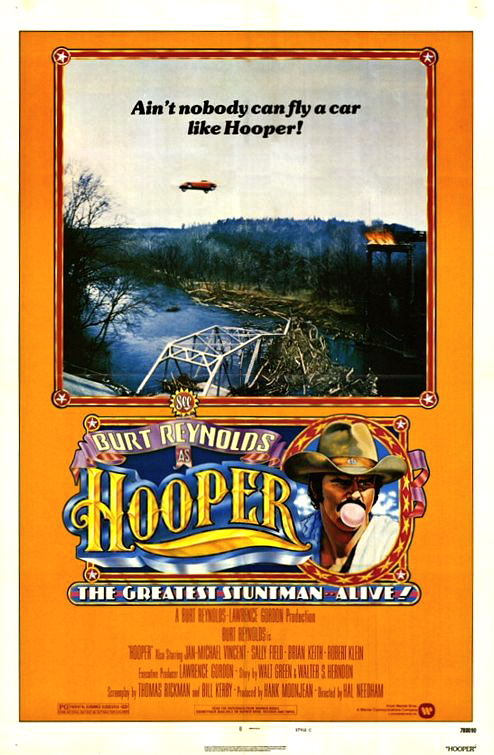
Hooper (1978)


          While this may not sound like the most enthusiastic praise, Hooper is better than most of Burt Reynolds’ myriad car-chase comedies of the ’70s and ’80s. However, because Reynolds’ good-ol’-boy charm was among the most appealing textures in mainstream ’70s cinema, noting that he was at the height of his powers when he made Hooper underscores why the movie works: Despite a story so thin it sometimes threatens to evaporate, Hooper offers 99 minutes of comic escapism driven by the macho charisma of its mustachioed leading man.
          One of several late-’70s/early-’80s film and TV projects celebrating the work of Hollywood stuntmen, Hooper stars Reynolds as Sonny Hooper, an aging daredevil who realizes a career change is imminent because his body can’t take much more abuse. When we meet him, Sonny is employed as the stunt double for Adam West (who plays himself) on the 007-style action picture The Spy Who Laughed at Danger. Despite being a pro who regularly delivers spectacular “gags,” Sonny clashes with the movie’s asshole director, Roger Deal (Robert Klein), since Deal demands impossible results on budget and on schedule, then takes credit for the footage Sonny and his team make possible.
          Sonny is involved with Gwen (Sally Field), the daughter of a retired stuntman (Brian Keith). Because Gwen has seen firsthand what stunt work does to the human body, she’s adamant that Sonny quit, but Deal’s pressure and Sonny’s own vanity become obstacles. Then a hot new stuntman, Delmore “Ski” Shidski (Jan-Michael Vincent), arrives on the scene. Although Sonny recognizes that he’s being replaced with a younger model, he insists on going out with a final super-stunt. The gentle drama of the picture, which obviously takes a backseat to action scenes and jokey interplay, stems from the question of whether Sonny will push his luck too far or succeed in providing Deal with the gag to end all gags.
          Hooper was a bit of a family affair for Reynolds, and the pleasure he presumably derived from making the picture is visible onscreen. The movie reunited Reynolds with his longtime buddy, stuntman-turned-director Hal Needham, following their success with Smokey and the Bandit (1977), and Field was Reynolds’ offscreen paramour in addition to being his frequent costar.
          Needham’s intimate familiarity with the stunt world benefits the movie greatly, because many details—from the preparations of car engines for jumps to the application of Ben-Gay on aching knees—feel effortlessly authentic. And while the character work and dialogue are as simplistic as one might expect from this sort of picture, the key actors are so watchable that we want Deal to get his comeuppance, we want Sonny to succeed, and so on. Plus, of course, the stunt sequences are fantastic, like the elaborate bit during which Sonny and Ski drive a sportscar through an entire town as it’s being demolished.

Hooper: GROOVY

Thursday, July 28, 2011

The World’s Greatest Athlete (1973)


          Considering that he had already appeared in a several hard-hitting movies for grown-ups by this point in his career, it’s bizarre that Jan-Michael Vincent was offered a juvenile role in this squeaky-clean Disney comedy; it’s even more bizarre he accepted the offer. The World’s Greatest Athlete is inane even by the standards of live-action Disney pictures, which is saying a lot. Fed up with his losing streak at a small college, coach Sam Archer (John Amos) and his trusty assistant, Milo (Tim Conway), head off for a safari vacation in Africa. (The fact of two adult males traveling without female companions is unremarked upon, as is their subsequent preoccupation with a half-naked young man.)
          During the safari, they discover a white jungle boy, Nanu (Vincent), who possesses extraordinary athletic abilities. Sam learns that, according to tribal custom, a man who saves another man’s life must accompany the rescued man wherever he goes. He thereupon tricks Nanu into such an obligation, or at least believes he does; in actuality, Nanu’s godfather, witch doctor Gazenga (Roscoe Lee Browne), wants Nanu to see the outside world. Accompanied by his pet tiger, Nanu travels to America with Sam and Milo, where Nanu is tutored by pretty teacher/love interest Jane (Dayle Haddon) and groomed for sports competitions. Yes, that’s really the plot—not Disney’s finest hour.
          Making matters worse, the picture is filled with painfully stupid physical comedy. There’s an awful running gag about a nearly blind landlady (Nancy Walker) mistaking the tiger for a person, and there’s an excruciating sequence in which Gazenga shrinks Milo down to three inches in height. The screenplay is so blunt that it’s as if the story’s being told to newborns, not youngsters, and pretty much everything related to Africa is nonsensical and quasi-racist—for instance, why does Nanu speak like Tarzan if his godfather speaks perfect English? The climactic scene, in which Nanu performs several athletic events in succession, is enjoyable, and Vincent deserves faint praise for trying to play the movie straight. But with Amos’ unpersuasive overacting, Conway’s nattering-idiot routine, and the degrading sight of Browne wearing feathered headdresses and, at one point, a bone through his nose, The World’s Greatest Athlete is unrelentingly dissonant.

The World’s Greatest Athlete: LAME

Wednesday, December 22, 2010

Damnation Alley (1977)


According to Hollywood lore, the fine folks at Twentieth Century-Fox originally thought Damnation Alley, based on a novel by journeyman genre writer Roger Zelzany, was going to be their big sci-fi hit for 1977, so they pumped more marketing money into this old-school cheapie than they did into that strange little movie George Lucas was shooting in England about some character called Luke Skywalker. Suffice it to say there was a course correction when Star Wars opened on May 25, so by the time Damnation hit theaters on October 21, it had already been rendered obsolete in almost every conceivable way by Lucas’ space opera. Looking at Damnation in the context of Hollywood history is about the only way to generate interest in the thing, which would have been passable as a pilot for one of those cheesy sci-fi shows that thrived on Saturday-morning TV in the ’70s, but doesn’t remotely make the grade as a theatrical feature. The plot is the usual post-apocalyptic hooey, with a gaggle of survivors traversing irradiated terrain in a pimped-out Winnebago while avoiding things like overabundant and/or oversized bugs. The effects are clunky in a sorta-endearing fashion (the scorching red skies are pretty cool), but the action and characterizations are utilitarian at best. The only real appeal, aside from the kitsch factor germane to all crappy ’70s sci-fi, is in watching the colorful B-grade cast: George Peppard, showing a glimmer of A-Team things to come, leads an RV filled with Jackie Earle Haley, Jan-Michael Vincent, Dominique Sanda, and Paul Winfield. All fun personalities, all badly underused here. Still, it’s impossible to hate a movie that features Peppard barking lines like this one into his CB: “Tanner, this is Denton. This whole town is infested with killer cockroaches. Repeat, killer cockroaches!”

Damnation Alley: LAME

Thursday, November 4, 2010

Big Wednesday (1978)


          Although John Milius is closely associated with cinematic ultraviolence, as a screenwriter (Apocalypse Now) and as a director (Conan the Barbarian), one of his most assured endeavors in both capacities is the lyrical surfing drama Big Wednesday, which he cowrote with lifelong surfer Dennis Aaberg. Wonderfully pretentious from beginning to end, the picture uses the interwoven adventures of three surf-crazy friends as a metaphor for self-realization, with human drama unfurling across years defined by seismic social change. Big Wednesday is a grandiose symphony of destiny, masculinity, and transcendance, with poetic speechifying and taut musculature the dominant instruments. In other words, it’s pure Milius, only without the beheadings.

          Set primarily in Malibu, the picture begins in 1962, when three macho pals live carefree lives of chasing girls and riding curls. They are levelheaded Jack (William Katt), unhinged Leroy (Gary Busey), and reckless Matt (Jan-Michael Vincent). Surfing is the center of their lives, and Milius uses the endless blue of the Pacific to express how these young men see their lives stretching to infinity. Yet Milius also employs the danger of testing oneself against the ocean’s power to underscore life’s ephemeral quality—Jack strives to use time well, Leroy defines himself by cheating death, and Matt courts his own demise, as if the sureness of mortality robs existence of its sweetness. Despite the heaviosity running through the picture, moments of levity emerge, sometimes in the form of hormone-driven tomfoolery and sometimes in the form of speeches that are quintessentially Milius. “I like fights,” says Leroy, nicknamed “The Masochist” by his pals. “I’ve dove through windows, I’ve eaten light bulbs, I like sharks, any kind of blood. If you gave me a gun, I’d shoot you in the face just to see what it looked like when the bullet hit.” That’s Milius, ever the voice of maniacs with twinkles in their eyes. (As a side note, Leroy mostly disappears from the movie soon after this speech—it’s as if Milius had nothing left to say about the character.)

          Early scenes of brawling and carousing work better than a long stretch during which the boys use creative lies to dodge the draft, but the movie eventually finds its groove—perhaps too much so—during an epic climax confronting the friends with the biggest waves of their lives, to the accompaniment of histrionic scoring by Basil Poledouris. From start to finish, the picture benefits from the great Bruce Surtees’s ominous photography (with significant assistance from the second unit), and the film’s principal actors contribute impassioned work despite the limitations of their skillsets. It’s poignant to see Busey and Vincent in their gleaming youth, given the damage ensuing years inflicted on both actors, and Katt complements them with the earnest Redford Lite vibe that, one year later, got him cast as a younger version of Redford’s signature character in Butch and Sundance: The Early Days.

          Ultimately, Milius’s choice to frame the movie as a Big Statement ensures the ocean is the most clearly defined individual in the film, but at least the ocean gives a hell of a performancesome of the surfing footage (captured in California and Hawaii) has terrifying power.


Big Wednesday: GROOVY

Tuesday, October 26, 2010

Vigilante Force (1976)


          Way before making the ’90s cult faves Grosse Pointe Blank and Miami Blues, George Armitage wrote and directed this odd exploitation flick, which boasts an eclectic cast, an insane storyline, and weird flourishes like happy banjo music accompanying scenes of bloody mayhem. Vigilante Force is so disconnected from recognizable reality that it’s like a drive-in flick viewed through the prism of an irreverent absurdist. And, yes, that’s a compliment: Vigilante Force is disorganized, illogical, and strange, but it’s also compulsively watchable.
          The outrageous story takes place in a small California oil town called Elk Hills, which has been overrun by itinerant workers. Blissfully eschewing restraint, Armitage depicts the interlopers as hordes of brawling rednecks; these faceless savages seem to be controlled by sociopathic groupthink. In the first 10 minutes alone, criminals trash a saloon, murder cops in broad daylight, and literally shoot a car to death. Given the many whimsical touches that follow, one can only imagine that Armitage envisioned his film’s opening act as a spoof of other movies about random violence, but then again, his storytelling is so capricious throughout Vigilante Force it’s hard to parse narrative intention.
          Anyway, the leading moral force in Elk Hills is Ben Arnold (Jan-Michael Vincent), a salt-of-the-earth widower who wants to protect the small town where he lives with his young daughter. At the urging of his neighbors, Ben tracks down his wayward Vietnam-vet brother Aaron (Kris Kristofferson), and then hires Aaron to form a peacekeeping militia. Initially, the scheme works, because Aaron and his rough-and-tumble buddies crack down on street crime. However, it soon becomes apparent that Aaron is even more dangerous than the thugs he was recruited to fight. Enlisting secret operatives to shake down local business owners and gleefully using murder to intimidate opponents, Aaron quickly gets Elk Hills under his militaristic thumb. Among other things, Aaron’s rampage features some of the most blasé murders ever shown in movies; the comic-book universe Armitage creates is almost entirely devoid of visible emotional consequences, a bizarre tonal choice accentuated by across-the-board understated performances.
          While all this is going on, the movie tracks Ben’s romance with a saintly schoolteacher (Victoria Principal) and Aaron’s thorny involvement with a cynical barroom singer (Bernadette Peters). While future Dallas star Principal is mostly relegated to stand-by-her-man ornamentation, Peters gets to show off her comedy chops through sly running gags. Plus, both women are blazingly sexy, so even though Vigilante Force is chaste by exploitation-movie standards, there’s plenty of eye candy—and since Kristofferson spends about half the movie shirtless, Armitage ensures there’s something for everyone to ogle. Furthermore, the supporting cast features several familiar faces, including Charlie’s Angels sidekick David Doyle, Breakfast Club villain Paul Gleason, and, in tiny roles, WKRP in Cincinnati bombshell Loni Anderson and B-movie icon Dick Miller.
          After meandering through a confusing but entertaining second act, Vigilante Force sticks the landing with an incredibly colorful finale: Aaron’s crew masquerades as a marching band in order to rob the Elk Hills bank, and Ben forms a militia of his own comprising local geezers and youths. Thus, the climax features Kristofferson blasting away with an M-16 while dressed in a cherry-red marching-band outfit and standing atop a giant oil tank. From its surreal opening to its even more surreal denouement, Vigilante Force maintains a breakneck pace that precludes questions about the nutty narrative until it’s all over. As a result, Vigilante Force is among the most uniquely entertaining schlock movies of its era. (Available as part of the MGM Limited Collection on Amazon.com)


Vigilante Force: FREAKY

Friday, October 15, 2010

Bite the Bullet (1975)


          There’s a major story problem at the center of this big-canvas adventure set in the afterglow of the Wild West era, so your ability to overlook the problem will determine whether you can enjoy the film’s many verbal, visceral, and visual pleasures. Here’s the problem. A macho adventure story about a brutal 700-mile horseback race across some of the southwest’s most unforgiving terrain, the narrative is predicated on the notion that competitors are willing to endanger their steeds in the hope of winning a significant cash prize. Fair enough. Yet the film’s hero, Sam Clayton (Gene Hackman), is consistently portrayed as such a devoted equine caretaker that he beats the tar out of anyone he observes abusing horses. Therefore, his choice to enter the race—even though his original role was merely to deliver a champion stallion to one of the competitors—makes very little sense. Seriously, is the most effective means of protesting an event that you consider to be inhumane participating in that event?
          As was often his wont, writer-director Richard Brooks pushes the story deep into the Myth of the American Man, which means that notions of heroism and legacy and pride often trump basic logic. That said, for viewers who can overlook the basic disconnect at the heart of the film’s principal characterization, Bite the Bullet is an exciting film.
          Predictably, the race attracts a colorful group of competitors. Clayton and Luke Matthews (James Coburns), are both veterans of Teddy Roosevelt’s famed Rough Riders. Sir Harry Norfolk (Ian Bannen) is an Englishman with high-minded notions of sportsmanship. Carbo (Jan-Michael Vincent) is a hotheaded kid looking to make a reputation as a tough guy, no matter the cost to animals or people. Miss Jones (Candice Bergen) is a prostitute eager to change her life. The oldest competitor (Ben Johnson), is a saddletramp with health problems who never shares his name—making him a surrogate for the countless anonymous adventurers whose labors helped birth the legend of the Old West.
          Brooks, an adept screenwriter who often wandered into strange narrative terrain, mostly stays focused in generating character-driven pathos and rip-roaring adventure, essentially recapturing the vivacious tone of his great film The Professionals (1966) while infusing the picture with a thread of melancholy. Much of this works. Brooks capably introduces the characters with pre-race vignettes, and then he follows groups and individuals during intimate scenes of adversity and bravery. Hackman hits consistently interesting notes by playing to his mean streak while also demonstrating compassion, Johnson hums the same elegiac melodies he performed so beautifully in The Last Picture Show (1971), and Vincent incarnates the arrogance of youth. Meanwhile, Bannen, Bergen, Coburn and fellow supporting player Mario Arteaga add important colors to Brooks’ palette.
         Speaking of palettes, the film looks terrific, with cinematographer Harry Stradling Jr. crafting just the right mixture of frontier grit and nostalgic beauty.
          Ultimately, the lingering image from this picture is that of horses moving in slow motion, sweat pouring out of their bodies in clouds of foam, as their riders push them beyond their limits. One imagines Brooks was after some sort of Big Statement here, so it’s a shame he didn’t find the right leading character to use as a prism. At best, the film’s Big Statement is hopelessly murky; at worst, the assertion is bewilderingly hypocritical. It doesnt help, of course, that the film is quite long-winded, especially during a pair of endless monologues, one inflicted by Hackman and the other by Johnson.

Bite the Bullet: FUNKY