Showing posts with label sally field. Show all posts

Monday, December 5, 2016

Mongo’s Back in Town (1971)


          Telling the story of a hit man who returns to his old neighborhood for a contract job that’s imbued with family issues, the made-for-TV melodrama Mongo’s Back in Town is fairly thoughtful in terms of characterization and themes. Making the piece even more interesting is a noteworthy cast: Joe Don Baker, Charles Cioffi, Sally Field, Anne Francis, Telly Savalas, Martin Sheen. Excepting Baker and Field, none of these players has room to do much that’s out of the ordinary, but their collective efforts, in tandem with director Marvin J. Chomsky’s understated storytelling, ensure that Mongo’s Back in Town feels like something more than a typical small-screen crime picture. The murky script has something to do with Mongo Nash (Baker) answering a call from his brother, low-rent gangster Mike Nash (Cioffi), to off someone. Local cop Lt. Pete Tolstad (Savalas) sees Mongo arrive, so he knows what’s up and tries to prevent bloodshed. Meanwhile, Mongo happens across Vikki (Field), a young woman who recently left her home in rural West Virginia to start a new life in the big city. Compelled by a combination of lust and pity, Mongo gives Vikki a place to stay, putting her in the crossfire as the date of the big hit approaches. Also pulled into the drama are a moll (Francis) and Tolstad’s partner (Sheen).
          Although the plot of Mongo’s Back in Town is alternately convoluted and pedestrian, it’s possible to watch the movie just for the acting and character work. On that level, it’s fairly rewarding. Baker gets to carry most of the picture’s dramatic weight, and he does so gracefully. Playing a thug defined by his past choices and the patterns they created, Baker shows glimmers of sensitivity in his scenes with Field, because even though she’s not purely innocent—a wise choice on the filmmakers’ part—she’s redeemable, which may or may not be true of Baker’s character. This unpredictable relationship creates dramatic tension of an emotional sort, which offers an effective complement to the ticking-clock suspense stemming from the contract killing. Yet it’s not as if Baker’s character comes across as some gentle giant in a world of nefarious hoodlums; some of the crimes that Mongo commits are horrendous. Less dimensional are the cop scenes, with Sheen’s character offering by-the-book contrast to his partner’s instinctive style. And to call the material with Francis’ character threadbare would require overstatement.
          Still, the best elements of Mongo’s Back in Town work well enough to make the picture worthwhile. Polished and quiet, Mongo’s Back in Town favors gentle shadings of morality over flamboyant action scenes, so the film’s creative team deserves credit for trying something different within the parameters of a familiar genre. 

Mongo’s Back in Town: FUNKY

Sunday, July 12, 2015

1980 Week: Smokey and the Bandit II


          Discussing the frothy action/comedy hit The Cannonball Run (1981), a snide critic once said that the picture seemed like an incidental byproduct of an enjoyable party, as if playing characters and telling a story was a secondary consideration for those involved. To a certain degree, the same observation could be made of all the lowbrow movies that stuntman-turned-director Hal Needham made with his buddy, leading man Burt Reynolds. The duo’s first effort, Smokey and the Bandit (1977), is a goofy romp made somewhat tolerable by lighthearted performances and spectacular car jumps. Their second and best movie together, Hooper (1978), comes dangerously close to having a heart, since it’s a loving homage to stuntman. But then comes the slippery slope comprising Smokey and the Bandit II, The Cannonball Run (1981), Stroker Ace (1983), and Cannonball Run II (1984). Each is dumber and lazier than the preceding. The problem, of course, is that Needham never really left his identity as a stuntman behind, so he offers little except the ability to stage automotive disasters and fistfights. Smokey and the Bandit II, for example, so enervated that the plot is virtually the same as the original picture’s narrative.
          While trucker Cledus “Snowman” Snow (Jerry Reed) and his escort driver, Bo “Bandit” Darville (Reynolds), haul illegal cargo through the Deep South, redneck Sheriff Buford T. Justice (Jackie Gleason) follows them “in hot pursuit.” Meanwhile, Carrie (Sally Field) once again leaves Justice’s idiot son at the altar in order to join her once-and-future lover, Bandit, on the road. The “twists” this time are as follows: the cargo is an elephant, a wacky Italian doctor (Dom DeLuise) tags along to care for the elephant, and Justice enlists his two brothers (both played by Gleason) for aid in the final showdown. Smokey and the Bandit II comprises 100 mindless minutes of car crashes, country-music performances, drinking scenes, redneck clichés, slapstick, and (thanks to Gleason) unbearable overacting. It’s hard to know whether Field and Reynolds returned for the party or the paycheck, or simply out of loyalty to Needham, but even describing their participation as half-hearted would require exaggerating. The elephant probably gives the picture’s best performance. Incredibly, Smokey and the Bandit II made enough money to warrant a third installment, the execrable Smokey and the Bandit Part 3 (1983), which was produced without Needham’s participation, and in which Reynolds makes only a brief cameo appearance. A decade later, Needham somewhat pathetically resurrected the franchise with a quartet of TV movies (all originally aired in 1994) featuring Brian Bloom as “Bandit.”

Smokey and the Bandit II: LAME

Wednesday, October 29, 2014

Sybil (1976)


          Nearly 20 years after winning on Oscar for The Three Faces of Eve (1967), in which she played a woman with three different personalities, Joanne Woodward switched from patient to therapist for the acclaimed telefilm Sybil. Telling the fictionalized story of a young woman with 16 different personalities, the picture was a breakthrough project for Sally Field, who plays the title role. Continuing the artistic maturation she’d begun with serious telefilms including Maybe I’ll Come Home in the Spring (1971), former sitcom actress Field proved she was capable of heavy lifting, dramatically speaking, earning an Emmy for her efforts. (Just three years later, she added on Oscar to her mantle, thanks to 1979’s Norma Rae.)
          This behind-the-scenes data is useful for contextualizing Sybil, which is excellent on many levels but very much a performance showcase. Originally broadcast over two nights, the unexpurgated version of the picture runs a whopping 187 minutes. And while it’s easy to see where fat could have been trimmed, the project’s integrity is beyond question. Not only is Sybil consistently earnest, humane, and intelligent, but it’s also made with the level of craftsmanship one would normally expect from a theatrical feature. Director Daniel Petrie employs extraordinarily long takes, correctly assuming that his leading actors’ remarkable work will sustain interest, and he shoots even the simplest locations with a rich sense of atmosphere. Additionally, Petrie and his collaborators made a strong choice by filming many scenes with horror-movie aesthetics, since the title character regards her multiple personalities—and the traumas of the past—like demons that are tormenting her. The overall experience of Sybil is immersive and powerful, if perhaps a bit too voluptuous.
          The movie begins in New York, where Sybil Dorsett (Field) is a graduate student and part-time schoolteacher prone to inexplicable behavior: She suffers blackouts during which she acts like someone other than herself. As the frequency and severity of her episodes increase, Sybil injures herself and lands in a hospital, where she encounters kindly psychologist Dr. Cornelia Wilbur (Woodward). Thus begins an 11-year journey during which Dr. Wilbur catalogs Sybil’s personalities—some of which appear only fleetingly, and some of which overtake her consciousness for long periods of time—and during which Dr. Wilbur tries to discover the reasons why Sybil’s psyche initially fragmented.
          The film’s therapy scenes are compelling, with Field providing the fireworks while Woodward counters with compassion and rationality. Concurrently, scenes of Sybil trying to live a “normal” life are poignant. The most incendiary material appears in the flashbacks to Sybil’s horrific youth, when she was mistreated and mutilated by her mentally ill mother. Many other films and TV projects have gone down similar roads in the years before and since Sybil. Nonetheless, the novelistic length of the project allows screenwriter Stewart Stern—working from a nonfiction book by Flora Rhela Schreiber—to explore myriad nuances of Sybil’s condition and treatment. Further, the more-is-more approach pays off handsomely during the climax. Filled with feelings and insights and truths, some beautiful and some ugly, Sybil is a unique film that transcends its small-screen origins.
          Hollywood unwisely tried dipping into the same well 20 years later, when CBS broadcast an 89-minute remake of Sybil starring Tammy Blanchard (as Sybil) and Jessica Lange (as Dr. Wilbur. The 2007 version was met with indifference.

Sybil: GROOVY

Wednesday, May 28, 2014

Maybe I’ll Come Home in the Spring (1971)


          Seeing as how she first gained mainstream attention by starring in the silly TV series Gidget (1965-1966) and The Flying Nun (1967-1970), Sally Field seemed destined for a career in light comedy. Yet as early as 1971, when she starred in this TV movie about the Generation Gap, Field made it clear she was both interested in exploring dramatic material and proficient at playing serious roles. So, even though Field didn’t truly burst free of typecasting until starring in the acclaimed telefilm Sybil (1976), this earlier endeavor represents an important step along her path. In Maybe I’ll Come Home in the Spring, Field stars as Denise Miller, the oldest daughter of upper-middle-class parents who are preoccupied with reputation and social position.
          When the story begins, Denise returns home after a year she spent on the road with hippies. Her arrival stirs up old tensions. Denise’s superficial father, Ed (Jackie Cooper), gets bent out of shape whenever rules of propriety aren’t followed, and Denise’s smothering mom, Claire (Eleanor Parker), ranges from passive-aggressive nastiness to outright judgmental cruelty. Meanwhile, Denise’s little sister, sexy teenybopper Susie (Lane Bradbury), has started a spiral even more destructive than Denise’s, maintaining a drug habit and quarrelling with her parents at every opportunity.
          As written with great sensitivity by Bruce Feldman, Maybe I’ll Come Home in the Spring creates tension by asking whether Denise can suppress her freespirited identity sufficiently to integrate into a repressive household. Concurrently, Susie repeats troublesome behaviors that she learned from Denise. At its most incisive, Maybe I’ll Come Home in the Spring features moments like the elaborate party scene during which Denise’s oblivious parents mistake Denise’s concern for Susie’s welfare as a signal that Denise is drugged or overwrought; the sequence provides an effective dramatization of people seeing only what they want to see.
          Produced and directed by the reliable Joseph Sargent, Maybe I’ll Come Home in the Spring has uniformly good acting and a steady pace, even if Sargent’s integration of flashbacks to Denise’s life among the longhairs isn’t especially graceful. Similarly, the ticking-clock device of Denise’s lover, Flack (David Carradine), making his way across the country to “rescue” Denise is a bit contrived, though it adds a sense of urgency. The film’s most interesting stylistic element is probably the inclusion of a song score performed by the great Linda Ronstadt, since her soulful vocals capture the angst of the storyline. Holding the whole thing together, of course, are the key performances. Field does an excellent job of complicating her good-girl image, often venturing to places of deep emotion, and Bradbury is terrific as a confused young woman who perceives herself as a victim even though she’s really a spoiled brat. Carradine, Cooper, and Parker inhabit their subordinate roles skillfully.

Maybe I’ll Come Home in the Spring: GROOVY

Wednesday, September 18, 2013

Norma Rae (1979)


          Gritty, heartfelt, and passionately political, Norma Rae is an old-fashioned message movie that could easily have slipped into the one-dimensional mediocrity one associates with generic TV movies. After all, it’s the fictionalized story of a real-life factory worker who risked her employment in order to unionize the workers in an oppressively conservative Deep South community. What elevates Norma Rae above the norm is the conviction of Martin Ritt’s filmmaking, the intelligence of the script by frequent Ritt collaborators Harriet Frank Jr. and Irving Ravetch, and, most importantly, the inspirational performance in the title role by Sally Field. After becoming famous on such dippy ’60s TV series as The Flying Nun and Gidget, Field demonstrated serious dramatic chops with the acclaimed telefilm Sybil (1976), but it took a few years for her to win a substantial role in a theatrical feature. She seized the opportunity with the same fervor that her character assumes her destiny as a labor leader. Downplaying her fresh-scrubbed prettiness (while still rocking an amazing figure in skimpy T-shirts and tight jeans), Field slips convincingly into the skin of a blue-collar working mom exhausted from trying to balance a job and a family.
          When we meet Norma Rae Webster (Field), she’s one of many put-upon drones in a cotton mill, though Norma Rae gives her thuggish superiors more lip than anyone else on the factory floor. One day, labor organizer Ruben Warshowsky (Ron Leibman) shows up to recruit workers interested in unionizing, and thus begins a sort of ideological courtship with Norma Rae. Although the two never become lovers—Norma Rae’s devoted to her decent but simple husband, Sonny (Beau Bridges)—Ruben opens Norma Rae’s eyes to the possibilities of the outside world. As a fast-talking Jew from New York, he seems like an exotic creature to Southern-bred Norma Rae, and the way he respects Norma Rae’s mind instills a newfound sense of intellectual pride. Empowered by Ruben’s friendship and driven by the desire to make the world better for her people, Norma Rae organizes a factory strike that has dangerous repercussions in her private and professional lives.
          Given its nature as an unlikely-hero parable, the ending of Norma Rae is a foregone conclusion, so one could easily complain that the dramatic stakes of the picture never feel terribly high. Then again, the purpose of a movie like this one is paying tribute to the sacrifices virtuous people are willing to make for worthwhile causes, and Norma Rae does indeed go through rough patches. It helps, tremendously, that Ritt and cinematographer John A. Alonzo shot the picture in a real factory and other genuine locations, so the texture of the piece feels real even when the dramaturgy gets schematic. The supporting cast is solid, featuring such reliable character players as Morgan Paull and Noble Willingham, and both Bridges and Leibman play their key roles with humanity and humor. Ultimately, of course, this one’s all about Field, who won an Oscar for her rousing work; Norma Rae also collected an Oscar for Best Original Song, the Jennifer Warnes-sung “It Goes Like It Goes.”

Norma Rae: GROOVY

Thursday, June 21, 2012

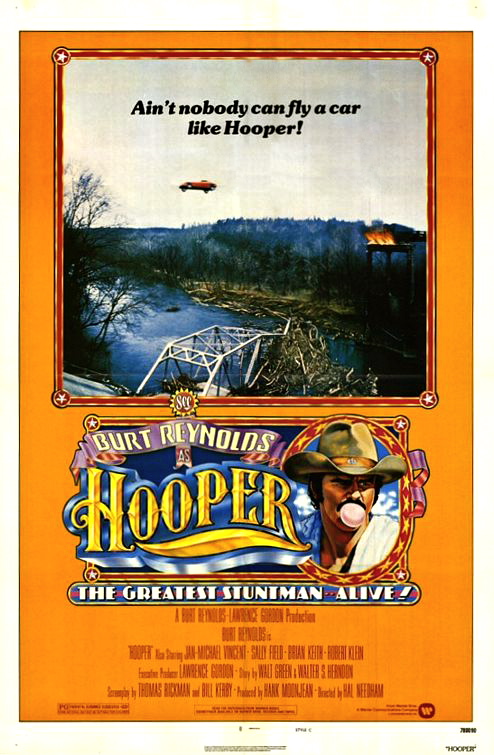
Hooper (1978)


          While this may not sound like the most enthusiastic praise, Hooper is better than most of Burt Reynolds’ myriad car-chase comedies of the ’70s and ’80s. However, because Reynolds’ good-ol’-boy charm was among the most appealing textures in mainstream ’70s cinema, noting that he was at the height of his powers when he made Hooper underscores why the movie works: Despite a story so thin it sometimes threatens to evaporate, Hooper offers 99 minutes of comic escapism driven by the macho charisma of its mustachioed leading man.
          One of several late-’70s/early-’80s film and TV projects celebrating the work of Hollywood stuntmen, Hooper stars Reynolds as Sonny Hooper, an aging daredevil who realizes a career change is imminent because his body can’t take much more abuse. When we meet him, Sonny is employed as the stunt double for Adam West (who plays himself) on the 007-style action picture The Spy Who Laughed at Danger. Despite being a pro who regularly delivers spectacular “gags,” Sonny clashes with the movie’s asshole director, Roger Deal (Robert Klein), since Deal demands impossible results on budget and on schedule, then takes credit for the footage Sonny and his team make possible.
          Sonny is involved with Gwen (Sally Field), the daughter of a retired stuntman (Brian Keith). Because Gwen has seen firsthand what stunt work does to the human body, she’s adamant that Sonny quit, but Deal’s pressure and Sonny’s own vanity become obstacles. Then a hot new stuntman, Delmore “Ski” Shidski (Jan-Michael Vincent), arrives on the scene. Although Sonny recognizes that he’s being replaced with a younger model, he insists on going out with a final super-stunt. The gentle drama of the picture, which obviously takes a backseat to action scenes and jokey interplay, stems from the question of whether Sonny will push his luck too far or succeed in providing Deal with the gag to end all gags.
          Hooper was a bit of a family affair for Reynolds, and the pleasure he presumably derived from making the picture is visible onscreen. The movie reunited Reynolds with his longtime buddy, stuntman-turned-director Hal Needham, following their success with Smokey and the Bandit (1977), and Field was Reynolds’ offscreen paramour in addition to being his frequent costar.
          Needham’s intimate familiarity with the stunt world benefits the movie greatly, because many details—from the preparations of car engines for jumps to the application of Ben-Gay on aching knees—feel effortlessly authentic. And while the character work and dialogue are as simplistic as one might expect from this sort of picture, the key actors are so watchable that we want Deal to get his comeuppance, we want Sonny to succeed, and so on. Plus, of course, the stunt sequences are fantastic, like the elaborate bit during which Sonny and Ski drive a sportscar through an entire town as it’s being demolished.

Hooper: GROOVY

Sunday, January 1, 2012

The End (1978)


          As written by TV veteran Jerry Belson and directed by Burt Reynolds, who also stars in the picture, The End is a nervy endeavor digging for jokes in the unlikely milieus of insanity, suicide, and terminal disease. The End is also among Reynolds’ most worthwhile ’70s movies, because instead of the car chases and redneck raunchiness that dominated much of his output during the era, The End features character-driven black comedy. At the beginning of the movie, Sonny Lawson (Reynolds) enjoys middle-class success and endures middle-class tribulations: His infidelities scuttled his marriage to Jessica (Joanne Woodward); he’s struggling to maintain a bond with his adolescent daughter, Julie (Kristy McNichol); and he’s confused about his relationship with a free-spirited young woman, Mary Ellen (Sally Field). So, when Sonny gets diagnosed with a terminal disease, he decides to kill himself rather than suffer a lingering demise.
          Belson’s droll script examines the various ways different people respond to Sonny’s decision; the script also features gentle moments with characters Sonny doesn’t bring into his confidence, like his amiably bickering parents (played by Myrna Loy and Pat O’Brien). Then, after Sonny botches his first suicide attempt, he gets thrown into an asylum and befriends a homicidal wacko, Marlon (Dom DeLuise), who becomes obsessed with helping Sonny shuffle off this mortal coil. Making a big creative jump forward from his directorial debut, the Southern-fried action flick Gator (1976), Reynolds shows a flair for light comedy, building elegant pacing and helping actors find easy rapport.
          He also does some of his very best comedic acting, pouring on the self-deprecating charm as a stud-turned-wimp who weeps when he gets his diagnosis and cringes at the idea of pain. His enjoyable turn is complemented by several deft supporting performances: comedy pros Norman Fell, Carl Reiner, and David Steinberg are sharp in small roles; Robby Benson has an entertaining cameo as an inexperienced priest; Field (Reynolds’ offscreen paramour at the time) does her patented cute-and-sexy routine; Loy and O’Brien are a hoot; and Woodward effectively softens her usual suburban-harridan persona. DeLuise is hilarious in his first few scenes, but then overcompensates once his character slips into repetitive behavior. Plus, the movie itself loses energy as it nears the climax. However, Reynolds’ last big scene, an anguished negotiation with God played mostly as a voice-over monologue, concludes the movie in high style.

The End: GROOVY

Thursday, November 17, 2011

Stay Hungry (1976)


          First, the bad news: Bob Rafelson’s Stay Hungry is a hodgepodge of incompatible elements; the tone is completely out of control, ping-ponging between heavy drama and silly comedy; and Arnold Schwarzenegger gives one of the movie’s most nuanced performances. That said, Stay Hungry is so willfully weird that it merits examination, even if curious viewers aren’t necessarily rewarded with consistent entertainment.
          The strange story revolves around Craig Blake (Jeff Bridges), a wealthy young Southerner whose parents died in an accident, leaving him ownership of a small estate in his hometown of Birmingham, Alabama. The directionless Craig has gotten involved with a cartel of unscrupulous real-estate developers, and he’s been charged with persuading the owner of a local gym to sell his property. Instead of accomplishing his dubious goal, however, Craig becomes enmeshed in the dysfunctional culture of the gym, befriending drunken owner Thor Erickson (R.G. Armstrong), bonding with star bodybuilder Joe Santo (Schwarzenegger), and falling for Santo’s on-again/off-again girlfriend, Mary Tate (Sally Field).
          Once all of these characters are introduced, director/co-writer Rafelson wanders somewhat aimlessly through disassociated vignettes. Craig slums with working-class Mary Tate, enjoying carnal bliss at home but ignoring her in public. Craig goes on adventures with Joe, leading to the bizarre scene of humungous Austrian Schwarzenegger visiting a gaggle of backwoods buddies for fiddle practice. (Later in the movie, Schwarzenegger performs a full-on fiddle concert.) Also thrown into the mix is a convoluted subplot about a bodybuilding contest. Some of the bits in Stay Hungry are enjoyably odd, like the sequence of toupee-wearing Thor and his pure-as-driven-snow sidekick (Roger E. Mosley) entertaining a pair of hookers in the gym, but much of the movie is abrasive. For instance, Craig is a shallow son of a bitch, so it’s boring to watch him mistreat the amiable Mary Tate and display his “friend” Joe like a freak.
          The slapdash quality of the storyline is exacerbated by Rafelson’s tonal indecision, since he waffles between celebrating and satirizing his characters. The ending is especially sloppy, with various plot threads resolving against a backdrop of half-dressed bodybuilders parading through downtown Birmingham. (At one point, several of them ride atop a city bus, posing and preening in Speedos.) Though ultimately a blip in the careers for most of its participants, Stay Hungry was significant for Schwarzenegger, since it was his first dramatic role in a big-budget movie; combined with his appearance in the documentary Pumping Iron, released the following year, Stay Hungry demonstrated Schwarzenegger’s powerful charisma, setting the stage for his success as an action-movie star.

Stay Hungry: FUNKY

Monday, June 27, 2011

Heroes (1977)


          Sincere and well-intentioned but not particularly good, Heroes takes a seriocomic look at the traumas plaguing Vietnam-era combat vets trying to assimilate back into normal life. The picture is most noteworthy as a star vehicle for Henry Winkler, who was well into his phenomenally popular run as ’50s greaser Arthur “Fonzie” Fonzarelli on the sitcom Happy Days (1974-1984). Leaving the leather jacket and pomade behind, Winkler plays a delusional vet named Jack Dunne, who flees a New York City mental hospital to pursue his bizarre dream of opening a worm farm with several combat buddies. He lands on a cross-country bus, seated next to conflicted city girl Carol Bell (Sally Field), who has also fled Manhattan; she’s ditching her impending nuptials for reasons that are never particularly clear. What ensues is an odd sort of romantic comedy, with these mismatched souls getting closer to each other as they experience colorful adventures.
          One of these exploits is a long visit with Jack’s Army pal Ken Boyd (Harrison Ford), a simple-minded Midwesterner with a self-destructive streak; he spends his time entering (and losing) stock-car races when he’s not getting hammered and shooting off his M16 in the fields of his family farm. Jack and Carol also run afoul of an ornery bus driver (Val Avery) and the slimy denizens of a redneck bar. Excepting the visit with Ken, the movie’s episodes feel contrived and random, a problem exacerbated by screenwriter James Carabatsos’ vague characterizations and, especially, by the casting of Field and Winkler. Carabatsos can’t figure out how to balance between the film’s comedic and dramatic elements, so the movie’s tonal shifts induce audience whiplash.
          As for Field and Winkler, they’re so inherently likeable that it’s hard to buy them as edgy characters, and the script constantly undercuts their work by going for cutesy jokes at the expense of emotional reality. Nonetheless, Heroes isn’t bad so much as sloppy. Many stretches of the film are charming, and Field and Winkler conjure flashes of sweet intimacy whenever the storytelling calms down enough to let them do serious work. It’s also interesting to see Ford playing a character role instead of a lead, since Heroes was made before his ascension to superstardom in Raiders of the Lost Ark (1981). He clearly relishes the hard work of inhabiting a troubled individual, and he has many strong moments.

Heroes: FUNKY

Friday, March 11, 2011

Smokey and the Bandit (1977)


          Probably the most popular of the innumerable trucker flicks that blazed across American movie screens in the late ’70s, this Burt Reynolds hit was the No. 2 box-office success of 1977, topped only by Star Wars. On one level, it’s not hard to see why audiences embraced the action-packed comedy, because it delivers almost nonstop juvenile amusement through car crashes, cartoonish characters, and curse words—to say nothing of rebelliousness and then-trendy CB jargon. However, laughing at Smokey and the Bandit is a bit like laughing at the bad kid in high school who shoots spitballs when the teacher isn’t looking: You know it isn’t really funny, but you can’t help smiling every so often by reflex.
          The directorial debut of veteran stuntman Hal Needham, Smokey and the Bandit tells the silly story of a quest to illegally transport a truckload of beer across state lines in the Deep South. Bandit (Reynolds) drives a hot black Firebird Trans Am as a “blocker” for his trucker pal, Snowman (Jerry Reed), meaning it’s Bandit’s job to drive so fast that cops chase him while Snowman’s rig cruises by unnoticed. When Bandit picks up a sexy runaway bride, Carrie (Sally Field), he also picks up a persistent pursuer: redneck sheriff Buford T. Justice (Jackie Gleason), father of the schnook Carrie left at the altar. Therefore most of the movie cuts between scenes of Bandit and Carrie getting frisky and scenes of Justice and his idiot son zooming down the highway in a police car that gets demolished piece by piece as the movie progresses.
          Needham’s daring auto stunts are fun for those who dig that sort of thing (cars soaring over rivers, crashing onto the backs of flatbed trucks, and so on), and Gleason aims for the cheap seats with a stereotypical performance (he shouts things like, “Nobody makes Sheriff Buford T. Justice look like a possum’s pecker!”). Gleason’s characterization would be unbearable if the actor wasn’t blessed with such meticulous timing, although it’s a bummer to see “The Great One” saddled with not-great material. Beyond Gleason’s shtick and the highway high jinks, the most appealing aspect of the movie is the easygoing dynamic between Field and Reynolds (who were an offscreen couple at the time), and the similarly loose buddy-movie vibe between Reynolds and country-singer-turned-actor Reed.
          Plus, there’s no denying that when he made this picture, Reynolds epitomized a certain ideal of über-’70s macho swagger—he’s like a never-ending party crammed into a lean, 5’ 11’ frame. After the huge success of Smokey and the Bandit, Reynolds’ comedies mostly devolved into uninspired variations on a theme (like 1980’s awful Smokey and the Bandit II), so it’s interesting to study this flick as the moment when he simultaneously perfected his good-ol’-boy act and began squandering audience goodwill by generating lackluster product that was probably more fun to make than it is to watch.

Smokey and the Bandit: FUNKY

Friday, December 31, 2010

The Poseidon Adventure (1971) & Beyond the Poseidon Adventure (1979)


          For some reason, I’ve always remembered a remark that Will Smith made around the time he broke through as a big-screen star with 1994’s Independence Day: When asked how he got so much mileage out of so little screen time, Smith explained that he studied Ernest Borgnine’s performance in The Poseidon Adventure because of how vigorously Borgnine attacked every scene. Smith was onto something, because even though Irwin Allen’s production of The Poseidon Adventure deserves its reputation as one of the cheesiest movies of the ’70s, it’s undeniably compelling for the same reason that Borgnine’s supporting performance is effective—the picture will do anything to get a reaction. Based on a novel by Paul Gallico, the story about a luxury liner turned upside down by a giant rogue wave is silly, because it presumes that the liner can stay afloat long enough for survivors to seek rescue through a hole in the bottom of the hull, but the movie is jam-packed with action, melodrama, romance, schmaltz, and spectacle. What’s not to like about unpretentious hokum that intercuts shots of gussied-up New Year’s Eve revelers singing “Auld Lang Syne” with vignettes of the ship’s stoic captain (Leslie Nielsen!) watching watery doom approach a few decks above their heads? Perfecting the disaster-movie template established by Airport (1970), The Poseidon Adventure offers a slapdash ensemble of familiar faces romping through one overwrought crisis after another. In sheer paycheck-cashing mode, Gene Hackman plays the hero of the piece, a swaggering priest who rediscovers his purpose in life by leading a band of hearty survivors to possible salvation; his performance is so faux-intense that it’s embarrassing and thrilling at the same time. Lending campy gravitas are Borgnine and other showbiz veterans, including Jack Albertson, Red Buttons, Roddy McDowall, and the flamboyantly buoyant Shelley Winters (“In the water, I’m a very skinny lady!”). Meanwhile, Carol Lynley, Pamela Sue Martin, and Stella Stevens shriek their lungs out in various states of soggy undress.
          The soap-opera storylines are drab, like the one about marital strife between a crass cop (Borgnine) and an ex-hooker (Stevens), but the fun of the picture is watching broadly sketched caricatures clash with each other against a backdrop of death and devastation. Allen spent a bundle on massive sets that could be flipped upside down and flooded, so what’s happening onscreen feels real because the actors actually got soaked, and drowning is such a universal phobia that it’s impossible not to sympathize with the characters’ anxiety. On top of everything, there’s a sky-high kitsch factor, especially when Lynley lip-syncs the movie’s atrocious but Oscar-winning theme song “The Morning After”—so whether you embrace the flick for its legit thrills or its unintentional humor, The Poseidon Adventure is a great ride.
          Allen reprised the story several years later, when his career was faltering; the sleep-inducing Beyond the Poseidon Adventure stars a bored Michael Caine as a sea captain who tries to salvage loot from wreck of the Poseidon shortly after the last moments of the original movie. Peter Boyle, Sally Field, and Jack Warden join the festivities, with Karl Malden playing Caine’s salty sidekick and Telly Savalas portraying the main villain. Unfortunately, the direction and script are so lifeless that even the colorful cast isn’t enough to keep the sequel afloat—Beyond the Poseidon Adventure is a grade-Z heist picture that merely happens to take place on an abandoned boat.

The Poseidon Adventure: GROOVY
Beyond the Poseidon Adventure: LAME