Showing posts with label race relations. Show all posts

Wednesday, July 15, 2026

Black Chariot (1971)


           An intriguing artifact from the same Black-power zeitgeist that produced Uptight (1968), Sweet Sweetback’s Baadasssss Song (1971), and The Spook Who Sat by the Door (1973), Robert L. Goodwin’s indie drama Black Chariot had a miniscule theatrical run in 1971, then disappeared until its recent rediscovery and restoration. Watching Black Chariot today, it’s evident why the movie failed to get more traction in 1971 because amateurish production values and scattershot scripting obscure the film’s sober meditation on provocative issues. In his first leading role, charismatic athlete-turned-actor Bernie Casey has more presence than skill, and it’s frustrating to realize that a polished version of Black Chariot could have featured an indelible performance by Casey as self-described “street brother” who develops a social conscience. As goes Casey’s portrayal, so goes the film—Black Chariot is full of weighty ideas, but Goodwin lacks the artistry and resources needed to realize his vision.
          Janky production values notwithstanding, the picture gets off to a strong start with a tense meeting between several members of an unnamed Black Power organization. Because the police killing of a group member was triggered by another member spilling secrets to cops, organization leader Plaz (Richard Elkins) calls a vote on whether the traitor should be executed. The only “no” is from Tuck (Casey). After the meeting, Tuck tracks down the turncoat, Brack (Robert L. Goodwin Jr.), to warn the man he’s in danger. Too frightened to listen to reason, Brack shoots his would-be savior. Then a local youth helps the wounded Tuck stagger to the home of Tuck’s devoutly religious mother, Sara (Paulene Myers), and the organization kidnaps a white doctor (Gene Dynarski) to treat their injured friend. Cue flashbacks depicting how Tuck joined the organization. The flashbacks also show his fraught romance with strident organization member Silvia (Barbara O. Jones), and his friendship with Dooley (Michael Warren), the young man whose death started the dramatic wheels spinning.
          There’s so much to admire in Black Chariot that it’s a shame Goodwin didn’t entrust his script to a producer with story sense and a director with visual flair. As executed by Goodwin, Black Chariot lacks important beats and lingers on peripheral moments. In fact, the best-written scene is a tangential conversation between Sara and the doctor while Tuck suffers in the next room. As Sara ponders how her son went astray, the doctor reveals that he loves Black music and supports the NAACP—it’s illuminating to watch these characters talk past each other. Alas, more typical of Black Chariot are confounding decisions that diminish the experience, for instance when the movie drowns a lengthy getting-to-know-you scene featuring Silvia and Tuck in drab music. Aesthetically, the picture is a mixed bag, with some scenes shot on 35mm and others on low-resolution video. Pictorial consistency would have helped.
          Nonetheless, Black Chariot is a valuable record of its moment. When Plaz says, “No brother is more important than the organization,” he advocates groupthink disguised as idealism, and when Tuck seeks mercy for Brack, he expresses the idea that Black-on-Black violence is never the answer. Black Chariot also gets into dilettante activism by revealing that Silvia lives well thanks to the patronage of her wealthy father, and religious hypocrisy when one of Sara’s Bible-study friends slides over to Sara’s apartment because she lusts after Tuck. Anyone whose interest in ’70s urban cinema begins and ends with blaxploitation flicks may find Black Chariot dull, but those genuinely curious about where people’s heads were at circa 1971 will find the experience edifying.
          FYI, Black Chariot is presently on a small theatrical roadshow thanks to Kino Lorber, with playdates throughout July 2026. For information, click HERE.
 
Black Chariot: FUNKY

Wednesday, September 24, 2025

Nationtime—Gary (1973)


        Some documentaries are such useful historical artifacts that quibbling about their artistic or technical shortcomings misses the point. Such is the case with Nationtime—Gary, a record of the first National Black Political Convention, which took place in Gary, Indiana, circa March 1972. Organized at a fraught moment when the Black Power movement, the Civil Rights movement, and resistance to Nixonian conservatism saw African-Americans gain ground culturally, economically, and politically, the convention pursued a noble goal of unifying various factions of Black activism. The effort was not successful, and apparently the follow-up event (held two years later in Arkansas) exacerbated problems. Nonetheless, the attempt was important, and therefore we’re lucky that Black documentarian William Greaves filmed the proceedings and edited his reportage down to feature length. Unsurprisingly, Greaves’s work was considered too provocative for wide release in 1973, so only a heavily truncated version was available for decades. In 2020, the full 80-minute doc was digitally restored.
          As journalism, Nationtime—Gary is undisciplined. The picture distills the three-day convention into a (more or less) chronological highlight reel, and some of the editorial choices are perplexing. Letting Jesse Jackson’s centerpiece speech run for a full 20 minutes doesn’t leave much room for other speakers to expound. Clipping performances short (including Isaac Hayes’s rendition of “Theme from Shaft”) seems arbitrary. And the presentation of a key debate is murky—we see moderator Amiri Baraka trying to get a platform adopted, which sparks friction between delegations from Michigan and New York, but Greaves neglects to convey the substance of the platform, so the quarrel is bewildering. Luckily, the convention’s core messages permeate Jackson’s speech, during which he explores such topics as the need for proportionate representation by Blacks within the Democratic Party. Making a different sort of impression is Dick Gregory’s edgy standup routine, and Nationtime—Gary features a handful of effectively wordless moments, for example an onstage appearance by Coretta Scott King.
          Some sequences feel almost impressionistic because of the way Greaves juxtaposes footage from inside the convention hall with (poorly recorded) audio of Harry Belafonte and Sidney Poitier reciting poetry and/or explaining what’s happening onscreen. Based on the number of shots marred by iffy lighting and shaky focus, it’s apparent this film was made with a meager budget. However, because Nationtime—Gary is inherently a subversive political statement, perhaps a slick presentation would have undercut the endeavor. In sum, Greaves reached for more than he could grasp—as did the organizers of the convention—but he still managed to capture a lot. FYI, when the documentary was restored, its title was confusingly abbreviated in marketing materials to Nationtime even though the full original title appears onscreen.

Nationtime—Gary: GROOVY

Sunday, November 17, 2024

The Sheriff (1971)


          After opening with a moderately exciting bank robbery and chase, which introduces audiences to the title character of even-tempered Southern California lawman James Lucas (Ossie Davis), The Sheriff gets down to business with a creepy scene of White traveling salesman Larry Walters (Ross Martin) menacing young Black woman Janet Wilder (Brenda Sykes). The ensuing (offscreen) sexual assault triggers a crisis in the mixed-race town that Lucas polices, which in turn spirals Lucas toward a crisis of his own—not just because the rape victim’s boyfriend is the sheriff’s son, but also because Lucas’s deputy, Harve (Kaz Garas), is married to a racist. All of this is fairly lurid stuff, and The Sheriff has shortcomings common to ’70s telefilms. The standard 74-minute runtime necessitates obvious storytelling, the aesthetics are cheap (what’s with backyard scenes shot on a soundstage?), and the horn-driven score lends a distractingly upbeat quality to an otherwise a downbeat narrative. Nonetheless, a couple of elements make The Sheriff respectable. Arnold Perl’s sturdy script is humane and reasonably thoughtful, while leading man Davis imbues the whole piece with dignity, purpose, and restraint.
          Presumably designed as a pilot for a series starring Davis—who at the time enjoyed prominence as an activist, director, performer, and theater artist—The Sheriff announces its intentions fairly early. When Lucas identifies the rape suspect as Caucasian, he asks his deputy to join him for the suspect interview because Lucas knows his word won’t be enough to indict a White man. Similarly, the choice to center Lucas’s son pulls the story into predictable but useful thematic terrain; impassioned Vance Lucas (Kyle Johnson) is impatient for social progress, whereas his father has reconciled himself to achieving incremental gains whenever possible. Adding an X factor to this dialectic is the attitude of Cliff Wilder (Moses Gunn), the father of the rape victim—as the sheriff’s chronological peer, Cliff recalls the bad old days when White men abused Black women with impunity, leading Cliff to consider frontier justice.
          Although nothing in The Sheriff would have been groundbreaking in 1971, the way the movie blends multiple race-related provocations gives the piece a measure of validity. So, too, does the overall quality of the acting. Martin, best known as the comic-relief sidekick on ’60s series The Wild, Wild West, essays one of several odious villains he portrayed in ’70s TV movies, and it’s to his credit that he neither injects vulnerability into his character nor comes across as a cartoon—Martin’s performance captures the most infuriating type of morally bankrupt entitlement. Others appearing in the movie include Davis’s real-life partner, Ruby Dee; reliable character players Edward Binns and John Marley; and ’60s/’70s starlet Lynda Day George. Everyone delivers solidly professional work, even when Perl’s dialogue tips into melodramatic extremes, so it’s tempting to believe the cast perceived The Sheriff as a worthy endeavor instead of just another small-screen paycheck gig.

The Sheriff: GROOVY

Thursday, September 19, 2024

Catch the Black Sunshine (1972)


The first of three schlocky movies directed by minor Hollywood actor Chris Robinson, this swampy adventure has such a problematic central element that it’s doomed from the start. Robinson, a White actor, plays an albino Black slave in 1859 Florida who finds a treasure map and flees a plantation to seek his fortune. Robinson’s casting is so offensive that it barely matters whether Catch the Black Sunshine is any good, which it is not. Nonetheless, attempting a complete survey of ’70s cinema requires giving Catch the Black Sunshine a view, so here goes. Sunshine (Robinson) searches for treasure with another runaway slave (Anthony Scott) while an overseer (Ted Cassidy) pursues them. The overseer joins forces with a group of backwoods thugs, and the runaways find companionship with a pretty widow (Phyllis Robinson) who, of course, falls in love with Sunshine. Robinson evinces little skill in multiple behind-the-camera jobs (writer, director, producer, and executive producer), so the first hour of the movie is thoroughly boring. Things perk up when the widow is introduced because she gets a smidge of characterization, and that’s also when tension between the overseer and his thugs nearly coalesces into drama. But then, inevitably, more dull scenes kill momentum—for example, Sunshine and the widow gaze at each other for several minutes while a gooey ballad plays on the soundtrack. Then the picture limps through a pointless climax. Robinson subsequently tested the world’s patience with two more features, first the atrocious Thunder Country (1974) and then The Intruder, which was made in 1975 but not released until 2017. Speaking of delays, Catch the Black Sunshine was shot in 1972 but didn’t reach theaters until 1974. At various times, the film has been retitled Black Rage and Charcoal Black—but by any name, it’s junk.


Catch the Black Sunshine: LAME


Saturday, February 19, 2022

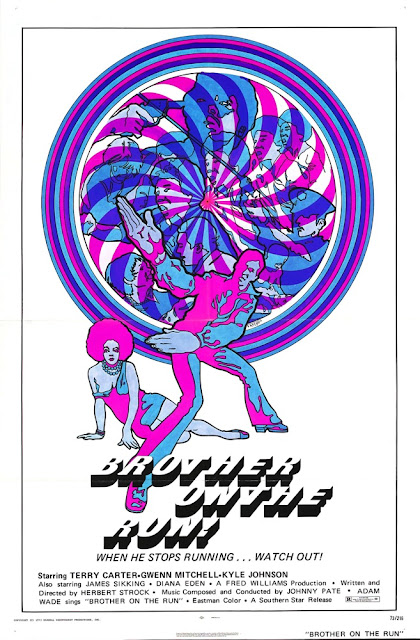
Brother on the Run (1973)


          Minor blaxploitation melodrama Brother on the Run doesn’t come anywhere close to fulfilling the promise of its fantastic title, and the reasons why begin with the premise. After an attempted robbery goes awry, leaving a shopkeeper dead, small-time crooks Billy (Kyle Johnson) and Frank (Gary Rist) become the targets of a police dragnet. For story reasons, it’s important to note that Billy is black. In scenes intercut with the robbery storyline, Brother on the Run sets up that college professor Grant (Terry Carter), who is also black, lives next door to a hooker named Maud (Gwenn Mitchell), with whom he’s casually acquainted. Maud is Billy’s older sister, so the fugitives try hiding at her place until the police come knocking. Grant gets hip to what’s going on, so he meets the crooks and becomes sympathetic to their plight. Then, once the manhunt resumes, Grant promises Maud that he’ll try to find Billy before the cops. All of this raises questions. Since Billy is guilty of at least being an accomplice, why does Grant get involved? Since Billy makes it clear at Maud’s place that he’s against surrendering to the cops, what is Grant’s plan once he tracks Billy down? And why does Grant stop in the middle of his search for Billy to service a horny white lady?
           One assumes the filmmakers neither thought these questions through nor expected theatergoers to do so—more likely, the goal was to generate cheap thrills by exploiting the provocative notion that any black suspect running from white cops has a target on his back. Several passable blaxploitation flicks arose from that same notion, so the failure of Brother on the Run to generate excitement seems attributable to behind-the-camera carelessness as well as shortfalls in production resources. Cowritten and codirected by veteran TV guys Edward J. Lasko and Herbert L. Strock, the movie feels choppy, rushed, and under-budgeted; characterizations are laughably thin, the storyline is riddled with dopey coincidences, and the movie’s attempts at sociopolitical messaging are pathetic. (If only the filmmakers had leaned into bizarro moments such as the bit during which Maud provides gentle BDSM fun for a cross-dressing client.)
          Offering marginal interest is the presence of actors better known for work they later did on the small screen. Playing the lead is Terry Carter, subsequently a regular on the original Battlestar Galactica series, and playing the main cop is James B. Sikking, who eventually found minor fame on Hill Street Blues. Even with a handful of watchable elements, however, Brother on the Run adds little to the blaxploitation experience.

Brother on the Run: FUNKY

Saturday, February 27, 2021

Deliver Us from Evil (1975)


          The last of three well-intentioned but hopelessly amateurish melodramas that writer/producer/director Horace Jackson made about the African-American experience, Deliver Us from Evil (later reissued as Joey) crams a hell of a lot of story into 96 minutes. Very broadly, the picture concerns the fateful intersection of a tormented man, a disabled child, a socially conscious grade-school recreation director, and a gang of drug-dealing thugs. There’s also a subplot about a young woman who appears in stage shows that dramatize troubles bedeviling her community, plus another subplot about a white cop struggling to understand systemic racism. Even a filmmaker of sublime storytelling ability would have difficulty balancing this many disparate elements. Jackson, despite his obvious desire to edify audiences, is not a filmmaker of sublime storytelling ability. Quite the opposite. Deliver Us from Evil sloppily connects badly constructed scenes, so not only is it difficult to track the narrative, it’s hard to take any single moment seriously because the writing, directing, and acting are substandard.

          After Chris (Renny Roker) is released from a mental institution, he encounters awful racists everywhere, so he’s understandably edgy. One day while driving, he spots a woman named Mindy (Marie O’Henry), who is stranded with car trouble, so he offers her a ride. Yet because Chris drives like a maniac, Mindy demands to leave his car. Upon doing so, she slaps Chris, so he chases her to a house where she visits wheelchair-bound Little Joe (Danny Martin), one of the students at the school where she works. Subsequently, Chris befriends Little Joe and starts dating a friend of Mindy’s. Meanwhile, a local street gang begins selling drugs at Mindy’s school, so she stands up to them, causing gang members beat Mindy and Little Joe. You get the idea. In trying to address a laundry list of social issues, Jackson creates an experience that’s confusing, grim, and preachy. (In one scene, Little Joe demonstrates his newfound ability to recite the Lord’s Prayer.)

          By the time Deliver Us from Evil climaxes with a nonsensical act of violence and a direct-to-camera speech about the futility of black-on-black violence, Jackson has fully succumbed to his worst inclinations, sacrificing narrative cohesion for ungainly rhetoric. It’s a pity, because while Jackson had many worthwhile things to say, he never found effective ways of saying them.


Deliver Us from Evil: FUNKY


Tuesday, March 13, 2018

Georgia, Georgia (1973)


          The celebrated writer Maya Angelou only penned two original screen stories in her lifetime, the script for this obscure theatrical feature and the teleplay for a 1982 TV movie called Sister, Sister. (Make what you will of the similar titles.) Georgia, Georgia is thoroughly discombobulated. In some scenes it’s an interracial romantic melodrama bordering on camp, complete with a subplot about a queeny manager romancing a hotel clerk who looks like a Swedish version of Dracula. In other scenes, Georgia, Georgia is a dead-serious meditation on issues related to the Vietnam War. And every so often, the picture leaves reality behind for impressionistic passages linking pretentious images with odd sonic counterpoints. Notwithstanding the presence of the same actors and characters from beginning to end, Georgia, Georgia seems like a collection of clips from several different movies.
          Georgia Martin (Diana Sands) is an American pop singer traveling through Sweden with her manager, Herbert (Roger Furman), and her caretaker, Mrs. Anderson (Minnie Gentry). News of Georgia’s arrival sparks interest among a community of American deserters, all of whom are black, because they hope to involve her in their cause, with the ultimate goal of persuading the Swedish government to grant political asylum. Meanwhile, Georgia participates in a photo shoot with Michael Winters (Dirk Benedict), an American living in Sweden. He’s white, so when Georgia begins to demonstrate romantic attraction to Michael, Mrs. Anderson becomes concerned. No interracial hanky-panky on her watch.
          It’s possible that some gifted director could have guided Angelou through revisions and thereby pulled the disparate elements of Georgia, Georgia together. Stig Björkman wasn’t the guy for the job. (In his defense, Björkman rarely makes films in English—which, of course, raises the question of why he was hired in the first place.) For long stretches, Georgia, Georgia is painfully dull because the character motivations are nonsensical and the onscreen actions are repetitive. Furthermore, many supporting actors give amateurish performances—and to note that Benedict is not in the same league as Sands is to greatly understate the situation. Then there’s the dialogue. Periodically, Angelou gets incisive, as when Mrs. Anderson says that Georgia “kinda kicked the habit” of embracing blackness. Yet for every line that works, a dozen don’t. For instance, Georgia exclaims, “I’m not gonna do anything but stay black and die!” That’s a good line for a character who hasn’t already been established as denying her African-American identity.
          It gets worse. During a love scene, Michael says to Georgia: “You taste like mystery.”
          At its most ridiculous, Georgia, Georgia gives both leading characters Bergman-esque contemplation scenes. In Georgia’s vignette, she wears a cape and walks by a lake at dusk while Sands recites poetry on the soundtrack. In Michael’s vignette, he stares into the mirror while raunchy burlesque music plays. However, these scenes aren’t nearly as bizarre as the ending, which won’t be spoiled here. Suffice to say that the finale elevates Georgia, Georgia from muddled to outrageous. For seekers into the cinematic unknown, this picture’s out-0f-nowhere ending makes the whole viewing experience worthwhile. Georgia, Georgia might be a mess, but when it matters, the movie isn’t timid.

Georgia, Georgia: FREAKY

Thursday, March 8, 2018

Bush Mama (1979)


          Context is everything. When it was released in 1979, indie drama Bush Mama was part of the “L.A. Rebellion” movement, which involved black filmmakers providing unvarnished glimpses at street life. Like the most celebrated example of this movement, Charles Burnett’s Killer of Sheep (which was completed in 1975 but not commercially screened until 2007), Haile Gerima’s Bush Mama explodes with cultural authenticity and sociopolitical anger, so its myriad flaws, ranging from grubby black-and-white photography to a meandering screenplay, matter less than the relevance of the material. In the context of the late ’70s, Bush Mama might have seemed revelatory. Seen today, it comes across as amateurish and repetitive, even though issues explored in the film are just as important as they were in 1979, if not more so.
          Set in an L.A. neighborhood plagued by crime and poverty, Bush Mama concerns Dorothy (Barbara O. Jones), a wife and mother struggling to get by. Her husband, T.C. (Johnny Weathers), is a Vietnam vet suffering from PTSD. Cops arrest T.C. on bogus charges, and he gets sent to prison. Then Dorothy must not only care for their child, but also decide what to do once she learns she’s pregnant again. Much of the film cuts back and forth between realistic scenes of Dorothy at home and stylized scenes of T.C. in prison. The Dorothy scenes feature clashes with social workers and encounters with friends who are similarly bedeviled by problems stemming from systemic racism. The T.C. scenes have a beat-poetry feel, with inmates delivering long speeches about oppression from behind bars. Taken together, these plot threads explain how and why Dorothy becomes radicalized, thereby articulating the underlying ethos of the L.A. Rebellion itself.
          Viewed as an artifact of vintage political art, Bush Mama is endlessly interesting because it juxtaposes humanistic and purely rhetorical elements. Viewed as proper cinema, Bush Mama much less impressive—though it must be noted that, like Killer of Sheep, this is essentially a student film. Gerima made Bush Mama while completing his MFA at UCLA circa 1975, four years before the movie gained a theatrical release. Perhaps that’s why some of the most effective moments in Bush Mama are the simplest. Whenever Gerima trains his camera on Jones quietly existing, the weight on her character’s shoulders painfully visible, he expresses as much truth as he does in long monologues.

Bush Mama: FUNKY

Friday, February 23, 2018

Quadroon (1971)


Unlike the notorious Mandingo (1975), this low-budget drama about slavery in the American South circa the 1830s represents a serious attempt at exploring intersections between personal and sociocultural dynamics. Alas, the good intentions are undercut by hideous acting—the performers in Quadroon seem like community-theater regulars giving cold readings. Accents come and go, dialogue is delivered stiffly, and emotional heat is restricted to scenes of outright passion and/or violence. Made properly, the same script could have resulted in something quasi-respectable. Instead, Quadroon is lifeless. Naïve Northerner Caleb (Tim Kincaid) arrives in New Orleans to stay with his Aunt Nancy (Marinda French) and her family. Caleb soon learns about quadroons, women born of white Creole fathers and black slave mistresses. These mixed-race ladies are raised to be elegant and polite—ideal mistresses for successive generations of Creole men. Predictably, Caleb meets and falls in love with a beautiful quadroon, Coral (Kathrine McKee), and he makes enemies with the most powerful Creole in town, Cesar Dupree (George Lupo). A battle for Coral’s body and soul ensues. The racial politics here are complicated and troubling, as during a scene in which the Creole villain commands slaves to gang-rape a woman who defies him. Nonetheless, Quadroon tells a sufficiently provocative story that for a few moments here and there it’s possible to look past the amateur-hour acting. As soon as reality inevitably reasserts itself, however, Quadroon loses its marginal appeal.

Quadroon: LAME

Wednesday, February 14, 2018

Cry for Me, Billy (1972)


          Many familiar ’70s-cinema textures converge in the bleak Western Cry for Me, Billy, which boasts a handful of riveting scenes but underwhelms overall. The film’s biggest problem is a predictable storyline, so director William A. Graham’s leisurely approach exacerbates inherent sluggishness. Additionally, leading man Cliff Potts, a workaday actor in films and television from the late ’60s to the late ’90s (notwithstanding minor recent appearances), wasn’t up to the task of carrying a movie. Oh, and it should also be noted that despite his prominent billing, the great Harry Dean Stanton only appears in about 10 minutes of the movie, mostly in the beginning and then again toward the end.
          Gun-toting drifter Billy (Potts) wanders into a tiny town, where he observes several Cavalry soldiers withholding water from a group of thirsty Indian prisoners. Incensed, Billy gives water to the prisoners, but later, when several prisoners escape, Billy watches helplessly while the soldiers kill the remaining Indians. Then Billy leaves town and encounters Little Sparrow (Maria Yolanda Aguayo), one of the escapees. She’s a beautiful young woman who for some reason is completely nude until Billy gives her a blanket. Despite a language barrier (the only word she ever speaks in the movie is Billy’s name), the two fall in love. Then, of course, the soldiers return to spoil their idyll, and bloodshed ensues.
          Given the trite narrative, Cry for Me, Billy should be interminable, but several elements redeem the movie. Markson’s dialogue is excellent, and he does a terrific job sketching the minor characters whom Billy and Little Sparrow encounter. Better still, the cinematography by Jorden Cronenweth is gorgeous; in scene after scene, Cronenweth finds clever ways to put the sun behind actors, creating beautiful pictorial depth. Also priaseworthy are brief but effective turns by Stanton, James Gammon, Don Wilbanks, and others. Alas, the main story, though presented with great care, underwhelms until the grim final act. FYI, Aguayo, who later married her costar Potts, was originally billed as “Xochitl,” an Aztec word for “flower,” hence some online sources giving that word as the name of her character. The alias represented a failed attempt to give her screen debut a bit of intrigue.

Cry for Me, Billy: FUNKY

Sunday, February 11, 2018

Joe Panther (1976)


          Telling the story of a modern-day Seminole Indian youth torn between the limitations of life in his impoverished village and the potential moral compromises of pursuing opportunities in the outside world, Joe Panther is clumsily effective. The story is eventful, the protagonist’s journey is meaningful, and the themes of assimilation and identity create believable points of conflict. Made with more sophistication, Joe Panther might have earned a place among the best coming-of-age stories from the ’70s. Unfortunately, the film falls short of contemporary standards for racial sensitivity thanks to any-minority-will-suffice casting, and that’s but one of many flaws. Nonetheless, Joe Panther is commendable for a few moments of genuine emotion as well as at least one scene of thrilling action.
          Living in a close-knit but financially troubled Seminole village near Miami, fatherless Joe Panther (Ray Tracey) worries about how to provide for his mother and his younger brother. Joe isn’t thrilled by his prospects in the village, and it galls Joe to watch his best friend, Billy Tiger (A Martinez), put on alligator-wrestling exhibitions for tourists. When Joe hears about a job on a fishing boat owned by kindly Captain Harper (Brian Keith), Joe accepts a wild challenge as a condition of employment—he must venture into the Everglades and capture an 11-foot gator that Harper’s brother can use as a tourist attraction at his resort. The mission becomes Joe’s trial by fire, especially when his wise Uncle Turtle (Ricardo Montalban) offers ominous warnings about the dangers of the Everglades.
          Casting Latin actors in prominent Seminole roles is distracting, and the thriller subplot that dominates the last third of the movie is a bit much. Yet parts of Joe Panther have real grit. The sequence of Joe trapping a giant alligator is frightening, and the bond that Martinez and Tracey convey is persuasive. So even if the movie often edges into drab formulas, as when both Keith and Montalban give monologues about the meaning of life, the picture’s intentions seem pure. Everything right and wrong about Joe Panther is epitomized by the gentle theme song, which is performed by soft-rock hitmakers England Dan & John Ford Coley—the message is there, but the choice of messengers is highly questionable.

Joe Panther: FUNKY

Saturday, September 9, 2017

Apache Blood (1975)


Nearly unwatchable because of narrative incoherence, this low-budget Western depicts the exploits of an Apache warrior seeking vengeance against deceitful and murderous U.S. soldiers. It also tracks the ordeal of a soldier left behind in the wilderness after a bear attack. If that second bit reminds you of Man in the Wilderness (1971) or The Revenant (2015), most likely that’s not a coincidence; the makers of Apache Blood probably encountered the same historical records that inspired the other films. Any tangential connection to real history, however, should not give the impression that Apache Blood—also known as Pursuit—is worth watching. While there may have been a passable action-adventure film somewhere in the raw footage, the assembled movie is a mess. Scenes start and stop abruptly, transitions don’t exist, and some of the production values, especially during the bear-attack scene, are laughable. Worse, the one thing that should give Apache Blood artistic merit, the choice to exclude dialogue from most scenes, helps render the picture incomprehensible. Who are the people onscreen? What are they doing? Why are they doing it? Don’t get your hopes up about answering any of those questions, because even detecting the broad outlines of the story is challenging. Every so often, a scene makes sense for a few moments, as when the protagonist, “Yellow Shirt” (Ray Danton), sneaks up on a military encampment because a guard has fallen asleep—but then the flick devolves into awkwardly filmed action and the viewer’s sense of narrative direction disappears. Oh, and just for good measure, the film is littered with clichés, as in the scene of a U.S. soldier buried up to his head in desert sand while Native Americans charge at him on horseback. Presuming the picture’s overall goal was to counter the demeaning image of Indians as savages, trite scenes like that aren’t helpful.

Apache Blood: LAME

Saturday, August 26, 2017

Gentle Savage (1973)


          Basically a riff on Billy Jack (1971) without the hippy-dippy speechifying and pretentions to political significance, Gentle Savage stars B-movie muscleman William Smith as “Camper” John Allen, an impoverished Native American who stumbles into a hassle with racist white people. Cheaply made and tonally inconsistent, the picture is little more than a brisk drive-in distraction, and the angsty leading role of pushes Smith’s limited acting abilities past their limits. What’s more, cowriter/director Sean MacGregor demonstrates only borderline competence, so the characterizations are stereotypical, the escalation of violence is predictable, and the oh-the-humanity pathos permeating the piece is trite. Yet taken for what it is, Gentle Savage (sometimes marketed as Camper John, hence the above poster) more or less gets the mindless job done. Naturally, those predisposed toward grooving on Smith’s singular screen persona, all growling primitivism and sinewy intensity, will get more out of the experience than others—even though his big crying scene is dodgy, Smith is interesting to watch whenever he expresses simplistic moods of anger, lust, and rebellion.
          John’s trouble begins one night at a dive bar, where hot-to-trot white girl Betsy Schaeffer (C.J. Hincks) propositions him. Initially refusing her advances, since he’s got a wife and kid at home, John unwisely accepts her offer of cash in exchange for a ride home on his motorcycle. Upon reaching her place, Betsy yanks John into bed, but then Betsy’s racist father, Kent (Kevin Hagen), arrives in time to swear vengeance against the escaping John. Later, Kent rapes his daughter and blames the crime on John, setting up a fugitive situation that enflames simmering racial tensions. Most of what follows is straightforward, excepting perhaps the “comedy” bits during which two white cops are stranded in the desert wearing nothing but underwear. Still, Gentle Savage hits the required notes of civil unrest, horrific violence, and martyrdom. Those seeking a race-relations drama with depth and relevance will be disappointed, but those seeking a straight shot of action-infused melodrama might find the picture adequate.

Gentle Savage: FUNKY

Friday, June 9, 2017

Malcolm X (1972)


          By translating The Autobiography of Malcolm X into a visual document, filmmaker Arnold Perl performed a useful historical service, condensing and contextualizing the turbulent life that transformed troubled orphan Malcolm Little into black-power activist Malcolm X and religious messenger el-Hajj Malik el-Shabazz. Within a tight 91-minute running time, Perl covers many of the important periods in his subject’s life, tracking Malcolm through a rough childhood and adolescence marked by abandonment and crime; a long period serving as an articulate emissary for controversial Nation of Islam leader Elijah Muhammad; an incendiary stretch preaching racial revolution and vilifying the “white devil”; and finally the crucially important final period when, after making a pilgrimage to Mecca, he sought to reconcile his supercharged political rhetoric with the peaceful teachings of his religion.
          Framing the whole story, of course, is the grim reality that Malcolm was assassinated, so instead of being a hagiographic tribute to a mythic figure, Malcolm X represents a passionate delivery of the man’s message. Perl’s portrayal embraces all of the changes and contradictions that made Malcolm intriguing, and this portrayal underscores that Malcolm possessed one of the most agile minds in the history of American political life.
          The film opens on a somewhat heavy-handed note, with Billie Holiday’s song “Strange Fruit” (the lyrics of which describe the aftermath of a lynching) playing over a black screen. The opening salvo continues with Malcolm’s famous “by any means necessary” remark, as well as an epithet-filled spoken-word piece by the Last Poets that, prophetically, sounds a lot like rap. Once Perl gets into proper storytelling, he juxtaposes short excerpts from The Autobiography of Malcolm X (as recited in voiceover by James Earl Jones) with a voluminous amount of archival footage. Sometimes, Perl illustrates points with newsreel shots of, say, civil unrest, but mostly he puts Malcolm onscreen.
          Appearing in public and on TV, Malcolm communicates with supreme eloquence and power, whether he’s expressing deference to Elijah Muhammed, disdain for whites, or a sophisticated synthesis of his past belief systems. As in real life, the Malcolm at the end of the story is the truly dangerous man, not because of his ability to drive people apart—anyone can do that—but because of his ability to bring people together. While stopping short of lodging a formal accusation, the film advances the prevailing theory that the Nation of Islam was responsible for Malcolm’s death. The notion that a black revolutionary might have died at black hands reaffirms the eternal truth that anyone with real power to alter the status quo exercises that power at his or her own peril.
          Prior to the release of Spike Lee’s epic biopic Malcolm X (1992), this documentary likely represented the fairest and fullest screen portrayal of its subject, and the existence of Lee’s movie has done nothing to diminish the documentary’s significance. Indeed, Warner Bros. (which released both projects) has on occasion packaged the movies together for home-video consumption. The films complement each other well, with Lee’s picture offering a personal view of a heroic figure and Perl’s documentary letting Malcolm speak his own truth. Accolades received by the 1972 Malcolm X during its original run include an Oscar nomination for Best Documentary Feature.

Malcolm X: GROOVY

Tuesday, February 21, 2017

Black and White in Color (1976)


          Viewed from either a political or a technical perspective, Black and White in Color­­—a coproduction from France and the Ivory Coast that won its year’s Oscar for Best Foreign Film—is highly impressive. The directorial debut of Jean-Jacques Annaud, Black and White in Color is a slick production with flawless costuming, photography, and production design, transporting viewers to West Africa circa 1915. Scenes inside dusty villages and military encampments are just as visually persuasive as scenes taking place on battlefields that sprawl from unforgiving plains to verdant jungles. Politically, the picture is just as strong, delivering a simple antiwar message by way of a quasi-farcical storyline about imperialist Europeans drawing unsuspecting Africans into pointless armed conflict. Yet there’s sometimes a gulf between ambitions and results. For all of its high-minded goals, Black and White in Color has significant shortcomings, worst of which is a tendency toward shallow characterizations. Annaud and his collaborators stuff the film with so many characters that none can be developed fully, so it’s hard to feel much emotional connection with the people onscreen, beyond normal sympathy for individuals mired in tragic circumstances. Given this weakness, Black and White in Color works better as a statement than as a story.
          The gist of the piece is that two European forts are situated in close proximity to each other, one occupied by French colonists and one occupied by Germans colonists. When French geologist Hubert Fresnoy (Jacques Spiesser) receives a care package containing months-old newspapers, he and his Gallic colleagues learn their country is at war with Germany. Despite the fact that the conflagration has been underway for some time with no impact on their lives, some of the Frenchmen experience a surge of nationalism and resolve to attack the German fort. They recruit natives as soldiers, offering household trinkets as payment. Tragedy, predictably, ensues.
          While some of the satirical moments in Black and White in Color are relatively subtle, too many are obvious. In one scene, for instance, a French priest rides in a chair carried by several natives, who sing in their own language about Europeans striking them as obese and odiferous. Oblivious to the meaning of the lyrics, the priest declares, “Oh, how I love this song!” Annaud films everything beautifully, whether he’s using long lenses to capture documentary-style details during crowd scenes or staging a trench-warfare scene in a rainy jungle ravine to amplify the physical discomforts of combat situations. He also gets a few scenes just right, notably the long sequence of a Frenchman leading a group over a tiny stream and pretending it’s the Rhine. Of such delusions horrific jingoistic arrogance is born. Nonetheless, Black and White in Color grows repetitive soon after the “declaration of war,” and it was a miscalculation to avoid making any of the Africans major characters. Annaud conveys considerable anthropological curiosity with his shots of natives going about everyday activities, but he inadvertently relegates Africans to the status of second-class citizens, which is one of the very things he skewers his European characters for doing.

Black and White in Color: FUNKY

Monday, February 20, 2017

Fight for Your Life (1977)


          According to William Lustig, CEO of cult-movie distributor Blue Underground, the original negative for the racially charged exploitation flick Fight for Your Life fell victim to Hurricane Sandy while being stored in New Jersey, Seeing as how the movie depicts a vile racist terrorizing a black pastor, it’s tempting to wonder if the destruction of the print wasn’t so much an accident as a deliberate act of God. After all, Fight for Your Life contains so much cruel ignorance and senseless violence that one can imagine a vengeful deity smiting the negative. In any event, the picture survives in digital form, so anyone who wants to spend 80-siomething minutes watching a demented redneck and his accomplices gang-rape the pastor’s daughter, kill various innocent bystanders, and psychologically torture the clergyman can do so at their leisure. Fight for Your Life is relatively well made for a film of its type, and the movie benefits from vigorous performances. The picture is also of mild interest for genre-cinema fans because it contains one of William Sanderson’s few starring roles. Known for his work in movies (Blade Runner), dramatic television (Deadwood), and sitcoms (Newhart), he’s among the industry’s most versatile players, so he’s long since made artistic amends for appearing in this, his first big-screen project. Plus, truth be told, he’s pretty good in Fight for Your Life, in the sense that he’s utterly repugnant in every scene. Rarely will you be more eager for a character to die.
          The flick begins with Jessie Lee Kane (Sanderson) and two accomplices escaping from a prison-transport vehicle. Hewing to the familiar Desperate Hours formula, the filmmakers place an unlikely refuge in Jessie Lee’s path, because he stumbles across the home of African-American minister Ted Turner (Robert Judd). Jessie Lee and his thugs kill people who approach the house and torment those inside, beating the minister and committing the aforementioned sexual assault. The Turners grow more defiant as the hours drag on, so at one point Ted’s wheelchair-bound grandmother unloads on the gun-toting Jessie Lee: “I’ll tell you something, Mr. Poor White Trash—you ain’t nothing but what you got in your hand! Your pappy shoulda thought of that before he stuck it in your mammy!” Given the predictable plot, it’s only a matter of time before the Turners get the better of their attackers. Meanwhile, police officers chasing the fugitives piece clues together—will they arrive in time to rescue the Turners, or to prevent the Turners from exacting revenge? In lieu of imaginative plotting, Fight for Your Life has a passable degree of suspense and a nauseating amount of hatred. Not only does Jessie Lee constantly spew the n-word, but he bombards his hostages with every other emotional, physical, and verbal humiliation he can imagine.

Fight for Your Life: FUNKY

Wednesday, February 15, 2017

Black Starlet (1974)


          Telling the familiar story of a young woman degraded by the humiliating compromises she makes while pursuing Hollywood stardom, Black Starlet should be a disposable exploitation flick. The budget is low, the cast is unimpressive, and the exploitation quotient is high enough to become bothersome, with gratuitous nudity periodically distracting from the story. Yet Black Starlet meets and nearly exceeds the very low expectations set by its subject matter and title. Star Juanita Brown, who acted in a handful of ’70s drive-in flicks, grows into her role, becoming stronger as her character falls from hopefulness to cynicism. While certainly not a skillful performance, her work is committed enough to put the movie across. Similarly, director Chris Munger and his collaborators put sincere effort into making clichéd characters and scenes feel fresh. Everything in Black Starlet is rote on the conceptual level, from the sleazy agents and producers to the horrific scenes of men demanding sexual favors in exchange for career opportunities, but the way Munger lingers inside scenes—rather than speeding through them—allows a sense of unease to take root.
          Waking up one day next to a man she clearly regrets sleeping with, Clara (Brown) steps to a window and looks out at Los Angeles, then flashes back to events that led to her current situation. In her old life, despite having taken years of acting classes, she was a millworker going through a dull routine with a loser boyfriend prone to bar brawls. After one too many humiliating Saturday nights, she left him and made her way to Hollywood, where she got a job in a dry-cleaning shop while hustling for acting work. Enter Brisco (Eric Mason), a scumbag agent willing to trade his services for sex. He got Clara’s career started, but he also spread the word she was willing to oblige, leading her into the beds of one bottom-feeding producer after another. Ignoring good advice from the few kind souls she encountered in Los Angeles, including business manager Ben (Rockne Tarkington), Clara became “Carla,” a drugged-out, self-loathing, tempestuous diva.
          What makes Black Starlet more or less palatable are the moments wedged between exploitation-flick extremes. An early scene features Clara waiting on a street corner for a bus. After several men stop their cars to solicit her, presuming a black woman alone on the street must be a hooker, a motorcycle cop threatens to arrest her, so Clara jumps into the next man’s car just to get away from the cop. That man steals all of Clara’s money. Lesson learned. Later, in the dry-cleaning shop, Clara endures hectoring from her boss, Sam (Al Lewis), a cigar-chomping putz who refers to all his customers as “slobs” and obsessively yells: “Don’t press above the crotch!” Individually, each of these scenes is serviceable, but cumulatively, they give the vapid storyline a foundation in human reality.

Black Starlet: FUNKY

Wednesday, February 1, 2017

The Autobiography of Miss Jane Pittman (1974)


          Three years before the miniseries Roots (1977) became an unexpected ratings blockbuster and opened many Americans’ eyes to the breadth of suffering that Africans and their U.S.-born children endured during a century of American slavery, The Autobiography of Miss Jane Pittman explored similar subject matter and earned a reputation as one of the best TV movies ever made. (Accolades showered upon the film included nine Emmy awards.) Based on a novel by Ernest J. Gaines, The Autobiography of Miss Jane Pittman is purely fictional, depicting a 110-year-old woman as she recalls her life from the Civil War in the 1860s to the Civil Rights era in the 1960s. Gaines’ clever structure, which involves a journalist asking Miss Jane Pittman for her memories, allows the film to present vignettes that illustrate myriad forms of abuse, oppression, and prejudice. Through each harrowing episode, themes of dignity and perseverance dominate, so the movie offers both an indictment of racist social structures and a tribute to the people who survived life within those structures.
          At the beginning of the picture, Jane (Cicely Tyson) is physically frail but mentally sharp, so she’s able to oblige a request from New York reporter Quentin Lerner (Michael Murphy) for a description of her life. Most of the film unfolds in flashbacks, with Valerie Odell playing the title character as a child in a few scenes and Tyson handling most of the performance. Some of the experiences that Jane describes are historic, as when a plantation owner grants young Jane her freedom, and some are horrific, as when racist vigilantes attack a group of ex-slaves, leaving Jane to fend for herself in unfriendly territory. Each time Jane finds joy, tragedy follows. Her happy marriage to Joe Pittman (Rod Perry) ends prematurely, and her guardianship of an orphan named Ned (played by three different actors) takes a dark turn. Jane recalls the tribulations of Reconstruction, during which northern carpetbaggers plundered the demolished American south, and she describes how working as a sharecropper following emancipation was simply another form of slavery. Yet the filmmakers never take the easy path of suggesting that Jane was some pivotal historical figure--excepting her incredible strength of character, she is an everywoman representing the African-American experience. Only at the very end of the story do the filmmakers gift Jane with “importance,” thanks to a climactic scene that encapsulates Jane’s mode of quiet defiance.
          Finding fault with The Autobiography of Miss Jane Pittman is not an impossible task, but only the most hard-hearted would try. The film’s politics are humane, and the story’s engagement with history is meaningful and unflinching. If no one real person actually had all of Jane’s experiences, so what? The stories of thousands who lived through the nightmare of slavery and its aftermath remain untold, so this fictional character speaks for them. Tyson does fine work, even when slathered in award-winning old-age makeup created by Dick Smith and Stan Winston. She plays every scene with emotion and sincerity, resisting many opportunities for cheap sentimentality and instead sketching a portrait infused with pride and resilience. The supporting cast is fine, the script by Tracy Keenan Wynn is efficient, and the direction by John Korty is unobtrusive, but the experience of The Autobiography of Miss Jane Pittman is all about watching Tyson channel decades of suffering through a prism of embattled self-respect.

The Autobiography of Miss Jane Pittman: RIGHT ON