Thursday, June 23, 2011

Brother Sun, Sister Moon (1972)


          Contextualizing the strange religious epic Brother Sun, Sister Moon requires a close look at the timing of its release. Arriving well over a decade after the boom in big-screen Bible pictures ended, the film has no relation whatsoever to the stodgy spectaculars of the Chuck Heston era. Instead, Franco Zeffirelli’s lush movie is completely of its early-’70s moment, because it’s an unabashed celebration of hippie idealism. Depicting formative events in the life of the man who became St. Francis of Assisi, the film tracks young wastrel Francesco (Graham Faulkner), the son of a wealthy merchant in 13th-century Italy.
          Returning from war traumatized, Francesco slowly discovers a divine connection with the natural world, then experiences a full religious epiphany. He gives away all of his possessions to become a beggar living in communion with flora and fauna, then rebuilds an abandoned church and forms a community of like-minded monks, all of whom shun the material world for the spiritual realm. When Francesco’s popularity invokes the violent ire of local leaders, the humble monk treks to Rome for an audience with Pope Innocent III (Alec Guiness), seeking guidance or punishment, whichever the pontiff deems necessary.
          Zeffirelli unfurls this deceptively simple story across 135 leisurely minutes, and there’s an organic logic to his approach—like his main character, the director stops to smell the roses at every juncture. Brother Sun, Sister Moon is a rapturously beautiful movie in terms of visuals, with one painterly widescreen shot of a gorgeous outdoor location after another. The costumes are ornate to the point of being art objects, and even the romantic leads of the film are so beautiful that their physiques are like graceful sculptures. As if these flourishes didn’t sufficiently underline the parallels Zeffirelli wants to draw between St. Francis’ back-to-nature spiritualism and the dreams of the flower-power generation, the director enlisted Scottish minstrel Donovan (Mr. “Mellow Yellow” himself) to infuse the picture with a series of twee story songs commenting on the action.
          Donovan’s tunes are crucial not only to the narrative (since much of Francesco’s journey is internal), but also to the enveloping counterculture vibe of the movie; listening to Donovan trill fruity lyrics about “jubilant joy” and other altered states illuminates the film’s design and themes. Brother Sun, Sister Moon has a handful of straightforward dramatic scenes, like those between Francesco and his incurably materialistic father, but much of the movie comprises airy montages of beautiful young Faulkner flitting about in wheat fields and other picturesque locations while Donovan sings on the soundtrack.
          So even though the story eventually comes to a head in the moving scene between Francesco and the pope, during which Guiness effectively portrays his character’s massive but fleeting psychological change, there’s no question that Brother Sun, Sister Moon is so precious and slight that it frequently threatens to evaporate. Still, one can’t argue with the film’s humanistic intentions, and the beauty of Zeffirelli’s images is similarly irrefutable. Brother Sun, Sister Moon may not be the transformative experience the director presumably envisioned, but it’s passionate and unique.

Brother Sun, Sister Moon: GROOVY

Wednesday, June 22, 2011

Overlord (1975)


          A quasi-experimental film offering an expressionistic view of the World War II experience, Overlord was assembled by director Stuart Cooper from a combination of original dramatic scenes and vintage documentary footage; the nonfiction material was created in the 1940s for British training films, with many scenes photographed during the actual D-Day invasion. (The operation centered around the Normandy landing was code-named “Overlord,” hence the film’s title.) Hushed and ruminative, the picture follows the emotional journey of a young Englishman, Tom (Brian Stirner), as he prepares for military service. Flashing backward and forward with dreamlike abandon, and often settling into long montages assembled from documentary footage, Overlord unfolds with the scattershot rhythms of discombobulated thought, which suits the material but challenges the viewer in more ways than one.
          On a superficial level, many stretches of Overlord are quite dull, since nothing in particular happens onscreen; although every moment in the picture contributes to the overall mood, the dramatic scenes are frequently perfunctory, and the montages linger too long, as if Cooper can’t bear to cut from compelling reality to contrived fiction. On a deeper level, however, the picture is tricky to watch because it’s so unrelentingly grim and opaque. Even when Tom and his fellow soldiers aren’t articulating their fears about the war, which they do often, Cooper stages scenes with oppressive soberness and stylization. In one vivid sequence, for instance, a love scene between Tom and a pretty paramour is presented as if she’s a mortician preparing his body for burial, not a lover undressing him for intimacy.
          Whether all of these affectations work is of course a judgment call for each viewer, but there’s a reason Overlord failed to find U.S. distribution when it was first released, despite having won two prizes at the 1975 Berlin International Film Festival. The picture is cold and quiet, though occasionally very beautiful, and it often gets lost in its own lyricism. As a result, it’s slow going even with a brisk 83-minute running time. Recalling nothing so much as a student film, given the intentionally grainy black-and-white photography and the parade of unfamiliar actors, Overlord is pure cinema art rather than commercial entertainment. To Cooper’s credit, that important distinction gives the movie inherent value, though it’s hard to say whether the film actually accomplishes its goals since it’s unclear whether Cooper was going for a pure mood piece or something with more concrete emotional impact.

Overlord: FUNKY

Tuesday, June 21, 2011

Snapshot (1979)


A strange stalker picture from the land Down Under, Snapshot stars Aussie starlet Sigrid Thornton as Angela, a hairdresser whose transition into modeling has disastrous results. Directed by Simon Wincer, a veteran of Australian television who later scored with the miniseries Lonesome Dove (1989) and the family favorite Free Willy (1993), Snapshot feels like several different movies jammed into one package. The thriller material, which is supposed to be the film’s main focus, is the least effective: With Aussie composer Brian May contributing awful disco-era backing music, Thornton runs around looking frightened while assorted weirdos chase after her and leave sick mementoes like dead animals and shredded clothing. All very standard stuff, and not done particularly well. Of greater interest (comparatively speaking) is the character material delving into the psyches of Angela and the people in her world. Thornton, who has an endearingly wounded quality in Snapshot, enjoys strong moments interacting with her character’s bitchy best friend, needy ex-boyfriend and overbearing mother, so she somewhat effectively conveys a young woman trying to form her own identify. Unfortunately, this interesting-ish stuff gets smothered in silliness, from the expected (the stalking scenes) to the unexpected (several visits to a discotheque at which a queeny drag performer sings bizarre songs). The movie also features what may be the most excessive repetition of a nude shot in movie history; a topless photo of Angela taken for an advertisement becomes a major plot point, so it’s shown literally hundreds of times, particularly during a scene in which a room is entirely papered with reproductions of the image. Despite offering such lurid extremes and fleeting moments of surprising credibility, Snapshot is such a jumble that it’s a chore to endure.

Snapshot: LAME

Monday, June 20, 2011

Little Big Man (1970)


          The kind of cinematic oddity that could only have been made on this lavish a scale during the New Hollywood era, Arthur Penn’s revisionist Western Little Big Man is as entertaining as it is completely bizarre. Based on a novel by Thomas Berger, the film tells the story of 121-year-old Jack Crabb (Dustin Hoffman), who claims to be the only white survivor of the Little Big Horn massacre that claimed the life of notorious Indian fighter Gen. George Custer. As the ancient Crabb relates his story to a doubting interviewer (William Hickey), the picture flashes back to Crabb’s childhood and then presents wild episodes from his life leading up to the slaughter at Little Big Horn. Along the way, Crabb spends time personifying virtually every archetype of the Old West, from gunfighter to snake-oil salesman to town drunk. Most of Crabb’s recollections detail his upbringing by Cheyenne Indians—after his parents were killed during a Pawnee raid, young Crabb was adopted by a Cheyenne elder named Old Lodge Skins (Chief Dan George).
          Crabb’s story is outrageous, and part of the charm of Little Big Man is that it doesn’t matter whether you buy into the myth or even the possibility of the myth—the point is reconsidering Old West iconography from the fresh perspective of the Plains Indians, rather than the usual viewpoint of the “civilized” whites who systematically eradicated those Indians.
          Hoffman’s casting is pure genius, not only because he gives such a funny and humane performance, but also because the sight of him slathered in war paint is so incongruous; the juxtaposition that Hoffman creates in every single frame underscores the film’s mischievous intentions. And even if Jack is ultimately somewhat of a cipher—the blank screen onto which the film’s political agenda is projected—other major characters are presented so clearly and cleverly that a full emotional experience emerges.
          Several Native American actors lend authenticity to featured roles, with Robert Little Star adding absurd humor as a flamingly gay Indian, and Ruben Moreno lending intensity as Crabb’s main rival in the Cheyenne community. Chief Dan George’s deadpan line deliveries are perfect for the vivid character of Old Lodge Skins, a man utterly at peace with his understanding of the universe (“I’ve never been invisible before!”); George was nominated for a Best Supporting Actor Oscar. Faye Dunaway, at her most beautiful, gives a nuanced performance by playing a woman in her prime and, later in the story, gone to seed; she appears as the wife of a religious nut who takes in an adolescent Crabb after he’s separated from the Cheyenne. Jeff Corey is sly as a twitchy but endearing Wild Bill Hickock, and Martin Balsam lends campy amusement as Mr. Merriweather, Crabb’s unlucky mentor in the snake-oil business.
          Best of all is Richard Mulligan as Custer—he plays the general as a megalomaniacal loon given to pronouncements like, “Are you suggesting the reversal of a Custer decision?” Since Mulligan has to, in essence, personify the theme of white hubris, it’s impressive that he delivers such an individualistic performance while playing a symbol. (At the time of the picture’s release, Little Big Man was seen as a veiled indictment of America’s involvement in Vietnam; the film’s thematic content is a bit more malleable when viewed with modern eyes.) Plus, even though Crabb is an intentionally chameleonic character, Hoffman is terrific in a wild range of settings. He’s sweet as a young man trying to find his way in a new world, ridiculous as a duded-up gunfighter called “The Soda Pop Kid,” and finally resolute once tragedy drives him to ensure that Custer meets an unhappy end.
         Little Big Man moves at an impressive pace throughout its 139 minutes, and it pulls off that special New Hollywood trick of blending wild tonal extremes into a weirdly coherent whole. Alternately harrowing and hilarious, its as unique as its protagonist.

Little Big Man: RIGHT ON

Sunday, June 19, 2011

Short Eyes (1977)


          The grim prison melodrama Short Eyes teems with authentic behavior and dialogue, and with good reason: Writer Miguel Piñero adapted the script from his own award-winning play, which was in turn extrapolated from a turbulent youth spent in and out of jail. Short Eyes depicts the tumult that arises in a men’s lockup when the prisoners discover a new inmate is a pedophile. As directed by Robert M. Young, a socially conscious filmmaker whose fictional work reflects his background in documentaries, Short Eyes is a gritty travelogue through the complex social dynamics formed by prisoners, and the picture is infused with gruesome textures. So even though the piece features passages of men bonding through pastimes like music and cockroach races, there’s no risk of glamorizing the prison experience.
          Quite to the contrary, Piñero and Young present a horrifying milieu in which danger is omnipresent, the exchange of sexual favors for protection is an everyday reality, and racial divisions are so regimented that there’s a table in the day room for the blacks, one for the Puerto Ricans, and one for the whites, who in this environment are the oppressed minority. There’s also a harshly enforced caste system, with pedophiles at the very bottom, meaning they’re fair game for abuse and violence.
          Piñero introduces several vivid characters, from the speechifying black revolutionary whose boasts eclipse his desire for real violence, to the hot-tempered Puerto Rican drug addict forever angling to make the prison’s youngest inmate his sexual plaything. At the center of the story is Juan (Jósé Pérez), a thoughtful con who adheres to the prison’s class divisions but uses diplomacy to defuse pointless conflicts. So when child-molester Clark Davis (Bruce Davison) arrives in the cellblock, Juan tries to understand Clark instead of leaping to judgment. In the picture’s most harrowing scene, Clark unloads his secret history, describing in excruciating detail how he finds his victims. Juan’s reaction to Clark’s purging is a complex mixture of anger, bewilderment, compassion, disgust, and rage, so it’s painful to watch prison’s hive-mind distill its collective response into a brutal form of vigilante justice.
          Although Short Eyes is undoubtedly amped up for dramatic effect, as seen in the prisoners’ tendencies toward revelatory encounter-group dialogue exchanges, the picture is fascinating and nauseating at the same time. The whole cast is strong, with Davison going deep into the abyss of his tortured character and Pérez providing a strong thread of anguished humanity. Future indie-cinema fave Luis Guzmán appears in a tiny role, and singers Freddie Fender and Curtis Mayfield (who also did the score) show up as inmates; each performs a tune in the day room.

Short Eyes: GROOVY

Saturday, June 18, 2011

Bobbie Jo and the Outlaw (1976)


Fleeting glimpses of a popular starlet in the altogether are the only quasi-redeeming values of Bobbie Jo and the Outlaw, a lovers-on-the-run picture so unremarkable that calling it pedestrian would disparage the myriad lovers-on-the-run pictures that are uninspired but at least tolerable. Directed by hack extraordinaire Mark L. Lester, who never let the quest for quality impede his brisk shooting schedules, the picture concerns a young drive-in waitress with dreams of becoming a country singer. For no discernible reason, Bobbie Jo abruptly quits her job and runs off with a customer who imagines himself a modern-day outlaw in the Billy the Kid mode (because, apparently, Bobbie Jo figures a crime spree will land her on the Opry stage). Playing the outlaw of the title is the charmless Marjoe Gortner, a minor ’70s figure who appeared in a series of awful movies before eventually drifting out of public view; nothing he does here defines his absence from the screen as a cinematic tragedy. With such a major vacuum at the center of the film and with Lester’s filmmaking characteristically shoddy, all eyes fall on the film’s leading lady, Lynda Carter. As always, the actress best known as TV’s Wonder Woman is an amiable presence, and as always, she’s an absolute knockout. So if ogling Carter for 88 minutes sounds like fun, dive in, and you’ll be rewarded with a few brisk peeks at her celebrated torso. If you actually want an interesting movie to accompany your eye candy, then, sadly, you’re out of luck. (Available as part of the MGM Limited Collection on Amazon.com)

Bobbie Jo and the Outlaw: SQUARE

Friday, June 17, 2011

Man from Atlantis (1977)


          The first of four telefilms that introduced the lead character of a subsequent (and short-lived) series bearing the same name, Man from Atlantis is a no-nonsense fantasy that neither oversells its ludicrous premise by trying for heavy drama nor undercuts the premise by opting for camp. Patrick Duffy, later of Dallas fame, plays Mark Harris, a mystery man who washes ashore and seems close to death until marine researcher Dr. Elizabeth Merrill (Belinda Montgomery) dunks him in the ocean, where the water revives him. Turns out Mark is an unprecedented man/fish hybrid with incredible underwater powers—he ended up on the beach after a knock on the noggin rendered him unconscious—so the stalwart Navy admiral (Art Lund) who oversees Elizabeth’s funding quickly recruits Mark for a mission. It seems a number of international submersibles have disappeared into a deep oceanic trench, so Mark agrees to investigate on behalf of his air-breathing benefactress.
          He dives into the trench and discovers that a brilliant madman, Mr. Schubert (Victor Buono), has captured the missing vessels, pillaged them for parts, and brainwashed the crew members, all in pursuit of a loopy master plan. In other words, the plot is standard comic-book fare, and as such it’s best not to investigate the particulars too closely. That said, Man from Atlantis has drive and focus, moving at an assured but unhurried pace and featuring such soft-spoken characters that it’s a refreshing change from the usual histrionics of fantasy television. It helps, a lot, that Oscar-winning composer Fred Karlin contributes an atmospheric score and that much of the picture takes place underwater, lending a sense of grandeur.
          Sure, there’s a lot of silliness onscreen, like the bit in which Mark races a dolphin across a pool before leaping out of the pool and grabbing a fish from the dolphin’s human trainer, and the miniature FX for submarine scenes aren’t exactly top-shelf. But the main character is inherently interesting—the last of his kind, and all that—and the script, by Mayo Simon, presents outrageous concepts in such a matter-of-fact fashion that it’s easy to relax and enjoy the ride. None of the actors does much to get excited about, excepting the always-enjoyable Buono, who eschews his usual flamboyance for a quieter kind of menace; but then again, the wooden performances suit the piece’s unvarnished approach. FYI, an enjoyable Man from Atlantis cast reunion took place in 2012, and remarks about that event appear here(Available at WarnerArchive.com)

Man from Atlantis: FUNKY

Thursday, June 16, 2011

Black Caesar (1973) & Hell Up in Harlem (1973)


          Some of the most entertaining blaxploitation flicks inserted predominantly African-American casts into classic Hollywood genres, resulting in exciting cross-cultural friction. Black Caesar is one such picture, because pulp auteur Larry Cohen’s quickie crime drama offers a downtown spin on the classic Warner Bros. gangster flick. Fred Williamson, the cocky ex-football player who became one of blaxploitation’s most charismatic stars, plays Tommy Gibbs, a Harlem kid with good reasons for questioning authority: When he was young, Tommy was beaten half to death by a corrupt cop, McKinney (Art Lund). So after completing a long stretch in juvie, Tommy gets right to work building his underworld résumé.
          He whacks a mobster who’s been targeted for assassination, then uses that credential to muscle his way into the closed shop of the New York mafia. The movie’s stereotypical greasy Italian types are wary of getting in business with a black man, and sure enough Tommy ruthlessly squeezes out his local godfather in order to become a big boss. Then Tommy nabs incriminating ledgers detailing years of bribes to city officials, thus ensuring police won’t touch his burgeoning operation. In the classic gangster-movie tradition, everything Tommy does to improve his stature puts him in greater danger, and he also runs into domestic trouble when his wife, Helen (Gloria Hendry), starts fooling around with his best friend, Joe (Philip Roye).
          Though everything that happens in Black Caesar is clichéd and predictable, the movie works because it’s so energetic. Cohen’s run-and-gun style creates gritty excitement, since it’s clear he “stole” most of his shots while onlookers tried to figure out what the hell was happening. Furthermore, Williamson has so much swagger that it’s easy to buy him climbing the gangland ladder, and the score by R&B legend James Brown is fantastic, featuring standout cuts like “The Boss” and “Down and Out in New York City.” The filmmaking isn’t pretty, but the style suits the material.
          The same, unfortunately, cannot be said for the rushed sequel, Hell Up in Harlem, which hit screens just 11 months after Black Caesar was released. Though Hell Up in Harlem has an interesting central idea—after Tommy’s estranged father helps his son out of the jam Tommy was in at the end of the first picture, Papa Gibbs gets delusions of grandeur and tries to squeeze Tommy out of his own operation—the storytelling is disjointed and repetitive. Filled with endless montages of people getting whacked in gory detail, the movie feels incomplete, as if huge swaths of important footage are missing, and sloppily dubbed off-screen dialogue is used (ineffectively) to bridge narrative gaps. Some of the murders are entertaining from a camp perspective, like the scene of Tommy impaling a gangster with a beach umbrella, but a lengthy subplot about Tommy’s children being taken away from their mother is confusing and grim. Kudos to Cohen for striking while the iron was hot, but in rushing to meet marketplace demand, he killed any appetite for future Tommy Gibbs adventures.

Black Caesar: FUNKY
Hell Up in Harlem: LAME

Wednesday, June 15, 2011

Doc Savage: The Man of Bronze (1975)


          Between the end of the campy TV series Batman in 1968 and the arrival of the reverent feature Superman in 1978, cinematic treatments of superheroes tended toward buffoonery. Doc Savage: The Man of Bronze is a prime example, because it’s a failed attempt to create an ironic live-action cartoon. Although an awful movie by any rational criteria, Doc Savage is so wall-to-wall kitschy—one doesn’t get the impression anyone involved with the project had illusions of creating art—that the picture offers a mix of intentional and unintentional amusement. The title character is an international adventurer who first appeared in pulp magazines in 1933, then expanded to comic books and radio (though his popularity waned in the late ’40s, he’s still kicking around thanks to sporadic revivals in various media). An unfailingly virtuous good guy who fights crime from his gadget-filled headquarters inside the Empire State Building, aided by a quintet of colorful sidekicks called the Fabulous Five, Doc is such a straight arrow he makes Superman seem edgy by comparison, and he’s not so much super-powered as super-realized: He’s a paragon of mental, moral, and physical perfection.
          In Doc Savage: The Man of Bronze, the character is presented with his original ’30s trappings intact while Doc and the Five trek to South America and investigate the murder of Doc’s father, a saintly missionary who uncovered a scheme to rob a Native tribe of its riches. The characterizations and plotting are painfully thin, the dialogue is cringe-worthy, and the production values seem intentionally artificial, as if brightly lit sets will sell the idea of a comic strip sprung to life. In the title role, Ron Ely is physically impressive—he played Tarzan in a ’60s TV series—though his performance style is closer to posing than acting. The rank-and-file character actors surrounding him are saddled with lame comic-relief bits that undercut any attempts to create credibility, and the film’s special effects are terrible, notably the animation for sequences of supernatural snakes floating through the air.
          What saves Doc Savage from being an unwatchable mess is an undercurrent of outright weirdness: One of the villains sleeps in an oversized crib and sucks his thumb; Doc’s slick logo is emblazoned on everything from his belt buckle to his private plane; and the film’s score comprises bombastic John Philips Sousa marches. Understandably, all of this Batman-style camp is a sore spot with hardcore Doc Savage fans—but even adherents must admit Doc Savage is such a silly property that the camp approach made sense. (After all, Doc’s verbose motto includes such easily parodied proclamations as, “Let me take what comes with a smile, without loss of courage.”) So whether this picture “honors” its source material or not, it has several audacious moments, like the ridiculous scene in which the various fighting styles used by Doc and an opponent are identified by onscreen text. (Available at WarnerArchive.com)

Doc Savage: The Man of Bronze: FUNKY

Tuesday, June 14, 2011

The Late Show (1977)


          After making his name by co-writing Bonnie and Clyde (1967) and other pictures, Robert Benton graduated to directing with the admirable Western Bad Company (1972), then tackled another beloved Hollywood genre with his sophomore effort. An homage to classic detective pictures, The Late Show proceeds from a decent premise: What happens when an old-school gumshoe right out of a ’40s private-eye flick gets thrown together with a hippie chick so peace-and-love ’70s that they barely speak the same language? Right from the beginning of the film, however, the premise is undercut by Benton’s undisciplined script, which wobbles between comedy, drama, and suspense; furthermore, logic takes a beating as characters make profoundly stupid decisions, survive impossible predicaments, and walk away from crime scenes as if nothing happened. And while it’s a given that engrossing mystery films can sometimes surmount nonsensical narratives (see 1946’s classic but incomprehensible The Big Sleep), The Late Show isn’t anywhere near entertaining enough to merit sorting through its unnecessarily convoluted plot.
          In addition to logic problems and tonal inconsistency, the movie is so slow-moving that it’s nearly interminable for viewers who don’t fall in love with the leading characters. On the plus side, Honeymooners icon Art Carney delivers a terrific leading performance as a crusty old private dick—his character is a tip of the fedora to the tough-but-decent investigators once played by Humphrey Bogart and the like. However, Carney’s costar, Lily Tomlin, comes across as an airheaded flibbertigibbet so preoccupied with “vibes” that it’s as if she’s transmitting from another dimension; she barely stops talking during her scenes, and nothing she says is remotely interesting. This makes the many Carney-Tomlin scenes forced and tiresome, whereas Carneys fleeting bits with comedy pro Bill Macy have a spark the rest of the picture lacks. As a result of its many flaws, The Late Show is a well-intentioned but dreary oddity that doesn’t come close to hitting the stylistic sweet spot.
          It should be noted, however, that the preceding represents a minority opinion; Benton received an Oscar nomination for his script, and Tomlin got a Golden Globe nod for her performance. The Late Show seems to have far more admirers than detractors, so if any of the above intrigues you, by all means, dig in and, as the saying goes, your experience may differ. For my part, I enjoy nearly everyone involved in The Late Show and was therefore surprised to find their combined efforts so thoroughly uninteresting—the disparate elements of the picture just didnt cohere for me.

The Late Show: LAME

Monday, June 13, 2011

Annie Hall (1977)


          Whether it’s viewed as the climax of Woody Allen’s early career as a self-deprecating comedian or the beginning of his later career as a serious filmmaker, Annie Hall is an extraordinary piece of work. Among many other things, Annie Hall is Allen’s first attempt at a Big Statement, simultaneously a deep exploration of one specific relationship and a microcosmic study of relationships in general. Furthermore, the picture contains two of the most vividly sketched characters in ’70s cinema, both of whom are fictionalized versions of the actors playing them: Annie Hall, the eccentric singer portrayed by Diane Keaton, and Alvy Singer, the neurotic comic portrayed by Allen.
          To the filmmaker’s great credit, neither character gets off easily, because both are depicted as fascinating people capable of infuriating behavior—and both are shown to be almost pathologically incapable of subverting their identities into the collective identity of a couple, despite being very much in love. (Allen had a lengthy real-life affair with Keaton, his costar in a string of beloved ’70s films.) Yet the bond between Alvy and Annie isn’t the film’s only romance; Annie Hall illustrates Allen’s devotion to the island of Manhattan by creating several hilarious fish-out-of-water scenes depicting Alvy gasping for air whenever he’s taken off the bedrock of New York City.
          The bits of Alvy disastrously trying to cook lobsters in a beach house and trying to drive in Los Angeles are tiny comic masterpieces, just as the interaction between Alvy and his sitcom-producer pal, Rob (Tony Roberts), articulates Allen’s contempt for the assembly-line approach to creating Hollywood pabulum. Some of the most vivid material in the picture involves Annie’s WASP family, particularly the unforgettably funny/creepy scenes of Annie’s brother, Duane (Christopher Walken), giving a speech about vehicular suicide—and then taking a terrified Alvy for a car ride.
          As the title suggests, however, the movie’s most memorable invention is Annie herself, a character so individualistic she inspired a fashion craze as women tried to mimic Keaton’s offbeat wardrobe of repurposed men’s clothing. Whether you find Annie appealing or irritating is a matter of taste, but it’s impossible not to appreciate moments like the scene in which Annie magically leaves her body during sex because she’s bored.
          Beyond Allen and Keaton, both of whom are at their very best, Annie Hall features a deep well of colorful actors in supporting roles, from featured performers Colleen Dewhurst, Shelley Duvall, Carol Kane, and Paul Simon (yes, the singer-songwriter) to bit player Sigourney Weaver, who makes her blink-and-you’ll-miss-it screen debut at the end of the picture. Yet perhaps the funniest mini-performance in the picture is given by author Marshall McLuhan, who appears in a quintessential Allen moment: As Alvy waits in line at a theater, listening to a windbag pontificate about McLuhan’s media theories, Alvy wishes he could set the guy straight, so he yanks the real McLuhan from behind a poster, upon which McLuhan says to the windbag, “You know nothing of my work.”
          It’s a given that Allen’s movies aren’t for everyone, but Annie Hall winningly sets his intellectualism, narcissism, and neuroticism into a palatable framework by dramatizing the perils of being opinionated about everything; in a very important way, Annie Hall is the Allen movie for people who don’t like Allen movies, since it depicts the inability of a character very much like Woody Allen to comfortably exist in everyday life.

Annie Hall: OUTTA SIGHT

Sunday, June 12, 2011

Let’s Scare Jessica to Death (1971)


A cult favorite not because of its excesses but because of its restraint, this eerie thriller is a great illustration of how much atmosphere resourceful filmmakers can generate even if they don’t have the budget for special effects. The story depicts a trio of hippies who take occupancy in a farmhouse somewhere in the Northeast, much to the chagrin of hostile locals. The hippies find a young woman squatting in the house and invite her to stay, soon realizing that she may be part of a supernatural cabal involving the unfriendly townies. What makes this interesting-ish is the mental state of the title character: Jessica (Zohra Lampert), one of the hippies, was just released from a mental institution because she’s plagued by hallucinations, so when creepy things start happening around the farmhouse and the town, her friends (and the audience) have good reason to wonder if the terrors are figments of her imagination. The devices that director John D. Hancock and his team use to create the picture’s disquieting tone aren’t especially subtle (unnatural music created on primitive electronic instruments, overlapping audio of the voices Jessica hears in her mind), but combined with Lampert’s strong performance, the devices get the job done nicely. A slight woman photographed to seem fragile and powerless, Lampert effectively uses flittering facial expressions and a distant smile to convey her character’s tentative grasp on reality. There’s a real feeling of menace from start to finish, and even if the payoff is less interesting than the buildup, Let’s Scare Jessica to Death is better than the average ’70s shocker simply because of its artistic approach to scare tactics. The open-to-interpretation finale closes the movie on an appropriately queasy note—so while Let’s Scare Jessica to Death may not really amount to much, it’s a creepy ride.

Let’s Scare Jessica to Death: FUNKY

Saturday, June 11, 2011

Breaker! Breaker! (1977)


Karate champion Chuck Norris took a baby step toward movie stardom by headlining this meagerly budgeted B-movie, which awkwardly meshes the martial arts, trucker, and vigilante genres. Given this slapdash approach and the movie’s crappy production values, it’s no surprise that Breaker! Breaker! has spent decades languishing in well-deserved obscurity. In fact, had Norris not subsequently achieved cinematic fame elsewhere, the picture probably would have fallen out of distribution entirely. Having said that, the movie has a promising hook—a redneck villain gets his backwater burg incorporated as a municipality called Texas City so he and his minions can use “official” traffic stops to rip off motorists and truckers. Norris plays a trucker whose little brother was last seen in Texas City, so he struts into town to find out the truth and, if necessary, issue swift-footed justice. There’s also a thread in the story about Norris calling in his brother truckers for help, resulting in a climactic scene of 18-wheelers literally mowing down the entire city. None of this hangs together well, so even though Breaker! Breaker! zips along (it’s barely 90 minutes), everything onscreen feels fake and meaningless. The fight scenes are absurd—Norris takes on what seems like the city’s entire male population at one point—and a crudely rendered subplot about a rural simpleton is especially pointless. Plus, while Norris fights impressively and exudes an easygoing likeability, he can’t act. The movie’s only interesting-ish performance is given by character actor George Murdock, as the city’s Shakespeare-spouting overlord, but his exertions are wasted because the movie as a whole is so forgettable.

Breaker! Breaker! LAME

Friday, June 10, 2011

The Medusa Touch (1978)


          One of the more unusual pictures to appear during the post-Exorcist boom in supernatural horror, The Medusa Touch is an imaginative thriller that quietly builds up a strong head of steam on its way to a genuinely frightening climax. Set in London, the movie begins when someone attacks British writer John Morlar (Richard Burton), leaving him in a coma; visiting French detective Brunel (Lino Ventura) is assigned to investigate. The case immediately seems out of the ordinary because even though Morlar should be dead after the beating he received, his brain activity reflects superhuman stamina. Deepening the intrigue, Brunel meets with Morlar’s psychiatrist, Doctor Zonfeld (Lee Remick), who reveals that Morlar believes himself capable of willing disasters to happen.
          In flashbacks depicting Morlar at different ages, we see him “cause” the deaths of his parents, his classmates at a boarding school, and many others who were unlucky enough to cross his path. As the story progresses, Brunel becomes more and more convinced that Morlar actually does possess otherworldly powers, and that Morlar is planning to cause his most horrific disaster yet because his brain still functions while his body is barely alive. Based on a novel by Peter Van Greenaway, The Medusa Touch is much more than just a creepshow—it’s also a provocative exploration of morality, asking the question of what responsible citizens must do if they become aware of a monster in their midst.
          The cadaverous appearance and contemptuous performance style that Burton possessed later in life suits The Medusa Touch well: Burton looks like a walking incarnation of death. By the end of the movie, just watching him is unnerving, especially when he locks into the deadly stare he uses when “willing” mayhem into being. Ventura, a stocky and weathered Frenchman, offers a terrific complement to Burton’s darkness; he seems vital and humane, though experienced enough to acknowledge the limits of his own understanding. Remick’s chilly beauty adds another interesting flavor to the mix.
          Elaborate pre-CGI special effects come into play toward the end of the picture, and the vaguely surreal quality of the effects accentuates the storyline’s enigmatic quality. So even though The Medusa Touch isn’t particularly subtle, the precision with which the narrative’s various threads are introduced and connected becomes steadily more impressive as the climax approaches, giving the last act real power. So, like all of the most effective movies about supernatural horror, The Medusa Touch is ridiculous when considered from a rational perspective, yet quite engrossing when taken at face value.

The Medusa Touch: GROOVY

Thursday, June 9, 2011

Play It As It Lays (1972)


          A pretentious mood piece about a movie star experiencing and recovering from a mental breakdown, this adaptation of Joan Didion’s acclaimed novel is like a high-art version of a Jacqueline Susann novel: The only difference between Susann’s trashy showbiz stories and Didion’s take on sleazy Hollywood is that Didion examines the milieu from a sophisticated psychological perspective.
          Tuesday Weld, one of the fiercest actresses to ever grace the screen, tries valiantly to sculpt a complete character from the discombobulated narrative shards of an unnecessarily arty script by Didion and her husband, novelist John Gregory Dunne, but Weld is held back by the ponderous direction of art-house mainstay Frank Perry (The Swimmer). Similarly, a poignant performance by costar Anthony Perkins is squandered because the film is so preoccupied with European-style abstract editing and overt symbolism that it forgets to simply tell a story.
          Buried amid the auteur-ish muck is a standard-issue Hollywood tragedy about fragile actress Maria (Weld) suffering through a marriage to overbearing film director Carter (Adam Roarke). Maria’s traumas include an abortion; the mental problems of her young daughter, who is institutionalized; and her intense friendship with bisexual producer BZ (Perkins), a doomed drug addict.
          Didion’s book is highly regarded for capturing a moment when promiscuity, psychoanalysis, recreational drugs, and tremendous wealth allowed a generation of Hollywood professionals to indulge themselves to the brink of insanity, but even with Didion and her spouse penning the script, the film version lacks effective cinematic equivalents for Didion’s literary tropes. Therefore, scenes gasp for air while they’re being suffocated with “significance” that viewers can sense but not really understand; it’s easy to envision the sort of Bergman-esque angst that Perry was trying to capture, but he doesn’t have sufficient control over the material to hit that elusive target.
          Amid this slog of a movie, Weld comes off the best, since she has so many opportunities to reveal Maria’s inner demons, and Perkins runs a close second, personifying world-weary soulfulness. Roarke, a cult-fave actor known for offbeat flicks like Psych-Out (1968), gives a credible performance as a domineering artiste, but the script lets him down even worse than it does Weld and Perkins. Play It As It Lays is admirable for what it tries to accomplish, and deeply disappointing for how badly it fumbles the attempt.

Play It As It Lays: FUNKY

Wednesday, June 8, 2011

Tracks (1977)


          Iconoclastic filmmaker Henry Jaglom’s second feature, the Vietnam-vet drama Tracks, is infinitely more coherent than his previous film, the interminable A Safe Place (1971) but it suffers the same pretentious excesses as all of his films. To Jaglom’s credit, his interest in human behavior is broad and genuine, and he gives actors room to run wild with Method-style flourishes. But unfortunately for viewers, Jaglom’s stories amble from one angst-ridden episode to another while unpleasantly self-involved characters mope, scream, and whine about feelings that somehow remain mysterious even after being explained to death.
          Tracks stars Dennis Hopper, at his most gratingly unhinged, as Sgt. Jack Falen, a traumatized soldier escorting a friend’s corpse home for burial. Most of the picture takes place on a train as Falen heads toward his destination and kills time with a swinger (Dean Stockwell) who wants Falen to play wingman while he woos eligible ladies. Despite being inexpressive and moody, Falen somehow hooks up with an innocent hippie chick (Taryn Power) and a randy liberated woman (Topo Swope), which means that viewers get not one but two scenes of Hopper extending his tongue and flailing it at women’s faces in a soggy simulation of kissing.
          Between sexcapades, Falen engages in psychobabble-filled chats with assorted passengers, and he periodically succumbs to psychotic episodes in which he imagines seeing things like gang rape, which prompts him to whip out his sidearm and threaten people. When this pedestrian PTSD shtick reaches a climax, Hopper strips naked and runs through the train; a bit later, he gets off the train and climbs into a grave that he mistakes for a foxhole, at which point another freakout ensues. None of this has much impact, however, since Hopper is so creepy that it’s impossible to care what becomes of his character. Watching Tracks will make most viewers want to make tracks—away from the movie.

Tracks: LAME

Tuesday, June 7, 2011

1941 (1979)


          After scoring two ginormous hits in the mid-’70s, director Steven Spielberg fumbled with his epic World War II comedy 1941, which was considered a major commercial and critical disappointment upon its initial release. The wildly ambitious (and wildly uneven) film has since gained more public favor thanks to wider exposure on television and video, and that’s all to the good—1941 isn’t a masterpiece, but it isn’t an outright disaster, either. In fact, the picture boasts some of Spielberg’s most audacious filmmaking, from expertly handled miniature effects to outrageously ornate crowd sequences, and it’s also filled with entertaining performances. The whole thing doesn’t hang together, and the film is far too long, but 1941 overflows with beautifully executed episodes.
          Written by Bob Gale and Robert Zemeckis in a madcap style that borrows from the Marx Brothers and Preston Struges, among others, 1941 tackles unique subject matter: the paranoia that gripped America’s West Coast immediately after the Japanese attack on Pearl Harbor. In the story, civilians and soldiers alike ramp up defensive efforts like placing armed lookouts in the Ferris wheel of the Santa Monica Pier and situating gigantic anti-aircraft guns on the lawns of beachside homes.
          The all-over-the-map script is stuffed with subplots and supporting characters, and some of the threads are more interesting than others. The business of a German U-boat commander (Christopher Lee) and his Japanese counterpart (Toshiro Mifune) incompetently searching for the California coast is very silly, despite the caliber of talent involved, but when the Axis duo captures and interrogates an American redneck (Slim Pickens), enjoyable lowbrow comedy ensues. A wartime romance between a fast-talking soldier (Tim Matheson) and a sexy military secretary (Nancy Allen) is amusing and spicy, especially during an elaborate seduction scene that takes place in a plane that’s still on the tarmac.
          The goofy stuff involving two Saturday Night Live comics is okay, with Dan Aykroyd playing the leader of a buffoonish tank crew and John Belushi mugging as Capt. “Wild” Bill Kelso, a pilot zooming around the West looking for targets. Some of the best material involves a patriotic family headed up by Ward Douglas (Ned Beatty), since this stuff slyly mixes domestic shtick with wartime high jinks. For sheer absurdity, however, it’s hard to beat the scenes with Robert Stack as a dopey general who cries watching the Walt Disney movie Dumbo.
          From start to finish, 1941 is unapologetically excessive, throwing explosions or hundreds of extras at the audience when simpler visuals would have sufficed, and things like narrative momentum and nuance get bludgeoned to death by the opulent production values. Still, the cast is filled with so many gifted actors (in addition to those already mentioned, look for John Candy, Eddie Deezen, Joe Flaherty, Murray Hamilton, Warren Oates, Wendie Jo Sperber, Treat Williams, and more) that even uninspired scenes are performed with consummate skill. The movie also looks amazing: Spielberg’s camerawork is intoxicatingly self-indulgent, since it feels like entire scenes were filmed simply to justify cool visuals, and peerless cinematographer William A. Fraker gives the whole thing a glamorous look. There’s even room for an energetic score by regular Spielberg collaborator John Williams.
          1941 is a mess, but it’s also a true spectacle.

1941: FUNKY

Monday, June 6, 2011

A Reason to Live, a Reason to Die (1972)


By the early ’70s, the whole spaghetti Western thing had gotten pretty wheezy, but that didn’t stop enterprising international producers from hiring American tough guys for more tedious slaughter in the arid plains, usually set to insanely overwrought music by Ennio Morricone or one of his numerous clones. In the forgettable A Reason to Live, a Reason to Die, the old Dirty Dozen formula of convicts recruited for a suicide mission is applied to Civil War intrigue. At the beginning of the movie, Union officer Colonel Pembroke (James Coburn), an otherwise hard-as-nails military man, is pilloried by his superiors for surrendering a supposedly impregnable Union fort to ruthless Confederate officer Major Ward (Telly Savalas). Pembroke offers to redeem himself by retaking the fort, but the only men the Union will give him are a group of condemned scoundrels. To motivate these lowlifes, Pembroke claims that his real motivation is recovering $500,000 in gold from the fort, but it’s clear he’s compelled by something deeper. The eventual revelation of what’s driving Pembroke is potent enough that it should have been articulated at the beginning of the movie, because this simple revenge angle gives the story clarity it lacks until the revelation. However, murky motivation is the least of the picture’s problems, because the movie also lacks distinctive characterizations, interesting drama, and really much of anything resembling narrative momentum; between the set-up and the finale, all the characters do is quarrel and wander without much interference from outside parties. This makes A Reason to Live, a Reason to Die quite boring, no matter how effectively Coburn scowls from beneath his cowboy hat. Plus, as in most spaghetti Westerns, much of the dialogue is dubbed, with supporting actors clearly speaking Italian on-set. So while this movie may indeed provide a reason for its characters to live and a reason for its characters to die, it certainly doesn’t give viewers a reason to watch.

A Reason to Live, a Reason to Die: LAME

Sunday, June 5, 2011

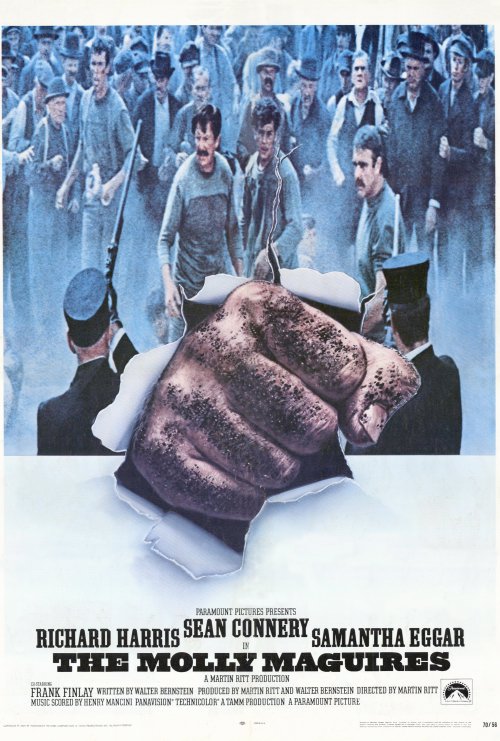
The Molly Maguires (1970)


          An old-fashioned morality tale somewhat in the vein of John Ford’s classic film The Informer (1935), The Molly Maguires offers a fictionalized take on a group of real-life Irish immigrants who worked in Pennsylvania’s coalmines during the late 19th century. When a group of fed-up miners led by Jack Kehoe (Sean Connery) lashes out at their oppressive employers through a covert campaign of bombings and murders, the police send an Irish-born detective, James McParlan (Richard Harris), to infiltrate and expose Kehoe’s group, causing McParlan to experience a crisis of conscience: The more he learns about the secret guerilla organization called “The Molly Maguires,” the more he sympathizes with them.
          As scripted by once-blacklisted Hollywood lefty Walter Bernstein and as directed by sensitive humanist Martin Ritt, The Molly Maguires takes an unusually nuanced view of radical politics. The picture lays out the reasons why the workers rebel—dangerous work conditions, a usurious pay structure in which the mining company withholds nearly all wages through outrageous “deductions”—yet the filmmakers don’t paint the Maguires as heroes. Instead, the Maguires are depicted as desperate men who resort to violence when pushed beyond reasonable limits.
          This distinction puts viewers squarely inside McParlan’s conflicted psyche, and the melancholy nature of Harris’ screen persona suits the story well. The actor is believable as a working-class bruiser and as a man who realizes he’s selling his soul for career advancement. The betrayal inherent to the story is accentuated by Connery’s tightly controlled performance, since the Kehoe character is acutely self-aware; especially toward the end of the picture, Connery does a strong job of demonstrating that Kehoe values his life less than the goal of making his oppressors understand his rage.
          Fittingly for a story about the Irish, there’s a darkly lyrical quality to The Molly Maguires; in particular, the tin whistles of Henry Mancini’s score and the lilting accents of the various players make the gloomy mines and rolling hills of Pennsylvania seem like lost colonies of the Emerald Isle. Several strong supporting players add muscle to the picture as well. Frank Finlay is odiously pragmatic as McParland’s superior officer, while Anthony Costello, Art Lund, and Anthony Zerbe are fierce as Kehoe’s accomplices. Female lead Samantha Eggar, making the most of an underwritten role, is quietly principled as the local girl who falls for McParland without knowing his true identity.
          Although too conventionally made and slow-moving to qualify as any sort of classic, The Molly Maguires is intelligent, sincere, and thought-provoking.

The Molly Maguires: GROOVY

Saturday, June 4, 2011

Piranha (1978)


          Of the myriad killer-fish flicks that followed Jaws (1975), the tongue-in-cheek Roger Corman production Piranha is probably the most beloved. While not a great movie by any measure—or even, quite frankly, a particularly good movie—Piranha is endearingly self-aware, satirizing its own silliness even as it delivers enough gore and nudity to please B-movie enthusiasts. Directed by the exuberant Joe Dante with a tip of the stylistic hat to Jack Arnold, the pulp specialist who made the original Creature from the Black Lagoon (1954), the cheaply produced Piranha tells the slight story of a summer resort getting attacked by a school of genetically engineered fish. The piranhas were created in a government facility, then accidentally released by a bounty hunter (Heather Menzies) and a mountain man (Bradford Dillman) while searching the government facility for signs of missing teenagers. (The teenagers, naturally, were the piranha’s first victims.)
          Most of the picture comprises a Huckleberry Finn-inspired rafting trip during which the heroes, along with a loopy scientist (Kevin McCarthy), slowly discover the piranhas’ lethal potential. After being captured by and escaping from nefarious government types (who, of course, want to cover up the crisis), the heroes try to prevent the killer fish from eating all the young swimmers at the resort, which lies dead ahead on the river.
          Boasting a whimsical screenplay by future indie-cinema star John Sayles, Piranha actually suffers for having too many jokes, because the wiseass tone and the chintzy special effects make it impossible to get frightened. Luckily, Corman stalwart Dick Miller steals the show with his thoroughly enjoyable performance as the resort’s cantankerous owner, because it’s fabulous to watch him keep a straight face while saying things like, “Don’t bother me about the goddamned piranhas!” Dante refined his jokey approach to horror with later hits including Gremlins (1984), and the killer fish he released into the world proved durable. No less a figure than James Cameron was hired (and fired) as the director of the awful sequel Piranha II: The Spawning (1981), and the original movie was remade with even more gore and nudity as Piranha 3D (2010).

Piranha: FUNKY

Friday, June 3, 2011

“There Was a Crooked Man…” (1970)


          The prospect of venerable studio-era director Joseph L. Mankiewicz (All About Eve) collaborating with brash New Hollywood screenwriters Robert Benton and David Newman (Bonnie and Clyde) raises curiosity about “There Was a Crooked Man…”, a Western comedy-drama centered around a brutal prison from which convicts conspire to break out so they can recover a cache of hidden loot. Unfortunately, the movie’s narrative is as fussy as its excessively punctuated title—the picture is a sloppy hodgepodge aspiring to run the stylistic gamut from adrenalized drama to insouciant comedy.
          One suspects that protagonist Paris Pitman Jr. (Kirk Douglas) was envisioned as a charming rogue, and Douglas certainly tries to sell the idea that his character is a heartless criminal whom we’ll find interesting because he does everything with a wink and a smile. But unlike the crooks in other Benton-Newman scripts, who evince believable complexity and vulnerability, Pitman comes across as a Hollywood contrivance, partially because Douglas brings so much movie-star baggage, and partially because Mankiewicz can’t decide from scene to scene whether the movie is dark, light, or some nebulous thing in between. The picture is shot in a blown-out, garish style that makes every image seem artificial; the cast is loaded with familiar character actors (Hume Cronyn, Burgess Meredith, Warren Oates, John Randolph), all of whom play silly caricatures; and the cringe-worthy music by Charles Strouse, complete with an awful title song performed by Trini Lopez, brings the movie close to camp.
          Worst of all, the story itself is convoluted and dull. It begins when Pitman robs a rich man for half a million dollars in cash, then buries the money in a desert rattlesnake pit. After Pitman is captured and imprisoned, assorted characters try to find out where the money is hidden, and Pitman builds a team of eccentric convicts so he can stage an elaborate breakout. Meanwhile, a relentless lawman (played by a bored-looking Henry Fonda) chases after Pitman for personal reasons.
          The narrative is such an anything-goes jumble that at one point, Cronyn literally does a slapstick routine by backing toward a hot stove before jumping up and down while shouting, “My heinie is on fire!” Veering completely to the other extreme, a studly inmate played by Michael Blodgett (Beyond the Valley of the Dolls) gets strapped to a pole, shirtless, and whipped for rebuffing the homosexual advances of a guard. Given the presence of that sort of material, it’s possible there was some sort of satirical purpose to the original Benton-Newman script, but as cluelessly directed by Mankiewicz (who couldn’t be further outside his comfort zone of tense verbal jousting), “There Was a Crooked Man…” has no discernible purpose except befuddling viewers.

“There Was a Crooked Man…”: LAME

Thursday, June 2, 2011

Nickelodeon (1976)


          The notorious flop that finally knocked director Peter Bogdanovich off the Hollywood A-list after a precipitous slide, Nickelodeon is a fascinating movie unfairly relegated to obscurity. In the overstuffed narrative, Ryan O’Neal and Burt Reynolds play early-20th-century ne’er-do-wells who stumble into cinema careers when they encounter a disreputable producer (Brian Keith); a romantic triangle then emerges because O’Neal and Reynolds are both infatuated with the beautiful klutz (Jane Hitchcock) who keeps crossing their respective paths. Eventually, O’Neal becomes a director and Reynolds becomes his long-suffering leading man, so they wend their way through calamitous filmmaking experiences accompanied by a motley crew of actors and technicians (played by a vibrant ensemble including George Gaynes, Tatum O’Neal, John Ritter, and Stella Stevens).
          In a rare case of a movie being too meticulously scripted for its own good, Nickelodeon smothers a slight premise with painstaking detail, since each new plot development is dramatized at considerable length; accordingly, the movie wavers between happy-go-lucky farce and romantic dramedy as Bogdanovich endeavors to include every colorful episode he can imagine, whether the episodes advance the narrative or not. Bogdanovich, a scholarly cinephile who interviewed many of the great studio-era directors, rewrote W.D. Richter’s original script to include fictionalized anecdotes drawn from the life experiences of real-life cinematic pioneers, and the all-business soberness of Bogdanovich’s attempt to re-create the madcap milieu of silent-era comedy undercuts the story’s frothy appeal.
          Yet even with these storytelling excesses (and an overreliance on slapstick gags like breakaway walls and pratfalls), there’s a lot of gorgeous filmmaking on display in Nickelodeon. Laszlo Kovacs’ photography is elegant, the craftsmanship of the sight gags is impressive, and the nerdy motif of shout-outs to classic directors is endearing. Ryan O’Neal and Reynolds lock into smooth grooves during light-comedy passages like their epic fistfight, while Tatum O’Neal delivers a memorable dose of her signature old-before-her-years edginess. So even though Nickelodeon is excessive and undisciplined, it’s crafted with such care that it can’t be ignored. In 2009, Bogdanovich revisited the movie for its DVD debut, adding several minutes of previously unused footage and converting the imagery to black-and-white, the format he originally intended to use; the disc features both the monochromatic version and the original full-color theatrical release.

Nickelodeon: GROOVY

Wednesday, June 1, 2011

Busting (1974)


          One of the first examples of what later became known as the “buddy cop” subgenre, Busting exemplifies the subgenre’s virtues and weaknesses. When buddy-cop flicks ruled the box office in the ’80s, for instance, movies like Walter Hill’s 48 Hrs. (1982) alternated wildly between broad humor and brutal violence. That same tendency is on display throughout Busting, which features a pair of scruffy vice cops determined to take down an arrogant crime lord who lubricates his operation with payoffs to powerful city officials. In some scenes, Busting feels like an out-and-out comedy, with leading players Robert Blake and Elliot Gould trading amusingly cynical quips. Yet in other scenes, Busting is a full-on action thriller, featuring intense shootouts and scary car chases. The piece doesn’t hang together perfectly, and the story meanders a bit in the middle, but Busting is nonetheless fascinating as a rough draft for a type of movie that soon became ubiquitous.
          Like Richard Rush’s outrageous Freebie and the Bean, which was released almost a year after Busting, writer-director Peter Hyams’ Busting presents cops who disrespect authority as much as the crooks they pursue. Detectives Farrel (Blake) and Keneely (Gould) are veteran LAPD officers tired of pinching perverts and prostitutes only to see the worst offenders set free because underworld boss Carl Rizzo (Allen Garfield) has so much pull downtown. So even though the cops know Rizzo is protected on every level, they go after him anyway, harassing his nightclubs, stalking him while he drives around town, and waiting for the day they catch him making a connection with his drug supplier.
          Throughout the first hour of the movie, this is all quite entertaining, because Gould’s world-weary routine is delightful. “We could be good bad guys,” he opines at one point. “Pays better. Better hours. More cooperation from the police.” Blake, later famous as TV’s Baretta (and as an alleged felon in private life), ratchets down his signature intensity, and he’s surprisingly effective as a straight man. Garfield is suitably slimy, especially in a long scene when the cops get in Rizzo’s face during a boxing match.
          The movie goes dark around the one-hour mark, losing a bit of its liveliness as it speeds toward an unsatisfying conclusion—yet even when it’s tonally awkward, Busting is impressive to watch. Hyams, a former photographer who closely supervises the look of his films, gives Busting a grimy feel with lots of wide shots filled with atmospheric detail; the only recurring visual hiccup is a device of extremely wide dolly shots for which the camera is positioned so far ahead of the actors that the camera rounds corners before the talent, leaving empty frames onscreen for long beats. Given how flatly many ’70s crime films were shot, however, noting that Busting has overly ambitious imagery is a compliment instead of a criticism. (Available as part of the MGM Limited Collection on Amazon.com)

Busting: FUNKY