Friday, September 7, 2012

I Escaped from Devil’s Island (1973)


Produced by Roger Corman to piggyback on the release of Papillon (1973), a big-budget drama about the inhuman conditions on the French penal colony known as Devil’s Island, this colorful but dull exploitation flick features an eye-popping procession of abuse, murder, sex, sweat, and torture. Set in the early 20th century, the picture follows the attempts of a violent criminal named Le Bras (Jim Brown) to flee the seemingly inescapable Devil’s Island, which is run by sadistic prison guards who whip inmates whenever the convicts aren’t being worked to death. Le Bras recruits unlikely accomplices in political prisoner Davert (Christopher George), who initially shuns violence, and Jo-Jo (Richard Ely), a “fancy boy”—or, in the less delicate terminology of today’s prison pictures, a “bitch.” The movie trudges through several repetitive and ugly scenes of these and other inmates getting beaten by guards until the “heroes” build a raft and flee, only to suffer a series of melodramatic crises. Their raft falls apart, they’re attacked by sharks while adrift on the ocean, they stumble into a leper colony once returning to shore on a remote part of the island, they’re captured by bloodthirsty natives, and so on. Director William Witney, a veteran of ’30s serials and Golden Age television, was near the end of an epic career when he helmed this pedestrian flick, and while he seems perfectly efficient at organizing crowd scenes and simulating violence, the film’s storytelling is enervated in the extreme. Brown occasionally livens up the proceedings with a sly line delivery or a charming smile, but since he’s mostly tasked with looking impressive while parading around shirtless, it’s not as if there’s much room for him to shape a persona. As for George, a limited actor with a campy sort of appeal, he spends most of his time gritting his teeth and snarling. Plus, while some of the production values are impressive-ish, notably crowd scenes during the climax, the film’s reliance on unvarnished exterior locations and tacky stock footage is unhelpful. Worse, the movie’s plot is so turgid the flick feels like it’s three hours long even though it’s only 89 minutes.

I Escaped from Devil’s Island: LAME

Thursday, September 6, 2012

F for Fake (1973)


          By the ’70s, faded auteur Orson Welles seemed to embrace the vagabond quality of his career, throwing together haphazard film projects while making his primary income through demeaning acting jobs, cartoon voiceovers, and commercials. For instance, while appearing onscreen as the host/narrator of his documentary F for Fake, Welles explains that some of the footage comprising the brief movie was originally intended for other, never-completed projects. This revelation warns viewers that coherence should not be expected, and, indeed, F for Fake is completely scattershot.
          The movie is ostensibly an examination of pranksters that focuses on Welles’ European acquaintance Elmyr de Hory, an art forger, and Elmyr’s American-born biographer, Clifford Irving—who, in the course of this documentary’s protracted production, earned notoriety by publishing a biography of reclusive billionaire Howard Hughes that turned out to be bogus. For the first hour of F for Fake, Welles and his editors jump around restlessly between interviews with Elmyr and Irving; footage of Elmyr painting; vignettes of Welles talking about Elmyr and Irving while Welles holds court at cocktail parties; scenes of Welles reviewing footage in an editing room; and other random bits, like cameos from Welles’ Hollywood pals Joseph Cotten and Laurence Harvey. Oh, and there’s also room in the movie’s undisciplined first hour for remarks about Welles’ notorious 1939 radio broadcast War of the Worlds, itself a famous example of fakery.
          After the Elmyr-Irving bit runs its course, Welles transitions to a lengthy dramatization of an encounter between European beauty Oja Kodar and legendary Spanish painter Pablo Picasso. (Welles’ filmmaking is particularly ingenious during this sequence, because he simulates Picasso’s presence through the use of still photographs and clever editing.) F for Fake is filled with fascinating ideas and inventive execution, but it’s maddeningly unfocused. The film never lands on solid narrative ground, and Welles often resorts to gimmicky motifs like recurring cutaways to spilled wine.
          As a result, it’s difficult to grasp just what Welles is trying to say here. Although he announces at the beginning of the film that F for Fake will be an examination of prevarication, it actually ends up being a celebration of elaborate lies by a man who relishes his own ability to twist the truth. F for Fake is highly watchable, but it also provides a sad reminder of the great work Welles could have been doing at this time of his life, instead of assembling unsatisfying pastiches like this one.

F for Fake: FUNKY

Wednesday, September 5, 2012

X, Y & Zee (1972)


          Yet another shrill melodrama from the bleakest period of Elizabeth Taylor’s screen career—the wasteland between her triumphant performance in Who’s Afraid of Virginia Woolf? (1966) and her ascension to grande dame status in the ’80s—X, Y & Zee features Taylor and Michael Caine as hateful spouses battling over issues including the husband’s myriad dalliances. In other words, it’s nearly 110 minutes of Taylor screaming, threatening, and whining. Set in London, the movie tracks the relationship between unfaithful architect Robert Blakely (Caine) and his disturbed wife, Zee (Taylor). They fight virtually from sun-up to sundown, with Zee constantly promising to kill herself and/or Robert; meanwhile, Robert alternates between joining the sparring matches and numbing himself with booze. At a lavish party one night, Robert meets Stella (Susannah York), an elegant and seemingly untroubled young woman, with whom he begins an affair. However, as Robert’s feelings for Stella blossom into love, a threatened Zee lashes out by stalking the lovers, tossing Robert’s possessions into the street, and, finally, attempting suicide.
          Then, while recovering in the hospital, Zee requests that Stella visit her, and Stella, quite stupidly, accepts the offer. Zee starts playing mind games with her husband’s mistress, who inexplicably reveals to Zee her deepest personal secret. And so it goes—to quote a line Stella delivers to Robert at one point, “It’s all very brittle and boring and trite.” She’s talking about Zee’s behavior, but she could just as easily be talking about X, Y & Zee itself. Caine is fine here, since he does icy nastiness better than just about anyone, though York is merely decorative, while Taylor is an outright embarrassment. She overacts ridiculously; she’s slathered with whorish eye makeup; she wears flamboyant costumes like muumuus and ponchos, presumably to mask her expanding waistline; and she sports silly fashion accoutrements like, at one point, a gold headband that looks like a leftover from her days playing Cleopatra. (Available through Columbia Screen Classics via WarnerArchive.com)

X, Y & Zee: LAME

Tuesday, September 4, 2012

Carrie (1976)


          It might be exaggerating to call Carrie a good film, since it’s unabashedly campy and lurid, but there’s no arguing with results—among other things, the movie earned two Oscar nominations, elevated director Brian De Palma to A-list status, turned leading lady Sissy Spacek into a star, initiated an epic relationship between Hollywood and novelist Stephen King, and became one of the most popular horror movies of the ’70s. Considering that the flick is so trashy it features beaver shots beneath the opening credits and culminates with a blood-soaked teenager using telekinesis to slaughter her classmates, that’s quite a list of accolades.
          Based on King’s first novel, Carrie tells the sad story of Carrie White (Spacek), a misfit American teenager so ignorant to the ways of the world that she freaks out upon getting her first period while showering in the school gym. Her vicious classmates, led by instigator Chris Hargensen (Nancy Allen), taunt Carrie mercilessly, pelting her with sanitary napkins, so Carrie is excused from school for the rest of the day. Once she returns home, we discover the source of Carrie’s troubles—her lunatic mother, Margaret White (Piper Laurie), is a Bible-thumping abuser who considers sexual development sinful and tortures Carrie with long imprisonments in a closet.
          As Carrie reels from the shower incident and her troubles at home, she discovers the ability to move objects with her mind. Meanwhile, Chris is banned from the upcoming prom—indirect punishment for tormenting Carrie—so she plans grotesque revenge. Adding a final thread to the story is Carrie’s sympathetic classmate Sue (Amy Irving), who persuades her dreamboat boyfriend, Tommy (William Katt), to take Carrie to the prom. One bucket of pig blood later, it all goes to hell.
          De Palma and screenwriter Lawrence D. Cohen took relatively few liberties with King’s narrative, so they delivered his signature combination of gore and pathos intact, and Carrie zooms along at tremendous speed. Excepting two ill-conceived comedic sequences (both of which feature cringe-inducing music), Carrie is laser-focused on developing empathy for the protagonist and setting up a Grand Guignol climax. Generally speaking, Carrie is an efficient movie, and some of the picture’s elements exist on an elevated plane. De Palma’s trademark tracking shots manifest in full force, for instance (though the shots are akin to guitar solos in overwrought hard-rock songs, flamboyance for the sake of flamboyance). Additionally, De Palma uses the supporting cast like an orchestra, getting exactly the right single note each from Allen, Irving, Katt, Laurie, and others (including Betty Buckley and John Travolta).
          Spacek’s Oscar-nominated performance holds Carrie together, since her character’s emotional journey drives the story. As played by Spacek, Carrie is fragile during early scenes, ferocious when assaulting her enemies, and poignant once she realizes the tragic fate to which she has been consigned. De Palma’s ending represents his biggest departure from King’s book, and while the film’s concise denouement is more cinematic than the protracted conclusion of King’s narrative, it’s a bit much, right up to the notorious “gotcha” coda. Once again, however, there’s no arguing with results; Carrie made such an impression that it earned a Broadway adaptation in 1988, a low-budget movie sequel in 1999, and big-budget movie remakes in 2002 and 2013.

Carrie: GROOVY

Monday, September 3, 2012

Which Way to the Front? (1970)


          Funnyman Jerry Lewis’ screaming-nincompoop shtick was beyond passé by the time he made the painfully unfunny World War II comedy Which Way to the Front? The film’s barrage of brainless sight gags and witless verbal jokes makes the lowbrow WWII-themed TV series Hogan’s Heroes seem inspired by comparison, because Lewis’ idea of a show-stopping joke is having Adolf Hitler idiotically rhapsodize about the Jewish snacks (e.g,, knishes, etc.) that Eva Braun prepares for him. Worse, Lewis plays the leading role in his typically oppressive manner, mugging nonsensically when his character goes into gibberish-spouting spasms and shouting nearly all of his lines in the second half of the picture, when his character masquerades as a German officer.
          However, it’s not as if producer-director Lewis would have done himself any favors by hiring a different star—every single aspect of Which Way to the Front? is as tiresome as Lewis’ performance. The silly story begins when billionaire Brendan Byers (Lewis) gets drafted for Army service—never mind that Lewis was about 43 when he made the picture—only to get classified 4F. Determined to help the war effort, Byers uses his fortune to build a private army comprising a handful of fellow 4F losers. Decked out in anachronistic uniforms that look more late-’60s than mid-’40s (oh, the turtlenecks!), Byers’ militia crosses the Atlantic on his private yacht, breaks into the stronghold of a Nazi officer who resembles Byers, and lures Hitler into an ambush. There isn’t a single worthwhile comedy idea here, and Lewis seems to know it; he often ends scenes by freeze-framing, jacking up big-band music on the soundtrack, and cutting to a bright swirl, Batman-style, as a means of hiding inanity behind momentum. So, need we even discuss the sequence of Byers learning German by listening to the album Music to Mein Kampf By? Or the scene at the end in which Byers masquerades as a Japanese officer by putting on Coke-bottle glasses and gigantic buck teeth?
          Inexplicably, Lewis stuck with the WWII theme for his next picture, the notorious unreleased concentration-camp film The Day the Clown Cried. After that production derailed, Lewis was sidelined for several years with health problems, and didn’t return to directing features until the 1981 misfire Hardly Working. Given the quality of Which Way to the Front?, he probably should have quit while he was behind. (Available at WarnerArchive.com)

Which Way to the Front?: LAME

Sunday, September 2, 2012

Steel (1979)


          While it’s mildly enjoyable as a manly-man action movie, Steel is actually more amusing when viewed for its unintentional subtext—endeavoring for macho swagger led the filmmakers weirdly close to the realm of gay erotica. The story begins when contractor “Big” Lew Cassidy (George Kennedy) heads to work on a new high-rise he’s building in Texas, explaining that the sight of a tall building “still gives me a hard-on.” When Lew dies in a workplace accident, his pretty daughter Cass (Jennifer O’Neill) pledges to finish the building, thus saving her family’s company from bankruptcy. To do so, she needs a “ramrod”—no, really, that’s the phallic job title of the movie’s real leading character, Mike Catton, played by the Six Million Dollar Man himself, Lee Majors.
          Mike is a construction foreman who quit working at high altitudes after suddenly developing a fear of heights. Now working as a trucker (picture Majors behind the wheel of a big rig in a cowboy hat and a wife-beater), Mike accepts the job on the condition that he can supervise work from a completed floor instead of climbing onto beams. As Cass’ second-in-command, “Pignose” Morgan (Art Carney), says to Mike: “You’re here because this building will give you a chance to get it up again.” Scout’s honor, that’s the line!
          The first half of the movie comprises Mike building his team of world-class steel workers, Dirty Dozen-style. These roughnecks include such walking clichés as a horny Italian named Valentino (Terry Kiser); a jive-talking African-American named Lionel (Roger E. Mosley); a stoic Indian named Cherokee (Robert Tessier); and a taunting bruiser named Dancer (Richard Lynch). Meanwhile, Lew’s estranged brother, Eddie (Harris Yulin), conspires to derail the project because he wants to seize control of Lew’s company. As the movie progresses, Mike tries to overcome his fear of heights while coaching his fellow dudes through long days of hard work and hard drinking.
          Steel is such a he-man enterprise that even though Majors engages in close physical contact and soft talk with most of his male costars, he can barely muster furtive glances for his nominal love interest, O’Neill. All of this is pleasantly diverting, in a Saturday-matinee kind of way—director Steve Carver’s cartoony style didn’t peak until his 1983 Chuck Norris/David Carradine epic Lone Wolf McQuade, but he moves things along—so it doesn’t really matter that the script is ridiculous, or that Majors is ineffectual as a leading man. Plus, to Carver’s credit, the plentiful scenes taking place on girders high above city streets are enough to give any viewer vertigo. And as for those lingering shots of sweaty men working hard, their biceps glistening in the hot Texas sun . . .

Steel: FUNKY

Saturday, September 1, 2012

The Dark (1979)


A dreadful mishmash of horror and science fiction, The Dark manages to make the quest to capture an extraterrestrial serial killer uninteresting. When the movie begins, a mysterious figure murders several people, including the daughter of author/ex-con Roy Warner (William Devane). Preoccupied with grief—but not so preoccupied that he doesn’t make time to flirt with TV reporter Zoe Owens (Cathy Lee Crosby), who is in turn tries to exploit Roy for a hot story—Roy dogs grumpy police detective Dave Mooney (Richard Jaeckel), the cop assigned to find the killer. Eventually, the various characters gravitate toward a blowsy psychic named De Renzy (Jacqueline Hyde), who has somehow intuited that the killer is an alien, and that the alien is inexplicably tethered to an out-of-work actor and . . . Oh, who cares? The Dark is one of those incompetent movies that can’t figure out how to deliver plot elements effectively, so it compensates by stacking characters and twists atop each other, as if the volume of concepts will compensate for the fact that none of the concepts is interesting. Worse, the story structure of boring filler scenes punctuated by a trite murder sequence every 10 minutes or so is beyond perfunctory. About the only time the movie gets vibrant is during the gonzo climax, when a 10-foot-tall, shambling man-monster squares off with an army of cops, frying the policemen with laser beams shot from the monster’s eyes. However, since the movie’s special effects are mediocre—and since the acting is so lifeless it feels like the performers were handed their lines just before they walked on camera—the film’s only redeeming value is atmospheric widescreen cinematography that lives up to the title. Using a mixture of deep shadows and epic lens flares straight out of the John Carpenter playbook, John Arthur Morrill’s tasty images almost make The Dark worth watching. Almost.

The Dark: LAME

Friday, August 31, 2012

Another Man, Another Chance (1977)


          Impressionistic and offbeat, French filmmaker Claude Lelouch’s romantic drama Another Man, Another Chance is nominally a Western, since most of the story takes place in the American frontier circa the late 1800s, but it’s also an international story with many episodes taking place in France during a time of ferocious class conflicts. Repurposing narrative concepts and themes from Lelouch’s 1966 hit A Man and a Woman—without actually being a remake of the previous film—Another Man, Another Chance tells the parallel stories of two sensitive people whose love affairs end in tragedy.
          David (James Caan) is an American veterinarian whose wife, Mary (Jennifer Warren), has grown tired of living in the wilderness, even though David adores the lonesome lifestyle because he relates better to animals than he does to people. Soon after delivering the couple’s first child, Mary is raped and killed by robbers one sad afternoon, while David’s away on business. Meanwhile, in Paris, impulsive young Frenchwoman Jeanne meets a photographer named Francis (Francis Huster), and falls in love. Wishing for adventure and an escape from the rampant poverty in Paris, Francis and Jeanne relocate to America, eventually settling in a town not far from David’s home.
          By the time David and Jeanne finally meet at the school attended by their children, Jeanne has suffered a loss of her own, so she has become guarded about romance. However, David is determined to build on their mutual attraction, so the story explores the challenges faced by people who are haunted by memories of loved ones.
          Lelouch, who also wrote the picture, uses an idiosyncratic storytelling style. He jumps back and forth in time, so viewers experience the story in the same psychological blur as the characters. This nonlinear approach doesn’t always work—some scenes are confusing—but when it connects, Lelouch expresses subtle nuances of anguish and perception. The filmmaker also employs long, unbroken takes that put viewers right in step with the actions of the characters; for instance, the scene in which David discovers Mary’s fate is a presented as a single tracking shot following Caan through every part of his character’s rambling homestead.
          Some of Lelouch’s indulgences are less effective, like a long race scene toward the end of the movie, and one could quibble that casual vignettes of David and Jeanne bonding with their children outlast their usefulness. But since the story takes place in a less hurried time, Lelouch’s leisurely pacing suits the milieu. Also in the film’s favor is the understated acting, with Caan eschewing his standard macho vibe and Bujold affecting a delicate quality that masks formidable resolve. Another Man, Another Chance is far too flawed to qualify as a great film, but it’s consistently heartfelt and thoughtful, in addition to boasting a rich, dust-choked Western atmosphere. (Available as part of the MGM Limited Collection on Amazon.com)

Another Man, Another Chance: GROOVY

Thursday, August 30, 2012

The Spikes Gang (1974)


          Taking themes from the John Wayne hit The Cowboys (1972) to an even darker extreme, The Spikes Gang is a terrific Western drama about a group of young farm boys who emulate an outlaw, with deadly results. Gary Grimes, still fresh off the coming-of-age charmer Summer of ’42 (1971), teams with Ron Howard and Charles Martin Smith, who previously costarred in American Graffiti (1973), to play a trio of young, unsophisticated men who discover a wounded outlaw in a forest near their families’ farms. The gunslinger, Harry Spikes (Lee Marvin), asks for their help, so Will (Grimes), Les (Ron Howard), and Tod (Smith) transport Harry to a barn, feed him, and tend to his gunshot wounds. Once Harry recovers, he promises to help the boys if they ever need anything, and then rides off on a horse Will provides. Will’s stern, ultra-religious father discovers his son’s activities and beats Will, which prompts the young man to run away from home.
          Eager for adventure and seduced by Harry’s grandiose stories about his exciting life as a criminal, Les and Tod join Will. They rob a bank, incompetently, and kill a bystander in the process, so they’re quickly indoctrinated into the dark side of the rebel lifestyle. Eventually, the lads get arrested and land in a Mexican jail, but Harry passes through the Mexican town and honors his debt by arranging their release. Flattered by the boys’ idolization, Harry hires the young men as his new gang and attempts a brazen robbery, during which things start going terribly wrong.
          Even with solid production values and uniformly good acting, the movie’s best virtue is a sensitive screenplay by Irving Ravetch and Harriet Frank Jr., the Western-cinema veterans who, not coincidentally, wrote the script for The Cowboys. Equally adept at crafting sparse dialogue and indicating characterization through behavior, Ravetch and Frank create a grown-up style of melodrama, so the storyline feels fresh and surprising as it winds toward a sad climax that’s infused with a powerful sense of inevitability.
          Director Richard Fleisher, a journeyman who worked in nearly every imaginable genre, serves the screenplay well by shooting scenes simply; his economical frames allow the actors to express the script’s relatable emotions in an unfussy manner. Playing the film’s leading role, Grimes does fine work, building on the frontier existentialism he explored in The Culpepper Cattle Co. (1972). Concurrently, Marvin’s gruff poeticism perfectly suits the role of a self-serving career criminal. Howard and Smith balance the leading players with their complementary shadings of adolescent angst and affable naïveté. It’s true The Spikes Gang traffics in familiar themes, but graceful execution and heartfelt performances help the movie connect on a deeper level than expected. (Available as part of the MGM Limited Collection on Amazon.com)

The Spikes Gang: GROOVY

Wednesday, August 29, 2012

Brewster McCloud (1970)


          Arguably Robert Altman’s strangest movie—a high standard, given his eccentric career—Brewster McCloud hit theaters shortly after the idiosyncratic filmmaker scored a major hit with M*A*S*H, but this picture was far too bizarre to enjoy the broad acceptance of its predecessor. In fact, Brewster McCloud shuns narrative conventions so capriciously that it seems likely Altman took taken perverse pleasure in confounding viewers. Consider the willfully weird storyline: Nerdy young man Brewster McCloud (Bud Cort) lives illegally in a workroom beneath the Houston Astrodome, and he passes his days studying avian physiology while building a pair of mechanical wings so he can eventually fly away to some unknown location.
          Three women in his life accentuate the peculiarity of Brewster’s existence. Hope (Jennifer Salt) is a groupie who visits Brewster’s lair and climaxes while watching him exercise; Suzanne (Shelley Duvall, in her first movie) is a spaced-out Astrodome tour guide who becomes Brewster’s accomplice and lover; and Louise (Sally Kellerman), who might or might not be a real person, is Brewster’s guardian angel, subverting everyone who tries to impede Brewster’s progress.
          This being an Altman film, the story also involves about a dozen other significant characters. For instance, there’s Abraham Wright (Stacy Keach), a wheelchair-bound geezer who makes his money charging merciless rents to seniors at rest homes, and Frank Shaft (Michael Murphy), a supercop investigating a series of murders that may or may not have been committed by Brewster and/or Louise. (Each of the victims is marked by bird defecation on the face.) Among the film’s other threads is a recurring vignette featuring The Lecturer (Rene Auberjonois), a weird professor/scientist who speaks directly to the audience about bird behavior while slowly transforming into a bird.
          Although it’s more of a comedy than anything else, Brewster McCloud incorporates tropes from coming-of-age dramas, police thrillers, and romantic tragedies, and the whole thing is presented in Altman’s signature style of seemingly dissociated vignettes fused by ironic cross-cutting and overlapping soundtrack elements. This is auteur filmmaking at its most extreme, with a director treating his style like a narrative component—and yet at the same time, Brewster McCloud is so irreverently lowbrow that Kellerman’s character drives a car with the vanity license plate “BRD SHT.” Similarly, Salt’s character expresses an orgasm by repeatedly pumping a mustard dispenser so condiments squirt onto a table.
          Appraising Brewster McCloud via normal criteria is pointless, since Doran William Cannon’s script is designed for maximum strangeness, and since none of the actors was tasked with crafting a realistic individual. A lot of what happens onscreen is arresting, and the movie is cut briskly enough that it moves along, but one’s tolerance for this experiment is entirely contingent on one’s appetite for mean-spirited whimsy. That said, Brewster McCloud is completely unique, even for an era of rampant cinematic innovation, and novelty is, to some degree, its own virtue. (Available at WarnerArchive.com)

Brewster McCloud: FREAKY

Tuesday, August 28, 2012

Brass Target (1978)


          Crammed with big-name actors, colorful locations, and complex schemes, Brass Target should be a rousing thriller. Unfortunately, the team behind the picture tried to do too many things, and the starring role was unwisely given to John Cassavettes—who by this point in his career preferred directing low-budget films to acting in Hollywood flicks—so the combination of a confusing script and a phoned-in leading performance makes it difficult to appreciate the picture’s many admirable qualities. Set in 1945 Europe, just after the defeat of the Nazis, Brass Target begins with an exciting robbery: Mysterious criminals attack an Allied train and steal a fortune in Nazi gold. The theft divides Allied powers, because Russians blame Americans for the loss, so belligerent U.S. General George S. Patton (George Kennedy) vows to recover the gold and prove his country’s innocence. And then the movie veers off-course.
          Instead of focusing on Patton and the conspirators who want to impede his investigation, the picture shifts to an Army detective, Major Joe De Lucca (Cassavettes), who digs into the robbery while dealing with myriad personal melodramas. Among other things, he’s got a fractious friendship with Col. Mike McCauley (Patrick McGoohan), a schemer who trades in stolen war loot, and both men love Mara (Sophia Loren), a European who survived the war by sleeping her way to safety. The movie’s plot gets even more complicated when the conspirators—primarily Col. Donald Rogers (Robert Vaughn) and Col. Walter Gilchrist (Edward Herrmann)—hire an enigmatic European assassin (Max Von Sydow) to kill Patton lest the general discover their crime.
          Any one of these storylines would have been enough for a satisfying movie, so Brass Target ends up giving each of its component elements short shrift. More damningly, the best scenes, which depict the assassin’s meticulous planning of an attempt on Patton’s life, feel like repeats of similar scenes in the acclaimed thriller The Day of the Jackal (1973). Nonetheless, Von Sydow gives the picture’s best performance, especially since the other acting in the movie is highly erratic.
          Cassavettes preens and scowls like some sort of irritable peacock; Loren looks lost, which is understandable seeing as how her character is anemically underdeveloped; Kennedy plays Patton as a foul-mouthed bully, his acting inevitably suffering by comparison to George C. Scott’s Oscar-winning turn in Patton (1970); and McGoohan is terrible, his accent shifting inexplicably from one line to the next. Still, Brass Target has tremendous production values, and the milieu of the story—postwar Europe as a lawless frontier—is fascinating. Plus, the central gimmick of the narrative, a conspiracy-theory explanation for the real Patton’s death in 1945, is imaginative. One suspects, however, that the premise was explored to stronger effect in the Frederick Nolan novel from which this film was adapted. (Available at WarnerArchive.com)

Brass Target: FUNKY

Monday, August 27, 2012

The Public Eye (1972)


          This refreshing British romance was adapted by the venerable Peter Shaffer from his own play (originally titled The Private Ear and the Public Eye), and directed by the enduring Carol Reed, of The Third Man fame. Featuring a trio of highly capable actors ripping through reams of sophisticated dialogue, this is a tasteful production from top to bottom, which makes it all the more interesting that the story is so peculiar. Michael Jayston (star of 1971’s Nicholas and Alexandra) plays an uptight London accountant named Charles, and Mia Farrow plays his wife, a freethinking young American named Belinda. Although Belinda pulled Charles from his shell during their courtship, he has retreated into stuffy traditionalism, so they’re drifting from each other. Fearful that she’s become unfaithful, Charles hires a detective agency to follow Belinda, and an unconventional investigator named Julian Christoforou gets the assignment.
          Played by one-named Israeli star Topol with the same vivaciousness he brought to his famous stage and screen role in Fiddler on the Roof, Julian is a voluptuary in love with love. Most of the story comprises one long dialogue scene between Charles and Julian, during which Charles describes the history of his relationship with Belinda and during which Julian explains the details of his surveillance; these incidents are depicted through extensive flashbacks. In the story’s main twist, Charles learns that Belinda remained faithful to him—until she noticed this peculiar Greek fellow shadowing her day after day. Turns out Belinda and Julia have enjoyed a platonic and wordless courtship, attending cultural events each afternoon. Charles is infuriated by this discovery, so the remainder of the movie explores how the triangle gets resolved.
          Fanciful and stylized, Shaffer’s story is more of a romantic fable than a realistic narrative, and the magical style is elevated by John Barry’s haunting music, which includes the frequently repeated song “Follow, Follow.” Shaffer’s dialogue is as resplendent as usual, though he occasionally lapses into self-indulgent loftiness, and the character work is sharp. Topol easily steals the movie, while Jayston invests his role with repressed humanity, and Farrow endeavors to come across as more than just a flighty hippie. The movie also benefits from the extensive use of evocative London locations, and the climax is genuinely surprising.

The Public Eye: GROOVY

Sunday, August 26, 2012

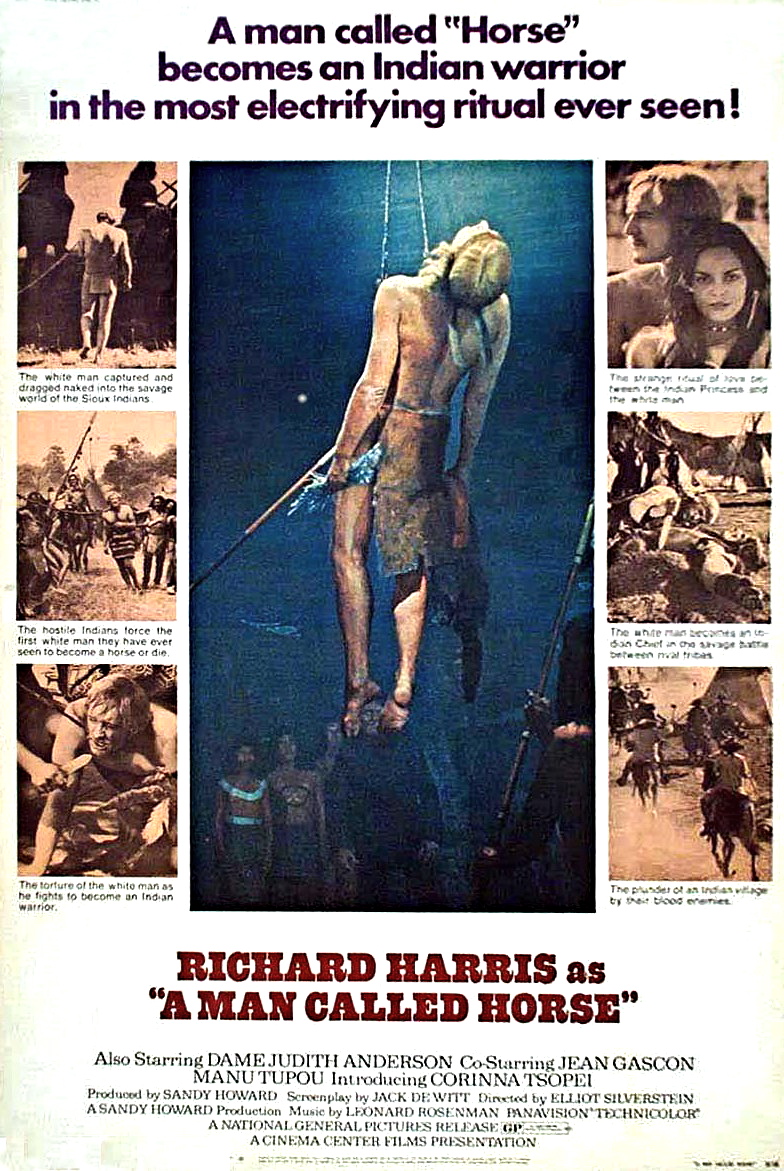
A Man Called Horse (1970) & The Return of a Man Called Horse (1976)


          Years before Kevin Costner played a Civil War-era soldier who bonded with Native Americans in Dances with Wolves (1990), Irish actor Richard Harris played a character on a similar journey in the harrowing A Man Called Horse series. Based on a 1950 short story by Dorothy M. Johnson, the first picture in the series, A Man Called Horse, was released in 1970. Although Harris was still relatively fresh from the success of the blockbuster musical Camelot (1967), he was quickly sliding into a rut of intense movies about men enduring physically and spiritually debilitating odysseys—for instance, A Man Called Horse was one of three early-’70s Westerns dominated by scenes of Harris suffering bloody abuse. (A shrink could have fun analyzing the actor’s career.)
          Harris stars as Lord John Morgan, a British aristocrat who is captured by a Sioux Indian band called the Yellow Hand while traveling in the American West. The sequence of his capture is typical of the picture’s disturbing vibe—Morgan is bathing in a river when Indians lasso him around the throat, yank him from the water, and then prod with spears while he tries to fight back, naked and vulnerable. Initially, Morgan’s captors treat him like property, and he learns about Yellow Hand culture and language from Batise (Jean Gacson), a fellow member of the tribe’s lowest caste.
          However, when an opportunity arises for Morgan to prove his worth in battle, he determines that he wants to become fully integrated into the Sioux Nation. Accepting the Indian name “Horse,” Morgan takes a Sioux wife and—in the film’s most famous sequence—endures a gruesome initiation ritual during which he’s hung from the roof of a giant tent by hooks dug into his pectoral muscles. (If you can watch that scene without feeling queasy, you’re a better man than I, Gunga Din.) Director Elliot Silverstein’s style is lurid and occasionally trippy, the otherworldliness of the piece accentuated by Native American music and a preponderance of dialogue spoken in the Sioux language. One can easily quibble with the film’s dramatic merits and historical accuracy, but it’s impossible to deny that A Man Called Horse possess a bizarre sort of cinematic power. Plus, while Harris was well on his way toward self-parody, given his penchant for operatic gestures and shouted dialogue, his commitment is unquestionable.
          Six years later, Harris reprised his role in the competent but unnecessary sequel The Return of a Man Called Horse, which replaces the original film’s grisly novelty with a ponderous narrative about the title character becoming a messiah for his adopted people. When the picture begins, Morgan has returned to England but regrets leaving the Sioux behind; subsequently, when he returns to America for a visit and discovers that the Yellow Hand were humiliated and relocated by white men, Morgan resumes his Horse persona and rouses his friends to a new chapter of accomplishment and purpose.
          Woven into this principal storyline is a thread of Morgan attempting to reclaim the spiritual fulfillment he felt while living among the Sioux, so the picture is filled with anguished speechifying, and, naturally, director Irvin Kershner presents yet another bloody initiation ritual. The Return of a Man Called Horse is handsomely made, but it suffers from bloat and humorlessness, so viewers may end up feeling as depleted as the protagonist by the time the thing runs its course. In 1982, Harris reprised the Morgan role one last time for The Triumphs of a Man Called Horse, but the focus of the threequel was actually Horse’s son, so Harris’ appearance in the substandard flick is really just a glorified cameo.

A Man Called Horse: GROOVY
The Return of a Man Called Horse: FUNKY

Saturday, August 25, 2012

The Dead Don’t Die (1975)


It’s fitting that the worst thing about this zombie flick is a lifeless performance. Made for TV by horror specialist Curtis Harrington, directing a script by Psycho novelist Robert Bloch, The Dead Don’t Die gene-splices the film-noir genre with supernatural horror. Because both of these genres feature existentialism and shadowy photography, they should mesh well, and indeed The Dead Don’t Die has some fun jolts involving zombies emerging from darkness in locations that could’ve been used in a Humphrey Bogart movie, but the thing never quite comes together. The story is set in 1934, when sailor Don Drake (George Hamilton) returns from military service to attend the execution of his brother, Ralph (Jerry Douglas), who claims he’s innocent of the murder charge for which he was convicted. In the course of investigating Ralph’s life and alleged crimes, Don enters the orbit of Jim Moss (Ray Milland), the shady promoter of bop-till-you-drop dance marathons. Eventually, it becomes clear that Ralph was mixed up with criminals who learned voodoo in Haiti, and are using the undead as soldiers in a nefarious scheme. Obviously, this is all very cartoony, but there should have been plenty here to sustain 74 creepy minutes. Alas, The Dead Don’t Die is merely mediocre, partially because of shortcomings in Bloch’s teleplay—his dialogue is way too obvious, for instance—and mostly because of Hamilton’s acting. A pretty-boy performer whose best work generally involves self-parody, Hamilton can’t muster anywhere near the intensity required to sell such outlandish material. Still, veteran actors including Joan Blondell, Ralph Meeker, and Milland provide competent supporting performances, and some of the zombie scenes work. As such, it’s not difficult to imagine some enterprising producer revisiting this material, smoothing out the rough patches, and coming up with an interesting remake.

The Dead Don’t Die: FUNKY

Friday, August 24, 2012

Cannon for Cordoba (1970)


          Even though it suffers from a muddy screenplay, the sweaty Western Cannon for Cordoba boasts a brisk pace and impressive production values. Another entry in the seemingly endless cycle of action pictures set during the Mexican revolution, the picture begins when ruthless Mexican general Cordoba (Raf Vallone) assaults a U.S. Army train and steals six cannons from troops led by U.S. General John J. Pershing (John Russell). Determined to reclaim the weapons, Pershing enlists maverick officer Captain Rod Douglas (George Peppard) to lead an undercover assault on Cordoba’s fortress. In the course of doing his job, Douglas gets into a romantic hassle with a sexy Mexican double agent (Giovanna Ralli) and alienates his hot-tempered second-in-command (Don Gordon).
          Despite telling a simple story, Cannon for Cordoba feels needlessly complicated, because Stephen Kandel’s script fails to sufficiently differentiate characters and explain motivations; furthermore, the scene that really gets the story moving, in which Douglas receives his orders from Pershing, doesn’t happen until the half-hour mark. That said, Cannon for Cordoba delivers the goods in nearly every other way. The action scenes are tense and violent, with an exciting mixture of close-quarters combat and big-canvas warfare (people get beaten, blown up, shot, stabbed, thrown off high ledges, and so on).
          The movie also looks and sounds fantastic. Cinematographer Antonio Macasoli emulates the look that famed DP Conrad Hall brought to a better picture with similar themes, The Professionals (1966), so the imagery in Cannon for Cordoba is sharp, textured, and vibrant. The music score thunders along nicely, since the producers hired Elmer Bernstein to give this movie the same gallop Bernstein provided for the Magnificent Seven pictures.
          Alas, Cannon for Cordoba cannot boast star power equal to that found in any of the movies it emulates. None of the supporting actors makes much an impression, and Peppard is merely okay, though he seethes with a suitable mixture of contempt and malice. Yet his chilly characterization doesn’t inspire a rooting interest, and there’s not enough humor to leaven his solemnity, which makes Cannon for Cordoba grim when glib might have been the better tonal choice. (Available as part of the MGM Limited Collection on Amazon.com)

Cannon for Cordoba: FUNKY

Thursday, August 23, 2012

The China Syndrome (1979)


          For viewers of a certain age, the title The China Syndrome recalls one of the eeriest synchronicities in the history of movie distribution. Starring and produced by Michael Douglas, this terrific thriller revolves around a whistleblower taking control of a nuclear power plant—as a TV reporter and her cameraman record the unfolding crisis, the whistleblower grabs a gun and forces a hostage situation in order to put national attention on safety problems at the facility. Intense, smart, and topical, The China Syndrome would have been a provocative picture in any circumstances, but an extraordinary coincidence made the movie seem downright prescient. Twelve days after the picture opened, a real-life accident occurred at the Three Mile Island nuclear plant in Pennsylvania, accentuating the film’s theme about the potentially catastrophic risks of nuclear energy.
          Directed and co-written by serious-minded humanist James Bridges, The China Syndrome works equally well as a dramatic film and as a suspense piece. As the story progresses, hard-driving reporter Kimberly Wells (Jane Fonda) and her idealistic cameraman Richard Adams (Michael Douglas) shift guises several times: They start out as observers, become opportunistic voyeurs, and finally transform into activists once they’re terrified by the prospect of a “China Syndrome,” a nuclear meltdown so severe that a plant’s core burrows through the entire globe. (Science tells us this eventuality is impossible, but the notion is nonetheless a sexy scare tactic.)
          The emotional heart of the movie, of course, is Jack Lemmon’s impassioned performance as the whistleblower, Jack Godell. A normal man pushed past his limit by his employers’ reckless indifference, Jack represents the quiet voice of reason exploding into scared-shitless rage, thus reflecting the tenor of anti-nuclear activists in the era of the No Nukes benefit concerts. Bridges channels this disquieting historical moment through meticulous storytelling, creating a rational narrative framework that counterpoints the edgy behavior of the characters. Furthermore, the picture taps into the conspiracy-theory vibe that permeated many grown-up ’70s flicks, and Bridges orchestrates the work of veteran character actors—including Wilford Brimley, James Hampton, Richard Herd, and James Karen—who balance the stars’ more flamboyant work. Best of all, The China Syndrome is an expertly mounted slow burn with a dynamic payoff, since the tension Bridges generates during the climax is quite potent.

The China Syndrome: RIGHT ON