Wednesday, May 15, 2013

Cisco Pike (1972)


          During the early ’70s, one of the most happening scenes in the music business revolved around the Troubadour club in West Hollywood, the watering hole of choice for folks like Jackson Browne, the Eagles, and Linda Ronstadt. Perhaps no single narrative movie captures the texture of this scene better than Cisco Pike, which tells the story of a rock star who turns to dealing grass when his career goes cold. Starring singer-songwriter Kris Kristofferson in his first acting role, Cisco Pike exudes atmosphere and authenticity as the storyline winds through nightclubs, recording studios, and the streets of Los Angeles—at its best, the movie almost feels like a documentary capturing what it was like to be high on tunes (and weed) in the City of Angels during a transitional moment between the idealism of the late ’60s and the decadence of the late ’70s.
          The weird part, though, is that Cisco Pike isn’t really a story about the music business. It’s a crime thriller exploring what happens when the title character gets into a hassle with a whacked-out cop who’s playing both sides of the law. The basic story involves an LAPD psycho named Leo Holland (Gene Hackman) forcing rocker-turned-recidivist Cisco (Kristofferson) to sell a huge trove of pot that’s fallen into Holland’s hands. In shaking down his old music-industry contacts for cash, Cisco finds out which friends have integrity and thereby arrives at a new but unsettling understanding of his place in the world. Thanks to this offbeat storyline, viewers can consume Cisco Pike several different ways. For instance, it’s possible to groove on the picture as a nostalgia trip, and it’s also possible to enjoy the narrative’s mild suspense.
          What makes film so rich, besides the colorful details woven into writer-director Bill L. Norton’s script and the extensive location photography, is the lively cast. Beyond Kristofferson, who exudes such powerful natural charisma that he subsequently became a movie star, Cisco Pike benefits from Hackman giving an energetically weird performance as the dirty cop, as well as Harry Dean Stanton blending humor and pathos as the title character’s once-and-future singing partner. The picture also features ’70s stalwarts Allan Arbus, Karen Black, Roscoe Lee Browne, Antonio Fargas, Howard Hesseman, and Severn Darden. For some fans, however, the highlight is a cameo by real-life rocker Doug Sahm, who plays a campy riff on himself—rhapsodizing about the virtues of great ganja and spewing subliterate hipster jive about music, he epitomizes the far-out vibe of stoned ’70s rock.
          It’s easy to find flaws with Cisco Pike, because the movie’s energy is fairly low and because Norton’s filmmaking style is way more conventional than, say, Dennis Hopper’s mind-bending approach, which might have suited this milieu better. But considering how many interesting things Cisco Pike presents in its 95 minutes, complaining that it could have been a stronger picture seems petty.

Cisco Pike: GROOVY

Tuesday, May 14, 2013

Octaman (1971)


While it might be overreaching to describe Octaman as the worst creature feature ever made, since the monster genre has spawned some truly ghastly cinematic atrocities, it’s fair to say that Octaman comprises 76 minutes of stultifying pabulum. The story, which borrows heavily from the classic monster flick The Creature from the Black Lagoon (1955), is the usual noise about a scientist accidentally disturbing the natural habitat of a missing-link beastie, thereby invoking primeval wrath. In this case, the beastie is an octopus who walks like a man—as depicted, I shit you not, by a dude walking around in a silly green suit with a giant green head and flailing tentacles. Amazingly, this terrible suit was co-created by future Oscar-winning effects great Rick Baker, so one presumes his best intentions were impeded by budget limitations and poor execution; even shrouding the monster in shadow and spritzing the costume with some sort of moisture would have delivered better results than showing the thing dry and in full sunlight, as happens periodically. It also doesn’t help that Baker and crew failed to articulate the monster’s eyes, which just sit there, disallowing any illusion of life. And the Octaman costume isn’t even the worst thing in the picture. For instance, Octaman has a baby, which is depicted through the use of a floppy little glob of painted rubber that gets tugged along the floors of locations by unseen strings. Writer/director Harry Essex relies heavily on stock footage, and it’s obvious that even though the story is supposed to be set in some exotic South American jungle, the whole thing was shot in and around such overly familiar L.A. locations as the Bronson Canyon caves. Making the whole enterprise seem even tackier is that fact that Essex has a screenwriting credit on the original Creature from the Black Lagoon—he’s incompetently plagiarizing himself. About the only entertaining aspect of Octaman is seeing how many pathetic attempts Essex makes to portray the titular critter as a killer. At various points, Octaman bitch-slaps enemies with his tentacles, strangles people with his tentacles, and even impales victims with the tips of his tentacles. The only fearful thing about this interminable crapfest is the prospect of actually watching the movie.

Octaman: SQUARE

Monday, May 13, 2013

Chisum (1970)


          A textbook example of movie-star ego riding roughshod over a potentially engrossing storyline, this latter-day John Wayne Western puts the Duke’s character at the center of a notorious real-life feud that involved dueling ranchers, out-of-control capitalism, and frenemies Billy the Kid and Pat Garrett. Chisum has so many story elements that it feels like a highlight reel from a miniseries, but the centrality of a typical Wayne protagonist bludgeons interesting nuances, transforming Chisum into a flat story of he-man heroism. Making matters worse are such painfully old-fashioned flourishes as the corny songs that play over tedious montages. Chisum has many watchable passages, thanks to abundant action scenes, vibrantly colorful location photography, and zesty supporting performances, but the picture is something of a mess.
          Set in New Mexico circa the late 1870s, the movie revolves around a rivalry between noble cattleman John Chisum (Wayne) and his disreputable competitor, Lawrence Murphy (Forrest Tucker). Chisum owns huge tracts of land but treats people fairly, whereas Murphy is an avaricious creep willing to cheat, lie, and steal in order to expand his holdings. As Murphy’s greed becomes more rapacious, Chisum gathers colleagues including crusty sidekick Pepper (Ben Johnson), fellow gentleman rancher Henry Tunstall (Patric Knowles), and principled nomad Pat Garrett (Glenn Corbett). Also drawn into the good guys’ armada is semi-reformed outlaw William “Billy the Kid” Bonney (Geoffrey Dueul), who works for Tunstall but romances Chisum’s niece. Meanwhile, Murphy gathers a horde of snarling henchmen, played in cartoonish fashion by lively actors including Robert Donner, Christopher George, and Richard Jaeckel. The cast of Chisum is huge, and as a result, most of the actors get shortchanged in terms of character development and screen time.
          Written and produced by Andrew J. Fenady, Chisum attempts to tackle an epic story within the confines of a standard feature, which makes everything seem rushed and superficial. Plus, whenever the movie slows down for something pointless, such as Chisum’s meeting with an Indian chief—a scene that communicates nothing except the lead character’s principles, which have already been described ad nauseum—narrative momentum suffers. As for the performances, Wayne is Wayne, still quite virile and not yet inhabiting the late-life gravitas that made some of his subsequent ’70s Westerns elegiac, while old hands from Johnson to Tucker sprinkle their one-dimensional roles with charm. Unfortunately, the younger players incarnating the star-crossed lovers (any sensible viewer knows it won’t go well for Billy and Chisum’s niece) are bland, and the actors portraying secondary villains have nothing to do except strut around in filthy clothes and shoot likable people.

Chisum: FUNKY

Sunday, May 12, 2013

Joyride (1977)


          Featuring a cast of attractive young actors, a somewhat lurid storyline, and the unique atmospherics of Pacific Northwest locations (subbing for Alaska), Joyride should be a distracting romp about ’70s youths seeking adventure in the boonies. Weirdly, however, good intentions derailed the movie’s potential. Instead of being light entertainment with a sprinkling of sex and violence, Joyride sits uncomfortably on the fence between comedy and drama, and the film’s storyline is over-plotted. Lots of things happen, but they aren’t compatible with each other, and they don’t contribute to an overall impact. In trying to do a lot, the filmmakers somehow accomplished very little.
          The picture begins in L.A., where friends Scott (Desi Arnaz Jr.) and John (Robert Carradine), together with John’s girlfriend, Susie (Melanie Griffith), decide to leave the big city for a new life as independent salmon fishers in Alaska. Arriving in the 49th state, the kids are chagrined to discover that work won’t be as easy to come by as they expected. The trio is also riven by romantic tension; not only does Scott lack a female companion, but some degree of threesome activity is implied. The story gets turgid once Scott and John start mixing it up with locals, because Joyride grinds through repetitive scenes of bar fights and such—a thread that culminates with a silly pissing-contest scene—until a fourth member joins the main group. She’s Cindy (Anne Lockhart), a sexy local who’s alternately presented as a prostitute, a tease, and a co-conspirator in a criminal enterprise. After hooking up with Scott, Cindy participates in a strange scheme whereby the Los Angelenos “kidnap” her and seek ransom from her employer, a pipeline company. Whatever.
          Directed and co-written by admirable B-movie helmer Joseph Ruben (who later scored with pictures including the 1991 Julia Roberts thriller Sleeping With the Enemy), this American International Pictures release features a likeably loose vibe and stronger production values than those of the average AIP joint; the abundant location photography of open spaces covered with brooding skies lends credibility. But given the lack of a meaty central storyline, the picture sprawls across 92 logy minutes without any sense of purpose. Even the gimmick of all four leads being second-generation actors doesn’t add anything beyond a marketing hook. (Each of the four actors is okay in his or her undemanding role, with Arnaz the weakest link, but none does anything particularly special.) So, while there’s plenty of diverting stuff in Joyride, from the pop-song score peppered with Electric Light Orchestra hits to the topless scenes featuring Griffith and/or Lockhart, Joyride ends up feeling like a movie caught in an identity crisis. Is it a counterculture story about youths looking for a simpler life away from civilization? Is it a lovers-on-the-run crime saga? Is it a melodrama about romantic entanglements? Actually, it’s all of those things—and less.

Joyride: FUNKY

Saturday, May 11, 2013

Bunny O’Hare (1971)


          The fine folks at Wikipedia report that Bette Davis sued the producers of this offbeat comedy because editing changes transformed what Davis had been promised would be grown-up satire into silly slapstick. And while it’s heartening to see that Davis was still her usual combative self even well into the twilight of her career, the question underlying this factoid is why Davis—or anyone, for that matter—could ever have envisioned Bunny O’Hare as grown-up fare, satirical or otherwise. A juvenile predicated on coincidence and contrivance, the film is marred by pervasively nonsensical plotting. The opening scene tells the tale. Bunny O’Hare (Davis) is a dippy widow who flies into a panic when workers show up to demolish her home after she’s defaulted on bank payments. She inexplicably asks a workman named Bill (Ernest Borgnine) to protect her house even though he’s just there to salvage plumbing items for resale. Then Bunny phones her adult children for help, but the kids are too self-involved to recognize that Mom’s in a jam. Next, after Bill fails to protect Bunny’s house (which wasn’t his responsibility in the first place), he succumbs to guilt and offers Bunny a ride. Huh? A series of unlikely situations ensues, during which Bunny discovers that Bill is actually a bank robber wanted by the police, so Bunny blackmails Bill into helping her rob the financial institution that she feels treated her shabbily.
          Bunny O’Hare is a deeply confused movie. For instance, the filmmakers can’t decide if Bunny is competent or helpless. Nor can they decide if the antagonist is a bank, the cops, or Bunny’s children. Yet the myriad story problems aren’t the worst aspects of this dreadful movie. The central visual gimmick involves Borgnine and Davis masquerading as hippies, so viewers are subjected to the surreal sight of bearish Borgnine and tiny Davis decked out in Day-Glo polyester while they hurtle down city streets on a motorcycle. Proving that Davis was at least correct to complain about the film’s editing, the flick is cut and scored with the frenetic, broad-as-a-barn storytelling style of a Jerry Lewis movie. Plus, many getaway scenes feature out-of-place banjo music, as if the picture aspires to be a cousin to Bonnie and Clyde (1967). Davis strives to retain her dignity and plays certain scenes well, but her crisp line deliveries clash badly with Borgnine’s boisterous energy. Costar Jack Cassidy, as the vain cop obsessed with catching the “hippie bandits,” delivers a tiresome caricature in lieu of a performance, while funnyman John Astin, playing one of Bunny’s kids, fares slightly better.

Bunny O’Hare: LAME

Friday, May 10, 2013

A Star Is Born (1976)


          First, the good news: This Kris Kristofferson-Barbra Streisand version of the oft-remade showbiz tale about a rising star’s doomed involvement with a veteran celebrity is not as bad as its reputation would suggest. Considering the vicious criticism the picture has received over the years, one might expect an outright disaster. Instead, A Star Is Born contains some credible dramatic elements, and the production values are terrific. As for the acting, it’s quite good—after a fashion. The main problem, which infects every aspect of the picture, is that viewers are asked to believe Barbra Streisand could have become a rock star in the mid-’70s. Considering that Streisand was a show-tune belter who incidentally dabbled in pop music, her casting creates fundamental believability problems. After all, the biggest song the movie generated was “Evergreen,” a ballad so gentle it could have been recorded by the Carpenters. A further complication is Streisand’s legendary vanity—the degree to which the movie contorts itself in order to showcase her looks is absurd. For instance, the number of Streisand’s costume changes seems even more comically excessive than it might have otherwise given the presence of a unique screen credit during the closing crawl: “Miss Streisand’s Clothes From Her Closet.” Oy.
          Anyway, Streisand plays Esther Hoffman, a singer-songwriter stuck working in small clubs until she meets John Norman Howard (Kristofferson), a darkly handsome rock star. (Never mind that Kristofferson found most of his real-life musical success on the country charts.) Howard mentors Hoffman until she becomes a bigger star than he ever was, at which point Howard determines that he must disappear—in every way possible—so as not to impede his apprentice’s ascent. Woven into this melodrama, naturally, is a love story between the musicians.
          Director Frank Pierson, who by this point in his career was a top screenwriter with such movies as Cool Hand Luke (1967) and Dog Day Afternoon (1975) to his credit, made a major professional leap with this project; before directing A Star Is Born, he’d mostly helmed TV episodes and low-budget features. Considering that poor Pierson must have gotten diva demands in stereo—beyond Streisand’s micromanagement, Pierson had to deal with hairdresser-turned-producer Jon Peters, who happened to be sleeping with Streisand at the time the movie was made—the fact that A Star Is Born moves along fairly well is a testament to Pierson’s innate storytelling abilities. Yes, the flick is overwrought and sudsy, but in some sequences—particularly Kristofferson’s final moments—Pierson renders solid drama about life under the media microscope. The picture also benefits from vibrant supporting turns by performers including Gary Busey and actor/director Paul Mazursky. Does A Star Is Born need to be 140 minutes? Not hardly. But is the picture worthwhile? Yes, especially for Pierson’s close attention to emotional detail and for Kristofferson’s charismatic performance. Plus, it must be said, Babs looks (and sounds) great.

A Star Is Born: FUNKY

Thursday, May 9, 2013

C.H.O.M.P.S. (1979)


A pathetic attempt by Hanna-Barbera Productions to mimic the Disney style of special-effects-driven family comedies, C.H.O.M.P.S. has nothing going for it except for glossy production values, a perky leading lady (Valerie Bertinelli), and a scruffy canine star. In fact, the only thing more dispiriting than the picture’s cliché-riddled storyline is the imbecilic dialogue. The plot cobbles together stock elements familiar to anyone who’s seen live-action Disney pictures from the ’70s. Successful entrepreneur Ralph Norton (Conrad Bain) owns a security company, and one of his employs is a ne’er-do-well inventor, Brian Foster (Wesley Eure), who is, of course, in love with Norton’s daughter, Casey (Bertinelli). After Brian gets fired, he shows Casey his new invention, C..H.O.M.P.S., a robot dog designed for home security. Complications of the dullest sort ensue when one of Norton’s competitors, Gibbs (Jim Backus), tries to steal C.H.O.M.P.S. before Norton recognizes the value of the invention. The movie also features inane subplots involving bumbling crooks (played by Red Buttons and Chuck McCann) and a mean neighborhood dog with whom C.H.O.M.P.S. tussles. C.H.O.M.P.S. is crammed with cloying music that erupts into disco jams during chase scenes, suggesting an unholy convergence of Carl Stalling and Giorgio Moroder, and the cast overplays cartoonishly, right down to Backus presenting a black-hat riff on his old Gilligan’s Island characterization. The picture also presents gruesome images irresponsibly. This is the sort of movie where villains get caught in explosions but walk away with nothing but ash-covered faces and ripped clothing; similarly, the bit where Brian rips off his robot dog’s head to display the inner workings to Casey seems unnecessarily savage. Yet the weirdest element is the presence of minor, PG-rated vulgarity (which was excised from G-rated release prints). Monster, the nasty dog who fights with C.H.O.M.P.S., “speaks” in voiceover, saying things like “Up your poop, granny.” If one strained to find a single meritorious aspect of this misbegotten movie, it could be noted that Bertinelli was as the apex of her girl-next-door adorableness—but fans of the actress would do better to scratch that particular itch by watching a One Day at a Time rerun.

C.H.O.M.P.S.: LAME

Wednesday, May 8, 2013

It’s Showtime (1976)


          After the success of That’s Entertainment! (1974), a slew of anthology films celebrating the Hollywood of yesteryear hit theaters, although few successors matched That’s Entertainment! for sheer ebullience and wow factor. Still, even a second-rate offering in this genre, such as It’s Showtime, has value. After all, where else can viewers survey scenes featuring many of Hollywood’s most famous animal performers, from Flipper to Rin Tin Tin, without having to watch entire movies featuring the performers? Because, let’s face it, after plowing through all 85 minutes of It’s Showtime, you’ll probably feel like you’ve seen enough Flipper and Rin Tin Tin to last the rest of your life. In addition to featuring marquee-name animal performers, It’s Showtime presents obscure bits culled from conventional features (meaning those starring human beings), as well as from shorts and special subjects. For instance, the anthology’s opening number features a chorus and orchestra of dogs performing a routine to “Singin’ in the Rain,” and then It’s Showtime shifts to such random sights as funnyman Joe E. Brown cavorting in an office with a lion; Roy Rogers and his trusty steed, Trigger, doing their thing; and a poodle undulating to the accompaniment of stripper music. Some of this stuff is fun, and a lot of it is odd. (In the case of the bumping-and-grinding poodle, “odd” gives way to “disturbing.”)
          Most of the picture comprises themed chapters grouping clips of particular types of animals (e.g. a section of horse scenes set to “The William Tell Overture,” etc.), but A-list critters including Asta (the Thin Man dog) and Francis the Talking Mule get their own stand-alone chapters. Writer Alan Myerson tries to give the clips some sort of narrative flow, starting with lighthearted comedy before moving into exciting action vignettes and finally tearjerker scenes, but even with this care given to the overall arrangement, the enterprise gets boring after a while. The problem isn’t the clips or the execution, per se, so much as the lack of any storyline. It’s Showtime is the sort of picture where the viewer can walk away from the screen for 10 or 15 minutes and miss absolutely nothing of importance. Aditionally, the tearjerker section gets tiresome thanks to the inclusion of overly long excerpts from Lassie Come Home (1943) and National Velvet (1944). It must be said, however, that seeing highlights of Rin Tin Tin’s myriad screen adventures makes a strong case for the noble German Shepherd as one of the great action stars of the silent era. Watching Rin climb walls, knock bad guys off cliffs, leap off rooftops, and such actually generates real thrills.

It’s Showtime: FUNKY

Tuesday, May 7, 2013

Sweet Sweetback’s Badasssss Song (1971)


          The lore of Melvin Van Peebles’ breakthrough picture is well known, especially since the maverick auteur’s son, Mario Van Peebles, made an entire movie about the creation of Sweet Sweetback’s Badasssss Song. As it happens, Mario’s highly entertaining behind-the-scenes flick, Badasssss! (2003), is much more accessible than Melvin’s guerilla-style original, in part because Mario’s narrative juxtaposes the overwrought subject matter of Sweet Sweetback with amazing tales about the obstacles Melvin surmounted to get the picture completed.
          That said, Sweet Sweetback occupies a unique place in both film history and sociopolitical history. Perhaps more than any other movie made by an African-American director in the ’70s, Sweet Sweetback captures the rage of the Black Power era by presenting a grim parable about a dude who fights back after getting fucked over by The Man. Sweet Sweetback was famously embraced by members of the Black Panther Party during early screenings, and this groundswell of support helped transform a scrappy little underground project into a surprise hit—despite being made for just $150,000, the movie grossed more than $15 million.
          Melvin Van Peebles’ storyline is lurid and nasty. In a brief prologue, young Mario plays the title character as a teenaged orphan—Sweetback earns his nickname by demonstrating tremendous sexual powers while losing his virginity in an L.A. whorehouse. After the movie cuts to the present, Melvin takes over the title role. (In addition to starring, he wrote, produced, directed, and scored the movie.) Now grown into a regular performer at the whorehouse who impresses crowds with his size and stamina while screwing in public, Sweetback is stuck in a degrading life cycle. Naturally, things get worse. Through a convoluted series of events, Sweetback gets framed for a murder and handcuffed to a Black Panther named Mu-Mu (Hubert Scales). Eventually, Sweetback and Mu-Mu escape police custody, resulting in an extended chase. By the climax of the movie, Sweetback makes a solo run for the Mexican border, surviving through the support of black strangers and, at regular intervals, by trading sex for patronage from women.
          Viewed through the most forgiving lens, Sweet Sweetback is a revolutionary fable that both employs and subverts clichés about African-American male identity. It’s also, unmistakably, a call for open revolution—if not necessarily violent uprisings, then at the very least angry protests against the racially imbalanced status quo. Because the picture is so politically charged, appraising Sweet Sweetback’s merits as a cinematic experience is something of a pointless endeavor—rather than being pure entertainment, Sweet Sweetback is an incendiary statement.
          And, indeed, Melvin’s politics are more evolved than his filmmaking skills. Certain segments of Sweet Sweetback have great power thanks to the use of trippy montages accompanied by dense sound design, and some scenes pack a punch simply because they contain so much sex and violence. But while the director/star brings innate tough-guy charisma to his leading performance, the supporting cast mostly comprises nonactors, giving many scenes an amateurish quality. Further, the camerawork is dodgy, with lots of grainy shots and hard-to-read nighttime photography. Yet in the end, it’s the attitude of Sweet Sweetback’s Badasssss Song that makes the movie so unique, and that loud-and-proud perspective is characterized by a provocative slogan on the movie’s poster: “Rated X by an All-White Jury.”

Sweet Sweetback’s Badasssss Song: FREAKY

Monday, May 6, 2013

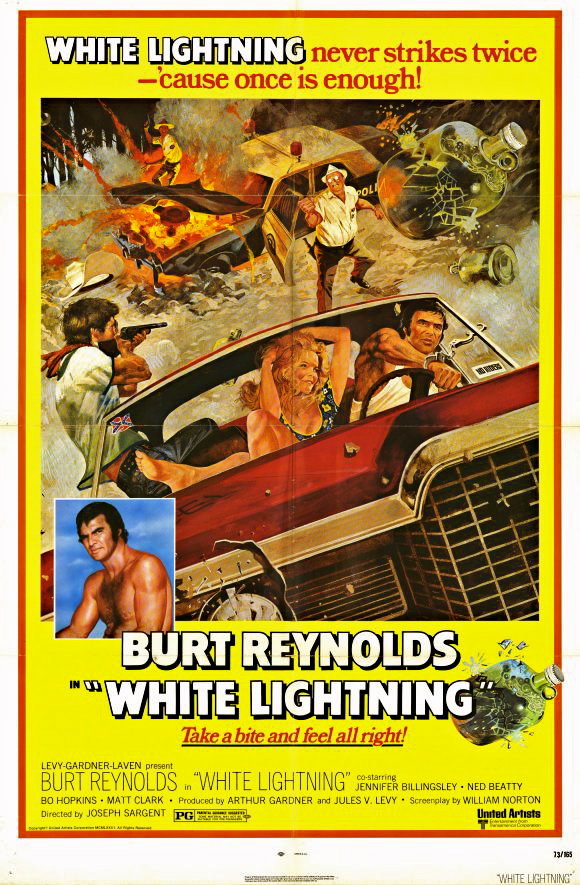
White Lightning (1973) & Gator (1976)


          The voiceover hype in the trailer says it all: “Burt Reynolds is Gator McCluskey—he’s a booze-runnin’, motor-gunnin’, law-breakin’, love-makin’ rebel. He hits the screen like a bolt of white lightning!” Indeed he does in White Lightning, arguably the best of Reynolds’ myriad ’70s flicks about working-class good ol’ boys mixin’ it up with John Q. Law. Whereas too many of the star’s Southern-fried action pictures devolve into silly comedy—including, to some degree, White Lightning’s sequel, Gator—the first screen appearance of Gator McCluskey is a sweaty, tough thriller pitting a formidable hero against an even more formidable villain. If youve got a hankering for swampy pulp, White Lightning is the gen-yoo-wine article.
          When the picture begins, Bobby “Gator” McCluskey (Reynolds) is incarcerated for running moonshine. Meanwhile, back home in the boonies, corrupt Sheriff J.C. Conners (Ned Beatty) causes the death of Gator’s little brother. Once Gator hears the news, he swears revenge and joins an FBI sting operation targeting Conners’ crew. Using a staged jailbreak for cover, Gator hooks up with a moonshiner named Roy Boone (Bo Hopkins) and penetrates Conners’ operation in order to dredge up incriminating facts. However, it’s not long before the no-good sheriff smells a rat, setting the stage for a showdown. Written by William W. Norton and directed by the versatile Joseph Sargent, White Lightning is a no-nonsense thrill ride. Even though the filmmakers cram all the requisite elements into the picture’s lean 101 minutes—including a love story between Gator and Roy’s girl, Lou (Jennifer Billingsley)—the focus remains squarely on Gator’s hunger for vengeance, which manifests in bar brawls, car chases, shootouts, and various other forms of 100-proof conflict.
          Working in the fierce mode of his performance in Deliverance (1972), Reynolds is a he-man force of nature, whether he’s punching his way through hand-to-hand combat or, in his own inimitable fashion, clutching a steering wheel and gritting his teeth while his character guides cars through amazing jumps. Reynolds’ fellow Deliverance veteran, Ned Beatty, makes a fine foil, especially because Beatty defies expectations by underplaying his role—hidden behind thick glasses, with his portly frame bursting out of tight short-sleeve shirts, he’s a picture of heartless greed. The gut-punch score by Charles Bernstain jacks things up, as well, so White Lightning lives up to its name—it goes down smooth, then burns when it hits your system.
          Reynolds let a few years lapse before returning to the character with Gator, which also represented the actor’s directorial debut. Essentially rehashing the narrative of the fist picture, but without the emotional pull of a murdered-relative angle, Gator finds our hero released from prison, again, to take down another corrupt lawman. What Gator lacks in originality, however, it makes up for in casting and production values. Country singer-turned-actor Jerry Reed gives great villain as smooth-talking redneck crook Bama McCall, chubby funnyman Jack Weston generates laughs as a sidekick prone to physical injury, and gap-toothed model-turned-actress Lauren Hutton lends glamour as Gator’s new love interest. (TV host and occasional actor Mike Douglas shows up in a minor role, too.) The sheer amount of property destruction in Gator is impressive, though the movie relies too heavily on spectacle since it can’t match the tension of its predecessor.
          Oddly, the weakest link in Gator is Reynolds’ performance, because the actor veers too far into comedy. By this point sporting his signature moustache and demonstrating his gift for pratfalls and other slapstick silliness, Reynolds seems to occasionally forget he’s making a thriller. Sure, some viewers might find this take on Gator McCluskey more fun to watch than the grim characterization in White Lightning, but it’s worth nothing that Gator helped start Reynolds down the slippery slope into his goofy Smokey and the Bandit and Cannonball Run movies. Gator’s worth a gander, since it’s hard to complain about a movie being too enjoyable, but it’s not as satisfying as the title character’s debut.

White Lightning: GROOVY
Gator: GROOVY

Sunday, May 5, 2013

Breaking Away (1979)


          An Oscar winner for Best Screenplay and a nominee for Best Picture, Breaking Away is one of the true gems of the late ’70s. While the film is inarguably a feel-good sports tale with a big race for a climax—which is to say that the story traffics in formulaic elements—Breaking Away explodes with so much in the way of memorable acting, characterization, and dialogue that the handicap of a preordained ending isn’t crippling. From start to finish, screenwriter Steve Tesich and director Peter Yates ground the story in specificity, separating Breaking Away from the pack of routine inspirational athletic pictures. Tesich, a Yugoslavian native whose family relocated to Indiana when he was a teenager, brings a unique outsider/insider viewpoint to this perspective on American culture; he captures the colorful textures of American idiom while evincing a sharp consciousness of class divisions. Further, the credible qualities of Tesich’s script enable the film’s four principal actors to sculpt distinct (and distinctly likable) personalities.
          Breaking Away’s protagonist is Dave (Dennis Christopher), a recent graduate from an Indiana high school who’s obsessed with a celebrated group of Italian bicyclists. Accordingly, even though Dave’s a corn-fed townie who spends his afternoons at a swimming hole with fellow high-school grads Cyril (Daniel Stern), Mike (Dennis Quaid), and Moocher (Jackie Earle Haley)—none of whom have clear plans for the future—Dave emulates Italian culture by singing along to opera and speaking Italian at every opportunity. This causes great consternation for Dave’s working-class dad, Ray (Paul Dooley); Ray’s befuddled rants about his kid’s abandonment of U.S. culture are endlessly entertaining. As the story progresses, Dave gets romantically involved—under false pretenses—with a pretty Indiana University coed, Katherine (Robyn Douglass), and he also decides to enter an annual bike race called the “Little 500.” Dave’s nervy encroachment into the rarified collegiate world exacerbates tensions between upper-crust students and blue-collar locals. (The college kids pejoratively refer to locals as “cutters” because limestone mining is a venerable local industry.)
          You can pretty much guess where things go from here, and, indeed, the story features lots of oppressor-vs.-underdog standoffs. Yet the joy of Breaking Away is the journey, not the destination. For instance, the ensemble scenes involving Dave’s friends feature crisp dialogue, naturalistic acting, and a warm sense of camaraderie. On a deeper level, the sense of anxiety these young men express speaks volumes about the fraught lives of people restricted by limited choices. Christopher, Haley, Quaid, and Stern function as a cohesive unit, even though Christopher has more scenes than anyone else, and their enchanting work is complemented by great supporting turns from Dooley and Barbara Barrie (who plays Ray’s wife). The actors playing IU snobs don’t fare quite as well, since their roles lack equal measures of complexity, but everyone is effective in his or her way. Director Yates, who often made thrillers such as Bullitt (1968) and The Deep (1977), captures Tesich’s humanistic storyline in an unvarnished style that suits the material, and his filmmaking soars during the climactic bike race.

Breaking Away: OUTTA SIGHT

Saturday, May 4, 2013

The Billion Dollar Hobo (1977)


Thanks to his small-screen success with McHale’s Navy (1962-1966) and The Carol Burnett Show (1967-1978), funnyman Tim Conway earned a shot at big-screen starring roles in the mid-’70s. With his impressive ability to play even the stupidest scenarios straight, Conway was ideally suited to ensemble work or to functioning as part of a comedy duo—hence his G-rated buddy movies with Don Knotts—but, inevitably, Conway wanted to topline his own pictures. And that brings us to The Billion Dollar Hobo, one of the most depressingly unfunny comedies ever made. Part of a two-picture deal Conway made with an indie outfit called the International Picture Show Company (the other picture being the equally awful 1978 romp They Went That-A-Way & That-A-Way), this misfire borrows narrative elements from Frank Capra and Preston Sturges, and then delivers its storyline by way of shtick so moronic it would embarrass Benny Hill. Conway stars as Vernon Praiseworthy, a well-meaning nincompoop who discovers he is heir to a railroad tycoon’s fortune. There’s a catch, of course, so Vernon is tasked with traveling the country as a hobo to learn life lessons before he’ll be granted his inheritance. How dumb is The Billion Dollar Hobo? Well, let’s see. In the first scene, Vernon gets hired as a short-order cook and left alone to run a kitchen after less than a minute of training, at which point Vernon fails to accomplish even the simplest kitchen functions, eventually blowing up the diner. Need more? How about the fact that the tycoon (Will Geer) assigns as Vernon’s traveling companion a dog whom the tycoon correctly believes is smarter than Vernon, and will keep Vernon out of trouble? And then there’s the whole business of Vernon stumbling into a criminal plot to kidnap a shar pei dog named “Lee Ching Win.” Can we stop now? Or must we dwell on scenes of Conway walking into doors and/or standing with his mouth open and his shoulders slumped, giving the impression that he’s just been lobotomized? Save yourself a few brain cells by giving The Billion Dollar Hobo a wide berth.

The Billion Dollar Hobo: SQUARE

Friday, May 3, 2013

Wizards (1977)


          The weirdest thing about Wizards is that the movie isn’t particularly weird. After all, the animated adventure was the first full-on fantasy film from maverick animator Ralph Bakshi, who made his mark with the X-rated cartoon feature Fritz the Cat (1972). Yet for this project, which is a hybrid of Tolkein-esque medieval/magic tropes and ecologically themed sci-fi, Bakshi mostly dialed back on the provocation and concentrated on spinning a yarn. Unfortunately, the yarn isn’t very good.
          In the distant future, after man has turned Earth into a wasteland, two sibling wizards—good Avatar (voiced by Bob Holt) and evil Blackwolf (voiced by Steve Gravers)—battle for control. Avatar’s all about nature, since he’s a mellow little dude who lives in a castle with a sexy faerie, whereas Blackwolf is a demonic-looking creature ruling an army of hell-spawned monsters, homicidal robots, and killer mutants. The bulk of the story depicts Avatar’s difficult trek from his castle to Blackwolf’s lair for a final standoff, and a major subplot involves Avatar’s conversion of one of Blackwolf’s assassins—a robot whom Avatar captures and renames “Peace” (voiced by David Proval)—into a soldier for good.
          This is all exactly as heavy-handed as it sounds, though the hipster prism through which Bakshi tells his tale makes the movie a bit more palatable than it might have otherwise. For instance, Avatar is prone to saying things like “this has been the biggest bummer trip I’ve ever been on.” He’s an appealing character, even though his attitude and lingo now seem dated.
          Bakshi employs the crude but innovative animation techniques that were his ’70s signature, occasionally sprucing up traditional cel-animation shots with trippy backgrounds that are generated by optical effects. He also spotlights herky-jerky images created by filming real actors and then tracing their basic shapes onto film frames to provide an effect akin to moving silhouettes. (During the picture’s climax, Bakshi takes the experiment further by integrating live-action footage, cutting to real shots of airplanes and tanks while Avatar’s army tangles with Blackwolf’s forces.) The oddest—and least effective—of Bakshi’s gimmicks involves cutting to montages of still drawings for transitional moments. As an uncredited Susan Tyrell soberly intones expositional voiceover, renderings by comic-book/magazine artist Mike Ploog depict scenes that Bakshi didn’t bother to animate. In addition to slowing down the action, these transitional moments make the rest of the movie look crappy by comparison, since Ploog’s drawings are beautifully detailed.
          Another significant problem with Wizards is that Bakshi, who also wrote and produced the film, can’t decide on a consistent tone—the movie lurches back and forth between action and slapstick and social commentary. In short, it’s a mess. Still, every so often Bakshi’s mad-scientist approach results in something exciting or funny or touching, and the one thing the movie can’t be said to lack is imagination.

Wizards: FUNKY

Thursday, May 2, 2013

Autumn Sonata (1978)


          Although Autumn Sonata borders on self-parody because writer-director Ingmar Bergman indulges his pain-freak sensibilities to an excessive degree, the innate humanism and sophistication of his style—combined with two extraordinary performances—give the picture resonance. A tough drama about the ways parents and children hurt each other when they’re unable to connect, the film is particularly noteworthy as the only project on which cinema’s two most famous Bergmans collaborated: Swedish-born Hollywood star Ingrid Bergman returned to her native land (and her native tongue) to give one of the most affecting performances of her career.
          Swedish-cinema icon Liv Ullmann plays Eva, a middle-aged woman living in a remote part of Sweden with her husband, meek pastor Viktor (Halvar Björk). Eva excitedly prepares for a rare visit by her mother, Charlotte (Bergman), a world-famous concert pianist. Immediately upon Charlotte’s arrival, however, myriad complications in the mother/daughter dynamic become evident. For instance, Charlotte is supremely chilly and withholding. Accordingly, while Eva was growing up, Charlotte was an absentee parent who expected her domestic existence life to be sunny and undemanding; by shunning family-oriented stress, Charlotte made real emotional connection with her daughter impossible. As a result, Eva became bitter, insecure, and needy. Thus, upon reuniting with her mother, Eva can’t stop herself from dumping loads of resentment onto Charlotte given the slightest opportunity. Furthermore, Eva surprises Charlotte by revealing that Charlotte’s other daughter, Eva’s sister Helena (Lena Nyman), is living in Eva’s house. Helena is severely disabled, and Charlotte finds time spent in Helena’s company excruciating—Helena radiates emotional thirst that Charlotte cannot quench.
          Filmed in extremely close quarters (the story rarely leaves Viktor’s humble house), Autumn Sonata is suffocatingly bleak. Writer-director Bergman almost never leavens the intense psychodrama with brightness or humor, so viewers are smothered by the dysfunction and pain of two complex women caught in an abusive cycle. At one point, the picture gets so heavy that Eva muses, via voice-over, how much she wishes she could simplify her existence by committing suicide. It is a testament to both leading actors that neither Charlotte nor Eva comes across as caricatured or contrived; these people seem agonizingly real.
          Adding to the grim quality of the experience is Ingmar Bergman’s choice to treat the piece more like a novel or play than pure cinema; actors speak in long, unbroken monologues and, on many occasions, speak directly to the camera or in theatrical soliloquies. Were it not for the amber-tinged beauty of Sven Nykvist’s cinematography and the consummate skill of the leading performances, the film’s arty flourishes would be fatal flaws. But with writer-director Bergman’s masterful hand pulling the strings, Autumn Sonata feels less like indulgence and more like an experiment—it’s as if the filmmaker deliberately discarded arbitrary storytelling conventions and used whatever tools he could in order to push as deeply into the anguished souls of his characters as possible.

Autumn Sonata: GROOVY

Wednesday, May 1, 2013

The Cowboys (1972)


          Although John Wayne’s actual cinematic swan song was The Shootist (1976), which depicts an aging gunfighter’s quest for death with dignity, the Duke’s earlier film The Cowboys is in many ways a richer closing statement about the themes Wayne spent decades exploring in Western movies. Instead of merely pondering the question of whether a man who lives by the gun must die by the gun—the poignant central theme of The ShootistThe Cowboys explores all the qualities, bad and good, that defined the Duke’s screen persona. His character, Wil Andersen, combines frontier values, heroic self-sacrifice, macho stoicism, and, of course, that most American of qualities: rugged individualism. The fact that Andersen’s journey inadvertently inspires a group of boys to become young men molded in Andersen’s honorable image perfectly echoes the manner in which Wayne’s characters inspired generations of moviegoers. So, whether you love or hate Wayne’s on- and off-screen politics, it’s easy to appreciate the elegance of this picture’s symbiosis between star and story.
          Based on a novel by William Dale Jennings and adapted for the screen by Jennings and the husband-and-wife duo Irving Ravetch and Harriet Frank Jr., The Cowboys tells a simple story about noble characters clashing with craven ones. In the beginning of the movie, rancher Andersen preps for a cattle drive until his crew abruptly quits to join the Gold Rush. In short order, Andersen finds himself interviewing an unlikely set of replacements—several schoolboys, some teens and some even younger. When the kids display unexpected determination, he agrees to hire them. However, word of available work also attracts a gaggle of varmints led by Asa Watts (Bruce Dern), whom Andersen quickly identifies as a dangerous type. Andersen refuses to hire Asa’s gang, and then sets off on the drive with the kids as his crew. A series of frontier adventures ensues, during which Andersen gruffly mentors the boys on what it takes to succeed in the cattle biz. Meanwhile, Asa’s nefarious gang trails the cowboys, eventually leading to an infamous showdown between Dern and Wayne—the climax of the duel won’t be spoiled here, but suffice to say one single moment helped cement Dern’s typecasting as a crazed villain.
          Although the storyline of The Cowboys is so schematic as to seem a bit like a fable, the piece works—mightily—because of immaculate craftsmanship and vivacious performances. Director Mark Rydell, himself a thespian, does a gorgeous job of blending different types of acting, so everything from Wayne’s stylization to Dern’s improvisation feels unified; Rydell also draws fine work from young performers including Robert Carradine, who made his screen debut in The Cowboys. (Grown-ups in the fine supporting cast include Roscoe Lee Browne, Colleen Dewhurst, and Slim Pickens.) Cinematographer Robert Surtees captures the rugged beauty of untarnished landscapes, while composer John Williams’ music strikes just the right balance of excitement and wistfulness. And if the movie’s a bit bloated at 131 minutes, so what? Thanks to its careful treatment of resonant themes, The Cowboys is arguably Wayne’s best film of the ’70s.

The Cowboys: RIGHT ON