The Astrologer: LAME
Monday, November 23, 2020
The Astrologer (1975)
Monday, October 26, 2020
Instagram Feed & 5 Million Views!
Hey there, groovy people! Checking in with a couple of fun updates. First, this blog has achieved yet another milestone that I could never have imagined when I started writing this thing a decade (!) ago: Every ’70s Movie has now received over 5 million page views. Thank you! I’m especially grateful to those of you have discovered (or rediscovered) the blog since regular daily posting ended. As always, enjoy the archived reviews, watch out for occasional new reviews as I gain access to previously unseen movies, and spread the word to like-minded cinemaniacs. Speaking of spreading the word, I'm also happy to report that Every ’70s Movie recently found its way to Instagram. The Instagram feed, which is updated every day, features links to nearly every review on this blog, in alphabetical order, accompanied by posters or stills. Please follow @every70smovie and share the feed with anyone who might enjoy the material. Anyway, that’s it for now. Thanks for your continued readership, and keep on keepin’ on!
Saturday, October 3, 2020
Death Line (1972)
Rarely will genre-picture viewers encounter a harder tonal shift than the transition occurring around the 23-minute mark of UK horror show Death Line, released in the U.S. as Raw Meat. The opening stretch of the movie proceeds like a standard-issue thriller. After a well-dressed gentleman is killed by an unseen assailant in a London subway station, a young couple discovers his body and learns from his ID that he’s an important official. The couple solicits help from a nearby cop, but upon returning to the scene of the crime, the victim has vanished—thus making the couple suspects in the disappearance of a VIP. Thereafter, quirky Inspector Calhoun (Donald Pleasence) probes the lives of the couple, American Alex Campbell (David Ladd) and Brit Patricia Wilson (Sharon Gurney). Then writer-director Gary Sherman abruptly cuts to secret catacombs adjoining the subway station, wherein a grotesque creature (Hugh Armstrong) tries feeding pieces of
the gentleman’s body to another creature, who dies. Enter the world of “The Man,” last survivor of an inbred cannibal tribe evolved from survivors of a construction cave-in that occurred 80 years previous.
From the moment Sherman introduces “The Man,” Death Line transforms into a depressing meditation on the nature of humanity. Lengthy and wordless scenes reveal aspects of The Man’s dismal existence. We see that he lovingly preserves the corpses of his dead companions, and that generations of mutations have rendered him animalistic, hence his taste for human flesh. Sherman approaches these scenes with a sort of tenderness, even though Death Line gets quite gory during moments of violence, as when The Man impales a victim. Meanwhile, Sherman tracks a melodrama aboveground, because Alex becomes cranky about getting roped into a police investigation, which has the effect of driving away Patricia, who finds Alex’s behavior to be callous. Scenes with Pleasence joking and sniffling as the persistent inspector lend much-needed humor, though the overall vibe is grim.
It’s not hard to see why the picture has gained a small cult following over the years. While there are myriad misunderstood-monster movies, Death Line employs its subterranean metaphor to good effect while exploring the always-interesting idea that civilized man is never all that far removed from his origins as a savage animal. If one indulges Sherman’s outlandish premise, the suggestion that The Man is merely following his nature comes across with a smidge of emotional heft. And if certain elements of Death Line are bland (such as Ladd’s performance), there’s usually something interesting to compensate. Not only does Christopher Lee show up for an entertaining cameo, but Sherman’s camera captures a whole lot of ’70s kitsch, from Gurney’s shag haircut to loving glances at London’s seedy red-light district. Does it matter that Sherman can’t quite land his ending, which tries to be simultaneously horrific and poignant? Not really. Even with its flaws, Death Line is memorably bleak.
Death Line: FUNKY
Saturday, September 12, 2020
Limbo (1972)
Notwithstanding a quick framing sequence, the picture begins on an Air Force base in Florida, when Sandy gets the news that her husband is MIA. After meeting Mary Kay and Sharon in a support group, Sandy moves in with the other women. Soap-style plotting ensues as Sandy gets courted by amiable gas-station attendant Alan (Russell Wiggins) and as Mary Kay succumbs to advances from a homely everyman named Phil (Stuart Margolin). The contrast between these storylines is the picture’s strongest element. Coloring the Sandy/Alan scenes is the fact that Sandy’s marriage was rocky before her husband departed for overseas service, so she doesn’t perceive her actions as a romantic betrayal. Conversely, because Mary Kay and Phil are older, their dalliance plays like a pragmatic means to an end—two adults dulling each other’s pain. All the while, Sharon becomes more and more judgmental of her friends, even as she resists acknowledging that the institutions to which she’s pledged herself—not just the Air Force but also the U.S. government—may not deserve her devotion. Running through the whole piece, of course, is profound ambiguity toward America’s involvement in Vietnam.
Cowriter Joan Micklin Silver, later to become a significant director, based her original script on interviews with wives of MIA soldiers. She was rewritten by the experienced James Bridges, a storyteller whose humanism was often undercut by his perfunctory approach to plotting. The blend of their styles is not ideal; many scenes are so gentle and understated as to feel lifeless, while others awkwardly strive for impact by expressing sociopolitical angst through underwhelming speeches. Also working against the movie’s goals are bland staging by director Mark Robson, an impossibly square musical score, and several pedestrian performances. Nolan has a few believably impassioned moments, Justice connects when her character’s façade cracks, and Margolin’s squirrely energy brightens his scenes. Alas, leading lady Jackson captures the surfaces of her character’s plight but only hints at the depths—note the many shots of Jackson looking into the distance with wide eyes and a gaping mouth, as if she’s as lost in her performance as her character is lost in a sad life.
Limbo: FUNKY
Wednesday, July 22, 2020
Explosion (1970)
The building blocks of a passable draft-dodger melodrama can be found somewhere inside Explosion, an American/Canadian production released stateside in 1970, but flaws ranging from an inept script to a terrible leading performance doom the picture. In the Pacific Northwest during the Vietnam War, college-aged Alan (Gordon Thompson) broods over the recent death of his brother, who had designs on avoiding military service by sneaking into Canada. Even though Alan is protected from the draft by a student deferment, he’s as intent on fleeing to the Great White North as his late brother was. Why? Explosion never provides satisfying answers to such questions. For instance, why does Alan visit his brother’s grieving girlfriend, Doris (Michèle Chiocine), then beat her during an attempted rape? The best answer the movie can conjure is that Alan’s on, like, a heavy emotional trip, man. Eventually, Alan befriends a longhair named Richie (Don Stroud) and they travel to British Columbia, finding work at a lumber operation. Later, when the guys cross paths with a pair of cops while joyriding in a stolen car, Alan shoots the cops dead. Why doesn’t Richie run away? Add that one to the heap of unanswered questions.
Following the cop sequence, the picture cross-cuts between scenes of the guys on the run and scenes of Alan’s shrink, Dr. Neal (Richard Conte), trying to find and rescue his patient. One imagines that cowriter/director Julies Bricken envisioned a parable about young people feeling disconnected from their country, but any hope of nuance died when Bricken characterized Alan as a one-note psychopath. Exacerbating the problem is a laughably stilted performance by Thompson, who later became a mainstay on soaps (notably Dynasty and Sunset Beach). Stroud, always a live-wire actor, does what he can playing a nonsensical role, but he’s not reason enough to watch the picture. Despite a few suspenseful moments, Explosion’s storyline is so erratic that one lighthearted interlude features a pillow fight. Seriously! On the opposite extreme, veteran composer Sol Kaplan’s score is painfully overwrought. And that’s Explosion—too much of everything the movie doesn’t need, too little of everything it does.
Explosion: LAME
Sunday, June 14, 2020
Outside In (1972)
Thursday, May 7, 2020
Title List Updated
Tuesday, May 5, 2020
American Tickler (1977)
Saturday, April 4, 2020
The Other Side of the Wind (2018)
Saturday, January 18, 2020
Dark August (1976)
Monday, December 9, 2019
The Pyramid (1976)
Saturday, November 2, 2019
4.5 Million Page Views!
Once again, salutations from the world beyond Every ’70s Movie! Although the pace of posts has greatly slowed in recent months, primarily because it’s getting more and more difficult to lay my eyeballs on content I haven’t seen before, it is mightily gratifying that readers continue to check out the blog. Yesterday, viewership reached another big milestone: Every ’70s Movie has now received more than 4.5 million page views. Thank you! As always, if you know how to track down films that have not yet appeared on the blog, please share your information with me. (Use the direct-message function if the video source needs to remain private.) To remind everyone of the parameters, the main focus of the blog is American produced (or co-produced) narrative movies that were commercially released in the U.S. from Jan. 1, 1970, to Dec. 31, 1979. I also occasionally review notable documentaries, foreign films, and telefilms, but the goal in this late stage of the project is to focus on theatrical features that have thus far escaped my grasp. To check whether a movie has appeared on the blog, I recommend using the search box located in the upper left-hand side of the home page, because the title list running along the right-hand side of the home page is overdue for an update. (If all goes well, I will tackle that project during the coming holiday season.) Thanks for reading, thanks in advance for your help finding missing titles, and keep on keepin’ on!
Sunday, September 29, 2019
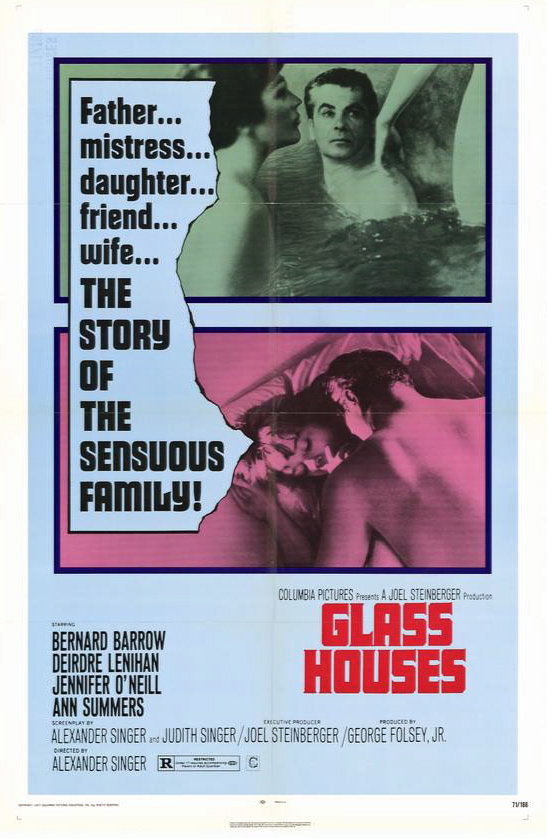
Glass Houses (1972)
Saturday, August 10, 2019
Cherry Hill High (1977)
Thursday, July 11, 2019
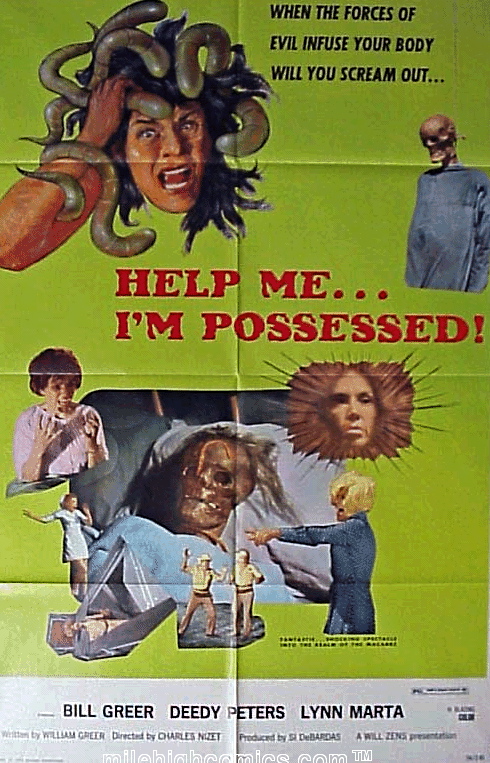
Help Me . . . I’m Possessed (1974)
Tuesday, June 11, 2019
Embassy (1972)
Thursday, May 23, 2019
My Brother Has Bad Dreams (1972)
Tuesday, April 23, 2019
The California Kid (1974)
Saturday, March 23, 2019
Steel Arena (1973)
Thursday, September 27, 2018
4 Million Page Views!
Saturday, June 9, 2018
Captain Milkshake (1970)
The problem is that for all of its slick photography and hip gimmicks, Captain Milkshake doesn’t have much of a script.