Sunday, November 6, 2011

Breakheart Pass (1975)


          Though he spent most of the ’70s starring in ultraviolent thrillers, Charles Bronson also displayed a lighter touch in occasional escapist adventures. One of the most diverting of these efforts is Breakheart Pass, adapted by bestselling novelist Alistair MacLean from his own book. Breakheart Pass is a Western thriller gene-spliced with bits and bobs from the espionage and murder-mystery genres, set primarily on a passenger train barreling through the wintry wilds of the Midwest. Governor Fairchild (Richard Crenna) is on board the train to oversee the delivery of medical supplies to a fort that’s suffering an outbreak of diphtheria. During a routine stop in a frontier town, U.S. Marshal Pearce (Ben Johnson) talks his way into passage on the train, bringing along his prisoner, medical lecturer-turned-suspected murderer Deakin (Bronson). Once the train gets moving again, several passengers are mysteriously killed, so Deakin sniffs around and discovers that the diphtheria outbreak is a ruse invented to cover a heinous conspiracy to which the governor is party. So, in the classic mode, Deakin has to figure out whom he can trust as he smokes out the bad guys, all while racing the clock before the train arrives at a rendezvous with destiny.
          Breakheart Pass is enjoyably overstuffed with manly-man excitement: The picture has bloodthirsty criminals, fistfights atop moving trains, marauding Indians, revelations of secret identities, shootouts in the snowy wilderness, unexpected double-crosses, and even a spectacular crash. As with most of MacLean’s stories, credibility takes a backseat to generating pulpy narrative, so trying to unravel the story afterward raises all sorts of questions about logic and motivation. Still, Breakheart Pass is thoroughly enjoyable in a cartoonish sort of way. Veteran TV director Tom Gries keeps scenes brisk and taut, and he benefits from a cast filled with top-notch character players, including Charles Durning, David Huddleston, Ed Lauter, Bill McKinney, and others. As for the leading players, Bronson presents a likeable version of macho nonchalance, while Crenna essays his oily character smoothly. Predictably, the female lead is Bronson’s real-life wife, Jill Ireland, who costarred in a dozen of her husband’s ’70s pictures.

Breakheart Pass: GROOVY

Saturday, November 5, 2011

House of Dark Shadows (1970) & Night of Dark Shadows (1971)


          Although the name of producer-director Dan Curtis looms large over small-screen ’70s horror—his projects from the era include the series The Night Stalker and the TV movie Trilogy of Terror—Curtis’ brand of melodramatic horror didn’t connect as strongly on the big screen, as evidenced by the fact that he only made one proper theatrical feature in his career, the 1976 Bette Davis shocker Burnt Offerings. Accordingly, it’s not surprising that the two big-screen spin-offs Curtis made from his cult-favorite supernatural soap opera Dark Shadows are unimpressive: The gimmicks that seemed bold and exciting in America’s living rooms weren’t enough to sustain interest in darkened theaters.
          Running from 1966 to 1971, Dark Shadows was an oddity in the milquetoast realm of daytime TV, mixing ghosts and werewolves and vampires into the usual soap tropes of domestic drama and doomed romance. Additionally, the show’s cheesy production values were part of its charm—so the fact that House of Dark Shadows and Night of Dark Shadows are competently made actually works against their efficacy. Whereas the series had a quasi-intentional tongue-in-cheek quality thanks to actors flubbing lines and stagehands walking through shots, the features are presented without irony, so they feel dull and humorless.
          The narratives also move at a glacial pace, as long stretches of screen time are filled with characters wandering through forests or hallways while spooky music plays in the background. Furthermore, it doesn’t help that the both movies awkwardly rehash plot threads from the TV show. House of Dark Shadows is a sort of “origin story” adventure featuring the series’ beloved vampire Barnabas Collins (Jonathan Frid), and Night of Dark Shadows is a Gothic romance about Quentin Collins (David Selby), an artist haunted by the demons of his past lives; both main characters were regulars on the series. In the first picture, anguished bloodsucker Barnabas explores a possible cure for vampirism until a romantic triangle involving a reincarnated lover ruins his plans for a plasma-free future. In the second picture, Quentin moves into the haunted family estate in Collinsworth, Maine, where he’s seduced by the angry spirit of a witch he loved in a previous life, a turn of events that understandably creates tension in Quentin’s marriage to spunky Tracy Collins (Kate Jackson, pre-Charlie’s Angels).
          Both pictures deliver the familiar visual style of the series, which means lots of deep-focus camerawork juxtaposing background and foreground actors; super-low angles accentuating ornate castle walls; and waves upon waves of ominous music. The acting is enthusiastic but mediocre, with actors hamstrung by florid dialogue and turgid pacing. Another reason neither movie is particularly satisfying is that each has something the other lacks—House of Dark Shadows has a steady flow of action leading to an overwrought Grand Guignol finale, while Night of Dark Shadows boasts a more vivid love story. In fact, had these movies been the world’s first exposure to the Dark Shadows franchise, it’s unlikely anyone would remember Barnabas and his extended clan today.

House of Dark Shadows: FUNKY
Night of Dark Shadows: FUNKY

Friday, November 4, 2011

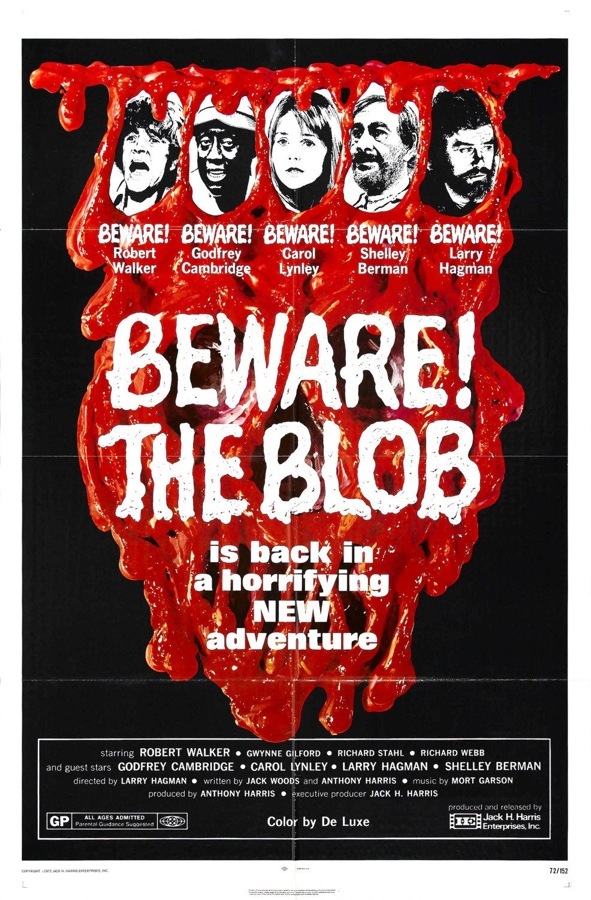
Beware! The Blob (1972)


The 1958 drive-in movie The Blob is fondly remembered for its absurd premise—a giant mass of radioactive goo invades a city, eating everyone in its path—and for the presence of future superstar Steve McQueen in his first leading role. However, the world probably wasn’t crying out for a sequel, much less one that hit theaters more than a decade after the original. Fitting the lack of marketplace excitement that preceded its arrival, Beware! The Blob is a genuinely terrible movie, noteworthy only for the participation of several familiar Hollywood names. Inexplicably, the picture was directed by Larry Hagman, who was at the time best known for starring in the ’60s sitcom I Dream of Jeannie. Hagman makes a very brief appearance in the picture, as do fellow cameo players Shelly Berman, Godfrey Cambridge, Carol Lynley, and Burgess Meredith; principal roles are played by second-stringers including Richard Stahl, Dick Van Patten, and Robert Walker Jr. The plot, which couldn’t matter less, involves the blob escaping captivity and attacking another town until our valiant young hero (Walker) traps the gelatinous beastie in an ice-skating rink. The picture was obviously envisioned as a spoof of horror movies, but insultingly cheap special effects and numbingly stupid jokes kill any humor potential, as does the movie’s tendency to wander off on tangents by introducing minor characters who appear onscreen just long enough to get consumed by the Blob. In one particularly pointless bit, a stoned hippie wanders into a barber shop, where the barber toys with him thusly: “I don’t cut hair, I sculpt it. Do you want a hair sculpt? It will be four hundred dollars.” As the saying goes, are we having fun yet? There’s a reason Hagman never directed another feature, and there’s a reason Hollywood ignored this misbegotten flick when it rebooted the Blob franchise more than a decade later with a gory remake of the original movie. Beware, indeed.

Beware! The Blob: SQUARE

Thursday, November 3, 2011

The Bermuda Depths (1978)


          Best known for their beloved stop-motion holiday specials, such as 1964’s Rudolph, the Red-Nosed Reindeer, Rankin/Bass Productions also ventured into darker fantasy terrain with projects like this bizarre TV movie, which is a queasy hybrid of a creature feature and a romantic fairy tale. To its credit, The Bermuda Depths hooks viewers quickly with atmosphere and mystery, but the more the story comes into focus, the more batshit crazy it becomes. Furthermore, the picture features terrible leading performances and a weirdly saccharine music score that includes lots of harpsichord—not exactly the instrument that comes to mind when one thinks of the Caribbean, where the story is set. Oh, and is it worth mentioning that the creature in this feature is a giant killer turtle the size of Godzilla? Yeah, that’s right: a giant killer turtle.
          When the story begins, a haunted young man named Magnus (Leigh McCloskey) returns to his childhood home of Bermuda, where his scientist father died under mysterious circumstances. Lying on the beach one day, Magnus spots a beautiful woman swimming far off the shore, so he heads out and dives under the waves when she does, but then nearly drowns because he can’t stay underwater as long as she can. The mystery lady, whose name we later learn is Jenny (Connie Sellecca), rescues Magnus and instantly bewitches him, partly because he vaguely remembers meeting someone very much like Jenny when he was a child.
          After Jenny takes off (as mystery women in weird movies are wont to do), Magnus hooks up with another childhood friend, Eric (Carl Weathers), who is working on an ambitious project as part of his marine-biology master’s thesis. Eric and avuncular old fish expert Dr. Paulis (Burl Ives) are trying to ascertain whether a monstrous turtle lives off the coast of the island, an inquiry that’s related in a convoluted way to the work of Magnus’ late father. And, because the movie apparently doesn’t have enough hokum yet, Dr. Paulis’ native housekeeper, Delia (Ruth Attaway), theorizes that Jenny is a magical siren who lives in the waters off Bermuda, cursing men to aquatic deaths. Eventually, all of this comes together in a sequence of high-seas adventure involving Magnus and Eric hunting down the giant turtle while Jenny begs Magnus to have mercy on the creature—even though, Magnus learns, the turtle ate his daddy.
          Obviously, none of this makes any sense, even though the story unfolds in such a simplistic fashion that viewers are never so much confused by the narrative as befuddled by its existence. Still, The Bermuda Depths offers pleasant distractions above and beyond the whacked-out plotting. The special effects, mostly achieved with such crude miniature work that the turtle scenes feel like outtakes from Land of the Lost, are hilarious. Ives is his usual florid self (“Yes, he was eaten!”), and Weathers strives valiantly to retain his dignity. Better still, former model Sellecca is beguilingly pretty in her first screen role, her pale eyes suggesting the blue-green of tropical waters—and though not much praise can be given to her actual performance, she’s a master thespian compared to McCloskey, who alternates between blank stares and unconvincing intensity. If you dive into The Bermuda Depths, by the way, stick with the movie all the way to the overstuffed ending, because the visual homage to Herman Melville must be seen to be believed. (Available at WarnerArchive.com)

The Bermuda Depths: FREAKY

Wednesday, November 2, 2011

The Horror of Frankenstein (1970)


          Even though Hammer Films’ long-running horror series were never big on continuity, it was a bummer whenever series entries were missing their regular stars. Thus, one of the many reasons The Horror of Frankenstein is so disposable is that Ralph Bates plays the titular mad scientist instead of Peter Cushing. It’s not that Bates is bad in the movie—quite to the contrary, he’s got a light touch for deranged perversity that suits Hammer’s campy style. However, the presence of Cushing in Hammer’s other Frankenstein pictures creates the illusion of a series that’s progressing forward, even though the movies are highly repetitive, simply because Cushing’s performance gets more intense in each successive film.
          Conversely, The Horror of Frankenstein represents pure narrative backsliding, because it’s a retread of the series’ first entry, The Curse of Frankenstein (1957); as in that picture, brilliant but reckless young doctor Victor Frankenstein tests his theories about the nature of human life by building a monster from pieces of corpses, only to see the monster escape the confines of Castle Frankenstein and murder unsuspecting villagers in the generic European countryside. Yes, it’s once more into the origin-story breach of Gothic production design, grubby henchmen, heaving bosoms, and over-the-top Technicolor gore.
          The specifics of the plot don’t merit recounting, since the storyline is just a mishmash of things you’ve seen a zillion times before, so only the movie’s few novel touches are worth mentioning. As directed and co-written by Hammer stalwart Jimmy Sangster, The Horror of Frankenstein tries to send up the series at the same time it delivers monster-movie thrills, so Bates gets to riff on the idea of doctor-as-deviant, and his grave robbers of choice are an amiable husband-and-wife team (he cuts up the bodies, she does all the digging). The movie’s monster is a big letdown, however, because he looks more silly than scary. As played by Darth Vader himself, British bodybuilder David Prowse, the monster looks like a Muscle Beach escapee in a Halloween costume, with a cheesy rubber skullcap and gauze-bandage bike shorts. So, while The Horror of Frankenstein has some meager redeeming values, the movie itself is like the monster—a patchwork of used parts artificially animated to something that fleetingly resembles life.

The Horror of Frankenstein: LAME

Tuesday, November 1, 2011

The Phantom of Hollywood (1974)


As the title suggests, this enjoyable TV movie relocates the gimmick of Gaston Leroux’s classic 1908 novel The Phantom of the Opera to a decaying Hollywood backlot: A physically and psychologically scarred madman haunts the abandoned dream factory, killing anyone who invades his domain. What makes The Phantom of Hollywood fun to watch is the verisimilitude of the location. The picture was shot in the old Metro-Goldwyn-Mayer backlot just before demolition, so viewers get to witness the last days of showbiz landmark. Seeing once-beautiful facades overrun with rust and weeds is so poignant that it’s easy to empathize with the nutjob who considers the backlot hallowed ground. That said, The Phantom of Hollywood’s narrative, credited to George Schenck and Robert Thorn, is perfunctory at best: When a fictional studio decides to sell its long-unused backlot, the Phantom (who wears in a medieval costume and wields old-school weapons like a bow and arrow) starts whacking interlopers, so the studio has to smoke out the psycho. Feeling trapped, the Phantom kidnaps the studio head’s daughter (Skye Aubrey), causing her boyfriend, PR man Ray Burns (Peter Haskell), to rush to the rescue. Not much in The Phantom of Hollywood will surprise (or really frighten) most viewers, but the picture benefits from brevity, delivering a steady stream of melodrama and thrills over the course of 74 fast-moving minutes. And though the incredible location is the real star of the picture, reliable actors including Broderick Crawford, John Ireland, and Peter Lawford lend authority. As the Phantom (and also in a secondary role), journeyman actor Jack Cassidy has a field day spewing Shakespearean quotes and other overwrought dialogue—in fact, he sounds rather like Claude Rains, who played Leroux’s original Phantom in Universal’s 1943 monster-movie take on the tale. There’s also creepy irony to Cassidy playing a burn victim; the actor, perhaps best known as the real-life father of ’70s teen idols David and Shaun Cassidy, died in an apartment fire two years after The Phantom of Hollywood was broadcast. (Available at WarnerArchive.com)

The Phantom of Hollywood: FUNKY

Monday, October 31, 2011

Tales from the Crypt (1972) & The Vault of Horror (1973)


          Years before the cult-favorite 1989-1996 HBO series reintroduced the title Tales from the Crypt into popular culture, the notoriously gory short stories that first appeared in the EC Comics periodical of that name inspired a pair of British anthology films. Here’s the backstory: Published by William Gaines, EC Comics’ horror titles were scandalized during a mid-1950s witch hunt that blamed comic books for juvenile delinquency. Gaines’ books were easy targets, with their viscera-laden morality tales about nefarious people suffering horrifically ironic fates; the vignettes were like O. Henry yarns with dismemberments. All of Gaines’ horror books were canceled as a result of censorship pressures—yet once the passage of two decades made lighthearted bloodshed socially acceptable again, Amicus Productions, the English company that briefly competed with Hammer Films for dominance of the lucrative Brit-horror market, licensed a slew of EC stories for a pair of films.
          Unfortunately, neither movie is particularly good. One gets the impression that brisk shooting schedules were to blame, since the acting and photography feel rushed, and, as a result, neither picture evokes the beloved shadowy atmosphere of the source material. The first picture, Tales from the Crypt, includes a familiar framing device: A character called the Crypt Keeper (Ralph Richardson) gathers several people into a mysterious tomb and exposes them to visions of horrible things they might or might not have done. Instead of the cackling cadaver from the comics or the HBO series, however, Richardson is just a bitchy old Englishman, sort of like an otherworldly schoolmaster.
          The five episodes in Tales from the Crypt are unnecessarily long-winded, though Tales benefits from the participation of Hammer Films stalwarts including director Freddie Francis and actor Peter Cushing. In the most generic episode, “All Through the House,” Joan Collins plays a murderous wife who gets stalked by a psycho on Christmas Eve, and in the most sadistic story, “Blind Alleys,” Nigel Patrick plays a former Army major who runs a home for the blind with ruthless efficiency until his charges exact bloody revenge. The picture also features “Wish You Were Here,” the umpteenth variation of the old short story “The Monkey’s Paw,” about people who get into trouble by making unwise wishes. Everyone delivers professional work in front of and behind the camera, but it’s all quite rote.
          The follow-up flick, The Vault of Horror, features more of the same, albeit with more efficiency and less impressive marquee value. In the most amusing episode, “The Neat Job,” a memorably prissy Terry-Thomas plays a clean freak who drives his wife to murderous distraction, leading to a gruesomely appropriate fate. Several Vault episodes go the supernatural route, including “Drawn and Quartered,” featuring onetime Dr. Who star Tom Baker as an artist using voodoo to kill people who stole his work, and “This Trick’ll Kill You,” with Curt Jurgens as a magician who steals a gag from the wrong snake-charmer. The problem with these movies, aside from their unrelenting gruesomeness, is the formulaic story structure: villain does creepy stuff, villain gets bloody comeuppance. Some episodes have more zing than others, but the novelty wears off quickly.

Tales from the Crypt: FUNKY
The Vault of Horror: FUNKY

Sunday, October 30, 2011

Black Moon (1975)


          French director Louis Malle’s only feature-length venture into surrealism, Black Moon is among the strangest movies released in the ’70s, even though it’s quite tame, in terms of content and style, when compared to the boldest sex-and-violence freakouts of the era. Instead of shock value, Malle opts for the weirdness usually found in the world of dreams, juxtaposing doomsday scenarios, mother fixations, paranoia, talking animals, and other loaded psychological signifiers. Viewers inclined to parse Black Moon for deeper meanings could write epic dissertations trying to analyze all of the aural and visual messages, and stoners could presumably groove on the wall-to-wall oddity. For viewers seeking narrative coherence, however, only consternation awaits.
          British actress Cathryn Harrison stars as Lily, a young woman driving through the French countryside and trying to avoid the warring parties in a violent armed conflict between men and women. Eventually abandoning her car, Lily spots a unicorn and follows the animal to an old estate, where she encounters several bizarre beings: an elderly woman (Therese Giehse) who conspires with mysterious colleagues via radio; a young handyman (Joe Dallesandro) and his beautiful sister (Alexandra Stewart), who barely ever speak; and a slew of animals, some of whom speak.
          While ostensibly trying to find the unicorn, and thereby prove she’s not crazy to think she saw the mythical animal, Lily slips into the peculiar life cycle of the estate. After watching Stewart’s character breast-feed the elderly woman, for instance, Lily helps out by breast-feeding the elderly woman when Stewart’s character is away. Black Moon is filled with images that might mean something, like the bit in which Lily berates the unicorn, which she eventually finds, for being overweight and ungraceful. The question is whether Black Moon actually generates enough excitement and interest to warrant investigation of its mysteries.
          On the plus side, the movie has a beautifully overcast look; revered cinematographer Sven Nykvist shot the picture in and around Malle’s real-life family estate, so there’s a palpable sense of old Europe’s earthiness and splendor. On the minus side, the lack of a strong narrative line makes the episodes comprising the picture feel random, as if Malle (who also produced and co-wrote the picture) transcribed a stream of consciousness instead of crafting a story. Still, for many viewers, anything out of the ordinary is noteworthy, and if there’s one thing Black Moon is not, that is ordinary. Moreover, the frequent critical parallels between this film and Alice in Wonderland are justified, so if you’re game for another trip down the rabbit hole, Black Moon will certainly take you there.

Black Moon: FREAKY

Saturday, October 29, 2011

From the Mixed-Up Files of Mrs. Basil E. Frankweiler (1973)


          A lighthearted children’s movie with a reassuring message about appreciating the virtues of home despite the allure of faraway places, From the Mixed-Up Files of Mrs. Basil E. Frankweiler was adapted from E.L. Konigsburg’s Newbery Medal-winning novel of the same name. (After an initial release under Konigsburg’s title, the film was reissued across multiple platforms as The Hideaways; a second adaptation, bearing Konigsburg’s title, appeared in 1995 with Lauren Bacall in the featured role.) When the story begins, gangly teenager Claudia Kincaid (Sally Prager) decides to run away from her suburban New Jersey home because she doesn’t feel appreciated. Enlisting her younger brother, preadolescent Jamie (Johnny Doran), as an accomplice, Claudia leads Jamie on a trek across the river to the Metropolitan Museum of Art in Manhattan. (She picks this destination because Claudia is fascinated by ancient lore about chivalry.) Drawing on their considerable ingenuity, the kids contrive means of living at the museum for several nights, hiding out from guards during closing time, grabbing coins from a wishing fountain for purchasing cafeteria lunches, and sleeping in beds that are on exhibit.
          While at the museum, Claudia becomes enchancted by a delicate statue of an angel, which may or may not have been carved by Michelangelo, so when homesickness motivates the kids to vacate the museum, they track down wealthy widow Mrs. Frankweiler (Ingrid Bergman), the statue’s previous owner. One of those gruff-but-loving types found only in children’s movies, Mrs. Frankweiler recognizes a kindred spirit in the willful Claudia, so the older woman shares a secret about the statue with her new young friend, giving Claudia an unexpected reward to her mischievous adventure, before Mrs. Frankweiler’s driver takes the children home.
          From the Mixed-Up Files isn’t made particularly well (the children’s acting is just okay and the photography is murky), but the story is a heartfelt celebration of youthful imagination, always a worthy theme. This picture exists in the comforting fantasy realm where nothing bad ever happens to kids, and contemporary youths weaned on the Night at the Museum franchise might find From the Mixed-Up Files bland. Nonetheless, with its fanciful narrative and sweet themes, to say nothing of Bergman’s formidable presence, From the Mixed-Up Files is respectable escapism from a different era.

From the Mixed-Up Files of Mrs. Basil E. Frankweiler: FUNKY

Friday, October 28, 2011

The Hindenburg (1975)


          A generation before James Cameron put Kate and Leo aboard the Titanic, transforming a historical tragedy into the colorful backdrop for a silly fictional story, the makers of The Hindenburg used a similar gimmick for their movie about history’s most famous airship disaster. Based on a speculative book by Michael M. Mooney, the picture presents one of the sexiest theories for why the famous zeppelin crashed while docking in New Jersey after a 1937 transatlantic voyage from Nazi Germany, where the ship was considered a powerful symbol of Third Reich accomplishment. According to the movie, anti-Nazi conspirators planned to destroy the ship after the passengers were safely away, but then a perfect storm of circumstance led to the deaths of 36 people.
          Completely missing every opportunity presented by this edgy storyline, The Hindenburg is a slow-moving bore filled with drab subplots, trite characterizations, and woefully little action. Using a tired Agatha Christie-type structure, the movie introduces Col. Franz Ritter (George C. Scott), a German pilot sent by the Nazi high command to spy on crew and passengers because of a bomb threat that was issued prior to the ship’s departure from Germany. (In typical disaster-movie fashion, every sensible person in the story recommends delaying the trip, but the expeditious high command insists on a timely liftoff.)
          Once the Hindenburg is airborne, Ritter pokes around the lives of various people, looking for clues of bad intent, so the picture quickly falls into a clichéd cycle of melodramatic vignettes that are supposed to make the audience wonder (and care) who’s going to live and who’s going to die. Unfortunately, none of the characters is interesting—not the German countess who shares romantic history with Ritter; not the songwriter and clown performing anti-Hitler routines; not the twitchy crewman whom the audience can identify as the saboteur the first time he appears onscreen. It doesn’t help that the supporting cast almost exclusively comprises character actors: William Atherton, Robert Clary, Charles Durning, Richard Dysart, Burgess Meredith, Roy Thinnes, and Gig Young are all solid performers, but they’re not exactly the mid-’70s A-list. (Lending a pinch more marquee value is Anne Bancroft.)
          The film’s production values are impressive-ish, including vivid re-creations of the Hindenburg’s interiors, and some of the flying shots feature handsome old-school effects, but director Robert Wise’s dramaturgy is so turgid that even these quasi-spectacular elements are for naught. Viewers who soldier through the whole movie are rewarded with a 20-minute climax featuring a detailed re-enactment of the Hindenburg disaster, which Wise presents in black-and-white so he can intercut his footage with newsreel shots of the real Hindenburg. This laborious denouement offers thrills, but it’s all too little, too late.
          If nothing else, the filmmakers get points for the sheer nerve of ending this bloated whale of a movie with vintage audio from the famous “Oh, the humanity!” radio broadcast: The last thing viewers hear before the credits is a voice announcing, “This is the worst thing I’ve ever witnessed.” Cinematic self-awareness?

The Hindenburg: LAME

Thursday, October 27, 2011

Farewell, My Lovely (1975)


          Highly regarded as one of the most faithful adaptations of a Raymond Chandler novel, Farewell, My Lovely is an oddity among the films that comprised the noir boom of the mid-’70s. Unlike, say, Chinatown (1974), which placed a contemporary cast in a period milieu to achieve a postmodern effect, Farewell, My Lovely stars an actor who appeared in several classics of the original late ’40s noir cycle: Robert Mitchum. And while Mitchum’s advanced age creates some storytelling hiccups, like the idea that his character is sexual catnip for a young beauty, his deep association with the genre and the hangdog quality that made him a good fit for vintage noir are used to great effect; Mitchum lumbers around Farewell, My Lovely like he’s the same poor bastard he played in Out of the Past (1947) after another 30 years of rough road.
          In addition to its well-cast leading man, the picture boasts a smooth script by David Zelag Goodman. The screenplay retains Chandler’s pithiest observations (via Mitchum’s world-weary voiceover) and lets the story spiral off into all the right murky tangents without losing narrative coherence. Describing a Chandler plot in the abstract does nothing to capture the story’s appeal, but the broad strokes are that a muscle-bound crook named Moose Malloy (Jack O’Halloran) hires private dick Philip Marlowe (Mitchum) to track down his long-lost girlfriend. This draws Marlowe into a web of hoodlums, politicians, and whores, so before long Marlowe’s been beaten, shot at, shot up, and generally put through the wringer. Along the way, he commences a torrid romance with a powerful judge’s fag-hag trophy wife, Helen Grayle (Charlotte Rampling). The movie gets seedier as it progresses, with Marlowe serving as the audience’s tour guide through the underworld.
          Director Dick Richards gets preoccupied with aping the visual style of classic noir flicks (lotsa neon and venetian blinds), so the more amateurish actors in the cast don’t get the attention they need, and Richards is pretty inept handling the sequence of Marlowe getting hopped up on dope. Nonetheless, the story is compelling—in Chandler’s universe, bad situations always get worse—and the supporting cast is colorful. John Ireland stands out as Marlowe’s policeman pal, the stalwart Detective Nulty, and Sylvia Miles received an Oscar nomination for her grotesque turn as a boozy ex-showgirl. Harry Dean Stanton, Joe Spinell, and Anthony Zerbe show up at regular intervals, and there’s even a brief appearance by a pre-Rocky Sylvester Stallone. Farewell, My Lovely is uneven, but its virtues are plentiful.

Farewell, My Lovely: GROOVY

Wednesday, October 26, 2011

Mikey and Nicky (1976)


          This hyper-realistic crime drama should hit my ’70s art-cinema sweet spot: It’s a quiet character piece about low-level hoods, grounded in energetic performances by two creative actors with a long offscreen history. It’s also a novelty as the only drama helmed by the great Elaine May, best known for her work in the realm of sophisticated light comedy. So, why doesn’t Mikey and Nicky work for me? In a word: Cassavetes. I realize it’s heresy to criticize the father of American indie cinema, but Cassavetes’ onscreen persona was grating at the best of times, and he’s downright insufferable here. It’s not just that he’s playing a pain-in-the-ass character; the problem is that Cassavetes treats every scene like an acting-class exercise, spinning into seemingly improvised riffs and repeating dialogue over and over again, presumably while awaiting the “inspiration” to say something different. Actors may find this stuff endlessly fascinating, but there’s a reason films usually capture results instead of process—nobody needs to see the sausage getting made.
          As the writer-director of this sloppy enterprise, May has to take the blame for letting her leading man run away with the movie to such an extent that Mikey and Nicky feels like one of Cassavetes’ own directorial endeavors. It’s a shame May didn’t exercise more discipline, since the premise could have led to something exciting. Small-time crook Nicky (Cassavetes) is convinced he’s on a Mafia hit list, so he reaches out to his long-suffering best friend, Mikey (Peter Falk)—and that early moment is when the story goes off the rails. It’s never clear what Nicky wants from Mikey, except perhaps companionship, since Nicky shoots down every suggestion Mikey makes for avoiding danger. Instead of running to safety, Nicky drags Mikey along for an evening of boozing and whoring, with more than a few pit stops for childish tantrums and emotional meltdowns. Nicky’s behavior is so obnoxious that it’s tempting to cheer when Mikey finally asks the obvious question: “Don’t you have any notion of anything that goes on outside your own head?”
          Appraising May’s contributions to Mikey and Nicky is almost impossible, since she seems like a passive observer capturing Cassvaetes’ tempestuous “genius” on film; stylistically, there’s nothing recognizable here from May’s other pictures. And befitting its on-the-fly nature, Mikey and Nicky is fraught with technical errors. In one scene, a boom operator is plainly visible in the mirror of a hotel room supposedly occupied only by the title characters. These amateur-hour mistakes are exacerbated by the fact that supporting actors including Ned Beatty, William Hickey, and M. Emmet Walsh are wasted in nothing roles. Mikey and Nicky gets all sorts of credit for trying to be something, and doubtless many discerning viewers will find admirable qualities. However, if there’s any great redeeming value buried in the self-indulgent muck, it was lost on me.

Mikey and Nicky: LAME

Tuesday, October 25, 2011

Killer of Sheep (1977)


          Viewed without any context, Killer of Sheep is difficult to appreciate or even grasp, because writer-director Charles Burnett eschews many of the tools that make narrative films accessible: Killer of Sheep doesn’t have much tension or structure, and the production values are, to be kind, humble. Killer of Sheep is also quite grim, depicting the hardscrabble lives of low-income African-Americans in mid-’70s Los Angeles. However, the harmony between the storytelling and the subject matter has made Killer of Sheep a favorite among some cinephiles. After the movie languished in obscurity for 20 years, Oscar-winning director Steven Soderbergh endorsed a 2007 re-release that introduced Killer of Sheep to a broader audience.
          The picture’s behind-the-scenes story is integral to understanding the significance that some fans attach to the movie. Burnett made the feature on weekends over the course of several years while he was a film student at UCLA, and there’s a huge difference between the realistic world Burnett depicts and the sensationalized milieu featured in mainstream features of the same era. Instead of the jive-talking junkies and pimps that dominated Hollywood’s ’70s portrayal of urban black life, the characters in Killer of Sheep are poorly educated strivers trapped by disenfranchisement and poverty.
          The main character, Stan (Henry Sanders), makes a meager living in an industrial slaughterhouse (hence the title), and then deals with assorted pressures in his home life. His friends tempt him with involvement in petty crime, his house is overstuffed with relatives who can’t afford separate residences, and everything from his car to his sink is in disrepair. Further, Stan’s kids play in dangerous vacant lots, his wife (Kaycee Moore) waffles between affection and alienation, and Stan’s whole life seems like an endless loop of disappointment.
          Burnett’s style is, appropriate to the film’s origins, that of a student film: grainy black-and-white photography and terrible sound recording stitched together into dramatic scenes and lyrical montages. Adding to the amateur-hour vibe, Burnett’s storytelling choices are erratic. At his most focused, he uses painstaking detail to depict a mundane vignette (like Stan and a friend carrying a motor down a flight of stairs). At his sloppiest, he veers away from promising story threads mid-stream. Supporters of the movie consider this style intentional, a metaphor representing the stop-and-start flow of real life, but it’s also possible Burnett simply failed to get the footage he needed.
          Whatever the case, Killer of Sheep is significant as one of the most fiercely independent black films of the ’70s, a soft-spoken alternative to the sociopolitical fireworks of, say, Melvin Van Peebles’ movies. Killer of Sheep is not particularly compelling, but it’s easy to understand why some consider it an important museum piece.

Killer of Sheep: FUNKY

Monday, October 24, 2011

Made for Each Other (1971)


Actors Joseph Bologna and Renée Taylor have been married in real life since the mid-’60s, and they’ve written and performed a number of lighthearted projects together for film, television, and theater. One of their earliest endeavors was this low-budget romantic comedy about a pair of neurotic New Yorkers who meet in an encounter group, embark on a whirlwind romance, and bicker their way to the realization that they love each other. The premise is fine, and the offscreen history that Bologna and Taylor share lets them get totally comfortable with each other onscreen; their interplay feels credible and spontaneous from start to finish. Unfortunately, the characters that Bologna and Taylor wrote for themselves are unrelentingly shrill. Gig (Bologna) is a nasty blowhard who perceives himself as a world-class stud, while Pandora (Taylor) is a lunatic who fancies herself a cabaret performer even though she can’t dance, sing, or tell jokes. To the duo’s credit, Bologna and Taylor don’t take the obvious route of showing these misfits supporting each other until their crazy ol’ dreams come true. However, in eschewing predictability and cheap sentiment, the writer-stars overcompensate by showing their characters berating each other so incessantly that it’s hard to see what they enjoy about each other. It’s true that Gig and Pandora would be intolerable to anyone except fellow basket cases, but still, where’s the fun in watching overbearing narcissists realize they’re stuck with each other? If Bologna and Taylor had some sort of satirical intent in mind, perhaps skewering the extremes of Me Decade self-centeredness, it’s not evident amid the screeching arguments and suffocating self-loathing. FYI, Olympia Dukakis and Paul Sorvino show up in supporting roles as Gig’s loutish parents.

Made for Each Other: LAME

Sunday, October 23, 2011

F.I.S.T. (1978)


          Jimmy Hoffa, Action Hero. If that sounds unlikely, then you’ve intuited why F.I.S.T. is such a peculiar movie. The team behind the picture clearly ached to tell the (fictionalized) story of Hoffa, the notorious labor leader whose alleged mob ties made him the target of a government investigation before he disappeared, but with Sylvester Stallone involved as leading man and co-screenwriter, a subtle approach to the material was impossible. Stallone, rewriting an original script by another man allergic to restraint, Joe Ezsterhas, imbues Hoffa doppleganger Johnny Kovak (played by Stallone) with qualities ranging from easygoing charm to operatic guilt to rugged idealism to social consciousness; he’s not just an everyman, he’s literally, it seems, every man Stallone could imagine, placing Johnny among the most absurdly overstuffed characterizations in American cinema.
          One suspects the problem was Stallone’s anxiety about potentially alienating viewers who loved him as underdog Rocky Balboa, but whatever the case, the effort to make Johnny heroic and likeable leads to weird tonal shifts. At the beginning of the picture, he’s a factory worker who mouths off to his odious boss about unfair working conditions, only to get fired for his impudence. Hired by an idealistic union boss (Richard Herd) as a recruiter for the Federation of Inter State Truckers (F.I.S.T.), Johnny quickly rises through the ranks because he’s good at motivating blue-collar workers. Seemingly overnight, Johnny evolves from the union’s hired hand to its most passionate advocate—and it simply doesn’t make sense that he cares about F.I.S.T. more than life itself, especially since the movie repeatedly affirms that Johnny isn’t even a trucker.
          Thus, as the movie gets more and more epic in scale, trying to beat The Godfather at its own game with a decades-spanning story of a man corrupted by power, the nonsensical underpinnings of the central character become so illogical that it’s hard to believe anything that happens. That’s a shame, since everything except Stallone’s characterization is solid. As directed by the versatile Norman Jewison, who obviously had a significant budget at his command, the movie has an impressive scope and vibrant energy; scenes of labor unrest, with picketing workers fighting union-busting thugs, are particularly exciting.
          There’s some enjoyable stuff with Peter Boyle as a union boss who talks a good game about serving the men but ends up dipping into union funds for personal luxuries, and Rod Steiger gets to showboat entertainingly as an ambitious Congressman who puts F.I.S.T. in his crosshairs. Supporting player Kevin Conway’s performance as a low-level mobster who gets his hooks into Johnny offers an amusing throwback to old-school cinematic criminality, and Tony Lo Bianco lays on the marinara as the Mafioso who drags Johnny even deeper into the organized-crime muck.
          Unfortunately, this two-and-a-half-hour opus is all about Stallone, and his performance is as unwieldy as his characterization. He speechifies like every scene is the finale of Rocky, complete with wildly inappropriate musical fanfare by Rocky composer Bill Conti, and his romantic scenes with Melinda Dillon feel like rehashes of the wonderful Rocky interactions between Stallone and Talia Shire. It’s true that all of this is quite watchable—the story covers so much ground, moves so fast, and reaches so many manipulative heights that it’s impossible not to be at least somewhat entertained. But does F.I.S.T. deliver a knockout thematic punch? Not so much.

F.I.S.T.: FUNKY

Saturday, October 22, 2011

Circle of Iron (1978)


          A strange blend of martial arts and philosophy that can’t be discounted because of its craftsmanship and sincerity, and yet can’t be taken seriously because much of the picture is patently ridiculous, Circle of Iron has an interesting backstory. The legendary Bruce Lee conceived the movie in the late ’60s, and he originally intended to co-star in the flick with his friend James Coburn. When the project got mired in development, Lee and Coburn moved on to other movies, and then Lee died. David Carradine, who by that point was a martial-arts icon thanks to starring in the TV series Kung Fu (1972-1975), took over Lee’s role in the project. More specifically, he took over Lee’s roles (plural), since Lee was originally slated to play the four parts that Carradine performs in the final film. It would be pleasant to report that all of this fuss was worthwhile, and that Circle of Iron is a great movie full of deep thoughts, but the film is instead a mixed bag.
          On the most superficial level, it’s a very silly adventure story set in a fantasy world that exists outside of time. Cord (Jeff Cooper) is a martial artist who wants to fight his way to the temple of Zetan (Christopher Lee), a wizard who possesses something called “The Book of All Knowledge.” During his travels, Cord meets and learns life lessons from a string of eccentric characters, many played by Carradine. The dialogue is pretentious (lots of Zen-lite aphorisms), the fights are exciting-ish, and the production design is goofy, so, as an action picture, Circle of Iron is weak. As an exploration of Lee’s philosophical beliefs, however, it’s interesting, even though the final screenplay is probably quite different from what Lee envisioned. (Lee, Coburn, and Stirling Silliphant wrote the story, Silliphant wrote the original script, and Stanley Mann wrote the final draft.)
          Many scenes in the picture are fanciful and provocative, like the vignette of Cord meeting the “Man-in-Oil” (Eli Wallach), a sad creature who has spent ten years sitting in a vat of oil in order to dissolve the lower half of his body and free himself from animal urges. Carradine is effective in his largest role as “The Blind Man,” a flute-carrying enigma who roams the land helping lost souls who don’t even know they’re lost. Unfortunately, Cooper is a non-entity whose campy costume, robotic performance, and surfer-dude looks add a distractingly comical element to the picture. Oddly, the picture explains nearly all of its mysteries with explanatory monologues during the climax; some viewers will find this clarification helpful and others will find it patronizing.
          Handsomely photographed by Ronnie Taylor and imaginatively edited by Ernest Waller (presumably under the supervision of director Richard Moore), Circle of Iron is far too well-made to dismiss as a standard B-movie, but when the story gets mired in segments like the fight scene during which Carradine is dressed as “Monkeyman,” it’s hard to see beyond the absurd visuals.

Circle of Iron: FUNKY

Friday, October 21, 2011

The Traveling Executioner (1970)


          The New Hollywood era was probably the only time The Traveling Executioner could have been made by a major studio, because the film is so dark and weird that at any other point in history, studios would have shunned the project like it was infected with a contagious disease. The movie is about exactly what the title suggests, an entrepreneur who owns an electric chair and shuttles between various Southern jails sending condemned killers to their final destinations. Imaginatively written by one Garrie Bateson (whose only other credits are a pair of early-’70s TV episodes), the picture doesn’t quite live up to the promise of its outlandish premise, but if only for its spectacular opening and closing scenes, it’s worth a look for adventurous viewers.
          Stacy Keach plays the wonderfully named Jonas Candide, a executioner working the Southern U.S. jail circuit in 1918. He’s perfected a colorful routine: As he straps terrified convicts into his chair, which he calls “Reliable” and treats as tenderly as a woman, he gives a spellbinding speech about how one of the men he killed contacted him through a medium and described “the fields of ambrosia” to which he was delivered after death. One warden chides Jonas for making the afterlife sound so appealing that guards are ready to line up for execution after hearing Jonas’ spiel.
          Our hero’s lifestyle gets derailed when he meets Gundred Herzallerliebst (Marianna Hill), the first woman scheduled for a rendezvous with Reliable. Gundred is persistent and slick, working the court system to obtain a series of stays on her execution, and she’s also a beauty willing to use her formidable wiles. Once Gundred gets Jonas in her sights, he’s a goner. She seduces him into feigning maintenance problems with Reliable, and then convinces him to bust her out of prison.
          The movie goes off-track at this point, getting lost in subplots about Jonas raising money for an elaborate breakout scheme, and the movie also loses its tonal focus; composer Jerry Goldsmith scores scenes in the middle of the picture like high comedy, as if the sequence of Jonas establishing a temporary brothel inside a prison is the height of hilarity. This discursion into ineffective black comedy is a shame, because the really interesting potential of the movie resides in elements like Jonas’ training of an apprentice (Bud Cort) and Jonas’ complex friendship with an amiable warden (M. Emmet Walsh). More damningly, the movie lets Jonas’ dynamic with Gundred slip into the cliché of black widow snaring a man with sex, when something more emotional would have had greater impact.
          Still, Keach is on fire throughout the movie, showing off his physical grace and his silky vocal delivery; the scene of him trying to sweet-talk a bank manager into providing a loan by pandering to the man’s patriotism is terrific. Even better, the dark turn the movie takes in its last act is simultaneously poetic and tragic, so by the end of the picture, Jonas’ peculiar identity as an evangelist for the afterlife has returned to the fore. This strange little picture also looks great, with journeyman director Jack Smight and veteran cinematographer Philip Lathrop assembling a series of stark widescreen frames that alternate between the shadowy spaces of prisons and dusty panoramas that make the picture feel like a deranged Western. (Available at WarnerArchive.com)

The Traveling Executioner: FREAKY

Thursday, October 20, 2011

Shivers (1975)


          Canadian provocateur David Cronenberg’s first proper feature, and also the first taste world audiences got of his disturbing biological-horror fixation, Shivers isn’t a fully realized piece of work, but it demonstrates Cronenberg’s skill with pacing and tone. The story is one of the writer-director’s signature cautionary tales about doctors mucking around with the human body and thereby causing organs to rebel. Specifically, a deranged M.D. invents a parasite that can supposedly enter the body of a diseased person, eat a dysfunctional organ, and take the place of the organ as a permanent (and functional) resident in the body. Unfortunately, the parasites have a tendency to turn their hosts into sex-crazed psychopaths, and to multiply by creating new parasites in the bodies of their hosts’ sex partners. (The creatures’ life cycle explains the film’s U.S. title, They Came from Within, featured on the above poster.)
          Instead of exploring the broader implications and big-canvas possibilities of this nasty premise, Cronenberg wisely takes the Invasion of the Body Snatchers route by restricting the action to one confined location: a small island outside of Montreal occupied almost exclusively by a high-rise apartment building. So, over the course of the story, the slimy little parasites—which, in one of the director’s characteristically perverse touches, look like crawling sex organs—spread from a few infected persons to the entire population of the building. Battling the creatures is physician Roger St. Luc (Paul Hampton), and suffering the monsters’ worst abuse is businessman Nicholas Tudor (Allan Kolman), who spends much of the picture convulsing while beasties squirm under the skin of his abdomen. Also along for the ride is B-movie icon Barbara Steele, whose character gets raped by one of the critters during a bath.
          Blood flows freely throughout Shivers, which doesn’t hit the balance of gore and ideas that distinguishes Cronenberg’s best bio-horror flicks, though the mercilessness of the picture gives it a kind of sadistic integrity. Cronenberg’s clinical camera style is impressively in evidence, as is his gift for clear-headed storytelling, despite the fact that Shivers features a cast of thoroughly mediocre actors; while some of the unfamiliar faces scream and suffer effectively, only Joe Silver (as a doctor unwittingly caught up in the infestation) conveys a distinct personality.

Shivers: FUNKY

Tuesday, October 18, 2011

Dreamer (1979)


This sports drama features one of the most undercooked scripts in a genre known for undercooked scripts, to the point that easily half a dozen significant subplots are introduced and abandoned with no explanation or resolution. So, if you’re looking for a movie with satisfying storytelling, move along. That said, there are minor consolations: With the roguishly charming Tim Matheson playing one of his few leads and reliable character actor Jack Warden providing support, Dreamer explores the world of high-stakes bowling, which has not been the subject of many feature films. So there’s that. Matheson, fresh off his supporting turn in Animal House (1978), stars as Dreamer (yes, everyone in the movie really calls him by that name), a promising amateur trying to get into the Professional Bowlers Association. He works as a jack-of-all-trades in a small-town bowling alley, he’s involved in a tempestuous romantic relationship with Karen (Susan Blakely), and he has a loving father figure in Harry (Warden), a man who once dreamed of becoming a pro but now focuses on training his protégé. Given this set-up, you know the drill: Dreamer fights to get taken seriously by the PBA, Dreamer works through his relationship with Karen, and Dreamer overcomes personal hardship to win the big game. Dreamer is so lightweight that it nearly evaporates, but the actors are watchable; Matheson goes for a cocksure/vulnerable balance, though it’s hard to understand why his character is so angsty, and Warden provides gravitas, though the climax of his character’s storyline makes very little sense. As for Blakeley, she’s a bit on the whiny side, and promising supporting characters played by Matt Clark, Richard B. Shull, and Barbara Stuart are wasted. Inexplicably, the movie features its overly emphatic theme song three times; for most viewers, soft-rock band Pablo Cruise’s tune “Reach for the Top” will wear out its welcome the first time. The same, sadly, can be said of Dreamer, though watching the movie is tolerable if one has affinity for the leading actors.

Dreamer: LAME

Monday, October 17, 2011

The Jerk (1979)


          After becoming a household name with bestselling albums and blockbuster TV appearances, comedian Steve Martin conquered the big screen with The Jerk, which he starred in and co-wrote. Instead of merely recycling audience-favorite routines, Martin and co-writer Carl Gottlieb created a proper narrative for the movie, which gives The Jerk a measure of artistic integrity. Moments like an out-of-nowhere kung fu scene break the mood, but for the most part, The Jerk is a sweet little story about an innocent adrift in the big, bad world: Think Forrest Gump with more deliberate punch lines.
          The absurdist vibe is established in the opening scene, during which drunken bum Navin Johnson (Martin) declares: “I was born a poor black child.” The movie then flashes back to the homestead where Navin grew up as part of a happy but impoverished black family. Shocked to discover he was adopted (“You mean, I’m gonna stay this color?!!”), Navin leaves home to find his destiny. A job at a gas station goes awry when a nutjob sniper picks Navin’s name out of the phone book while looking for random victims, and a job with a carnival veers off-course when Navin becomes the boy toy of a psychotic female daredevil. Eventually, Navin falls in love with soft-spoken Marie (Bernadette Peters), and then he learns that a gadget he invented is a runaway success. Wealth doesn’t bring Navin happiness, however, and the sudden loss of his unexpected riches sends him to skid row, bringing viewers back to a reprise of the opening scene.
          Merely reciting the plot does little to suggest the movie’s wall-to-wall whimsy. Martin’s dialogue is filled with offbeat touches, like his character’s predilection for “Pizza in a Cup” and his belief that a thermos is an appropriate gift for a paramour. Martin spoofs Navin’s ignorance relentlessly, so viewers get gems like the letter Navin writes home to his parents: “I think next week I’ll be able to send some more money as I may have extra work—my friend Patty promised me a blow job.”
          Some of the comedy is forced, like the kung fu scene, but generally, director Carl Reiner lets humor bubble up organically from the interplay between cynical modern life and simple Navin. Better still, the love scenes between Marie and Navin are gentle and sweet, foreshadowing Martin’s deft touch with romantic stories later in his career. Reiner, himself a stone-cold comedy pro, gives Martin room to spin his comic webs. In one particularly effective scene, Peters feigns sleep during a two-shot that runs for several minutes while Martin performs an elaborate routine; the sense that Reiner creates of silly things happening in otherwise realistic setting accentuates Martin’s irreverence.
          Ultimately, The Jerk is a bit too lightweight, because when the movie goes for pathos toward the end of the storyline, the transition doesn’t feel natural. However, Martin’s charm and wit are irresistible; Peters is a fine light comedienne (and a voluptuous knockout); and the supporting cast includes pros like Mabel King, Bill Macy, Jackie Mason, M. Emmett Walsh, Dick O’Neill, and Richard Ward. The Jerk is merely the opening act of Martin’s beloved screen career, but it’s also 104 minutes of silly fun with heart.

The Jerk: GROOVY

Sunday, October 16, 2011

Moment by Moment (1978)


Although performer Lily Tomlin and writer Jane Wagner have been a formidable creative team for decades, creating top-rated TV specials and Tony-winning stage productions, whatever magic they normally conjure together is absent from Moment by Moment, Wagner’s sole outing as a feature-film auteur. Starring Tomlin as an existentially adrift Malibu divorcee and John Travolta as the soulful young drifter who brings her loins back to life, the movie isn’t so much awful as indifferent. Though impeccable from a technical standpoint, the film is flat in every other regard, from acting to dialogue to staging; Moment by Moment feels like a rehearsal instead of an actual movie. There’s also the significant issue of Tomlin and Travolta lacking anything resembling chemistry—no matter how many times Tomlin plops onto Travolta and slides her hands down his pants, it’s difficult to believe these two people want to sleep with each other, much less connect on a deeper level. This isn’t because Tomlin is gay in real life (she and Wagner were already a couple by the time they made Moment by Moment), but because the actors give lifeless performances. In their meager defense, few performers could overcome limp lines like, “You seem so withdrawn, like you’re not even there,” which Tomlin actually says to Travolta at one point. What’s more, the storyline itself is so obvious, shallow, and unconvincing that it almost parodies itself. Thus, in trying to portray sensitivity, Travolta comes across as a girly-man on the verge of weeping in almost every scene, while Tomlin sounds robotic issuing trite observations. (Another gem: “I don’t even know what the word ‘love’ means anymore. I don’t know what cheap sex is.”) The film’s effort to seem heartfelt gets so arch that in one scene, Dan Hill’s infamous wimp-rock ballad “Sometimes When We Touch” plays in the background. Watching this pointless endeavor grind along, one can only wonder what potential Wagner and the actors saw in the material, because in its final form, Moment by Moment is 102 moments of attractive, star-driven nothing.

Moment by Moment: LAME

Saturday, October 15, 2011

The Brink’s Job (1978)


Since director William Friedkin is mostly known for making intense pictures like The Exorcist (1973), it should come as no surprise to report that his occasional ventures into comedy aren’t among his most impressive achievements. So, even though The Brink’s Job has many of his trademarks (naturalistic acting, realistic locations) it fails in a rather significant regard: It’s not the least bit funny. Telling the real-life story of a group of brazen thieves who broke into a Brink’s building in late ’40s Boston and boosted almost $3 million, the picture is supposed to be a farce about a gang of nincompoops who slipped through cracks in the Brink’s security system, then became folk heroes once FBI director J. Edgar Hoover made catching them a top priority. Instead, it’s a good-looking but flat recitation of events involving people who aren’t admirable or interesting. The ensemble Friedkin assembled couldn’t be more appropriate for this sort of thing, with Peter Falk leading a gang that includes Peter Boyle, Allen Garfield (billed as Allen Goorwitz), Warren Oates, and Paul Sorvino, but they all play dull stereotypes: Falk is a cantankerous mastermind, Boyle is a hot-headed career criminal, Garfield is a simpering idiot, Oates is a shell-shocked war veteran eager to kill people, and Sorvino is a seen-it-all dandy who prefers jobs that don’t require him to get his hands dirty. The performances are fine, but they’re not specific enough to elevate the ho-hum screenplay by Walon Green; although some of Green’s dialogue has street-level authenticity, his narrative is plodding. Plenty of crime films have surmounted turgid narratives, however, so The Brink’s Job might have fared better if audiences hadn’t been told to expect laughs that the movie never delivers. (Available as part of the Universal Vault Series on Amazon.com)

The Brink’s Job: FUNKY

Friday, October 14, 2011

Every ’70s Movie is One Year Old Today!

The first Every ’70s Movie review appeared online a year ago today, on Thursday, October 12, 2010—the review was of Martin Scorsese’s great entry into the annals of chick flicks, 1974’s Alice Doesn’t Live Here Anymore, which got a well-deserved “Right On” rating—and in total, 417 movies have been reviewed since the blog launched. Lots more to come in the future! If you’re digging this scene, show your support by becoming a follower, spreading the word so new readers can groove on the reviews, and perhaps even considering a donation through the blog’s new PayPal donation button (it’s on the upper right-hand side of the main page, just under my profile). Every little bit helps, because the more support I have, the deeper I can dig for hard-to-find titles. In the meantime, thanks for reading, and keep on keepin’ on, fellow ’70s-cinema addicts!