Sunday, July 8, 2012

Thunder and Lightning (1977)


Yet another drive-in flick about rambunctious moonshiners, Thunder and Lightning would linger far below the pop-culture radar if not for the popularity of its leading actors, David Carradine and Kate Jackson. Working once again under the penny-pinching aegis of producer Roger Corman, Carradine pours on the rebellious charm to liven up the story’s aimless cacophony of chase scenes, explosions, and fist fights. In fact, Carradine is forced to contribute extra effort—if smirking can be described as effort, that is—because Charlie’s Angels spitfire Jackson is more or less a nonentity given the colorless nature of her co-starring role. Carradine plays Harley Thomas, a good ol’ boy whose graying uncles cook up moonshine that he delivers in his souped-up ’57 Chevy. Harley dates Nancy Sue Hunnicut (Jackson), a wealthy young woman who doesn’t realize her father, Ralph Junior Hunnicut (Roger C. Carmel), hides a massive moonshine operation behind the front of his legit soda-pop empire. Through the machinations of an unnecessarily convoluted story, Ralph Junior gets into trouble with the Northeast mafia, Harley gets into trouble with Ralph Junior, and everybody ends up chasing after a massive shipment of poisoned moonshine. The fast-moving picture also makes room for an alligator-wrestling preacher, a pair of incompetent Noo Yawk assassins, and Ralph Junior’s knuckle-dragging henchmen, two of whom are played by ’70s B-movie stalwarts George Murdock and Charles Napier. Although Thunder and Lightning is ostensibly a comedy, frenetic onscreen action is presented in lieu of actual jokes. Given the movie’s choppy editing, one suspects that director Corey Allen’s on-set camerawork was chopped apart during post-production to rev up the pacing, so if Thunder and Lightning ever had nuance (unlikely), it disappeared long before the movie hit screens. Still, the picture offers a few brainlessly diverting scenes, as well as some choice examples of redneck patois—like the moment when a motorcycle cop sees a pair of cars zoom by and exclaims, “Sweet kidneys of Christ, those boys were movin’!”

Thunder and Lightning: FUNKY

Saturday, July 7, 2012

The Duchess and the Dirtwater Fox (1976)


          A spectacularly unfunny comedy made by a group of people who should have known better, The Duchess and the Dirtwater Fox features the promising onscreen combination of Goldie Hawn and George Segal. Despite working so hard to elicit laughter that they sometimes seem close to collapsing from exhaustion, the stars cannot compensate for an uninspired storyline and a litany of wheezy jokes.
          Hawn plays Amanda Quaid, a prostitute/showgirl eking out an unsatisfactory living in Old West-era San Francisco. Segal plays Charlie Malloy, an arrogant gambler who recently absconded with $40,000 from a group of gun-toting robbers. When their paths cross, Amanda seduces Charlie and steals the valise in which he’s hidden his cash, so an adventure ensues with various interested parties chasing after Amanda, Charlie, and the stolen loot. The tiresome plot also involves Amanda’s attempts to masquerade as an English duchess so she can secure the job of caretaker to a wealthy Mormon’s numerous children.
          Among the film’s myriad problems is the fact that neither protagonist is remotely likeable. Amanda is foul-tempered and Charlie is smug, so the idea that we’re supposed to care about these characters falling in love is dubious. Furthermore, neither character is sufficiently clever to make his or her misdeeds interesting. In a typically witless scene, Amanda and Charlie speak in pidgin code mixing French, Italian, and Yiddish so they can avoid the prying ears of the nearby Mormon whom they refer to as “El Schmucko.” Oy!
          The scenes in which Amanda performs barroom tunes are especially grating, since Hawn sings in a crass Cockney accent, and the various chases and shootouts are painfully dull. About the only watchable bit is the long passage during which Amanda and Charlie get stranded in the wilderness, because that sequence relies entirely on the stars’ considerable charm. To its meager credit, the movie looks great, with handsome photography by Owen Roizman, and the costuming and production design are lush. But director/producer/co-writer Melvin Frank, who began his film career writing gags for Bob Hope in the ’40s, was clearly out of ideas, so The Duchess & the Dirtwater Fox is a vacuous wasteland.

The Duchess and the Dirtwater Fox: LAME

Friday, July 6, 2012

Let It Be (1970)


          A fascinating rock doc whose interest stems more from historical significance than cinematic merit, Let It Be came closer than any other artifact to capturing the breakup of the Beatles while it was happening. The film’s history is complex. After completing The White Album, a stressed-out Fab Four followed band member Paul McCartney’s suggestion to make a stripped-down LP featuring live-in-studio jams rather than another record filled with elaborate overdubbing. The concept eventually grew to include a visual component, with British filmmaker Michael Lindsay-Hogg recruited to shoot the recording sessions for a proposed TV special. At the time, circa early 1969, the project was titled Get Back after one of the songs slated for inclusion.
          However, the tensions that eventually broke up the band, exacerbated by the intrusion of film cameras, threw the recording sessions into disarray. Although a dramatic finale was shot, featuring a legendary rooftop performance in London that became the band’s final concert, the movie (and the album) went on the shelf while the Beatles recorded their last album, Abbey Road, and then disbanded. Thus, by the time the Get Back project was resuscitated for audio release (with superstar American producer Phil Spector hired to sweeten the raw tracks, defeating the project’s original purpose), the Beatles were effectively a memory, at least as a performing/recording entity.
          Linsday-Hogg’s footage, trimmed down to an unvarnished 81-minute snapshot for theatrical exhibition, became the antithesis of the loose celebration McCartney originally envisioned. Instead, the movie is dreary and slow, despite the inclusion of many wonderfully energetic songs, so watching the picture is like eavesdropping on the tension preceding a divorce.
          McCartney and his longtime songwriting partner, John Lennon, look as if they can’t stand each other, and they’re clearly operating on different frequencies. McCartney is a hard-driving populist eager to give the people what they want, whereas Lennon (with Yoko Oko at his side) has already transitioned into a more experimental phase in his creative life. Guitarist George Harrison actually gets in a few snippy comments against McCartney—although the ugly moment when he temporarily quit the band was left on the cutting-room floor—and easygoing drummer Ringo Starr simply looks uncomfortable.
          Still, despite the sometimes-painful studio footage, Let It Be ends on a triumphant note with the arrival of irrepressible keyboardist Billy Preston. His optimism and spirited playing seem to reset the Beatles’ brains so that, for those few glorious moments atop the Apple Records building, they actually seem to enjoy performing with each other. Good luck finding a copy of Let It Be these days, however; after a brief VHS release in the ’80s, the movie went out of print and is now mostly available via bootleg DVDs.

Let It Be: GROOVY

Thursday, July 5, 2012

The Great Gatsby (1974)


          While this much-maligned adaption of F. Scott Fitzgerald’s classic Jazz Age novel is highly problematic, it’s not the disaster its reputation might suggest. And while the movie’s biggest shortcomings are indecisive direction and poorly conceived leading roles, it must be acknowledged that the source material’s inherent ambiguity prevents easy translation to the cinematic medium.
          The basics of the movie’s storyline are intact from the novel. In 1920s Long Island, carefree young socialite Daisy Buchanan (Mia Farrow) endures a financially comfortable but loveless marriage to the abusive and adulterous Tom Buchanan (Bruce Dern). One summer, Daisy’s life is brightened by the arrival on Long Island of a favorite cousin, comparatively penniless Nick Carraway (Sam Waterston). Nick resides in a small cottage next to the palatial estate of Jay Gatsby (Robert Redford), a mystery man who throws lavish parties that he doesn’t attend.
          Jay befriends Nick as a means of arranging a meeting with Daisy, whom we learn was in love with Jay prior to her marriage. The Daisy/Jay romance was originally thwarted by Jay’s poverty, so in the intervening period he acquired great wealth through dubious means. A dreamer mired in the past, Jay hopes to steal Daisy away from her unworthy husband and reclaim the idylls of yesteryear. Fitzgerald’s novel is a meditation on the blithe manner in which the rich trifle with the lives of the poor, and the book explores such rich themes as ambition, jealousy, self-delusion, and self-destruction.
          The screenplay, credited to Francis Ford Coppola but reportedly tweaked by director Jack Clayton and producer David Merrick, simplifies Fitzgerald’s story in hurtful ways, accentuating some of the novel’s least interesting aspects—the seductive glamour of Roaring ’20s clothing, the silly revelry of Prohibition-era parties, the trashy extremes of a subplot involving Tom’s déclassé mistress, Myrtle Wilson (Karen Black). Clearly, when the adaptation of a book famed for its internal qualities gets mired in surfaces, there’s a major disconnect on some level.
          Furthermore, it’s no coincidence that Clayton didn’t direct another Hollywood movie for nearly a decade after The Great Gatsby: His storytelling is so awkward that he sometimes contrives complex tracking shots that land in the wrong place, with a key character obscured while delivering dialogue, and Clayton gets completely lost during party scenes, lingering on unimportant details like the flailing hem of a flapper’s skirt while she’s doing the Charleston.
          The lead performances are similarly unfocused. Farrow is far too stilted to evoke Daisy’s signature quality of intoxicating carelessness, and Farrow’s clumsy reactions during the most dramatic scenes recall the over-the-top mugging of silent films. Redford fares better, nailing several important nuances, though he seems like he’s in a different movie from everyone else—he’s striving for quiet depth while other actors settle for loud melodrama. Waterston finds a comfortable middle ground between the extremes of Farrow’s and Redford’s performances, and the scenes between him and Redford are the movie’s best.
          Dern is very good, too, though he’s boxed in by a one-note characterization, and supporting player Scott Wilson is quietly moving in a key role. As for Black, there’s a reason a punk band bears the ironic name The Voluptuous Horror of Karen Black—the operatic style she displays here is an acquired taste.
          The commercial and critical failure of this movie was enough to scare Hollywood away from Fitzgerald’s book for decades, as had happened previously with a reckless 1949 adaptation starring Alan Ladd; notwithstanding a bland TV version broadcast in 2000, Hollywood avoided The Great Gatsby until 2012, when flamboyant director Baz Luhrmann mounted a lavish new version (in 3D!) starring Leonardo Di Caprio as Gatsby.

The Great Gatsby: FUNKY

Wednesday, July 4, 2012

Terror on the Beach (1973)


Dune-buggy riders on the rampage—why not? Two years after being menanced by a driverless 18-wheeler in the small-screen classic Duel (1971), lanky leading man Dennis Weaver found himself on the wrong end of a different set of wheels in this suspenseful telefilm. It should be said up front that Terror on the Beach is a tease, since it lacks the conviction to deliver a nasty ending in keeping with its menacing storyline, but there’s plenty here to entertain the undiscriminating viewer nonetheless. Weaver and Estelle Parsons play Neil and Arlene Gwyn, parents of a generic American family that also includes teenaged kids DeeDee (Susan Dey) and Steve (Kristoffer Tabori). Packed into their spacious RV, the Gwyns head to a remote beach for some quiet camping, but they soon realize they’ve picked the same spot as an aggressive youth gang that may or may not be a cult. Writer Bill Svanoe and director Paul Wendkos don’t worry too much about narrative credibility, providing only the thinnest explanations for why the Gwyns don’t flee during their many opportunities to do so, but the rote storytelling steers things down the exciting Straw Dogs path of a gentle man discovering his capacity for violence. (Richard’s inner brute surfaces once he realizes his wimmin-folk are at risk, so don’t look to Terror on the Beach for advanced thoughts on gender issues.) Aside from the leading performances, which are sufficiently florid to keep things lively, Terror on the Beach offers visual appeal thanks to Wendkos’ use of wide-angle lenses; when the movie’s really cooking, Wendkos portrays the rampaging gang members like Fellini-esque grotesques popping out from behind dunes. Throw in some creepy music and the inherent loneliness of a near-empty beach, and the piece starts to show some style. Plus, just to ensure there’s something for everyone, Wendkos keeps Dey’s figure on ample display. The Partridge Family beauty, who was around 20 when she made this picture, spends much of her screen time in a bikini, to the obvious enjoyment of the male gang members who ogle her.

Terror on the Beach: FUNKY

Tuesday, July 3, 2012

Winter Kill (1974)


          After actor/producer Andy Griffith left the series that bore his name, the 1960-1968 family favorite The Andy Griffith Show, he spent nearly two decades casting about for another project that curried equal favor with the public. Some of the failed pilots and short-lived series he made during these wilderness years, which extended until the 1986 launch of his geriatric-lawyer show Matlock, are interesting because they’re edgier than the kind of material one normally associates with Griffith. For instance, the 1974 telefilm Winter Kill, the first of three TV movies designed to launch a new series featuring Griffith as a small-town sheriff facing grislier problems than The Andy Griffith Show’s unflappable Andy Taylor ever encountered, is a suspense story about a serial killer. It’s startling to see good-ol’-boy Griffith tracking down a psycho who slips on a ski mask and prowls around a snow-covered resort town by night, blowing away victims with a shotgun and spray-painting the number of each murder near the crime scene. Mayberry, this ain’t.
          Even aside from the novelty of seeing Griffith in a new context, Winter Kill is fairly effective, and with good reason: Screenwriter John Michael Hayes, whose career was winding down at this point, counted three Alfred Hitchcock classics, including the seminal Rear Window (1954), among his past credits, so he clearly learned a few things about generating tension from the Master of Suspense. Winter Kill unfurls in a straightforward fashion, with Sheriff Sam McNeill (Griffith) uncovering his neighbors’ tawdry secrets while he looks for connections between murder victims. This prompts flashbacks showcasing the sordid sex lives of various townies, and we also discover the pressures McNeil faces when he starts treating his constituents as suspects.
          Although the specifics of the story are a bit on the generic side and the supporting cast is largely populated with workaday actors (exception: a young Nick Nolte shows up as a cocky ski instructor), Winter Kill manages to sustain interest from start to finish because Hayes and director Jud Taylor stay focused on the race to catch the killer. Furthermore, the murder scenes are memorable for their docudrama simplicity: Watching the masked killer methodically load his weapon and then trudge through snow toward his next victim preys upon the universal fear of something awful creeping out of the night. And who better to protect us than our beloved Sheriff Andy? If nothing else, Winter Kill is a reminder of Griffith’s versatility, something worth remembering on the sad event of his passing today at the age of 86. (Available at WarnerArchive.com)

Winter Kill: GROOVY

Monday, July 2, 2012

The Shootist (1976)


          The Duke finally rode off into the sunset with this solemn but satisfying Western, which echoes the conclusion of star John Wayne’s film career through a storyline about an aging gunfighter looking for the right way to die. Although Wayne had been experimenting with possible final cinematic statements throughout the early ’70s—for instance, he was memorably martyred in the terrific 1970 adventure The Cowboys—it’s generally agreed that Wayne knew his health would prevent him from completing another film after The Shootist. Thus, the parallels between his offscreen and onscreen exits make the picture feel weightier than it might otherwise, since the film is actually rather gentle and talky.
          After a montage of clips from old Wayne movies is used to cleverly convert his various cowboy characterizations into episodes from the colorful life of his current character, John Bernard Books, the movie proper begins with Books’ arrival in Carson City at the tail end of the Wild West period. Aware that he’s not well, Books seeks an examination from a trusted physician—played, in a nice touch, by fellow cowboy-movie veteran Jimmy Stewart—and learns he’s got terminal cancer.
          Books rents a room from a graying widow, Bond Rogers (Lauren Bacall), whose twentysomething son, Gillom (Ron Howard), predictably regards Books with worshipful awe. As the leisurely plot unfolds, old friends and enemies gravitate toward Books, some trying to exploit him and some trying to settle old scores, so a major theme of the movie is that Books’ violent life has left him with few real emotional connections. (Although it explores them far less elegantly, The Shootist anticipates themes that Clint Eastwood later investigated in his own farewell to Westerns, 1992’s Unforgiven.)
         The story twists and turns in order to set up the inevitable final shootout, so the resolution of Books’ quandary about how to die won’t catch anyone by surprise. Nonetheless, the way the picture assembles great Old Hollywood faces, and juxtaposes them with newcomer Howard, basically works. And because director Don Siegel was a master at screen economy—lest we forget, he was Eastwood’s directorial mentor—The Shootist never wanders into the realms of preaching or sentimentality, two potential traps given the material. Instead, The Shootist is an exercise in Hollywood mythmaking, and therefore exactly the right way for the actor born Marion Robert Morrison to retire the larger-than-life screen persona he spent a lifetime investing with idealistic meaning.

The Shootist: GROOVY

Sunday, July 1, 2012

Billy Jack (1971) & The Trial of Billy Jack (1974) & Billy Jack Goes to Washington (1977)


          Actor-turned-auteur Tom Laughlin first portrayed Billy Jack, a karate-chopping recluse who fights for righteous causes, in the 1967 biker movie The Born Losers. Laughlin occupied several behind-the-scenes roles on the picture but used pseudonyms for directing, producing, and writing—one gets the impression he wanted to downplay the idea of his movie as an ego trip. Furthermore, The Born Losers hinted at Laughlin’s agenda of creating a platform for sharing progressive political ideas. Combined with the inherently weird nature of the Billy Jack character, a spiritually enlightened pacifist who solves problems by killing people, The Born Losers revealed that Laughlin was one complicated cat. However, The Born Losers was just the overture.
          After other, non-Billy Jack projects fell through, Laughlin returned to his signature role for the 1971 release Billy Jack. In the series’ defining installment, Billy Jack is the guardian of a hippy-dippy school in rural California, so when local thugs prey upon the school—going so far as to and murder a Native American student and rape saintly teacher Jean (played by Delores Taylor, the real-life Mrs. Laughlin and his constant cinematic collaborator)—Billy Jack springs into action. He carves his way through a goon squad of redneck locals determined to undermine Jean’s flower-power educational aspirations, using the martial art hapkido and the lethal skills he learned while serving as a Green Beret in Vietnam.
          Laughlin stacks the narrative deck, presenting the bad guys as one-note ogres and the good guys as paragons of virtue, with Billy Jack occupying a weird middle ground between the opposite poles. The movie is a disaster politically, arguing that violence is the path to peace, and it’s strange from a storytelling perspective, with meandering sequences that depict touchy-feely rap sessions and other with-it school practices. Yet the cumulative effect of the movie is quite something, one man’s plea for greater compassion in modern society.
          Laughlin also cuts an impressive figure, dressed in head-to-toe denim and sporting one of the coolest hats in ’70s cinema, a flat-brimmed black cowboy job with a multicolored band. Billy Jack became one of the most successful independent movies of the era—although originally delivered to theaters by Warner Bros., the movie was re-released by Laughlin once he regained distribution rights, and the second time around, Billy Jack did bang-up business. Further sequels therefore became inevitable, though Laughlin quickly lost sight of what made Billy Jack popular.
          For instance, the next installment, The Trial of Billy Jack, is a three-hour death march into the surreal wilderness of Laughlin’s imagination. Weakly framed around vignettes of a hospitalized Jean (Taylor) recovering from a mysterious incident at the school, the picture weaves together three primary storylines—Billy Jack’s legal struggles stemming from the events in the last movie; the ongoing culture clash between the locals and Jean’s school, which escalates to even greater levels of violence; and, finally, Billy Jack’s Native American-styled vision quest in the desert.
          Although the movie includes a few exciting fight scenes, Laughlin also makes room for embarrassingly sensitive musical numbers featuring students at Jean’s school, to say nothing of interminably earnest and repetitive speeches. The Trial of Billy Jack is Billy Jack on steroids, but not necessarily in a good way—it’s among the most excessive and indulgent movies of the ’70s, a period not known for cinematic restraint. By the time the threequel climaxes in a ridiculous bloodbath meant to evoke the historical atrocities of My Lai and Sand Creek, it’s clear The Trial of Billy Jack has left the normal realm of human consciousness. Depending on what you bring to the movie, you’ll either find this singular experience a heavy trip or a major bummer.
          Unfortunately, no such ambiguity is needed when appraising the final opus in the series, Billy Jack Goes to Washington, which is wretched. As the title implies, the movie is a direct remake of the Jimmy Stewart classic Mr. Smith Goes to Washington (1939). And, yeah, that means we get to see Billy Jack in a suit, filibustering Congress, which is exactly as awkward and uninteresting as it sounds. Beyond being insipid, Billy Jack Goes to Washington is the only movie in the series badly marred by technical shortcomings—whereas the other pictures have a certain kind of swaggering style, Billy Jack Goes to Washington suffers from dodgy sound work, with many scenes featuring distractingly overdubbed dialogue. Unless you’re determined to see every frame of this series, the final film is to be avoided at all costs.
          Given the diminishing returns of the series, it’s unsurprising Laughlin never completed his proposed fifth entry, The Return of Billy Jack, production on which began and ended quickly in 1985. But, to his credit, he’s still regularly issuing messages on his website, circa 2012, claiming that a brand-new Billy Jack picture is in the works. You’ve been warned.

Billy Jack: GROOVY
The Trial of Billy Jack: FREAKY
Billy Jack Goes to Washington: SQUARE

Saturday, June 30, 2012

Ordeal (1973)


Although its content couldn’t be simpler—a cuckolded husband gets abandoned in the desert by his wife and her lover, and the husband’s lust for revenge compels him to survive—Ordeal has a sweaty intensity that makes it a bit more charged than the average early-’70s telefilm. It’s also unrelentingly dark, since each character in the picture is an awful human being, so the movie’s morality is enjoyably gray. And if the piece sputters to a halt with the kind of unsatisfying non-ending that plagued many small-screen movies in the ’70s, so be it—a five-minute letdown shouldn’t completely erase 85 minutes of solid buildup. Arthur Hill, the veteran stage actor whose big-screen credits include The Andromeda Strain (1971), stars as Richard Damian, a domineering son of a bitch whose callous ways have sucked the life out of his marriage to the icily beautiful Kay (Diana Muldaur). One day, Richard and Kay head out for a desert getaway with greasy local Andy Folsom (James Stacy) as their guide, even though Richard really considers Kay excess baggage during his various macho adventures. Turns out Kay has seduced Andy, so when an “accident” leaves Richard stranded on a high cliff, Kay and her lover flee with no intention of sending help. Thereafter, the movie enters a long and surprisingly compelling sequence of Richard trying to withstand dehydration, exhaustion, exposure, and the various ailments stemming from a leg injury. Director Lee H. Katzin comes up with several enterprising camera setups to keep things visually interesting, and his focus on Richard’s desire for payback ensures the movie is consistently tense. Meanwhile, cutaways from Richard’s travails to scenes of Andy and Kay reveal the disintegration of their tenuous bond. Even without a potent climax, Ordeal is an edgy exploration of the ways people abuse each other.

Ordeal: FUNKY

Friday, June 29, 2012

Le Mans (1971)


          Virtually an experimental film despite its big budget and marquee star, Le Mans is actor Steve McQueen’s most ardent cinematic love letter to auto racing. Although fast-moving cars played important roles in previous McQueen flicks, notably Bullitt (1968), vehicles are more important to Le Mans than actors, including McQueen himself. Shot on location during the 1970 edition of the grueling 24 Hours of Le Mans road race, the picture has very little characterization, dialogue, or plot. Instead, it’s an impressionistic assembly of exciting footage that plays out like a blend of documentary and European art film.
          We eventually grasp the major threads of the piece, particularly the psychological damage that stoic American driver Michael Delaney (McQueen) suffered after his involvement in a crash at the previous year’s race. We also get glimpses of Delaney’s strained relationships with other drivers and the women who form an emotional constellation around the racetrack. Yet these supporting characters, played by minor European actors, all fade into the background—McQueen’s star power ensures that his is the only personality to emerge from the noise.
          Still, it’s possible that no degree of character definition would have made this piece more distinctive, since there’s a long tradition of auto-racing movies in which actors are overwhelmed by the sturm und drang of their roaring engines. Plus, it’s so clear in every frame of this picture that McQueen gets off on the mechanics of auto racing that it seems likely he got this picture made for his own satisfaction, with the idea of entertaining anyone but hardcore racing fans a secondary consideration. Thus, Le Mans is impressive but soulless.
          Some of the racing footage is undeniably exciting, showing low-riding speed machines blasting around French streets in dangerous conditions like darkness and inclement weather, so it’s impossible not to react viscerally while waiting for the inevitable catastrophes. (The movie’s crash scenes are compelling, with finely tuned vehicles crumbling to scrap given their speeds at the moment of impact.) Furthermore, director Lee H. Katzin’s team employs some truly extraordinary editing, using devices like audio dropouts and jump cuts to maximize the drama of key moments within races, and composer Michel Legrand’s jazzy, Golden Globe-nominated score turns some sequences into the equivalent of slick music videos. However, one longs for a greater sense of the men behind the wheel and the women who love them.

Le Mans: FUNKY

Thursday, June 28, 2012

Toomorrow (1970)


          There’s a reason wholesome Aussie thrush Olivia Newton-John seemed so comfortable on camera in her first major American movie, the blockbuster musical Grease (1978). Unbeknownst to stateside audiences, she’d been acting in English movies and TV shows for several years, following her debut performance in the obscure Australian picture Funny Things Happen Down Under (1965). The most noteworthy of Newton-John’s pre-Grease credits is Toomorrow, a bizarre hodgepodge of music and sci-fi that has a small but cultish fan base.
         Playing the movie’s female lead, Newton-John displays every aspect of her G-rated appeal, singing and go-go dancing through her performance as a girl-next-door coed who performs in a band called Toomorrow while wearing a succession of miniskirts and short-shorts. Blonde, ebullient, and smiling, she’s a vision of virginal sexiness, whether she’s delivering unfunny one-liners, playing vacuous music, or simply hanging out with the aliens who abduct Toomorrow. Yeah, aliens.
          Written and directed by Val Guest, a UK fantasy-cinema veteran whose credits include The Quatermass Xperiment (1955), Tomorrow begins in outer space. Against a backdrop of trippy incidental music, a glowing spacecraft hurtles toward Earth and fetches the human-looking John Williams (Roy Dotrice) from his English estate by way of a glowing transporter beam. Once aboard the starship, John strips off his human shell to reveal that he’s a blue-skinned, slit-eyed alien, and that he’s the “Earth observer” tasked with identifying interesting developments by the human race. According to him, there haven’t been any—but then he’s told by fellow aliens that a new rock group, Toomorrow, has invented musical vibrations deemed crucial to the survival of the alien race.
          John resumes his human guise and woos the band by pretending to be a musical impresario. The band members, who are students at the London College of Arts, also get embroiled in a murky subplot involving campus protests. Guest vamps through several dull scenes of Toomorrow making lighthearted mischief (a wan riff on the Beatles’ signature tomfoolery), before the plot gets going. In a typical scene, drummer Benny (Benny Thomas) asks a lunchroom full of students if they mind listening to a rehearsal by calling out, “Hey, any of you cats mind a groove?” Naturally, they don’t, so the tacky lip-synching commences, since every number Toomorrow performs is a perfect studio production.
          The best tunes have some kick, although the band’s musical bag is a totally squaresville vibe that recalls vanilla pop groups like the Association, and the music is ultimately the least interesting element of the movie. More arresting are the sci-fi bits, like the scene in which the band members get tossed around a spaceship in slow motion while regressing back and forth to their childhood selves. And then there’s the sex. Guest indulges his randy side with lots of peekaboo glimpses at buxom supporting players. For instance, outrageously curvy British starlet Margaret Nolan appears as Johnson, an alien masquerading as an earth girl in order to seduce band member Vic (Vic Cooper), the band’s resident tomcat.
          How all this is supposed to add up is a mystery. The musical numbers get overshadowed by narrative nonsense, the sci-fi content is too geeky for casual viewers, and the smut feels out of character with the rest of the movie. Therefore, the amazing thing about Toomorrow is that it exists—did the producers even read Guest’s script? It’s no wonder Newton-John distanced herself from this strange flick, and it’s no wonder Toomorrow has yet to receive proper worldwide distribution. According to Wikipedia, the movie played for just one week in London during 1970, and then sat on a shelf (excepting bootleg copies) until receiving a UK-only DVD release in 2011.

Toomorrow: FREAKY

Wednesday, June 27, 2012

The Driller Killer (1979)


The first feature film to which Noo Yawk director Abel Ferrara signed his name takes a literal approach to the concept of artistic horror, since the lead character (played by Ferrara under a stage name) is an artist who commits horrific acts. Yet while The Driller Killer is made with competence and a certain amount of grungy downtown style, this is clearly the work of the man whose previous effort (credited under an alias) was the X-rated flick 9 Lives of a Wet Pussy. In other words, it’s unwise to expect good taste from early Ferrara. In The Driller Killer, Ferrara plays Reno, a hot-blooded artist living in a grimy pocket of Greenwich Village. Perpetually broke and upset with his crime-ridden surroundings, Reno gets pushed over the edge by a series of disturbing hallucinations and by the insufferable noise of a punk-rock band’s rehearsals in a neighboring apartment. Then, as rational people are wont to do, Reno expresses his angst by murdering people with a power drill. As in most of Ferrara’s movies, ennui and violence are closely intertwined, so we’re not meant to regard Reno as a monster; instead, we’re supposed to ask questions about why society drives some people toward unspeakable cruelty. However, it’s good that Ferrara got better at exploring this sort of material in subsequent movies, like his cult-fave 1981 revenge flick Ms. 45, since The Driller Killer doesn’t hit the mark. While the movie cannot be completely dismissed (Ferrara was clearly trying to explore something), the flick’s onslaught of bloodletting and general ugliness is unpleasant instead of provocative. Nonetheless, it’s to Ferrara’s credit that he committed so wholeheartedly to the piece, shooting on cobbled-together 16mm film inside his own apartment and the surrounding neighborhood, on top of playing the leading role. Furthermore, the fact that his gamble paid off by kick-starting his directing career gives The Driller Killer a minor historical significance the movie probably doesn’t deserve.

The Driller Killer: LAME

Tuesday, June 26, 2012

Godspell (1973)


          One of the more peculiar outgrowths of the flower-power movement was a string of movies and stage shows drawing parallels between hippie idealism and the teachings of Jesus Christ. Arguably the most culturally significant of these projects was the 1971 Andrew Lloyd Webber-Tim Rice musical Jesus Christ Superstar, which became a 1973 film. Yet Godspell, featuring music and lyrics by Stephen Schwartz, arrived almost simultaneously: The stage version debuted off-Broadway in 1971, and the film adaptation was released in 1973. Unlike Superstar, which is bold and nervy, Godspell is a gentle story about Christ preaching to his apostles. Adapted directly from the Gospel of Matthew (with a few snippets from Luke’s version of events), Godspell unspools like a piece of theological performance art.
          The only actors appearing onscreen are those playing Christ and the apostles (except during a brief prologue and epilogue), so even though the cast dances and sings throughout modern-day New York City, the locations seen abandoned—Manhattan becomes an elaborate metaphorical backdrop instead of a real city. When the picture begins, John the Baptist (David Haskell) summons a group of energetic young people to Central Park, where he bathes them in water from a public fountain and transforms their everyday clothes into multicolored Woodstock Nation costumes. During this ritual, Christ (Victor Garber) appears. Soon, the Messiah leads the whole gang on a far-flung walking tour of New York City, delivering sermons that the apostles act out in comedy-musical sketches.
          The movie works best when it’s in full-on musical mode, since many of Schwartz’s melodies are beautiful. In fact, the original off-Broadway cast’s recording of the main theme, “Day by Day,” became a pop hit. Along with writers David Greene (who also directed) and John-Michael Tebelak (who wrote the book for the stage show), Schwartz diligently dramatizes Christ’s greatest hits: stories about the Good Samaritan and Lazarus and the prodigal son and so forth. It’s peculiar, however, that the apostles regularly slip in and out of campy vocal inflections, speaking lines in the mode of Groucho Marx, Mae West and other iconic figures. Combined with the movie’s eye-popping color palette, frenetic choreography, and restless picture editing, the silly vocal flourishes help contribute to an overdose of good vibes.
          This musical is passionate and sincere, but for viewers without any religious background (myself included), Godspell is an empty spectacle. For instance, setting scenes at astonishing locations like the roof of the World Trade Center (which was still under construction during filming) pointlessly distracts from the straightforward nature of the homilies being related. Still, the music is good and sometimes great, with talented performers like Garber, Robin Lamont, Jerry Sroka, and Lynn Thigpen blasting notes up to the rafters.

Godspell: FUNKY

Monday, June 25, 2012

The Onion Field (1979)


          Former L.A. cop Joseph Wambaugh forged a new career writing fiction and nonfiction books inspired by his time in uniform, and the moment his debut novel was published in 1971, he started getting attention from Hollywood. Yet by the end of the decade, he was reportedly sick of the liberties filmmakers took in their adaptations of his work—so for The Onion Field, Wambaugh insisted on writing the script and working closely with the director. The result was a highly intelligent look at the unique emotional challenges of police life, shown through the prism of how one detective is scarred by his involvement in a killing.
          As directed by Harold Becker, whose best movies are filled with actual and metaphorical shadows, The Onion Field paints a bleak picture of modern law-enforcement: The policemen in this story are easy targets, while criminals armor themselves with the legal system. Based on a real case, the narrative takes place in the early ’60s, when newly minted Detective Karl Hettinger (John Savage) is assigned to work with slightly older partner Ian Campbell (Ted Danson). Hettinger is an oversensitive ex-Marine, and Campbell is a conflicted soul who plays bagpipes for relaxation and contemplates whether he should quit police work.
          Meanwhile, simple-minded thief Jimmy Smith (Franklyn Seales) has the bad luck to hook up with intense career criminal Greg Powell (James Woods) shortly after Smith’s release from prison. Powell’s a live wire who’s too smart for his own good, since his hodgepodge education leads him to misunderstand as many things as he comprehends. These duos from opposite sides of the law intersect when the criminals take the police officers captive. Soon, Campbell is dead in a roadside ditch near an onion field in the rural community of Bakersfield. Ettinger escapes captivity, though his real trauma has just begun. Haunted by guilt over what he might have done differently, Ettinger spirals into depression and petty crime, eventually losing his badge. He’s also forced to relive his worst moments again and again because after Powell and Smith are arrested, the hoodlums mount endless legal challenges.
          Wambaugh’s close attention to the psychological after-effects of crime ensures that every frame of The Onion Field is compelling, even though his handling of the story’s female characters is weak. Becker’s meticulous images accentuate Wambaugh’s dramaturgy, since Becker uses long lenses to isolate figures and, at other times, deep shadows to smother them.
          Woods’ performance dominates, not only because he’s got the showy role of a psychotic chatterbox, but also because Woods adds textures of deviousness, humor, intelligence, perversion, and self-loathing. (He received his first Golden Globe nomination for The Onion Field.) Savage is touchingly vulnerable, though he sometimes drifts into affected, Method-style twitchiness, and Seales displays wide-open emotion as a loser who stumbles into a situation he can’t handle. Danson is terrific in one of his earliest roles, putting across something memorably humane in just a handful of scenes.

The Onion Field: GROOVY

Sunday, June 24, 2012

Flood! (1976) & Fire! (1977)


          After the success of his lavish blockbusters The Poseidon Adventure (1972) and The Towering Inferno (1974), producer Irwin Allen tried to keep the disaster-movie momentum going, but most of his subsequent flicks ended up getting made for television on pathetic budgets. Therefore, it’s not surprising that Allen refused onscreen credit for producing the first of these also-ran projects, Flood!—the exclaiming title of which promises more excitement than the movie delivers.
          A random gang of actors, most of whom were on their way down the Hollywood ladder at the time, portray residents of a small town called Brownsville, which gets submerged when the local dam succumbs to pressure after heavy rainfall. Since the movie features an idiot politician who refuses to acknowledge the potential for danger until it’s too late, calling Flood! trite would be giving the thing too much credit. Furthermore, the special effects, normally Allen’s hallmark, are laughable. One silly gimmick involves placing a container of water in front of the camera, then shooting over the container toward a nearby building, as if this bargain-basement illusion can persuade viewers they’re beholding a catastrophe of Biblical proportions. Worst of all, the movie is dull and slow, despite the hearty efforts of actors including Richard Basehart, Robert Culp, Barbara Hershey, Martin Milner, Cameron Mitchell, and Poseidon Adventure survivors Carol Lynley and Roddy McDowall.
          Allen’s next TV endeavor, for which he actually did take onscreen credit, nearly earns its exclamation point. Fire! stars Poseidon Adventure veteran Ernest Borgnine, whose campy acting style always enlivens silly movies, and the simplistic plot gets the job done: When a convict on a labor crew working in a mountaintop forest starts a fire to obscure his escape attempt, the conflagration spreads toward a resort town, forcing guests and locals to flee. Meanwhile, easygoing local Sam (Borgnine) sticks around to help with the evacuation because he’s in love with the local hotelier (Vera Miles). The cast is unimpressive (Alex Cord, Patty Duke, Erik Estrada, Donna Mills, Lloyd Nolan), but Allen and his director, Earl Bellamy (who also helmed Flood!), get the formula right in terms of meshing melodrama with nature-gone-wild tragedy. It helps that the movie relies on practical effects, with real buildings and trees burning on camera, rather than chintzy tricks. Fire! is terrible, of course, but it delivers the goods.
          Clearly, however, the bloom was off the rose, so even though Allen oversaw three additional made-for-TV disaster flicks, they suffered ignoble fates. With C-listers like Bert Convy starring, Allen’s production Hanging by a Thread, in which people flash back to their pasts while trapped in a cable car, aired to no acclaim as a two-night miniseries in late 1979. Next, the self-explanatory The Night the Bridge Fell Down was shot in 1979 but not broadcast until 1983. Then, after Allen’s final big-screen disaster movies, The Swarm (1978) and When Time Ran Out . . . (1980), the end of his cycle finally came with Cave-In, a long-winded TV movie about just what the title suggests, which aired in 1983, shortly after The Night the Bridge Fell Down. (All made-for-television titles available at WarnerArchive.com)

Flood!: LAME
Fire!: FUNKY

Saturday, June 23, 2012

Swashbuckler (1976)


Two depressing facts emerge when one surveys actor Robert Shaw’s career following his breakout performance in Jaws (1975): Shaw’s days on this earth were numbered, so he only had three years in which to enjoy his newfound fame, and almost every post-Jaws movie in which he starred was terrible. Nonetheless, one gets the impression that Shaw had a blast play-acting in macho leading roles, so, for instance, he exudes contagious joie de vivre in this terrible pirate movie. On some metaphysical level, the possibility that Shaw had fun making Swashbuckler compensates for the lack of enjoyment viewers derive from watching the movie. On the plus side, Swashbuckler is a fairly lavish production about an 18th-century buccaneer battling a crazed tyrant in Jamaica. Additionally, even though director James Goldstone can’t come close to matching the lighthearted approach to swordfighting featured in Richard Lester’s Musketeer movies of the same era, at least Goldstone fills the screen with talented actors. Dressed in a silly costume of red tights and a flowing red blouse, Shaw presents a lusty copy of Errol Flynn’s patented derring-do, and he shares mildly amusing interplay with his cheerful second-in-command, played by James Earl Jones. (The cast also includes Beau Bridges, Geneviève Bujold, Geoffrey Holder, and a young Angelica Huston.) However, the material is so generic that copious screen time is wasted on clichés like peg-legged pirates brandishing their cutlasses and growling. Worse, Peter Boyle’s performance as Lord Durant, the aforementioned tyrant, is atrocious. Woefully miscast, his contemporary American patois seeping through the fruity period jargon he’s forced to spew, Boyle tries to enrich his characterization with perverse qualities, but he seems like he’s in a different movie than everyone else. Unfortunately, the movie he’s in isn’t any better than Swashbuckler.

Swashbuckler: LAME

Friday, June 22, 2012

The Story of Adele H. (1975)


          Offering a harrowing but sensitive look at an obscure historical figure, the acclaimed French film The Story of Adele H. is significant as the movie that brought actress Isabelle Adjani her first international notoriety. Although the picture is very much an auteurist statement by director/co-writer François Truffaut—the most consistently accessible filmmaker to emerge from the celebrated French New Wave movement of the ’60s—his gifts were known to world audiences by the time this film was released. Therefore, the discovery of the picture is Adjani’s fearless acting.
          Portraying a young woman who throws away social position and wealth in Europe in order to chase a caddish soldier across the Atlantic, Adjani incarnates disturbing qualities of delusion, mania, obsession, and self-destruction. During the course of the movie, we literally watch a soul depart a body as Adjani’s character succumbs to madness. The performance is all the more noteworthy given Adjani’s arresting beauty—since the easier path of appearing in decorative roles was surely available to her, it’s impressive the actress chose challenging work. And because The Story of Adele H. set a template for many later Adjani roles, it’s fascinating to see how good she already was at portraying instability in this, her first major screen role.
          The story begins in Halifax, Nova Scotia, circa 1863. A refined but skittish French beauty (Adjani) arrives on a boat from Europe, and then takes up occupancy at a boarding house. She gives each person she meets a different explanation of her identity, eventually settling into the alias of Miss Lewly. In fact, Adele is the daughter of Victor Hugo, the great French literary and political figure. We soon learn that Adele is in love with Lieutenant Pinson (Bruce Robins0n), a British military officer stationed in Halifax. They were involved briefly in Europe, an interlude Adele mistook for the beginning of a lifelong romance.
          A callous gambler who moves from one lover to the next without a backward glance, Pinson doesn’t return Adele’s continued affection, so he’s startled to find she crossed an ocean to be with him. Adele’s fixation on Pinson grows stronger each time he spurns her, so even as Adele builds a network of supportive friends in Halifax—and even as Victor Hugo writes heartbreaking letters begging for her return home—Adele disappears into her fantasy of predestined love. She spends hours in her dark room writing a “book” that is actually just the ramblings of a troubled mind, and she humiliates herself by claiming that she’s married to and pregnant by Pinson.
          Truffaut tells the story largely in blackout sketches—appropriately, like chapters in a gloomy novel—and he steadily tracks Adele’s transformation to a skeletal wastrel wandering the streets in rags. Some of Truffaut’s storytelling devices feel forced, like the trope of Adele reading her own writing out loud as she works, but in general Truffaut approaches the material unobtrusively, often letting the bottomless mysteries of Adjani’s face fill the screen for long, wordless moments. Furthermore, one could argue that the lack of development in supporting characters is a way of helping viewers see the world through Adele’s myopic vision.
          Ultimately, The Story of Adele H. is a cold-blooded exercise, more clinical study than emotional journey, but for those willing to embrace the piece on its own terms—literary, meticulous, psychological—it’s a potent inquiry into the fragility of the human heart.

The Story of Adele H.: RIGHT ON

Thursday, June 21, 2012

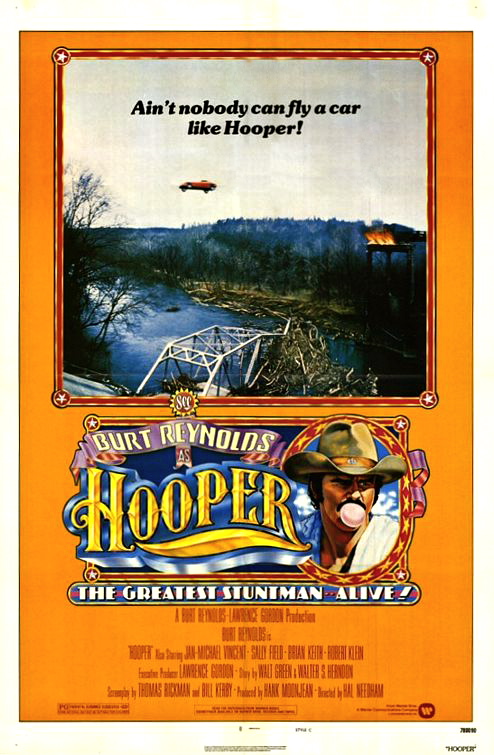
Hooper (1978)


          While this may not sound like the most enthusiastic praise, Hooper is better than most of Burt Reynolds’ myriad car-chase comedies of the ’70s and ’80s. However, because Reynolds’ good-ol’-boy charm was among the most appealing textures in mainstream ’70s cinema, noting that he was at the height of his powers when he made Hooper underscores why the movie works: Despite a story so thin it sometimes threatens to evaporate, Hooper offers 99 minutes of comic escapism driven by the macho charisma of its mustachioed leading man.
          One of several late-’70s/early-’80s film and TV projects celebrating the work of Hollywood stuntmen, Hooper stars Reynolds as Sonny Hooper, an aging daredevil who realizes a career change is imminent because his body can’t take much more abuse. When we meet him, Sonny is employed as the stunt double for Adam West (who plays himself) on the 007-style action picture The Spy Who Laughed at Danger. Despite being a pro who regularly delivers spectacular “gags,” Sonny clashes with the movie’s asshole director, Roger Deal (Robert Klein), since Deal demands impossible results on budget and on schedule, then takes credit for the footage Sonny and his team make possible.
          Sonny is involved with Gwen (Sally Field), the daughter of a retired stuntman (Brian Keith). Because Gwen has seen firsthand what stunt work does to the human body, she’s adamant that Sonny quit, but Deal’s pressure and Sonny’s own vanity become obstacles. Then a hot new stuntman, Delmore “Ski” Shidski (Jan-Michael Vincent), arrives on the scene. Although Sonny recognizes that he’s being replaced with a younger model, he insists on going out with a final super-stunt. The gentle drama of the picture, which obviously takes a backseat to action scenes and jokey interplay, stems from the question of whether Sonny will push his luck too far or succeed in providing Deal with the gag to end all gags.
          Hooper was a bit of a family affair for Reynolds, and the pleasure he presumably derived from making the picture is visible onscreen. The movie reunited Reynolds with his longtime buddy, stuntman-turned-director Hal Needham, following their success with Smokey and the Bandit (1977), and Field was Reynolds’ offscreen paramour in addition to being his frequent costar.
          Needham’s intimate familiarity with the stunt world benefits the movie greatly, because many details—from the preparations of car engines for jumps to the application of Ben-Gay on aching knees—feel effortlessly authentic. And while the character work and dialogue are as simplistic as one might expect from this sort of picture, the key actors are so watchable that we want Deal to get his comeuppance, we want Sonny to succeed, and so on. Plus, of course, the stunt sequences are fantastic, like the elaborate bit during which Sonny and Ski drive a sportscar through an entire town as it’s being demolished.

Hooper: GROOVY

Wednesday, June 20, 2012

Bless the Beasts & Children (1971)


          Adapted from a 1970 novel by Glendon Swarthout, Bless the Beasts & Children is a weird meditation on adolescent angst, the ostracism of oddballs, and the ugliness of killing animals for pleasure. Despite all of these conflicting elements, Bless the Beasts and Children is highly watchable, though perhaps not for any of the reasons producer-director Stanley Kramer intended. The histrionic performances by the child actors comprising the film’s main cast give the picture a so-bad-it’s-good kitsch factor, the overwrought nature of the plot offers the lurid appeal of sensationalism, and the unearned intensity of Kramer’s storytelling commands attention in a traffic-accident sort of way. Bless the Beasts & Children isn’t a disaster, but it’s an oddly beguiling mess.
          The picture begins at a summer camp in Arizona, where counselors train boys in the ways of the Western frontier. The Bedwetters, occupants of the camp’s lowest-ranked cabin, are traumatized because of a recent field trip to a buffalo ranch. During the field trip, the boys witnessed the shooting-gallery slaughter of excess livestock. Led by high-strung John Cotton (Barry Robins), the Bedwetters flee camp one night, intent on freeing the next group of buffalo marked for death. As the movie follows the kids’ odyssey across the Southwest, Kramer cuts to flashbacks of key episodes from each child’s past, and it all leads up to a ridiculous climax filled with Kramer’s usual sledgehammer moralizing.
          The concept of unruly kids sharing an adventure is appealing, so scenes of the Bedwetters traveling through the desert on stolen horses, or zipping down the open road in a stolen car, are lively. Unfortunately, the characterizations are way too arch (for instance, the effeminate Bedwetter complements his uniform with bleach-blonde hair, a headband, and a shag vest) and the villains are preposterously two-dimensional (every adult is a mouth-breathing ogre). On the bright side, the cinematography by Michael Hugo is bright and muscular, while the music is, to say the least, assertive.
          Composers Barry De Vorzon and Perry Botkin Jr. smother the movie with maudlin strings, and one of their principal motifs was later repurposed for Olympics broadcasts as the famous “Nadia’s Theme,” and then again repurposed as the title music for the long-running soap The Young and the Restless. (Years later, the music became the sample underlying Mary J. Blige’s signature song, “No More Drama”). The musical bludgeoning continues in the movie’s main-title song, performed by the Carpenters. (Available through Columbia Screen Classics via WarnerArchive.com)

Bless the Beasts & Children: FUNKY

Tuesday, June 19, 2012

The Town That Dreaded Sundown (1976)


Despite scoring a major hit on the drive-in circuit with his first movie, the Bigfoot-themed mockumentary The Legend of Boggy Creek (1972), low-budget auteur Charles B. Pierce dabbled in stories about Indians and moonshiners before returning to his comfort zone of Southern-fried horror. Once again flimflamming viewers by claiming that a highly fictionalized story was based on true events, Pierce’s The Town That Dreaded Sundown dramatizes the reign of terror that a real-life serial killer inflicted on a small Arkansas town during the 1940s. To give the story momentum, Pierce and his frequent screenwriter, Earl E. Smith, focus on a hard-driving Texas Ranger (Ben Johnson) who tries to capture the murderer. So far, we’re off to a good start—and, indeed, many aspects of The Town That Dreaded Sundown seem promising at first glance. The title is great, the poster is spooky, and the trope of a psycho appearing from darkness wearing a sack over his head while he wields a pitchfork is memorably disturbing. (A long sequence in which the so-called “Phantom Killer” stalks a woman played by Gilligan’s Island star Dawn Wells almost fulfills this gimmick’s promise.) Unfortunately, Pierce’s usual problems with maintaining a consistent tone and sustaining dramatic interest derail the film. Recalling the faux-newsreel style he used for Boggy Creek, Pierce presents most of the movie like a documentary, complete with narration and re-enactments, but he occasionally abandons the style to showcase long stretches of straight narrative. This doesn’t work. Furthermore, a comedy subplot about an inept policeman (played by Pierce) is beyond tiresome, and the murder scenes are so sadistic they feel out of character with the rest of the picture. In other words, enjoy the poster and skip the movie, otherwise you’ll say goodbye to 86 minutes that could have been spent more constructively.

The Town That Dreaded Sundown: LAME

Monday, June 18, 2012

The Hawaiians (1970)


          James Michener’s 1959 novel Hawaii was a major bestseller, but it was also a monster in terms of narrative scope: Sprawling over nearly 1,000 pages, the book traces centuries of history from the formation of the islands by geological forces to the present day at the time of the book’s publication. Therefore, even though Hollywood was eager to capitalize on the novel’s success, putting the entire story onscreen was impossible. Taking a creative approach to the challenge, producer Walter Mirisch decided to film the book as a pair of epic features, but the first picture to be filmed, Hawaii (1966), barely covered one chapter of Michener’s story. Hawaii did well enough that Mirisch pressed forward with the second film, which, given the nature of the source material, is less a continuation of the first picture’s story and more of a companion piece.
          Whereas Hawaii dramatizes early conflicts between European missionaries and Hawaiian natives, The Hawaiians takes place a generation later, when the son of the first movie’s protagonist has grown into a middle-aged bureaucrat named Micah Hale (Alec McCowen). Yet the real center of The Hawaiians is Hale’s cousin, sea captain Whip Hoxworth (Charlton Heston). When the story begins, Whip returns from the sea to accept an inheritance from his recently deceased grandfather. Unfortunately, the estate was left to Hale. Incensed, Whip starts a plantation on the meager stretch of uncultivated land he owns.
          His workers include a pair of impoverished Chinese immigrants, Mun Ki (Mako) and Wu Chow’s Auntie (Tina Chen). (The relationship between these characters is way too complicated to describe here.) To endow his plantation with a unique cash crop, Whip sails to French Guiana and steals pineapples, which are not yet being grown in Hawaii. Wu Chow’s Auntie proves adept at nurturing the plants, so Whip gives her some land to start a small farm of her own. Thus, the foundations of two parallel dynasties are formed. The movie tracks Whip’s ascension to supreme wealth as an agricultural tycoon, and the rise of Wu Chow’s Auntie as the matriarch of an expansive immigrant clan. The picture also features subplots about leprosy, mental illness, political unrest, and other intense subjects.
          The Hawaiians crams an enormous amount of narrative into 134 minutes, and much of what happens onscreen is interesting, like the arcane workings of the Chinese community in Hawaii. However, tackling so much material gives the picture a diffuse quality. Director Tom Gries handles individual scenes with workmanlike efficiency, but neither he nor screenwriter James R. Webb are able to forge a unified statement. One episode unfolds after another, time passes, and a resolution of sort arrives, but it’s all somewhat random.
          It doesn’t help that the film’s central performance is its least compelling, since Heston grimaces and growls in his usual blustery manner. Chen and Mako do much more nuanced work, although the age makeup applied to Chen in later scenes is unconvincing. (McCowen is too polite to make much of an impression.) The Hawaiian locations are, of course, quite beautiful, so the land itself becomes the most arresting character—it’s easy to see why generations of people battled for control over this vast paradise of adjoining islands. (Available as part of the MGM Limited Collection on Amazon.com)

The Hawaiians: FUNKY

Sunday, June 17, 2012

The Last Detail (1973)


          Jack Nicholson’s post-Easy Rider ascension to Hollywood’s A-list continued with The Last Detail, a crowd-pleasing road movie of sorts dominated by the raunchy Navy sailor whom Nicholson portrays with manic intensity. Written by Robert Towne from Darryl Ponicsan’s novel, and directed by the peerless humanist Hal Ashby, The Last Detail begins when enlisted men Buddusky (Nicholson) and Mulhall (Otis Young) get assigned to a demeaning task: They’re to escort a sailor named Meadows (Randy Quaid), who has been sentenced to eight years in jail for petty theft, across several states so he can commence his incarceration.
          Buddusky is a heavy-drinking troublemaker who peppers nearly every sentence with some variation of the word fuck, and Mulhall is a savvy African-American whose strategy for survival is flying below The Man’s radar. Buddusky convinces Mulhall to drag out their transport duty so they can pocket extra per-diem money, and once they meet Meadows, both men become sympathetic to the kid’s pathetic circumstances. A simple-minded stooge whose real crime was pissing off a superior officer, Meadows is so green that he’s never had booze, cigarettes, or sex. Buddusky decides to ensure Meadows experiences all three before hitting the brig, so the trio’s journey becomes a hell-raising odyssey.
          Some of the episodes are exactly what one might expect, like a brawl with a group of Marines, but others exude pure early-’70s quirkiness. The sailors meet a hippie chick who meditates with Far East chanting, so Meadows picks up the habit, and the sailors make a pit stop at Meadows’ home to discover the bleak reality he left behind when he joined the Navy. The Last Detail walks a fine line between comedy and drama, often pivoting instantaneously from raucous to somber and back again. While Ashby’s masterful control of tone anchors the storytelling, the picture rises to an even higher level on the strength of the performances.
          Quaid works the weird gentle-giant vibe that characterized many of his early roles, and it’s to his great credit that Meadows keeps surprising us right through to the final scene. As for Nicholson, his flamboyant turn in The Last Detail cemented his cinematic persona. And while he’s probably over the top in many respects, exaggerating his character’s volatility almost to the point of seeming insane, excess seems like an appropriate acting choice since Buddusky’s supposed to represent the male animal cut loose from decorum and propriety. (Young is fine, by the way, but his character is so underdeveloped that he’s regularly eclipsed by his costars.)
          The Last Detail isn’t perfect, given its weakness for clichés like the hooker with the heart of gold (Carol Kane plays this thankless role with a blend of cynicism and sweetness). Nonetheless, by the time the movie reaches its downbeat finale, Ashby and his collaborators have delivered a potent statement about the limitations that bureaucracies—and, really societies in general—place upon individuality.

The Last Detail: RIGHT ON