Showing posts with label david doyle. Show all posts

Thursday, November 17, 2016

My Boys Are Good Boys (1978)


A combination heist thriller and youth drama, My Boys Are Good Boys is awful in that it lacks consistent style, narrative credibility, and a viable theme. Nonetheless, some viewers might find the movie strangely interesting because three actors from another era participate. Their scenes are old-fashioned but slick, whereas vignettes concerning the activities of juvenile delinquents (which comprise the bulk of the running time) are relatively contemporary. These disparate elements clash badly, but that’s what gives My Boys Are Good Boys its minor train-wreck appeal. The nominal protagonist is working stiff Bert Morton (Ralph Meeker). His son, Tommy (Sean Roche), is the ringleader for a group of underage inmates. One day, they immobilize guards at their reformatory and escape so they can rob an armored truck. Bert is the truck’s driver, so the crime is fraught with Oedipal issues. Had this story been executed with any real skill, it could have been provocative. Alas, cowriter-director Bethel Buckalew is borderline incompetent, and Meeker, who also produced the picture, torpedoes the project with a lifeless non-performance. Costarring with Meeker are fellow Hollywood veterans Ida Lupino (as Bert’s wife) and Lloyd Nolan (as a dogged investigator). Despite Meeker’s low energy, these three create a veneer of studio-era professionalism. Separately, scenes with Tommy and his young accomplices recall The Bad News Bears (1976), with a diverse group of crude kids making mischief. Inexplicably, these teenaged thieves gain a bottomless supply of knockout gas and, just for good measure, a smoke grenade. Oh, well. The film’s title connects to a pair of horrid elements, the countrified theme song and a bizarre monologue delivered by reformatory guard Harry Klinger (David Doyle). That this relatively minor character vocalizes the moral of the story is typical of the film’s discombobulated nature.

My Boys Are Good Boys: LAME

Thursday, August 13, 2015

Charlie’s Angels (1976)


          Nearly all the elements that made the glossy detective series Charlie’s Angels popular are present in the feature-length telefilm that preceded the weekly show, and yet some early ideas that were later abandoned are in evidence, as well. The pilot is just as fluffy and silly as the rest of the series, although the T&A quotient is relatively tame considering how much focus was later given to displaying the series’ leading ladies in bikinis, cheerleader costumes, low-cut gowns, and such. Rather than cleavage and legs, the caveman-mentality focus is primarily on the “novelty” of beautiful women demonstrating competence as private investigators, although the distaff detectives get even more male supervision during the pilot than they usually did in their weekly adventures.
          The pilot introduces the three original protagonists—Jill Munroe (Farrah Fawcett-Majors), Kelly Garrett (Jaclyn Smith), and Sabrina Duncan (Kate Jackson)—receiving their first assignments from mysterious employer Charles Townsend (the never-seen character whose voice is provided by John Forsythe). In a brief prologue that later became the show’s iconic opening-credits sequence, viewers are told that the women graduated from the police academy only to be given thankless jobs, and then were hired to work for Townsend. The Angels, as Townsend calls them, take instructions from their direct supervisor, Woodville (David Ogden Stiers), a character who was dropped before the first regular episode. The ladies’ other male colleague is fellow detective John Bosley (David Doyle), portrayed in the pilot as a cheerful buffoon and later reworked as stalwart coworker.
          Written by series creators Ivan Goff and Ben Roberts—veteran screenwriters whose collaborative record stretches all the way back to the James Cagney classic White Heat (1949)—the mystery that the Angels explore in the pilot isn’t really a mystery. Undoubtedly bearing the fingerprints of producer Aaron Spelling, who made a fortune playing to the lowest common denominator of the American viewing audience, the narrative is spoon-fed to viewers, with every complication explained in a condescending manner. The daughter of a wealthy California vintner disappeared years ago, and now that the vintner has also disappeared, his estate may fall into the hands of his unscrupulous widow. It’s up to the Angels to determine whether anything shady is happening, thus prompting the usual cycle of Jill, Kelly, and Sabrina masquerading as various people in order to find information.
          The supporting cast features solid players Bo Hopkins and Diana Muldaur, as well as a young Tommy Lee Jones, and the whole thing drags a bit, not just because the thin story is stretched to almost 80 minutes but because composer Jack Elliot uses the series’ signature twinkling musical sting so many times the cue becomes annoying. Seeing as how Fawcett-Majors was the first season’s breakout star thanks to her dazzling barrage of big hair, erect nipples, and shiny teeth, it’s interesting to note that Smith gets the most screen time in this initial outing. As always, she’s lovely but vapid. In any event, Charlie’s Angels the pilot movie is exactly as disposable as any episode of Charlie’s Angels the series, so the appeal of watching the piece (besides eye candy) is the opportunity to examine the unremarkable beginnings of an enduring pop-culture franchise.

Charlie’s Angels: FUNKY

Thursday, September 27, 2012

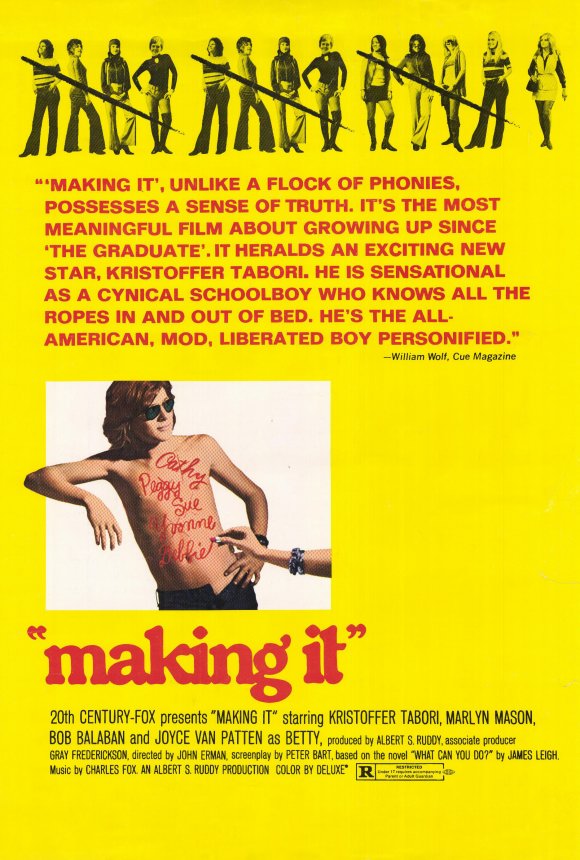
Making It (1971)


          When the lyrics of a movie’s opening theme proclaim, “Everybody’s busy learning yesterday, but I’m into tomorrow—that’s a better way,” you know you’re in for a dated Generation Gap story about a hip kid showing uptight adults what it’s all about, man. And while many movies of this stripe are unwatchable today, thanks to arrogant leading characters and pretentious themes, Making It is more worthwhile than its lurid title might suggest. The hero of the piece is Phil (Kristoffer Tabori), a high-school schemer who’s juggling sexual affairs with Debbie (Sherry Miles), a dim-bulb classmate, and Yvonne (Marlyn Mason), the horny wife of his gym coach. Meanwhile, Phil’s mom, Betty (Joyce Van Patten), is a lonely divorcée looking to start over with bland but reliable businessman Warren (Dick Van Patten), who happens to be married to another woman. The depiction of Phil’s home life explains why he finds monogamy overrated, but as the story progresses, Phil discovers the consequences of cocksmanship—he gets Debbie pregnant, runs into a hassle with Yvonne’s husband, and so on.
          Until his comeuppance, Phil is a self-aware operator who talks the talk of a disaffected ’70s rebel in order to court older women (sample pickup line: “That’s where it’s at, being honest with each other”). Yet the filmmakers ensure that we can always see the naïve young man beneath the swaggering façade. All of this may sound rather ordinary, and, indeed, Making It is a minor film in every way. However, the picture’s acting, direction, and writing are so smooth that Making It ends up exemplifying the entire post-Graduate genre. More importantly, the film follows its storyline to a logical conclusion instead of merely stirring up unresolved ambiguity.
          Tabori, the son of B-movie director Don Siegel, is strong in the leading role, effectively blending innocence with sass, and the supporting players are solid—the cast also includes Bob Balaban, as Phil’s snide crony, and David Doyle, as an exasperated administrator. Prolific character actor Lawrence Pressman is especially good as a teacher who sarcastically challenges Phil’s vision of kids leading the charge for social change: “I propose a new flag,” the teacher says at one point, “no stars, just acne.” A little much, sure, but it gets the point across. Interestingly, the film’s screenplay was penned by then-studio executive Peter Bart, who later gained fame as the editor-in-chief of Variety and as the host of various TV shows about showbiz. Nice to know he made a respectable effort during his brief tenure in the trenches of Hollywood’s creative scene.

Making It: GROOVY