Showing posts with label gary lockwood. Show all posts

Tuesday, April 18, 2017

Stand Up and Be Counted (1972)


          In what should be a standout moment during the feminism-themed comedy Stand Up and Be Counted, ladies meet for a rap session about their encounters with sexism. Participants include Dr. Joyce Brothers (as herself), future Jeffersons star Isabel Sanford, and a nun. Alas, comedic sparks never fly, because like the rest of this flat-footed studio picture written and directed by men, the scene devolves into oversimplifications and slogans. Progressive-minded producer Mike Frankovich and his collaborators, director Jackie Cooper and screenwriter Bernard Slade, seem as if they perceived the women’s-lib movement as a whimsical fad. To a one, the feminists in this movie are portrayed as shrill whiners whose only real accomplishment is alienating the men in their lives. The picture ends on a fairly hip note, so it’s not quite as dunderheaded an affair as the preceding remarks might suggest. Nonetheless, there’s a reason Stand Up and Be Counted is not remembered as a milestone in Equal Rights Amendment-era propaganda.
          Jacqueline Bisset stars as Sheila, a fashion reporter assigned to do a magazine story on the burgeoning women’s movement. To do so, she flies to her hometown of Denver. (The script pathetically explains Bisset’s English accent by saying she spent time in London.) During the flight, Sheila rekindles her romance with an ex, Elliot (Gary Lockwood). In Denver, Sheila discovers that her mother is part of a “Senior Women’s Liberation” organization, and that her ultra-feminist younger sister, Karen (Lee Purcell), wants to hire a man to impregnate her. Torn between new and old ideas about gender roles, Sheila moves in with Elliot, only to discover he’s a patronizing chauvinist. Other threads involve a housewife rebelling against her domineering husband, and a trophy wife demanding respect for the work she does at her husband’s bra factory.
          Stand Up and Be Counted is one of those bad movies that isn’t really a bad movie. In its clumsy way, the film means well, but problems compound problems. Sheila is a hopelessly passive character, thus draining the movie of momentum, and supporting players deliver livelier work than Bisset, causing her presence to seem ornamental. (She’s simultaneously breathtaking and uninteresting.) Lockwood’s performance is lifeless, Purcell is feisty but underused, and minor turns by comic pros including Hector Elizondo, Steve Lawrence, Loretta Swit, and Nancy Walker offer only fleeting relief from the overall mediocrity. FYI, although Helen Reddy’s anthem “I Am Woman” plays during the closing credits, it was not composed for the picture. After releasing the tune a year before, Reddy re-recorded “I Am Woman” for Stand Up and Be Counted, and the second version became a hit.

Stand Up and Be Counted: FUNKY

Wednesday, March 2, 2016

Bad Georgia Road (1977)


While some viewers might enjoy huffing Bad Georgia Road as a straight shot of clichéd moonshine-cinema stupidity, the picture is unimpressive even by the low standards of its drive-in-friendly genre. Yes, Bad Georgia Road has betrayal, brawls, chases, drunkenness, sex, shotguns, skinny-dipping, and nearly every other signifier associated with ’70s redneck flicks. What it lacks, however, is spunk. Whereas the best moonshine flicks roar through the backwoods on overdrive, Bad Georgia Road ambles through the same territory in a frustratingly low gear. Carol Lynley plays bitchy New Yorker Molly Golden, who inherits an estate in rural Georgia. Told she can cash out the estate for $100,000 if she shows up in person to sign papers, Molly quits her job and drives to Georgia. Upon arrival, Molly realizes she’s been duped—a lawyer persuades her to sign over the $100K to creditors, so her real inheritance comprises a decaying house, a few acres of land, and a ramshackle moonshine operation. Left with no options, Molly takes over the operation and clashes with her driver, Leroy Hastings (Gary Lockwood), an alcoholic womanizer. Predictably, other local moonshiners declare war on Molly’s operation. As B-movie setups go, this isn’t bad. Unfortunately, Lynley is shrill and uninteresting in the leading role, while Lockwood is questionable as her loutish compatriot. His accent is dodgy, his mannerisms are cartoonish, and he seems bored in most scenes. Everything in Bad Georgia Road feels trite, and the Taming of the Shrew dynamic between the leading characters is so retrograde as to seem grotesque. After all, Bad Georgia Road is one of those icky “lighthearted” movies in which the hero seduces the heroine by raping her. Thanks, but no thanks.

Bad Georgia Road: LAME

Wednesday, November 4, 2015

The Ghost of Flight 401 (1978)


          Given their low budgets and quick turnaround times, TV movies have always been able to jump on both cultural trends and ripped-from-the-headlines stories more easily than theatrical features. That's one reason why numerous ’70s telefilms dramatize sensationalistic events with supernatural connotations. “Weird news” items lacking the factual foundation and/or social significance to merit feature treatment were ideal fodder for movies of the week. All of this should set the proper context for The Ghost of Flight 401, a slight but somewhat thoughtful riff on strange phenomena that followed the crash of a commercial airliner in Florida. In real life, people reported hearing, seeing, and even smelling the ghost of the doomed plane's copilot long after he died from injuries sustained in the crash.
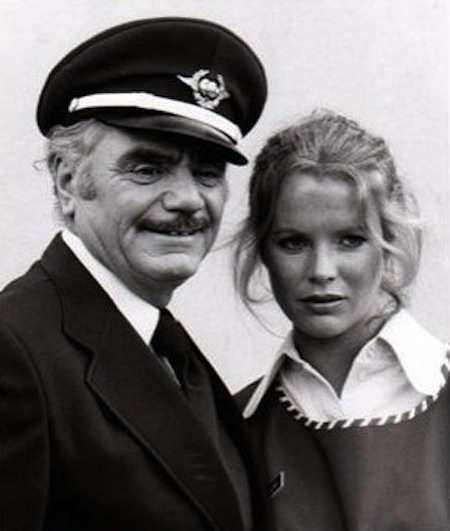
          After the usual gravitas-laden opening narration warning viewers that what they're about to see maybe-kinda-sorta could have actually happened, the picture introduces veteran flyer Dom Cimoli (Ernest Borgnine), a likeable family man with a weakness for Bay Rum cologne. Despite a premonition from his wife that something bad is about to happen, Dom joins the cockpit crew of a plane that suffers landing-gear failure, loses altitude, and crashes in the Everglades. Among the few survivors is flight attendant Prissy Frasier (Kim Basinger). She and others who knew Dom sense his presence in the days and weeks after the crash, first by catching a whiff of Bay Rum and then by actually seeing his physical body for fleeing moments. Airline administrator Jordan Evanhower (Gary Lockwood), an avowed agnostic, dismisses the sightings as mass hysteria, so when Prissy swears she encountered the deceased Dom on a night flight, Jordan tells her she needs to see a shrink before returning to duty. Eventually, enough people report sightings that Jordan is forced to broaden his horizons, leading to a kicky final act.
          As directed by the capable Steven Hilliard Stern, The Ghost of Flight 401 doesn't break ground in terms of otherworldly thrills. Instead, the film effectively depicts the emotional states of otherwise rational people who encounter things beyond their understanding. Stern guides actors toward restrained, tense performances, and cinematographer Howard Schwartz bathes everything in evocative shadows that Stern maximizes with elegant camera moves. Calling The Ghost of Flight 401 a cut above the normal made-for-TV fare would be exaggerating, and it's worth noting that Borgnine's screen time is limited (although Basinger, in one of her earliest roles, is quite prominent). Nonetheless, the respectful way that the filmmakers explore such pseudoscientific concepts as pscyhometry makes The Ghost of Flight 401 more ruminative than exploitive.

The Ghost of Flight 401: FUNKY

Tuesday, October 14, 2014

Project: Kill (1976)


Shot in the Philippines by an American director with American leading actors, this shoddy action/thriller picture contains a handful of moments that almost work, but the movie overall is incoherent and inept. Leslie Nielsen, back when he was still a wooden dramatic actor, stars as John Trevor, the chief instructor at a secret training camp for government operatives. He’s grown weary of using drugs and mind control to transform recruits into killers, so he flees the base and seeks refuge with former war buddies who are based in the Philippines. Meanwhile, the government sends John’s lieutenant, Frank Lasseter (Gary Lockwood), to track him down. Complicating matters is the fact that both men use the same drugs as their trainees, so John is going through painful withdrawal. Another wrinkle is the murky presence of a Filipino crime boss, Alok Lee (Vic Diaz), who wants to find John before Frank does. In theory, Project: Kill should be a simple chase story. In practice, however, it’s a mess. Director William Girdler, who generally fared better in the realm of monster movies, can’t do much of anything with the jumbled script, which is credited to David Seldon and Galen Thompson. Moreover, Girdler botches many scenes by creating logic gaps the size of the Grand Canyon. For instance, many scenes feature characters walking away from fistfights and/or shootouts as if nothing happened. Similarly, John spends most of his time romancing a pretty Chinese woman, Lee Su (Nancy Kwan), even though he knows his brain is disintegrating and even though he’s supposed to be finding a safe hideout. Furthermore, the picture’s action scenes are confusing—Frank and John are supposed to be super-deadly martial artists, but Lockwood (who is genuinely terrible in the film) and Nielsen move with the grace of skid-row drunks. Project: Kill also suffers from cheap production values and nonexistent transitions between scenes. Capping all of these problems is the difficulty of taking Nielsen seriously, given his subsequent career as a comic actor. In fact, one scene features a line Nielsen could have delivered in one of his Naked Gun movies—while lamenting to Lee Su that it’s hard to shake his mind control, John says, “I’m not programmed to love.”

Project: Kill: LAME

Sunday, September 18, 2011

R.P.M. (1970)


          Though admirable for his commitment to exploring progressive causes onscreen, producer-director Stanley Kramer was also a total square whose movies were so conventional they felt ancient even when they were new. That’s certainly the case with R.P.M. (the poster of which provides the handy translation Revolutions Per Minute), which explores the student unrest that was pervasive on college campus circa the late ’60s. However, instead of building his movie around a student leader whose experiences might illuminate issues related to the counterculture, Kramer focuses on a fiftysomething professor who’s so “hip” to the youth scene that his live-in girlfriend is a 25-year-old grad student (Ann-Margret). Yes, in Kramer’s archaic viewpoint, being a dirty old man is a revolutionary act.
          Further identifying this weird movie as an establishment statement about anti-establishment themes, studio-era leading man Anthony Quinn stars as Professor Paco Perez, a social-sciences specialist recruited by his school’s board of trustees to serve as an interim president after students storm the administration building and force the resignation of the previous president. With his hep-cat clothes and “rebellious” motorcycle, Paco swings to the same lefty tune as student leaders Rossiter (Gary Lockwood) and Dempsey (Paul Winfield), but once Paco starts engaging in rap sessions with the protestors, he discovers the gulf between his grown-up pragmatism and the kids’ all-or-nothing extremism. This renders the whole film somewhat pointless, because the focus on the uninteresting topic of Paco’s midlife crisis pushes the whole subject of student unrest into the background.
          That said, R.P.M. is strangely watchable. Kramer’s filmmaking is energetic, even though he opts for borderline embarrassing vignettes like a dream sequence in which school administrators are seen as clowns. There’s also considerable pleasure to be found in watching Kramer struggle with the movie’s climax, because his shots of the inevitable student riot are laughably overwrought. Furthermore, the dialogue is like a greatest-hits collection of ’60s slang; R.P.M. was penned by future Love Story author Erich Segal, who knew a thing or two about tapping into the zeitgeistLeading man Quinn is comparatively restrained, embracing the talky role of an intellectual as a switch from his usual casting as animalistic macho men. Lockwood, best known for his costarring role in 2001: A Space Odyssey (1968) is quietly charismatic; Winfield is characteristically intense; and Ann-Margret’s sex appeal is as formidable as always.
          Ultimately, R.P.M. is fascinating not only for its clumsy onscreen examination of the generation gap, but because its very style demonstrates the breadth of that gap—in every scene, it’s painfully obvious that Kramer and the kids he’s depicting come from totally different worlds. (Available through Columbia Screen Classics Request via WarnerArchive)

R.P.M. : FUNKY