Showing posts with label raymond st. jacques. Show all posts

Monday, July 27, 2015

Book of Numbers (1973)


A soufflé that wasn’t kept in the oven long enough to rise, the blaxploitation period drama Book of Numbers suffers from choppy storytelling, erratic acting, and a general lack of narrative focus. The only movie directed by versatile African-American actor Raymond St. Jacques, who plays a supporting role even though he’s billed as the lead, Book of Numbers is a discombobulated movie that appears to have been cobbled together from incomplete principal photography and then infused with lengthy passages of voiceover that explain the plot. Based on a novel by Robert Deane Pharr, the picture is set in Depression-era Arkansas. Fast-talking young hustler Dave (Philip Michael Thomas) and his middle-aged friend, Blueboy (St. Jacques), quit their jobs as waiters in order to become bookies in a small black community. Their encroachment into lucrative terrain angers a white gangster, who sends thugs to harass Dave and Blueboy. Meanwhile, Dave romances pretty Kelly Simms (played by “Band of Gold” singer Freda Payne). Violent confrontations ensue, leading inevitably to tragedy. Even though Book of Numbers is only 81 minutes long, some pointless scenes stretch on to interminable lengths, notably a music-driven church service. St. Jacques the director also squanders St. Jacques the actor, giving all the juiciest material to Thomas, later of Miami Vice fame. Although Thomas attacks his role vigorously, he comes across as more arrogant than empathetic. As such, it’s nearly impossible to care what happens, even on the rare occasions when the story temporarily achieves clarity and momentum. Oh, and word to the wise—the most widely available video master of this movie is ghastly, with atrocious image reproduction and muddy sound. Better presentation would improve the experience, but the catastrophic narrative problems would still be present.

Book of Numbers: LAME

Monday, June 29, 2015

Born Again (1978)


          This milquetoast religious drama credits Jesus with the redemption of lawyer-turned-Nixon-advisor Charles Colson, who was convicted and imprisoned for his role in the Watergate cover-up. Based on Colson’s book, the movie takes its title from Colson’s conversion to fundamental Christianity in the period between his departure from the White House and his entrance into a federal work farm. Viewers are asked to believe that the Charles Colson who naïvely followed Nixon’s orders was a different man from the Charles Colson who bravely accepted responsibility for crimes against the U.S. Constitution. And if this sounds like an awfully convenient explanation, then, well, who ever knows the truth of what happens inside another man’s soul?
          Written and shot in the perfunctory style of an assembly-line TV movie, Born Again stars Dean Jones—best known for a string of silly Walt Disney comedies—as Colson. His performance is adequate at best, because whenever Jones peels off his glasses to cradle his face in his hands and weep, he seems more robotic than sincere. Like Jones’ performance, the script by Walter Bloch depicts Colson’s conversion without actually making a case for why viewers should believe what they’re seeing. During the heat of the Watergate investigation, Colson’s rich friend Tom Phillips (Dana Andrews) explains that he was born again after realizing that wealth is an empty reward. This encounter flicks a switch in Colson’s mind. Overnight, he begins spouting Bible passages. He also builds bridges with onetime political enemies who share his love for Jesus. By the time Colson is an inmate, leading Bible-study lessons and wooing African-American criminal Jimmy Newsom (Ramond St. Jacques) to the bosom of the lord, the whole movie feels a bit silly, especially since scene after scene is underscored with saccharine music.
          Yet the most egregious shortcoming of Born Again might be the way the filmmakers lay all the blame for Colson’s problems solely on Nixon. After all, wasn’t the lesson of Watergate that we need to beware political conspiracies, not just overzealous individuals? And doesn’t the suggestion that Nixon was some earthly agent of the devil absolve people like Colson of personal responsibility? With all due respect to the faithful people who made this movie—which was coproduced by an entity called Prison Fellowship Ministries—briskly discarding issues of ambition, complicity, greed, moral relativism, and willful ignorance seems both rhetorically and socially dubious.

Born Again: LAME

Monday, March 3, 2014

Cotton Comes to Harlem (1970) & Come Back, Charleston Blue (1972)


          Most reputable sources peg 1971, the year of Shaft and Sweet Sweetback’s Baadasssss Song, as the beginning of blaxploitation—yet two 1970 releases, Cotton Comes to Harlem and They Call Me MISTER Tibbs!, contain many signifiers closely associated with the genre. For instance, both movies include funky soundtracks, primarily black casts, and urban milieus. Tibbs!, of cousrse, is a sequel In the Heat of the Night (1967), whereas Cotton Comes to Harlem, cowritten and directed by African-American actor/playwright/activist Ossie Davis, is a whimsical celebration of modern black life, depicting a wide range of characters occupying a spectrum of social stations. Exploitation? Far from it. That’s why Cotton Comes to Harlem is interesting as a cultural milestone. As entertainment, however, Cotton Comes to Harlem isn’t quite as noteworthy.
          Based on a novel by Chester Himes, the movie is absurdly over-plotted and overpopulated, with a story that’s alternately difficult to believe and difficult to follow. The shortest possible summary is this: After a robbery/shootout disturbs a public rally, black NYPD detectives Coffin Ed Johnson (Raymond St. Jacques) and Gravedigger Jones (Godfrey Cambridge) investigate a criminal conspiracy related to flamboyant preacher Duke O’Malley (Calvin Lockhart). A wild chase/investigation involving angry citizens, drugs, drunks, revolutionaries, riots, stolen money, wronged women, and a giant bale of cotton unfolds, with scenes taking place throughout Harlem—culminating in a hellzapoppin finale on the stage of the Apollo Theater.
          Cotton Comes to Harlem is filled with provocative ideas and vivid performances, so it’s never boring. In fact, some parts might be too vivacious, with actors including Lockhart going way over the top at regular intervals. Conversely, Cambridge and St. Jacques are likeably cool and cynical throughout the piece, while iconic comedian Red Foxx—in one of his few movie roles—is surprisingly restrained. So, even though Cotton Comes to Harlem is bit of a mess, there’s something edifying about seeing what conscientious artists did with the same narrative DNA that, just a short while later, produced the dubious universe of blaxploitation.
          Cambridge and St. Jacques reprised their detective roles two years later in Come Back, Charleston Blue, which was adapted from another of Hines’ novels. This time around, the director was Mark Warren. The sequel is more disciplined than its predecssor, in both good and bad ways. While the stoyline of Come Back, Charleston Blue is a bit easier to track than that of Cotton Comes to Harlem, the second movie doesn’t have quite as much exuberance. That said, Come Back, Charleston Blue offers a faint echo of the charms that made Cotton Come to Harlem interesting, namely the offbeat fusion of comedy and drama and the loving depictions of black culture. Coffin Ed and Gravedigger, as well as other principal characters, are introduced during a charity ball that climaxes with a nasty murder. Eventually, the detectives learn that someone is playing vigilante by killing local mobsters, using straight razors to slit the throats of criminals plaguing Harlem neighborhoods. Clues suggest the culprit might by a fellow nicknamed Charleston Blue, who waged a similar war on crime years earlier but has long been thought dead.
          As Coffin Ed and Gravedigger search for the real identity of the avenger, they get into hassles with their superiror officer, Captain Bryce (Percey Rodrigues), and they dig around the activities of a photographer/activist named Joe (Peter De Anda). Along the way, the detectives get demoted to beat cops, employ various silly disguises, and survive lots of slapstick antics. Like the previous movie, Come Back, Charleston Blue is unweildly in terms of tone, bouncing between cartoonish comedy and extreme violence, but some of the elements work well, such as a running joke about a precocious street kid. Oddly, the leading actors are underused, since the filmmakers get disracted by nonsense. (What’s with the homage to The Public Enemy, the 1931 gangster classic with James Cagney?) This results in episodic pacing that makes Come Back, Charleston Blue feel overlong and sluggish.
          Perhaps that’s why Coffin Ed and Gravedigger didn’t appear onscreen again until A Rage in Harlem (1991), featuring Sam Pierce and George Wallace in the roles.

Cotton Comes to Harlem: FUNKY
Come Back, Charleston Blue: FUNKY

Wednesday, August 22, 2012

Cool Breeze (1972)


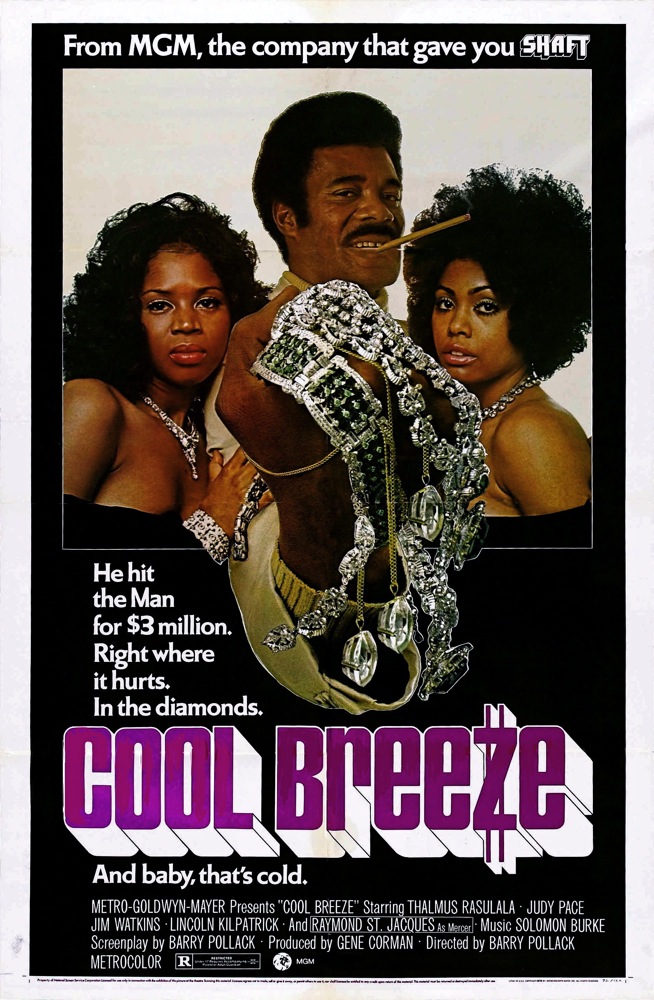
          A blaxploitation take on W.R. Burnett’s classic crime novel The Asphalt Jungle—previously filmed as a 1950 film noir by director John Huston—Cool Breeze nearly works. The intricate story about a criminal mastermind gathering cohorts for a jewel heist is filled with betrayal and danger, so the narrative fits comfortably into the blaxploitation milieu. Furthermore, the film’s acting is generally very strong. However, first-time writer-director Barry Pollack’s inexperience shows. He fails to reveal exposition clearly, so it’s hard to track who’s doing what to whom, and nearly every scene has the same level of intensity, which creates tonal monotony. That said, the picture has a gritty look and a thumping soul-music soundtrack, so what it lacks in narrative polish, it makes up for in tough atmosphere.
          The antihero of the piece is Sidney Lord Jones (Thalmus Rasulala), a slick thief who just bribed his way out of prison. Planning the robbery of a vault containing diamonds worth millions of dollars, Sidney gets into business with Bill Mercer (Raymond St. Jacques), a wealthy crime boss who agrees to bankroll the job. Sidney then hires accomplices including a priest who moonlights as a safe-cracker and a ne’er-do-well Vietnam vet who provides muscle. Also lurking around the story are various cops—some corrupt, some honest—including the unhinged Lt. Brian Knowles (Lincoln Kilpatrick).
          The movie toggles between subplots at weird rhythms, as if Pollack can’t decide whether he’s making an ensemble piece or telling Sidney’s story, but many vignettes are vivid. On the lurid side of the spectrum, the always-ravishing Pam Grier shows up for one sexy scene as a hooker servicing Sidney, and on the character-driven side of the spectrum, supporting actor Stewart Bradley entertainingly chews through his role as an exasperated police captain. (Discovering that Mercer has a young mistress, Bradley goes off on a rant: “I can tolerate a little masturbation. I can tolerate a little sodomy. Let him cavort with a cow! But an old man with a nice, pretty, young girl—that’s too much.”)
          Playing a bookie helping Sidney set up his team, Sam Laws gives the movie’s most amusing performance, because his character is likeable, flabby wimp who whines whenever danger is near. As for Rasulala, he’s appropriately cocky and smooth throughout the picture. Had Pollack’s skills been sharper, this same cast and story could have coalesced into something really memorable; as is, Cool Breeze is entertaining but frustrating. (Available at WarnerArchive.com)

Cool Breeze: FUNKY