Showing posts with label thalmus rasulala. Show all posts

Monday, September 12, 2016

Mr. Ricco (1975)


          It’s not wrong to describe Mr. Ricco as disposable escapism featuring a past-his-prime star pandering to cinematic fashion by appearing in a gritty urban thriller with more than a little Dirty Harry in its DNA. And, indeed, very little about Mr. Ricco or leading man Dean Martin’s performance will linger in your memory after you watch the picture. So whether or not you dig this flick depends almost entirely on your appetite for that quintessential ’70s-cinema vibe. Shot in slick widescreen on dingy and glamorous locations throughout San Francisco, Mr. Ricco has a hip attitude, a jangly jazz score, lively supporting performances, plenty of violence, and a smidgen of sarcasm thanks to the title character’s wiseass dialogue. If you go for this sort of thing, you’ll devour Mr. Ricco like a hearty serving of comfort food. If not, you’ll likely—and understandably—dismiss the picture as soulless Hollywood product.
          Martin plays a defense lawyer named Joe Ricco, and the filmmakers embellish the title role with colorful flourishes. Joe’s a smooth-talking widower whose friendships with cops blur ethical boundaries, he cheats at golf, and he tolerates all the weed his young associates smoke while doing legal research, because, hey, live and let live. When the story begins, Joe gets black radical Frankie Steele (Thalmus Rasulala) acquitted on murder charges, earning adoration from the counterculture and enmity from the Establishment. After two cops are killed, Frankie emerges as Suspect No. 1, so Joe gets pulled into dual intrigue—even as he investigates whether Frankie’s really guilty, he tries to track the fugitive down before trigger-happy police find him. Notwithstanding a few subplots, the most important of which involves a mystery figure who might or might not be Frankie trying to kill Joe at regular intervals, that’s basically the plot. What Mr. Ricco offers beyond its serviceable narrative is vivacity. Future sitcom star Cindy Williams appears briefly as Joe’s spunky secretary, and future Miami Vice guy Philip Michael Thomas plays a suspect whose sister hires Joe. Reliable character actor John Quade turns up in a couple of scenes as a grinning pimp. Oh, and Frankie leads an underground group called the Black Serpents. You get the idea.
          Director Paul Bogart doesn’t drench every scene in style, but he uses well-chosen actors and locations to create a world that feels coherent, if not necessarily realistic. Accordingly, all the menacing and posturing and scheming in this movie goes down smoothly, particularly when the nocturnal, small-combo syncopation of Chico Hamilton’s score enlivens the images. Plus, every so often, the picture embraces its own cartoonishness, as in this monologue from Joe’s police-captain friend George, played with gritted-teeth crankiness by Eugene Roche: “I don’t need you to tell me my job. I’ve been doing it for 20 years—20 years of being shot at and beat up on by sick, filthy creeps whose own mothers would’ve flushed ’em down the toilet if they’d known how they were gonna turn out!”

Mr. Ricco: GROOVY

Wednesday, May 21, 2014

Bucktown (1975)


          One of my favorite ’70s drive-in flicks is the violent oddity Vigilante Force (1976), starring Jan-Michael Vincent as a redneck who recruits his Vietnam-vet brother, played by Kris Kristofferson, to clean up a town that’s become infested by unruly newcomers. Alas, the cure is worse than the disease, because Kristofferson’s character and his hired guns seize control of the town, forcing a showdown with Vincent’s character. Anyway, go figure there’s a blaxploitation movie with virtually the same plot. Released more than a year before Vigilante Force, the far less satisfying Bucktown stars Fred Williamson as a tough guy named Duke Johnson. When the story begins, Duke returns to his Southern hometown, which is nicknamed “Bucktown” by racist white authorities because of the municipality’s large concentration of black citizens, in order to attend his brother’s funeral. Duke quickly learns that his brother, who owned a nightclub catering to black customers, was murdered, and that cops under the supervision of Chief Patterson (Art Lund) mercilessly squeeze African-American business owners for protection money. Determined to set things right, Duke reopens his brother’s club and summons his badass buddy Roy (Thalmus Rasulala) from Chicago with a request to “bring muscle.” Together, Duke, Roy, and Roy’s hired guns topple Chief Patterson’s operation, but then Roy decides to establish himself as the new underworld king of Bucktown.
          Naturally, even though Duke spendt the first half of the movie proclaiming his intention to leave Bucktown after defeating Chief Patterson, Duke decides to stay and fight Roy. Part of Duke’s motivation, of course, is a burgeoning romance with local beauty Aretha, played by the va-va-voom Queen of Blaxploitation herself, Pam Grier.
          As written by Bob Ellison and directed by the perpetually disappointing Arthur Marks, Bucktown is a compendium of missed opportunities. The characterizations are paper-thin, the possibilities of defining a community by illustrating the vibe at Duke’s nightclub are never exploited, and the logic problems created by open warfare in the streets of an American city are ignored. As a result, the vibrant actors populating the cast are left to flounder while trying to energize lifeless material. Williamson’s at his best, focusing on righteous indignation and suppressing his tendency toward megalomaniacal strutting, but every single thing he does is a cliché. Rasulala fares slightly better, since his character gets to arc from noble to nefarious, but it says a lot that the climax of his performance involves taking a brutal kick to the groin. Grier is almost completely wasted, since she’s relegated to showing off her astonishing body and watching the main action from the sidelines. Making a story this colorful boring required considerable effort, but Marks and his team somehow managed that dubious accomplishment.

Bucktown: FUNKY

Wednesday, August 22, 2012

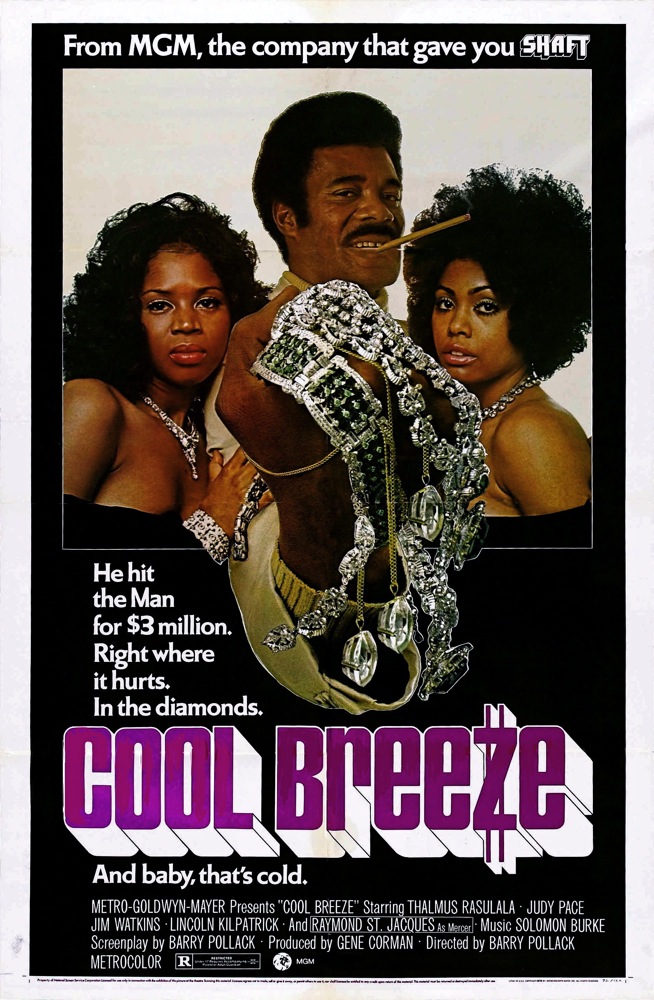
Cool Breeze (1972)


          A blaxploitation take on W.R. Burnett’s classic crime novel The Asphalt Jungle—previously filmed as a 1950 film noir by director John Huston—Cool Breeze nearly works. The intricate story about a criminal mastermind gathering cohorts for a jewel heist is filled with betrayal and danger, so the narrative fits comfortably into the blaxploitation milieu. Furthermore, the film’s acting is generally very strong. However, first-time writer-director Barry Pollack’s inexperience shows. He fails to reveal exposition clearly, so it’s hard to track who’s doing what to whom, and nearly every scene has the same level of intensity, which creates tonal monotony. That said, the picture has a gritty look and a thumping soul-music soundtrack, so what it lacks in narrative polish, it makes up for in tough atmosphere.
          The antihero of the piece is Sidney Lord Jones (Thalmus Rasulala), a slick thief who just bribed his way out of prison. Planning the robbery of a vault containing diamonds worth millions of dollars, Sidney gets into business with Bill Mercer (Raymond St. Jacques), a wealthy crime boss who agrees to bankroll the job. Sidney then hires accomplices including a priest who moonlights as a safe-cracker and a ne’er-do-well Vietnam vet who provides muscle. Also lurking around the story are various cops—some corrupt, some honest—including the unhinged Lt. Brian Knowles (Lincoln Kilpatrick).
          The movie toggles between subplots at weird rhythms, as if Pollack can’t decide whether he’s making an ensemble piece or telling Sidney’s story, but many vignettes are vivid. On the lurid side of the spectrum, the always-ravishing Pam Grier shows up for one sexy scene as a hooker servicing Sidney, and on the character-driven side of the spectrum, supporting actor Stewart Bradley entertainingly chews through his role as an exasperated police captain. (Discovering that Mercer has a young mistress, Bradley goes off on a rant: “I can tolerate a little masturbation. I can tolerate a little sodomy. Let him cavort with a cow! But an old man with a nice, pretty, young girl—that’s too much.”)
          Playing a bookie helping Sidney set up his team, Sam Laws gives the movie’s most amusing performance, because his character is likeable, flabby wimp who whines whenever danger is near. As for Rasulala, he’s appropriately cocky and smooth throughout the picture. Had Pollack’s skills been sharper, this same cast and story could have coalesced into something really memorable; as is, Cool Breeze is entertaining but frustrating. (Available at WarnerArchive.com)

Cool Breeze: FUNKY

Saturday, September 3, 2011

Friday Foster (1975)


          First, the good news. In the last of her ’70s blaxploitation star vehicles, leading lady Pam Grier looks fantastic, and she displays an endearing quality during the film’s too-few comedic bits. She’s also supported by an eclectic cast: Godfrey Cambridge, Scatman Crothers, Julius Harris, Yaphet Kotto, Thalmus Rasulala, Carl Weathers, and the always-bizarre Eartha Kitt. There’s even room for erstwhile Love Boat bartender Ted Lange, who plays a pimp named “Fancy Dexter” in a spectacularly bad performance.
          Now, the bad news. Friday Foster is a silly adventure story adapted from a family-friendly newspaper comic strip, but with the requisite level of sex and violence to earn its blaxploitation bona fides—meaning it’s too rough for lightweight escapism, and too soft to be a real action picture. The characters are cardboard, the plot is clumsy, and the storytelling is so numbingly obvious that the whole thing feels like an episode of Wonder Woman (which is not a compliment).
          Friday (Grier) gets assigned to photograph a possible sighting of Blake Tarr (Rasulala), known as “the black Howard Hughes.” Instead of grabbing a paparazzi shot, however, she photographs an assassination attempt, drawing her into a conspiracy targeting leading members of the black community. If that sounds promising, prepare for disappointment, because Friday’s unauthorized investigation, with cranky PI Colt Hawkins (Kotto) at her side, comprises a clichéd string of close calls with incompetent would-be killers and convenient discoveries of clues that only make sense when one of the characters provides a recap of the plot thus far. It’s all very garish and labored, so it’s impossible to care what happens, even in the rare instances when the storyline is decipherable.
          What makes this so unfortunate is that Grier is actually stronger than usual here; she clearly relished the chance to try something a bit outside the grimy blaxploitation norm. It’s also fun to see Kotto playing a gruff charmer instead of one of his ususal menacing roles. Yet, no matter how likeable Grier and Kotto are in fleeting moments, they can’t make up for the flat filmmaking and tedious narrative.

Friday Foster: LAME