Wednesday, August 22, 2012

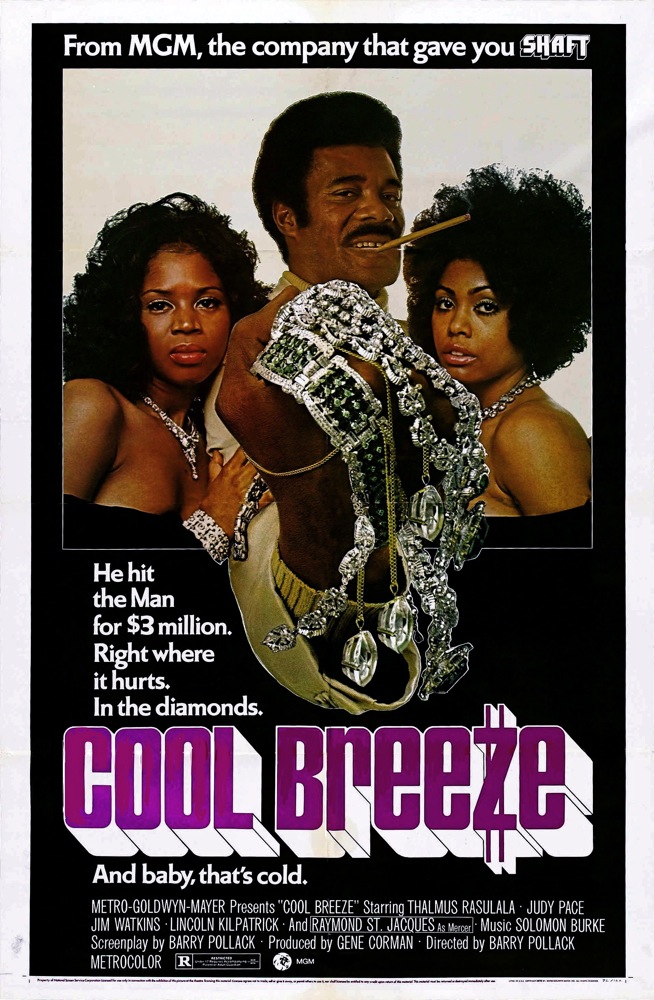
Cool Breeze (1972)


          A blaxploitation take on W.R. Burnett’s classic crime novel The Asphalt Jungle—previously filmed as a 1950 film noir by director John Huston—Cool Breeze nearly works. The intricate story about a criminal mastermind gathering cohorts for a jewel heist is filled with betrayal and danger, so the narrative fits comfortably into the blaxploitation milieu. Furthermore, the film’s acting is generally very strong. However, first-time writer-director Barry Pollack’s inexperience shows. He fails to reveal exposition clearly, so it’s hard to track who’s doing what to whom, and nearly every scene has the same level of intensity, which creates tonal monotony. That said, the picture has a gritty look and a thumping soul-music soundtrack, so what it lacks in narrative polish, it makes up for in tough atmosphere.
          The antihero of the piece is Sidney Lord Jones (Thalmus Rasulala), a slick thief who just bribed his way out of prison. Planning the robbery of a vault containing diamonds worth millions of dollars, Sidney gets into business with Bill Mercer (Raymond St. Jacques), a wealthy crime boss who agrees to bankroll the job. Sidney then hires accomplices including a priest who moonlights as a safe-cracker and a ne’er-do-well Vietnam vet who provides muscle. Also lurking around the story are various cops—some corrupt, some honest—including the unhinged Lt. Brian Knowles (Lincoln Kilpatrick).
          The movie toggles between subplots at weird rhythms, as if Pollack can’t decide whether he’s making an ensemble piece or telling Sidney’s story, but many vignettes are vivid. On the lurid side of the spectrum, the always-ravishing Pam Grier shows up for one sexy scene as a hooker servicing Sidney, and on the character-driven side of the spectrum, supporting actor Stewart Bradley entertainingly chews through his role as an exasperated police captain. (Discovering that Mercer has a young mistress, Bradley goes off on a rant: “I can tolerate a little masturbation. I can tolerate a little sodomy. Let him cavort with a cow! But an old man with a nice, pretty, young girl—that’s too much.”)
          Playing a bookie helping Sidney set up his team, Sam Laws gives the movie’s most amusing performance, because his character is likeable, flabby wimp who whines whenever danger is near. As for Rasulala, he’s appropriately cocky and smooth throughout the picture. Had Pollack’s skills been sharper, this same cast and story could have coalesced into something really memorable; as is, Cool Breeze is entertaining but frustrating. (Available at WarnerArchive.com)

Cool Breeze: FUNKY

Tuesday, August 21, 2012

The Salzburg Connection (1972)


          In one of the most frequently repeated film-director tutorials of all time, Alfred Hitchcock explained his method of generating suspense. Picture a scene of two people talking in a room, and then suddenly a bomb explodes. That’s shock. Now picture the same scene, but insert a shot at the beginning revealing the presence of the bomb—information the audience possesses, but the characters do not. That’s suspense. Hitchcock’s theory helps explain at least one of the reasons why The Salzburg Connection is among the least suspenseful thrillers of the ’70s. During the first half of the movie, characters chase after something, but the audience has no idea what they’re pursuing. Therefore, it’s impossible for us to determine whether we should care about the outcome of the search.
          Exacerbating this problem is one of the blandest leading characters ever featured in a mystery movie, American lawyer Bill Mathison. As played by Barry Newman, best known for playing the cipher-like protagonist of Vanishing Point (1971) and the title character of the TV series Petrocelli (1974-1976), Mathison is an average dude with average intelligence and average manners—he seems more like a passerby who wandered into the movie than a leading man.
          Adapted from a popular novel by Helen MacInnes, The Salzburg Connection depicts the international search for World War II-era documents containing the names of Nazi spies, which is interesting-ish, but the filmmakers waste far too much screen time on lifeless dialogue scenes. Making matters worse is the competent but uninspired work of leading lady Anna Karina, the French beauty who was jean-Luc Godard’s on- and offscreen muse during the ’60s. (In her defense, the only requirements of her anemic role are looking appealing and frightened.)
          Not that it makes much difference, The Salzburg Connection was the English-language debut of Austrian actor Klaus Maria Brandauer, who enjoyed significant international success in the ’80s. He’s fine here, but the movie is such a dud it’s no surprise he failed to secure another major role in an English-language picture until playing the villain in the “unofficial” 007 flick Never Say Never Again (1983).

The Salzburg Connection: LAME

Monday, August 20, 2012

Days of Heaven (1978)


          Much of the mythology surrounding enigmatic filmmaker Terrence Malick stems from the making and aftermath of his sophomore feature, Days of Heaven. Following idiosyncratic artistic instincts rather than Hollywood convention, Malick took nearly three years to craft this moodily poetic work, which treats its simplistic storyline like an afterthought. During that time, rumors spread about the director’s offbeat methods: For instance, he dictated that large sections of the film be shot at dusk, thereby abbreviating many of his shooting days to short bursts of activity. Then, after the film received a mixed critical reception, Malick disappeared from the Hollywood scene for 20 years. His mysterious withdrawal cast Malick as an artist too pure for the crass ways of Hollywood, triggering years of reappraisal and rediscovery.
          By the time Malick resumed directing with The Thin Red Line in 1998, Days of Heaven was firmly entrenched alongside the director’s debut feature, Badlands (1973), as one of the most respected films of the ’70s. Does it deserve such rarified status? Yes and no. Visually, Days of Heaven is unparalleled. Malick and cinematographers Nestor Almendros and Haskell Wexler mimicked turn-of-the-century paintings and photographs to evoke the supple textures of a Texas wheat farm circa 1916, the movie’s central location. Malick presents several astoundingly beautiful scenes of workers wading through fields, their bodies silhouetted against pastel-colored sunsets, while composer Ennio Morricone’s lilting music evokes a time when life moved at a more contemplative pace.
          Working with frequent collaborator Jack Fisk (credited here as art director), Malick oversaw the creation of a remarkable focal point, the elegant mansion that sits atop a wheat-covered hill, and Malick uses this structure as an effective metaphor for man’s tumultuous relationship with nature: Not only is the house a shelter during weather, it’s a place where relationships that had previously been allowed to roam freely get trapped within the conventions of propriety.
          The main plot, which never quite gels because Malick leaves many details unexplained and/or unexplored, begins in Chicago. Traveling workman Bill (Richard Gere), his girlfriend Abby (Brooke Adams), and his little sister Linda (Linda Manz) flee Chicago after Bill kills a supervisor during an argument. Upon reaching Texas, the trio accepts work on the wheat farm, which is owned by a sickly man identified only as The Farmer (Sam Shepard). For murky narrative reasons, Bill and Abby pretend to be brother and sister instead of a couple. So, when The Farmer becomes interested in Abby, Bill encourages the romance—believing The Farmer is terminally ill, Bill hopes to seize The Farmer’s wealth through marriage and build a new life for his family. Unfortunately, complications ensue, leading to heartbreak and tragedy.
          Despite the gifts for incisive storytelling he displayed in Badlands, Malcik badly fumbles basic narrative elements in Days of Heaven. His characters are ciphers, his pacing is erratic, and he relies far too heavily on the narration spoken, in character, by Manz. (A similar device was magical in Badlands, but here the narration just seems like a desperate attempt to add coherence.) Thanks to these flaws, the whole movie ends up having the hodgepodge feel of a student film, albeit one with awe-inspiring cinematography. Nonetheless, Days of Heaven casts a spell, which is a rare accomplishment.

Days of Heaven: GROOVY

Sunday, August 19, 2012

Boss Nigger (1975)


Blaxploitation stalwart Fred Williamson was well on the way to becoming a bad-movie auteur by the time he wrote, produced, and starred in this brazenly titled Western, so Boss Nigger features his signature elements of a take-no-guff protagonist and substandard storytelling—in Williamson’s cinematic world, attitude is everything and quality is a needless luxury. Presumably conceived as a dramatic riff on the previous year’s comedy blockbuster Blazing Saddles, this blaxploitation joint employs the same narrative contrivance as the earlier film—a black man becomes sheriff of a frontier town, much to the chagrin of the white locals. However, instead of being installed in the job through political chicanery, as in Blazing Saddles, Boss (Williamson) seizes the vacant sheriff’s position in order to hunt down a rival—and also to tilt the race-relations scales in favor of African-Americans. “Sorry, we can’t stay for supper,” Boss says in a moment indicative of the film’s obviousness, “but we got us mo’ whiteys to catch.” Much of the picture comprises uninspired scenes of Boss and his comic-relief sidekick, Amos (D’Urville Martin), humiliating white people while they pursue a criminal named Jed Clayton (William Smith), a standard-issue Western villain who kills for fun and profit. All of this should be diverting in a trashy sort of way, but the movie is too enervated to enjoy. Director Jack Arnold, a veteran whose career stretches back to sci-fi classics including The Creature from the Black Lagoon (1955), seems utterly disinterested in his work (Can you blame him?), and the generic funk score clashes with Arnold’s old-fashioned visuals. Plus, Williamson’s script lacks both restraint and taste—during the climax, for instance, Williamson features Boss getting crucified by the bad guys.

Boss Nigger: LAME

Saturday, August 18, 2012

Agatha (1979)


          Elegant and smart, Agatha has so many virtues it should be a better movie, but a sloppy script and questionable casting get in the way of the film’s lush production values and sensitive performances. An imaginary exploration of what might have happened in 1926, when the internationally famous mystery novelist Agatha Christie disappeared for 12 days, the movie presents a complex intrigue involving adultery, deception, romance, and a wicked plan to kill someone using an offbeat weapon—obviously, the idea was to entangle Christie in a murder plot as ornate as those found in her books. Alas, the piece is more ambitious than successful, largely because the filmmakers fail to properly define Christie and the other main character, an American journalist working in England, before things get weird; thus, viewers are forever racing to catch up with what’s happening, which precludes any real emotional involvement in the storyline.
          Furthermore, leading lady Vanessa Redgrave, playing Christie, and leading man Dustin Hoffman, as the journalist, are mismatched aesthetically and artistically. While it’s refreshing to see a female star tower over her male counterpart, the duo lacks chemistry, and Redgrave’s spacey detachment feels natural while Hoffman’s affectation of globe-trotting sophistication feels contrived.
          The story proper begins when Englishwoman Christie has a quarrel with her awful husband (Timothy Dalton), who wants a divorce so he can marry his attractive secretary (Celia Gregory). Meanwhile, popular columnist Wally Stanton (Hoffman) has become infatuated with Christie, whom he saw from afar at a press conference. When a distraught Christie flees her home, Wally tracks her down to a spa, where she has registered under an alias. He also learns that the secretary is a guest there. Disguising his true identity, Wally courts Christie and determines she means to harm the secretary.
          As written by Kathleen Tynan and Arthur Hopcraft, Agatha wobbles indecisively between drama, romance, and thrills for much of its running time, thereby failing to excel in any of the three genres. Versatile director Michael Apted guides actors well (even though the geography of scenes is muddied by arty camera angles), and legendary cinematographer Vittorio Storaro elevates the material considerably with his luminous images. Both leading actors are strong, though they seem to be starring in totally different movies: Hoffman’s charming turn is all surface, while Redgrave’s intellectualized performance is all subtext. So, while Agatha has many admirable qualities, not least of which is a genuinely imaginative premise, the lack of a solid narrative foundation prevents these qualities from coalescing into a satisfying whole. (Available at WarnerArchive.com)

Agatha: FUNKY

Friday, August 17, 2012

The Night Porter (1974)


          Disturbing and provocative, the Italian film The Night Porter belongs to a small subgenre of movies exploring the sexual depravity of Third Reich officers. Yet instead of taking the obvious route by simplistically portraying black-hearted Nazis exploiting innocent victims, co-writer/director Lilina Cavini presents a more complicated vision in which predator and prey become symbiotic; accordingly, The Night Porter can be taken literally or as a cruel metaphor representing the human tendency to embrace humiliating entanglements that generate electrifying sensations.
          The story takes place in 1957 Vienna, where Max (Dirk Bogarde) works the night desk at a posh hotel. One evening, he spots a beautiful woman in the hotel’s lobby, and recognizes her immediately as Lucia (Charlotte Rampling). Over the course of several flashbacks, Cavini reveals the nature of the couple’s relationship during World War II. Max was part of a group of SS officers who transformed prisoners into sexual playthings, and while Max grew infatuated with Lucia (he refers to her as “my little girl”), she succumbed to his aristocratic handsomeness despite his sadism. Now, years after the war, Lucia is married to an American orchestra conductor, and Max is associated with a cabal of former Nazis who purge war records in order to shield themselves from war-crimes prosecution. Initially, Max worries that Lucia will expose him, but when he confronts her, their old psychosexual attraction rekindles—so Max hides Lucia from his fellow Nazis, creating a private world of pain and pleasure.
          The first movie that veteran Italian filmmaker Cavini made in English, The Night Porter is challenging and perverse, with the film’s glossy surfaces and classical-arts milieu (ballet recitals, orchestral performances) communicating the thorny concept of sophisticated savagery. For instance, Max is a fastidious gentleman with immaculate grooming and manners, but he also derives erotic glee from hurting Lucia. Similarly, Lucia is something other than a mere victim; she finds satisfaction in subjugation. Throughout the film, Cavini toys with traditional associations. In the picture’s most famous scene, Rampling serenades a group of Nazis while wearing an officer’s cap, black leather opera gloves, and men’s trousers tethered to her rail-thin body with suspenders; Rampling’s casual toplessness and Cavini’s brazen mixture of contradictory signifiers elevates the scene into a study of abnormal desire.
          Despite consistently graceful camerawork and editing, The Night Porter occasionally succumbs to excess—the pacing is precious and slow—and some viewers will find the central relationship impossible to accept. Plus, Bogarde and Rampling are so icy that we mostly observe their dynamic from the outside, rather than getting drawn into their passions. Yet while The Night Porter probably alienates as many viewers as it intrigues, it’s inarguably a bold film bursting with artistry, ideas, and integrity.
 
The Night Porter: GROOVY

Thursday, August 16, 2012

Gable and Lombard (1976)


          Gable and Lombard, a romantic drama about the illicit love affair and subsequent marriage of real-life Golden Age movie stars Clark Gable and Carole Lombard, is so preposterously fictionalized that it’s a pointless endeavor. Among many other howlers, the movie features a climactic scene in which Lombard (Jill Clayburgh) testifies on behalf of Gable (James Brolin) at a court hearing related to his divorce from the woman to whom he was married when he began keeping company with Lombard. Not only did this testimony never happen, but the filmmakers portray Lombard as such a crude loudmouth that when asked to describe her relationship with Gable, she proclaims, “Me and that big ape over there have been hitting the sack every night, and I’ve got a sore back to prove it!” Yet Gable and Lombard lacks the courage of its convictions—instead of going wholeheartedly down the road of tabloid tawdriness, the movie is meant to be some sort of loving tribute to once-in-a-lifetime passion. Unfortunately, Barry Sandler’s inept screenplay and Sidney J. Furie’s unsophisticated direction makes the leading characters look like sex-crazed buffoons instead of incandescent lovers.
          This tone-deaf portrayal is exacerbated by performances that are, to say the least, uneven. While Clayburgh is grandiose and shrill, it’s possible to discern some of the emotional realities she’s attempting to communicate. However, Brolin is laughable, growling and smirking through a paper-thin impersonation of Gable’s most obvious onscreen tics. When these dissonant performances merge during interminable dialogue scenes—Gable and Lombard runs a deadly 131 minutes—the result is loud, superficial nonsense. It’s also impossible to know whom this movie was meant to please: The picture’s narrative is far too bogus to please diehard Gable-Lombard fans, and far too cliché-ridden to work as a standalone romance. Yes, the movie is handsomely produced, but so what? Even the supposed appeal of re-creating Old Hollywood is wasted, since the only other major character drawn from history is studio chief L.B. Mayer (played unpersuasively by Allen Garfield). As the real Lombard’s onetime secretary told syndicated columnist Dick Kleiner at the time of the Gable and Lombard’s release: “I couldn’t associate a single scene with anything that I’d lived through. Nothing in it is right, not even the clothes.”

Gable and Lombard: LAME

Wednesday, August 15, 2012

Rollercoaster (1977)


          Pure escapism, Rollercoaster combines many styles of pulpy entertainment that thrived in the ’70s: It’s a disaster movie, a police procedural, a terrorism thriller, and a theme-park romp all rolled into one. So, while it might be exaggerating to call Rollercoaster a good movie, it’s a lot of fun to watch. The movie begins when a psycho identified only as “Young Man” (Timothy Bottoms) begins a killing spree by blowing up the tracks on a rollercoaster in Virginia. Ride investigator Harry Calder (George Segal) arrives to survey the damage, suspecting foul play instead of a simple accident. Soon, the Young Man strikes again and issues a demand for $1 million to prevent further attacks. Although hard-nosed FBI Agent Hoyt (Richard Widmark) is placed in charge of the investigation, Harry insists on remaining involved, which turns out to be a bad mistake, since the Young Man identifies Calder as his preferred courier for ransom payments.
          Thus begins an enjoyably silly cat-and-mouse game that climaxes with a showdown at the Magic Mountain theme park near Los Angeles (which fans of ’70s kitsch know and love as the setting for the TV movie Kiss Meets the Phantom of the Park). Plus, as happens in these sorts of contrived cinematic situations, Calder’s teenaged daughter (Helen Hunt) gets caught up in the danger, so catching the crook becomes a personal matter for Our Hero. Although Rollercoaster is padded with a few tiresome sequences, like an extended concert by the New Wave band Sparks and lengthy point-of-view rollercoaster shots designed to showcase the “Sensurround” format in which the picture was released, the bulk of the movie is suspenseful and zippy.
          Segal’s dry humor fits the thriller genre well, offering a sly wink at the audience whenever the plot gets too preposterous, and the idea of a madman hiding amid the huge crowds at an amusement park is consistently unsettling. (Casting the boyish Bottoms was a clever choice that adds to the queasiness.) Justifying the disaster-movie element of its cinematic DNA, Rollercoaster delivers several harrowing highlights, though the flick never slips into gory excess. After all, producer Jennings Lang was an ace at the disaster genre, having made 1974’s Earthquake and most of the Airport movies. Widmark and fellow supporting player Henry Fonda ground the movie with their familiar personas, and it’s a kick to see future Oscar winner Hunt at the apex of her child-acting career. All in all, Rollercoaster is a tasty trifle with the added benefit of capturing vintage theme-park scenes that will make any former ’70s kid nostalgic for simpler times.

Rollercoaster: GROOVY

Tuesday, August 14, 2012

Sixpack Annie (1975)


American International Pictures might as well have titled this lowbrow comedy Boobs in the Boondocks, because it’s nothing more than a compendium of cleavage shots, demure nude scenes, and insulting redneck clichés. Some elements are executed with borderline competence, and the story basically makes sense from start to finish, but beyond that it’s hard to identify virtues except for the attractiveness of leading lady Lindsay Bloom. In other words, if you want a serving of Southern-fried stupidity with a side of smut, Sixpack Annie is the movie for you. The narrative concerns small-town waitress Annie Bodean (Bloom), who must raise money to save her family’s greasy-spoon diner from bankruptcy. Annie decides her best hope is sleeping with a rich man for cash, so she works her way through locals to no avail, then hooks up with her older sister, big-city hooker Flora (Louisa Moritz), for help identifying prospects in Miami. Accompanying all of this sleaze is inept slapstick—there’s literally a banana-peel gag—and horny dialogue so crude it barely deserves to be called innuendo. (Sample lyric from the movie’s execrable theme song: “Bang, bang, the whole dang town would love to bang Annie down.”) Director Graydon F. David, who wisely never made another movie, shoots the picture lifelessly, the script is idiotic, and the movie regularly stops dead for extended bits like comedian Stubby Kaye’s hackneyed traveling-salesman routine. Since none of this is actually funny, the main attraction is Bloom, who is pretty and shapely even though she sports a tacky blonde dye job throughout the picture; while she’s not especially skilled as an actress, Bloom exhibits believable sass and tries hard to make terrible jokes work. FYI, future TV star Bruce Boxleitner appears briefly as Annie’s boyfriend. (Available as part of the MGM Limited Collection on Amazon.com)

Sixpack Annie: LAME

Monday, August 13, 2012

Manhattan (1979)


          Woody Allen’s most impassioned movie—if one accepts the popular notion that the great love of the comedian’s life is New York City, not any of his children or romantic companions—Manhattan is intoxicating from an aesthetic perspective. Allen’s genius notion of pairing George Gershwin’s resplendent music with artful black-and-white images of New York City turns every exterior shot into a cinematic postcard, and the way Allen stages an elaborate dance of interconnected romantic relationships against this magical backdrop accentuates the appealing idea that Manhattan is made for lovers. Yet the film is also challenging and complex, a hyper-literate saga starring Allen as a character for whom it’s difficult to sympathize.
          By the filmmaker’s own admission, Manhattan synthesizes elements from his two immediately preceding pictures, the bittersweet romance Annie Hall (1977) and the bleak family story Interiors (1978). Thus, Manhattan’s blend of farce and pathos arguably represents Allen’s first truly mature work, a human story that neither hides behind crowd-pleasing jokes nor indulges in pretentious psychodrama. Manhattan is not for every taste, to be sure, but it’s a fascinating film made with exceptional intelligence and skill. Plus, even if the characters are painfully neurotic and self-serving, that’s at least partially the point—building on the sharply observed character work in Annie Hall, Allen used Manhattan to further hone his skills for cultural observation and social satire, and none of the film’s characters (including the Allen-esque scribe whom the director portrays) escapes devastating scrutiny.
          The main plot concerns the romantic travails of Isaac Davis (Allen), a comedy writer who is sleeping with a 17-year-old student (Mariel Hemingway). Despite this entanglement, Isaac is also drawn to a woman his own age (Diane Keaton), who is having an adulterous fling with Issac’s (married) best friend (Michael Murphy). Meanwhile, Isaac’s ex-wife (Meryl Streep), who came out as a lesbian after her marriage to Isaac ended, is writing a tell-all book about their relationship. Working once more with Annie Hall cowriter Marshall Brickman, Allen constantly jogs back and forth between comedy and drama, often in the same scene, and the film’s acidic dialogue explores the many ways people impede their own happiness.
          The central love story isn’t as compelling as that in Annie Hall—it’s hard to root for a grown man who’s schtupping a schoolgirl—and the movie sometimes skews a little too downbeat. However, the blazingly intelligent writing, the uniformly wonderful performances, and Gordon Willis’ spectacular cinematography make the film thoroughly rewarding. (Of special note among the actors is Hemingway, who gives the best performance of her career at a very young age; the curiosity, emotion, and naïveté she brings to her character almost makes Isaac’s inappropriate involvement understandable.) Most of all, it’s compelling to watch Allen’s artistry reach an early peak, and to realize that over the course of the ’70s, he rapidly evolved from a lightweight jokester to one of the world’s most important cinematic storytellers. 

Manhattan: RIGHT ON

Sunday, August 12, 2012

Mr. Billion (1977)


Representing an unsuccessful attempt to transform spaghetti-Western star Terence Hill into an American box-office attraction, Mr. Billion is one of those unfunny comedies with so many action scenes, onscreen smiles, tarted-up visual transitions, and upbeat musical cues that its desire to please the audience seems desperate—because, ultimately, Mr. Billion offers everything an audience wants except genuine entertainment. The story is a simplistic fable in the Frank Capra mode. When an American billionaire dies, he bequeaths his fortune to his Italian nephew, Guido (Hill). After this revelation, the billionaire’s nefarious executor, John Cutler (Jackie Gleason), flies to Italy intent on bamboozling Guido out of his inheritance. And while Guido initially seems like a rube—he’s a childlike soul infatuated with American cowboy movies—Guido insists on taking time before acceding to Cutler’s demands. Thanks to an iffy plot contrivance, however, Guido must arrive in San Francisco by a specified date in order to accept his money. And since Guido is afraid of flying, he travels by boat and train, allowing the filmmakers to present a “madcap” trek, during which Guido meets such stereotypical characters as ignorant rednecks (Slim Pickens alert!) and jive-talking African-Americans. Cutler also hires a prostitute, Rosie (Valerie Perrine), to seduce Guido into signing away his money—which means, of course, that Guido falls in love with Rosie and must eventually save her from Cutler’s henchmen. There’s not a single original idea in Mr. Billion, and director/co-writer Jonathan Kaplan can’t quite muster the right tonalities. Among other dubious choices, he shoots the picture in a dark, run-and-gun style that feels more suited to an exploitation movie than a laugh riot. Plus, while Hill is incredibly likeable, he’s hamstrung by the inability to master English dialogue. Furthermore, Perrine lacks the charisma that’s necessary for this sort of piffle, and Gleason’s performance feels utterly perfunctory.

Mr. Billion: LAME

Saturday, August 11, 2012

Trouble Man (1972)


Whereas most blaxploitation flicks take place in the dingy milieu of dealers, junkies, pimps, and streetwalkers—making exposed flesh, outrageous fashions, and tough slang important elements of their sleazy appeal—Trouble Man belongs to a more restrained crime-picture tradition. Excepting the color of the lead character’s skin, the presence of a soul-music score, and the use of terms like “honky” and “motherfucker,” Trouble Man is basically an old-fashioned potboiler in the Bogart tradition. The lead character, Mr. T. (Robert Hooks), is a take-no-guff private eye who gets framed for murder by ambitious gangsters, so he calls upon his ample resources of a clever mind, a fast gun hand, and plentiful contacts within the police force and the underworld to extricate himself from a sticky situation. Along the way, he clashes with a mixed-race pair of hoodlums (played by an overacting Ralph Waite and a hard-working but underused Paul Winfield), and he enjoys a few moderately interesting arguments with policeman Joe Marx (William Smithers). Mr. T also shares a few pointless scenes with his girlfriend, Cleo (Paula Kelly), and he hangs out in his groovy lair—a back office in a pool hall. Presenting an African-American environment free from blaxploitation’s usual clichés makes Trouble Man mildly refreshing, but the movie’s storyline is disappointing. The deadly first hour comprises lots of convoluted exposition, so, ironically, the sensationalistic extremes found in other blaxploitation flicks are missed. Things pick up a bit in the end, but not quite enough. This is a shame, not only because the picture avoids reducing African-Americans to cartoonish stereotypes, but also because director Ivan Dixon employs solid camerawork and lighting, giving the piece a polished look. Plus, Hooks is a formidable leading man who seems as if he could’ve done something with better material. Yet even the silky score, by Motown legend Marvin Gaye, lacks sufficient energy; only the main theme has a lingering groove.

Trouble Man: FUNKY

Friday, August 10, 2012

Chariots of the Gods (1970) & The Outer Space Connection (1975) & Mysteries of the Gods (1976)


          The notion that space aliens visited Earth in the distant past was the stuff of science fiction (and Scientology) until Swiss author Eric Von Däniken published his blockbuster book Chariots of the Gods? in 1968. Utilizing a sexy mix of conjecture, factoids, and pseudoscience, Von Däniken argued that because ancient civilizations accomplished seemingly impossible tasks (for example, building the Pyramids), “ancient astronauts” must have provided extraterrestrial assistance. Although considered a joke by the scientific community, Von Däniken’s book was quickly adapted into a German documentary movie, which was then re-dubbed into English and released in America as Chariots of the Gods—without the question mark, a telling detail. While it’s easy to imagine the movie thrilling audiences during an era rich with drugs and existentialism, Chariots of the Gods is thoroughly ridiculous, and quite dull, when viewed today.
          Comprising National Geographic-type footage of various locations around the globe, the movie is driven by wall-to-wall narration and cheap-sounding electronic music. The following excerpt from the narration captures the movie’s loopy perspective: “Hardly more than a thousandth of these ancient sources has given up its secrets. Moreover, what has been decoded calls for careful study to determine just what verifiable facts they contain. We should no longer permit ourselves to dismiss accounts of sky vehicles and traveling deities as sheer imagination.” In other words, who needs proof when we’ve got exciting theories? Things get really silly when literal interpretations of the Bible are offered as evidence of alien technology—what if Sodom and Gomorrah were destroyed by the world’s first nuclear bombs? At its worst, Chariots of the Gods succumbs to childish mental exercises: “If you multiply the height of the pyramid by 1 billion, it equals almost exactly the distance from the earth to the sun—a mere coincidence?”
          Chariots of the Gods was re-edited, and given a new Rod Serling narration track, to become a 1973 TV special called In Search of Ancient Astronauts, and Serling also narrated the 1975 theatrical documentary The Outer Space Connection. Dry and meandering, the movie rehashes ideas from Chariots of the Gods and wanders into other puzzlers that captured the popular imagination in the ’70s, including the Bermuda Triangle. Serling’s vocal work is as robustly eerie here as it was during his Twilight Zone days, but the parade of unanswered questions and vague insinuations gets boring. At its goofiest, The Outer Space Connection features an interview with some beardy scientist who claims “It’s very possible that pyramid energy could be used to preserve tissues over extended periods of time, such as long space travel or cloning purposes.” A similar doc, Mysteries from Beyond Earth, was released in 1975, with Hollywood actor/director Lawrence Dobkin hosting, but that one covers such a wide spectrum of pseudoscience topics that it’s tangential to this set of films.
          In terms of sheer kitsch, the most enjoyable “ancient astronauts” doc is Mysteries of the Gods—or, to cite the full title that reveals the movie’s secret ingredient—William Shatner’s Mysteries of the Gods. Yes, our beloved Captain Kirk leads the search for evidence that little green men once bivouacked on Earth. Originally filmed as a German documentary titled Botschaft der Götter (which was based on a Chariots sequel book by Von Däniken), the picture was refurbished for American audiences by adding Shatner’s narration and several long scenes of Shatner interviewing “experts” about life beyond our planet. The combination of Shatner’s campy performance style and the film’s low-rent electronic music makes Mysteries of the Gods entertaining despite the movie’s dubious assertions. Wearing tacky ’70s fashions, Shatner strolls around places like the Kennedy Space Center, listening to outlandish claims that alien visitations explain the Big Bang and the development of the human brain.
          In the movie’s most unintentionally hilarious scene, Shatner visits a woman who discovered a “crystal skull” among Mayan ruins. “We’ve used the modern airplane to come and see something very ancient, the crystal skull—it’s ominous, it’s awesome,” Shatner intones dramatically. Then, once he’s got the artifact in his hands, he says, “I’m trying to put myself back in time and space, back to when the skull was used for religious ceremonies. Can you describe to me [dramatic pause] how it was used?” By the time Shatner’s chatting with psychic Jeanne Dixon—who says that absolutely, definitely, for sure aliens will visit Earth in August 1977—Mysteries of the Gods has achieved liftoff as a masterpiece of reckless bullshit. Although the “ancient astronauts” genre is still going strong, with projects including occasional revivals of the Chariots of the Gods franchise, nothing will ever capture the sheer ’70s-ness of the fad better than Shatner’s stupefying spectacle.

Chariots of the Gods: LAME
The Outer Space Connection: LAME
Mysteries of the Gods: FUNKY

Thursday, August 9, 2012

The Outside Man (1972)


          Although technically a French film (original title: Un homme est mort), the contemplative thriller The Outside Man was shot in America with most of the dialogue spoken in English, and several Hollywood stars appear in the cast, so it plays like a U.S. film with Gallic flair. The picture begins with French hit man Lucien Bellon (Jean-Louis Trintignant) arriving in L.A. to kill a mobster. Bellon performs his task efficiently, but then things get strange when it becomes apparent that an American assassin, Lenny (Roy Scheider), has been hired to whack Bellon. Instead of fleeing back to his homeland, Bellon lingers in California—realizing he’s been used as a pawn in a larger game, Bellon is determined to take out his enemies lest he remain a perpetual target.
          Since the French gave us the word ennui, and since that anguished state was the dominant flavor in so many ’70s movies about people searching for meaning in a turbulent world, it’s fitting that a French filmmaker came to America to make a crime picture as cynical as anything from William Friedkin or Walter Hill or Sam Peckinpah. Veteran director Jacques Deray shoots The Outside Man in a minimalistic style, positioning Bellon as a cold-blooded cipher who functions perfectly in an amoral universe so long as his criminal counterparts behave predictably—thus, when his lawless world is jostled, he’s as adrift as everyone else in the topsy-turvy ’70s, desperately grasping for the terra firma of a lost reality that will never return.
          If all of this sounds a bit lofty for a hit-man thriller, rest assured that Deray’s thematic implications live mostly in the film’s subtext, since The Outside Man comprises brisk, exciting scenes of Bellon avoiding danger and forming peculiar allegiances. The Gallic gunman’s main crony is a gangland moll named Nancy Robson (Ann-Margret), who provides information and shelter, although Deray accentuates Nancy’s initial reluctance to get pulled into Bellon’s crisis. The movie also features a witty subplot involving a single mother (Georgia Engel) whom Bellon abducts—on top of never demonstrating the hysterics one might expect from someone in her situation, she eventually becomes titillated by the proximity to death, a sly commentary on how starved for excitement “average Americans” can become.
          Deray guides his actors toward restrained work that speaks to his theme of people deadened by life’s repetitive rhythms, so the diverse cast feels unified. Trintignant is lethal in a gentlemanly sort of way, Ann-Margret is amiably jaded (and sizzling, thanks to her cleavage-baring dresses), Scheider is elegantly savage, and Engel is subtly funny. (Other featured players include Angie Dickinson, as the murdered gangster’s wife, and a very young Jackie Earle Haley, as the son of Engel’s character.) The Outside Man is saturated with dense ’70s texture, from the brooding funk/jazz score by Michel Legrand to the extensive location photography that captures early-’70s L.A. in all of its sun-baked seediness. This is crime cinema at its most nihilistic, but there’s also a surprising current of human connection running through the story.

The Outside Man: GROOVY

Wednesday, August 8, 2012

Invasion of the Body Snatchers (1978)


          The storyline of the 1958 sci-fi classic Invasion of the Body Snatchers is so tethered to the historical moment in which the film was made—a period of anti-Communist paranoia and rampant conformity—that it seemed unlikely a remake could update the storyline’s themes in a meaningful way. And yet that’s just what director Philip Kaufman and screenwriter W.D. Richter accomplished with their 1978 version of Invasion of the Body Snatchers, which equals the original film in terms of intelligence, social commentary, and terror. The premise, taken from Jack Finney’s 1955 novel The Body Snatchers, is the same in each movie: An alien race arrives on earth, gestates copies of human beings in plant-like pods, and kills the human beings in order to replace them with the “pod people” who serve the alien race’s hive-mind. In the ’50s, the plot distilled the clash between jingoistic postwar Americans and the supposed radical element of domestic communists. In the ’70s, the plot crystallizes divisions between lockstep consumers and counterculture freethinkers.
          The hero of the 1978 version is Matthew Bennell (Donald Sutherland), a San Francisco health-department inspector who loves his co-worker, Elizabeth Driscoll (Brooke Adams), even though she’s romantically involved with an uptight businessman named Geoffrey Howell (Art Hindle). Geoffrey is among the aliens’ first victims, but since Elizabeth has no idea what’s really happened, she’s unable to explain disturbing changes in his personality. Concerned for Elizabeth’s emotional welfare, Matthew introduces her to his pal David Kibner (Leonard Nimoy), a pop psychologist with a predilection for catch phrases and turtlenecks. The Kibner angle is one of many clever flourishes in the 1978 version, because the film’s tuned-in characters initially believe they can solve their problems with talking-and-listening therapy—the very sort of human contact threatened by the aliens’ nefarious scheme. Yet Kaufman’s movie isn’t entirely preoccupied by sly observations of modern life, because the director is just as adept at generating excitement.
          The picture has a menacing atmosphere right from the first frames, with everything from shadowy photography to the weird look of the pods contributing to a frightful aesthetic. Kaufman stages a number of effective suspense scenes, like the scary bit at a mud bath run by Matthew’s friends Jack (Jeff Goldblum) and Nancy (Veronica Cartwright). Richter’s witty dialogue and Kaufman’s preference for naturalistic acting allow the actors to sketch individualistic characterizations, and Nimoy, in particular, benefits from the sophisticated storytelling—this is probably his best work outside the Star Trek universe. Watch out, too, for a just-right cameo by Kevin McCarthy, the star of the 1958 version—and do yourself a favor by ignoring the underwhelming later versions of this story, which include the Abel Ferrara-directed dud Body Snatchers (1993) and the Nicole Kidman-starring disaster The Invasion (2007).

Invasion of the Body Snatchers: GROOVY

Tuesday, August 7, 2012

Empire of the Ants (1977)


It’s not as if the world needed another schlocky H.G. Wells adaptation from producer-director Bert I. Gordon, following his execrable 1976 giant-animal movie The Food of the Gods. Yet apparently that one did well enough for American-International Pictures to release a follow-up—and while Empire of the Ants is an awful movie virtually devoid of redeeming values, it’s moderately better than its predecessor. Both films are adapted from Wells in the loosest sense, borrowing merely the fantasy-fiction legend’s titles and central gimmicks. Therefore, as in The Food of the Gods, the plot of Empire of the Ants is mostly Gordon’s own—not a good thing. The setting is the Florida Everglades, where Marilyn (John Collins) is a real-estate con artist. Escorting a boatload of losers to whom she hopes to sell worthless swampland, Marilyn leads her group deep into the wilderness, unaware that illegally dumped radioactive waste has transformed local ants into monsters the size of grizzly bears. How can the ants function at this overgrown stature, given their rail-thin limbs? Why do the ants suddenly develop a taste for human flesh? And why are the ants the only animals transformed by the radioactive waste? If you expect answers to these questions, you’ve never seen a Bert I. Gordon movie. Instead of logic—or, for that matter, excitement—viewers get tacky scenes in which bland footage of real ants is awkwardly superimposed onto location shots in order to create the unpersuasive illusion of large creatures running amok. Gordon also humiliates his actors by forcing them to wrestle with large mock-ups of ant torsos during close-ups of bloody attacks. None of the performers delivers laudatory work, though eye-candy starlet Pamela Susan Shoop fills out her skintight costume well. Luckily for all concerned, Gordon stopped pillaging Wells’ oeuvre after this flop crawled in and out of theaters.

Empire of the Ants: LAME

Monday, August 6, 2012

The Cassandra Crossing (1976)


          A runaway train meets a viral outbreak in the overwrought disaster flick The Cassandra Crossing, which has just enough florid acting and gonzo energy to remain lively for all of its 129 absurd minutes. Things get started when terrorists attack the headquarters of the International Health Organization because they’ve learned U.S. officers at the IHO are holding a sample of a deadly plague. Most of the attackers are killed, but one of the terrorists gets exposed to the toxin and escapes, slipping onto a train heading from Geneva to Stockholm. Soon after, the terrorist’s infection spreads to other passengers.
          The official tasked with containing the situation, U.S. Army Col. Stephen Mackenzie (Burt Lancaster), reroutes the train to Poland, where it will pass over a decaying bridge known as the Cassandra Crossing. Mackenzie’s civilian counterpart, Dr. Elena Stradner (Ingrid Thulin), realizes the colonel plans to collapse the bridge beneath the train, killing everyone aboard as a means of preventing the plague from reaching any major population centers, so she reaches out to one of the train’s passengers, neurologist Dr. Jonathan Chamberlain (Richard Harris), for help—because, of course, a super-genius scientist happens to be on board. With Stradner’s guidance, Chamberlain tries to quarantine victims so Mackenzie’s scheme can be halted.
          Director and co-writer George P. Cosmatos gooses this pulpy storyline with melodramatic subplots involving Chamberlain’s ex-wife (Sophia Loren), a larcenous May-December couple (played by Martin Sheen and Ava Gardner, if you can picture that peculiar combination), and other random characters. (Also populating the grab-bag cast are John Philip Law, Lee Strasberg, O.J. Simpson, and Lionel Stander.) Borrowing a page from Hollywood’s master of disaster, producer Irwin Allen, Cosmatos fills the screen with so much noise that viewers are constantly distracted by changes of scenery and tone. Thus, the movie capriciously flits between, say, torrid domestic squabbles involving a caustic Harris and a haze-filter-shrouded Loren, and grim command-center showdowns involving idealistic Thulin and merciless Lancaster. Interspersed with the dramatic scenes are handsomely mounted shots of the train zooming across the European countryside, and, of course, it all leads to a carnage-filled climax.

The Cassandra Crossing: FUNKY

Sunday, August 5, 2012

The Last Waltz (1978)


          The reasons why The Last Waltz has enjoyed adoring praise since its release are myriad. The documentary captures the final performance of the Band, the seminal ’60s/’70s rock group that first caught notice as Bob Dylan’s backup outfit when the folksinger went electric; in addition to being critical darlings for their artistic integrity and rootsy grooves, the Band had the rare grace to step off the public stage before they wore out their welcome. Thus, the movie is not only a compendium of passionate performances, but also a record of musical history. Additionally, the Band invited many of their famous friends to join them onstage, so The Last Waltz features killer numbers by Dylan, Neil Diamond, Joni Mitchell, Neil Young, and others. Beyond the stars and the tunes, however, The Last Waltz has something other ’70s music movies don’t: Martin Scorsese.
          Because the fast-rising auteur was a close friend (and onetime roommate) of the Band’s principal songwriter, Robbie Robertson, Scorsese was a natural choice to oversee the Band’s grandiose vision of a filmed farewell concert. And because Scorsese is among the most musically sensitive filmmakers of his generation, he seized the opportunity by creating an opulent visual atmosphere. Lighting San Francisco’s Winterland Arena like a soundstage (and supplementing concert footage with artsy flourishes shot on an actual soundstage), Scorsese approached The Last Waltz like a feature instead of a straight documentary. Therefore, an overall artistic vision is evident in every scene—Scorsese set out to elevate the feeling of a concert into something mythic, defining his subjects as magical figures emerging from darkness to make joyous noises.
          To realize this elaborate visual scheme, Scorsese enlisted several gifted cinematographers (including Michael Chapman, László Kovács, Hiro Narita, and Vilmos Zsigmond), thus ensuring consistently elegant camerawork. Yet the film also has a personal quality, thanks to unvarnished interviews with Robertson and his bandmates that Scorsese conducted in a Malibu recording studio; one senses the presence of Scorsese the fan and Scorsese the historian, not just Scorsese the artiste. Some have griped that the filmmaker actually put too distinct a stamp onto this movie, placing style over substance, but an argument can be made that Scorsese’s choice to complement the Band’s handmade aesthetic with a sophisticated visual treatment created a dynamic juxtaposition.
          No matter how you regard the presentation, though, it’s hard to argue with the music. Beyond performing their own classic songs (“The Night They Drove Ole Dixie Down,” “Up on Cripple Creek,” “The Weight,” and more), the Band provide thunderous backing for Dylan (“Forever Young”), Young (“Helpless”), and the film’s other guests. From the simple charms of the Band’s ingratiating music to the extravagant flair of Scorsese’s cinematic embellishments, The Last Waltz is filled with rich textures.

The Last Waltz: GROOVY

Saturday, August 4, 2012

Dying Room Only (1973)


After the success of Duel (1971), it was inevitable that prolific fantasy/sci-fi writer Richard Matheson would pen more TV movies in the same mode, although none of these subsequent projects had Duel’s strengths of an inspired concept and a superstar-in-the-making director. Still, second-rate Matheson telefilms including Dying Room Only are highly enjoyable, simply because the man knew how to twist the screws of a suspense story. In this seedy melodrama, stressed-out spouses Bob Mitchell (Dabney Coleman) and Jean Mitchell (Cloris Leachman) pull into a roadside motel while traveling through the Southwest. The Mitchells are suitably disturbed by the locals occupying the diner adjacent to the motel, including corpulent customer Tom King (Ned Beatty) and snarling short-order cook Jim Cutler (Ross Martin), so they decide not to stay. Yet while Jean uses the restroom, Bob disappears, and the locals try to persuade her that Bob bolted. Thus begins a slow-burn nightmare in which Jean must convince a small-town sheriff (Dana Elcar) that a conspiracy is afoot. Although the storyline of Dying Room Only is predicated on the usual contrivance of ostensibly intelligent people making stupid choices (when you walk into a redneck diner and everyone glares, leaving is probably your best option), Matheson brews a tangy combination of claustrophobia and paranoia. Leachman freaks out effectively, accentuating the primal emotions inherent to Matheson’s narrative; furthermore, reliable character players Beatty, Coleman, and Elcar nail their supporting roles, while Martin is surprisingly sinister as the main villain. Familiar to TV audiences for his long run as a wisecracking sidekick on The Wild, Wild West (1965-1969), veteran actor Martin digs into darkness with gusto. Like so many TV movies of the era, Dying Room Only ends abruptly since the brief running time precludes full exploration of the story, but it’s a fun ride while it lasts. (Available at WarnerArchive.com)

Dying Room Only: FUNKY

Friday, August 3, 2012

The Frisco Kid (1979)


The runaway success of Mel Brooks’ Western spoof Blazing Saddles (1974) inspired many underwhelming imitators, including pictures by a handful of directors who should have known better. For instance, Robert Aldrich, whose career includes several great action films and melodramas, had no business helming an “outrageous” romp about a rabbi-turned-outlaw—although whether anyone could have made a watchable movie from this gimmicky premise is open to debate. Anyway, Blazing Saddles star Gene Wilder is Rabbi Avram Belinski, a wide-eyed rube who travels from Poland to America in order to assume his post as the leader of a San Francisco synagogue. After getting robbed by hooligans upon reaching the East Coast, Avram finds work on a railroad as a means of making his way West. This brings him into the orbit of Tommy Lillard (Harrison Ford), an outlaw who takes sympathy on the hapless traveler. They become unlikely companions for a series of what presumably were conceived as “wacky adventures.” In Aldrich’s hands, however, the episodes comprising The Frisco Kid are loud non-events, spasms of shouting and slapstick connected by exhaustingly exuberant music—the vignettes look and feel like comedy without actually being funny. While much of the blame falls to Aldrich and his screenwriters for failing to summon inspiration, Wilder is complicit, too. Succumbing to his worst excesses, notably bulging his eyes at regular intervals and screaming most of his dialogue, Wilder presents such a broad caricature of Jewishness that he’s almost unbearable to watch, to say nothing of borderline offensive. This isn’t Wilder at his worst (alas, he was even more grating while acting in the first couple of movies he directed), but this sure ain’t Wilder at his best. As for Ford, caught in the post-Star Wars transitional period of his career, he doesn’t really have a character to portray, so he overcompensates with unearned intensity that doesn’t suit the comedic milieu.

The Frisco Kid: LAME

Thursday, August 2, 2012

International Velvet (1978)


          International Velvet is an oddity. The picture is an elaborate sequel to National Velvet (1944), the movie that transformed 12-year-old Elizabeth Taylor into a movie star—she played Velvet Brown, a precocious equestrian who wins a major contest, becoming a heroine in her native England, only to be disqualified due to her age. Produced 34 years later, without Taylor reprising her role, International Velvet dramatizes a new adventure in Velvet’s life. Now settled into quiet, rural domesticity with her husband, successful author John Seaton (Christopher Plummer), Velvet (Nanette Newman) becomes the guardian of her recently orphaned niece, Sarah Brown (Tatum O’Neal). After some initial trouble adjusting to life in England, Sarah follows in her aunt’s footsteps by becoming a world-class rider, entering the Olympics atop the son of the horse Velvet rode in the first picture.
          Sequels arriving decades after their predecessors rarely work, and the absence of Taylor in the Velvet role makes International Velvet feel particularly unnecessary. Therefore, since the movie is primarily a vehicle for O’Neal—who, by the late ’70s, was a top child star with an Oscar to her credit—wouldn’t it have made more sense to simply remake the original film instead of awkwardly contriving a follow-up? Alas, one can only guess at the machinations of producer/director/co-writer Bryan Forbes, whose eclectic career includes several intelligent but unremarkable movies. And, unfortunately for Forbes, the biggest draw of International Velvet—O’Neal’s performance—is a letdown. Caught at an awkward age, O’Neal is an attractive teenager but neither a fascinating child nor a fully formed adult, and her acting is so mannered that she’s outclassed by her costars.
          In the early scenes, depicting Sarah’s integration into her aunt’s country estate, Plummer’s suave demeanor and wry line deliveries dominate. Later, when Sarah joins the British Olympic team, Anthony Hopkins takes over the movie with his funny turn as a witheringly sarcastic coach. (As for Newman, the director’s real-life spouse, she’s elegant but forgettable.) Forbes mounts an impressive production, with extensive location photography, glamorous lighting, and vivid sports sequences. Additionally, some of his dialogue is quite tasty, particularly the bitchy monologues issued by Hopkins. However, the lack of real suspense in the movie, save for a harrowing plane trip during which a horse’s life is endangered, makes International Velvet feel as deep as a postcard.

International Velvet: FUNKY

Wednesday, August 1, 2012

Old Dracula (1974)


For about the first 15 minutes of its running time, the British-made horror spoof Old Dracula seems as if it might turn into something amusing. David Niven plays a courtly, modern-day version of the famous bloodsucker. Instead of attacking victims in their homes, he allows tours through his castle, “pretends” to be Dracula, drugs his guests, and discreetly drains their blood via IV tubes. Turns out he’s searching for the rare blood type that can revive his undead girlfriend, Vampira. After establishing this passable premise, however, Old Dracula devolves into crass buffoonery. When several Playboy models, one of whom is black, visit Dracula’s castle, the count drains their blood and revives his lady—but thanks to a plasma mix-up, Vampira (Teresa Graves) becomes black. Thereafter, Dracula and his resuscitated companion chase the models across Europe, hoping to find the blood that’s required to “correct” Vampira’s transformation. Sadly, the movie’s cavalcade of insulting stupidity has merely begun. After seeing a blaxploitation movie, Vampira starts talking like a clichéd ghetto click, and then Old Dracula gets bogged down in dull melodrama straight out of a Hammer flick: Caddish swinger Marc (Nicky Henson) tries to save his girlfriend (Veronica Carlson) from Dracula’s clutches, even though Marc is (sort of) under Dracula’s hypnotic spell. Alas, none of this is funny. It’s a bummer to see the eternally charming Niven mired in this dreadful movie, which was originally titled Vampira but renamed to piggyback on the success of Mel Brooks’ 1974 smash Young Frankenstein. Niven is the only top-shelf actor in the picture, and the starlets surrounding him (Graves included) are terrible; furthermore, the storyline drags from one repetitive incident to the next, becoming tackier with each passing scene. Ultimately, Old Dracula makes the mediocre 1979 Dracula spoof Love at First Bite seem sublime by comparison. (Available as part of the MGM Limited Collection on Amazon.com)

Old Dracula: LAME

Tuesday, July 31, 2012

Hanover Street (1979)


          While not a career zenith for any of its major participants, except perhaps leading lady Lesley-Anne Down, Hanover Street is a respectable World War II romance filled with old-fashioned themes of heroism and sacrifice. The movie’s reliance on narrative coincidence is a problem, and one wishes writer-director Peter Hyams had moved past archetypes to investigate his characters more deeply, but Hanover Street delivers much of what it promises—the stars are attractive, their onscreen love affair is complicated by unusual circumstances, and the movie spins inexorably toward an action-packed climax. So, even though it’s all a bit rudimentary in conception, the full package—accentuated by David Watkin’s shadowy cinematography and John Barry’s plaintive musical score—goes down smoothly.
          Harrison Ford, giving the most satisfying performance of his wilderness years between Star Wars (1977) and The Empire Strikes Back (1980), stars as David Halloran, a U.S. pilot stationed near London circa 1943. After a quick meet-cute with British nurse Margaret Sellinger (Down), David persuades his new acquaintance to join him for a long afternoon of tea and conversation. Although they fall in love almost instantly, Margaret reveals she’s married—but then the trauma of being caught in an air raid pushes them together. They begin an affair. This affects both of their lives badly, because David loses his combat edge while worrying about when he’s going to see Margaret again, and Margaret introduces a chill into her marriage to Paul Sellinger (Christopher Plummer). Paul was a teacher during peacetime, but he’s now an officer with British Intelligence—and when he feels Margaret drifting away, he recklessly volunteers for a mission behind enemy lines, hoping to win back her respect.
          The coincidence with which Hyams merges the fates of these characters stretches believability, but Hyams commits wholeheartedly to the ensuing melodrama, and the second half of the movie—when the story shifts from romance to thrills—is brisk and tense. As far as the actors go, Ford sulks a bit too much, though he’s sufficiently dashing during action scenes to compensate for his moodiness; and if Down fails to provide much substance behind her mesmerizing beauty, that’s acceptable as well, since she’s primarily meant to be an object of desire. Plummer is, predictably, the picture’s saving grace, lending elegance, humor, and vulnerability to his characterization. FYI, Hanover Street is far more palatable than the similarly themed Yanks, which was released later the same year—although the latter picture, directed by John Schlesinger, is more sophisticated, it’s a lifeless museum piece compared to Hyams’ fast-moving crowd-pleaser.

Hanover Street: GROOVY